
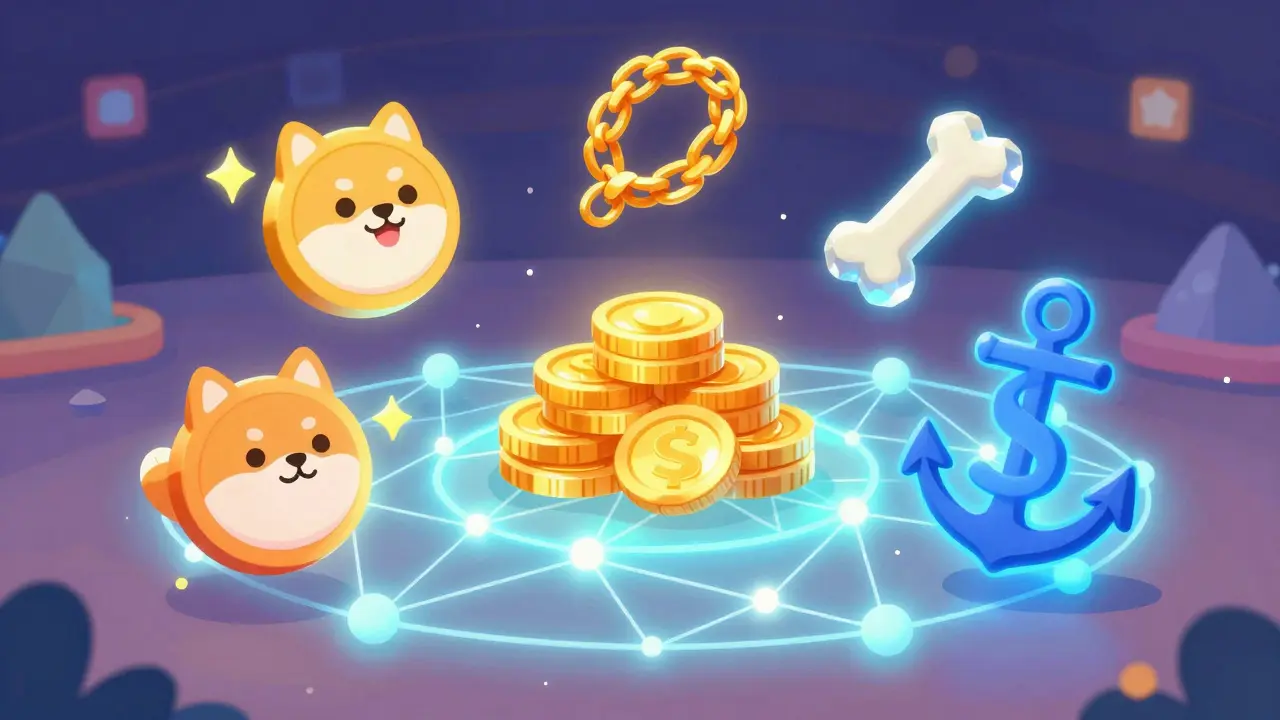
Shina Inu (SHI) isn't another memecoin trying to go viral. It’s the stablecoin built into the Shiba Inu ecosystem to bring real utility to a project that started as a joke. While SHIB exploded in price thanks to memes and social media hype, SHI was designed to stay steady - pegged to the US dollar - so people can actually use it for everyday crypto tasks without watching their balance swing 30% in a day.
What exactly is SHI?
SHI is a stablecoin, meaning its value is meant to stay locked at $1 USD. Unlike SHIB, which can jump or crash based on tweets or celebrity mentions, SHI doesn’t care about hype. It’s built to be reliable. Think of it like digital cash inside the Shiba Inu world - something you can hold, send, or use to buy other tokens without losing sleep over volatility.
It wasn’t created alone. SHI is one piece of a five-token system that makes up the full Shiba Inu economy:
- SHIB - The original memecoin, used for trading and as the main community token.
- LEASH - A rare, high-value token meant to reward loyal holders.
- BONE - The governance token. Holders vote on upgrades and changes to the ecosystem.
- TREAT - The liquidity token. It’s what keeps SHI stable by backing it with reserves.
- SHI - The stablecoin. The glue that holds everything together.
Each token has a job. SHI doesn’t compete with SHIB - it complements it. While SHIB gets the headlines, SHI handles the boring but essential work: keeping value steady so people can trade, stake, and spend without panic.
How does SHI stay stable?
SHI doesn’t just magically stay at $1. It’s backed by TREAT tokens, which act like collateral. When you want to mint or redeem SHI, the system uses TREAT to balance the supply. If too many people try to cash out SHI for dollars, the system burns TREAT to reduce SHI supply and keep the peg. If demand rises, more TREAT is locked in to print new SHI.
This system runs on Shibarium, the Layer-2 blockchain built by the Shiba Inu team. Shibarium is what makes SHI practical. On Ethereum’s mainnet, transaction fees can hit $50 or more. On Shibarium, they’re often under $0.01. That’s why SHI can actually be used for small payments, DeFi swaps, or staking rewards - things that would be impossible on Ethereum with a volatile coin.
Validators on Shibarium need to hold BONE tokens to run nodes, and they earn BONE as rewards. This creates a loop: BONE secures the network, TREAT backs SHI, and SHI gives users a stable place to park value. It’s not perfect, but it’s designed to work as a system - not as a standalone coin.
How is SHI different from USDT or USDC?
Most people know USDT (Tether) or USDC (USD Coin) as the big stablecoins used across crypto. They’re backed by real bank reserves, audited, and trusted by institutions. SHI is different. It’s not backed by banks. It’s backed by another crypto token - TREAT - and runs on a community-run blockchain.
That makes SHI riskier. If TREAT’s value crashes, the SHI peg could break. There’s no corporate team promising to refill reserves. Instead, it’s a decentralized experiment built on trust in the Shiba Inu community.
But SHI has one advantage: it’s built for the meme economy. If you’re already holding SHIB, LEASH, or BONE, you can swap directly to SHI on ShibaSwap without leaving the ecosystem. You don’t need to go to Coinbase or Binance. That convenience matters. For millions of retail users who live inside the Shiba Inu world, SHI is the only stablecoin they’ll ever need.
Who uses SHI - and why?
SHI isn’t for traders chasing 10x gains. It’s for people who want to:
- Stake their SHIB and earn rewards in SHI - no price swings during staking.
- Swap between SHIB and other tokens without losing value to volatility.
- Use DeFi apps on Shibarium without paying high gas fees.
- Hold a stable asset inside the Shiba Inu ecosystem without cashing out to fiat.
Since Shibarium launched in 2023, millions of transactions have gone through it. Most of them involve SHI. That’s not because it’s the flashiest coin - it’s because it’s the most useful one for daily operations inside the ecosystem.
There’s also a psychological angle. The Shiba Inu community is huge. Over 1 million wallets hold SHIB. Many of them are tired of the rollercoaster. SHI gives them a safe harbor - a way to stay in the game without selling everything when the market dips.
Is SHI safe?
No crypto is 100% safe. SHI’s biggest risk is its reliance on TREAT and the Shibarium network. If TREAT loses value fast - say, because of a massive sell-off - the system could struggle to maintain the $1 peg. There’s no FDIC insurance. No bank backing. Just code and community.
But here’s the thing: the Shiba Inu team has been careful. The SHI contract is audited. The liquidity pools are locked. The governance is open. And the community has proven it can rally to fix issues - like when a bug in 2023 caused a temporary price glitch, and users voted to fix it within hours.
Compared to other stablecoins built on meme ecosystems (like Dogecoin’s DOGE-based stablecoin ideas), SHI is the most mature. It’s not just a token with a whitepaper. It’s actively used, integrated, and growing.
Where can you get SHI?
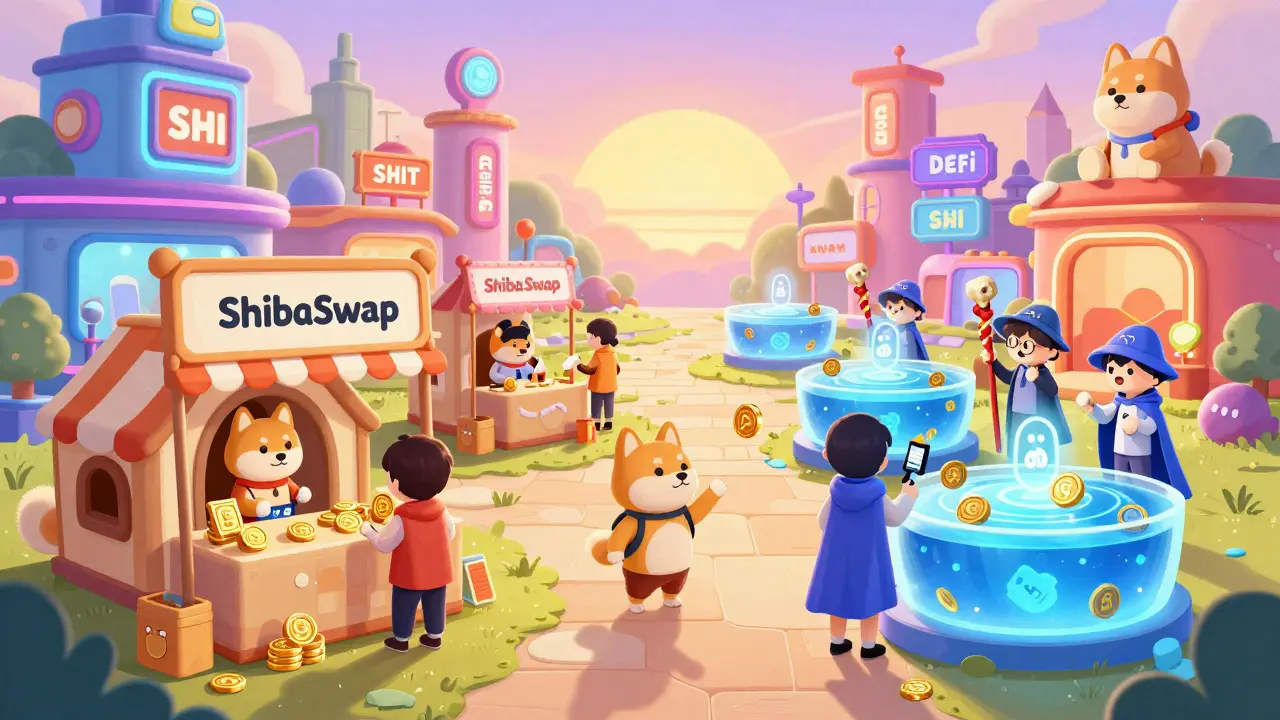
You won’t find SHI on Coinbase or Kraken. It’s not listed on big centralized exchanges. To get SHI, you need to go to ShibaSwap - the official decentralized exchange of the Shiba Inu ecosystem.
Here’s how:
- Connect your wallet (MetaMask, Trust Wallet, etc.) to shibaswap.com.
- Swap SHIB, BONE, or TREAT for SHI.
- Use it to stake, trade, or hold.
You can also earn SHI by providing liquidity to SHI/SHIB pools on ShibaSwap. It’s not high-yield, but it’s steady - and you’re helping keep the system running.
What’s next for SHI?
The future of SHI depends on two things: Shibarium’s growth and community trust. If more apps build on Shibarium - like games, NFT marketplaces, or payment tools - SHI will become the default stablecoin inside them.
The team is already working on cross-chain bridges to bring SHI to other networks like Polygon and Arbitrum. That could open it up to millions more users who aren’t part of the Shiba Inu world but want a cheap, fast stablecoin.
Regulators are watching stablecoins closely. If the U.S. or EU passes strict rules, SHI might struggle because it’s not backed by fiat. But if the trend keeps going toward decentralized, community-run finance, SHI could become a model for how memecoins evolve into real infrastructure.
For now, SHI isn’t trying to replace USDT. It’s trying to replace the need to leave the Shiba Inu ecosystem. And that’s a powerful goal.
Is SHI the same as SHIB?
No. SHIB is the original memecoin with no price stability - its value changes daily. SHI is a stablecoin pegged to $1 USD. They serve completely different purposes: SHIB is for speculation and community identity, SHI is for stable trading and DeFi use.
Can I buy SHI on Binance or Coinbase?
Not directly. SHI is only available on decentralized exchanges like ShibaSwap. You need to connect a crypto wallet and swap another token - like SHIB or BONE - for SHI. Centralized exchanges don’t list it because it’s not a standalone project; it’s part of the Shiba Inu ecosystem.
Is SHI backed by real money?
No. Unlike USDT or USDC, SHI isn’t backed by bank reserves or cash. It’s backed by TREAT tokens - another crypto asset - within the Shibarium ecosystem. Its stability comes from smart contracts and liquidity pools, not traditional finance.
Why does SHI need Shibarium?
Shibarium is the Layer-2 blockchain that makes SHI usable. On Ethereum, transaction fees are too high for small swaps or daily use. Shibarium cuts fees to pennies and speeds up transactions, making SHI practical for staking, trading, and DeFi. Without Shibarium, SHI would just be another token stuck on a slow, expensive network.
Can SHI lose its $1 peg?
Yes, technically. If TREAT’s value drops sharply or if there’s a massive rush to redeem SHI, the system could struggle to maintain the peg. But so far, it’s held steady since launch. The community and automated mechanisms work together to correct imbalances quickly.
Should I invest in SHI?
If you’re looking for quick profits, no. SHI isn’t meant to go up in value - it’s meant to stay at $1. If you’re already in the Shiba Inu ecosystem and want a stable way to hold value, trade, or earn rewards without volatility, then SHI is a useful tool. Think of it like cash in your wallet - not an investment.

Comments
Robert Mills
SHI is the real MVP of the Shiba ecosystem. No cap. 🚀
Joshua Clark
I've been holding SHIB since 2021, and honestly, I didn't even pay attention to SHI until last month... but now? I get it. It's not about getting rich quick-it's about having a stable place to park your gains without cashing out and losing access to the whole ecosystem. The way TREAT backs it, the Shibarium gas fees being pennies, the fact you can stake SHIB and earn SHI without sweating every price swing... it's actually brilliant. I used to jump between Binance and ShibaSwap just to avoid volatility, but now I just swap to SHI and chill. It’s like having a digital wallet that doesn't scream at you every time Bitcoin sneezes.
Ramona Langthaler
This is why crypto is a joke. Backed by another crypto? Thats not stable thats just gambling with extra steps
Sunil Srivastva
Hey, just wanted to add something-SHI isn’t just for Shiba fans. If you’re into DeFi on low fees, Shibarium is one of the cheapest places to swap tokens. I’ve been using it to move between BONE and SHIB without paying $20 in gas. And yeah, TREAT backing might sound sketchy, but the contract is audited, liquidity is locked, and the community has fixed bugs faster than most centralized projects. It’s not perfect, but it’s way more real than half the ‘stablecoins’ on Solana.
Jerry Ogah
Oh wow. Another meme coin pretending to be finance. The fact that people actually believe this is 'utility' is why crypto is doomed. They’re not building infrastructure-they’re building a cult. And you’re all just handing over your money so some guy in a hoodie can get a Lamborghini.
Andrea Demontis
It’s fascinating how SHI flips the script on what 'stable' even means. USDT and USDC are stable because they’re backed by banks, regulators, and legal contracts-but SHI is stable because of code, incentives, and collective belief. That’s a philosophical shift. It’s not about trust in institutions anymore-it’s trust in a decentralized feedback loop. If TREAT crashes, the system self-corrects. If people lose faith, the peg breaks. It’s a living, breathing experiment in emergent stability. And maybe that’s the future: not centralized control, but emergent order from chaos.
Raju Bhagat
Bro SHI is the only reason I still hold SHIB after the 2022 crash I was ready to sell everything but SHI kept me in the game man
Elizabeth Jones
I appreciate the clarity here. SHI isn’t trying to be the next Bitcoin. It’s trying to be the Swiss franc of the Shiba Inu universe. And honestly, that’s more valuable than another 100x meme coin. The fact that it’s integrated into Shibarium, used for staking, and not listed on centralized exchanges shows intentionality. Most projects are chasing hype. This one is solving a real problem: volatility within an ecosystem that thrives on chaos.
Edward Drawde
SHI? More like SHI-t. Why would I use this when I can just use USDC?
Richard Kemp
i didnt even know shi existed until today. kinda cool that its just... there. doing its thing. no fanfare. no influencers. just code and users. kinda like the internet used to be
Gary Gately
i been swapping shib to shi for staking and its been smooth as butter. no more panic selling when the market dips. shib still does the hype, shi does the work
Brandon Vaidyanathan
This is exactly why I left crypto. People think a token backed by another token is 'stable'. You’re not building finance, you’re building a house of cards made of memes. And you’re proud of it? Pathetic.
Gareth Fitzjohn
An interesting approach. The reliance on TREAT introduces systemic risk, but the low transaction costs on Shibarium do make SHI practically usable. Not for institutional use, perhaps, but for retail participants in the ecosystem, it serves a clear purpose.
Katie Teresi
SHI? More like SHI-ty. Who lets a meme coin run a stablecoin? This is why regulators are coming for crypto. You people are laughing while the house burns down.
Moray Wallace
I like that SHI doesn’t try to be everything. It knows its role. It’s not trying to replace USDT-it’s trying to be the quiet utility token in a noisy space. Sometimes that’s the most powerful thing you can be.
William Hanson
This whole thing is a scam. TREAT is a garbage token. If it crashes, SHI crashes. And the team? They’re just milking the community. No audits, no transparency, just vibes.
Jeremy Dayde
I’ve been using SHI for months now and I’ve never had an issue with the peg even during the 2023 bear market when everything else was swinging 20% in a day. I use it to swap between BONE and SHIB on Shibarium and the gas is always under 5 cents. I used to hate how expensive Ethereum was for small trades but now I barely think about fees. The real win is that I can stake my SHIB and earn SHI without worrying about losing half my balance overnight. It’s not glamorous but it’s reliable. And in crypto, reliability is rare.
Akhil Mathew
From India, here. SHI is the only reason I still use crypto. My friends think I’m crazy for holding SHIB but they don’t get that SHI lets me trade without cashing out to INR and paying 5% in fees. Shibarium is lightning fast and cheap. I swap SHIB to SHI, then SHI to BONE, all in 2 minutes for less than 10 cents. No bank, no paperwork. Just code. And yeah, TREAT backing is risky-but so is keeping cash in a bank during inflation. We’re all gambling. At least this one’s transparent.
Tom Sheppard
SHI is the unsung hero of the Shiba universe 🙌 I was ready to quit crypto until I discovered SHI. Now I just swap to it when things get wild and chill. It’s like having a calm corner in a storm 🌊🧠 #ShibaFamily
Devyn Ranere-Carleton
so shi is backed by treat... but what if treat crashes? like what happens then? is there a safety net? or is it just 'trust the code'?
Kevin Thomas
If you’re in the Shiba ecosystem and you’re not using SHI, you’re doing it wrong. It’s not an investment-it’s a tool. Like using a hammer to drive nails. You don’t buy a hammer to get rich, you buy it because it works. SHI is that hammer. And Shibarium? That’s the workshop. Stop comparing it to USDT. It’s not supposed to be. It’s supposed to be the glue. And it’s holding.
Brianne Hurley
Oh please. A stablecoin backed by a token nobody cares about? You think this is innovation? You’re just creating a new way to lose money while pretending it’s safe. This isn’t finance, it’s fanfiction with a blockchain.
Tressie Trezza
It’s weird how something so boring-like a stablecoin-can be the most important part of a project built on chaos. SHI doesn’t have memes, it doesn’t have Elon tweets, it doesn’t have influencers. It just... exists. Quietly. Reliably. And somehow, that’s what makes it powerful. Maybe the future of crypto isn’t in the hype-but in the quiet infrastructure nobody notices until it’s gone.
Dylan Morrison
SHI is the quiet neighbor who always waters your plants when you’re away. No fanfare. No selfies. Just doing the job. And when you come back, everything’s still alive. That’s what crypto needs more of. Not hype. Just reliability.
Lori Quarles
You guys are underestimating SHI. It’s not just a stablecoin-it’s a statement. It says: 'We don’t need Wall Street to make crypto useful.' And I love that. Keep building, Shiba team. You’re doing something real.