

Custodial Risk Calculator
Token Risk Assessment
Input your wrapped BTC holdings to determine your custodial risk exposure and receive tailored diversification recommendations.
Custodial Risk Assessment
Custodian Risk Score
0% = No custodial risk | 100% = Highest risk
Recommendations
Diversify across 3+ tokens
Check custodian audits monthly
Limit WBTC exposure to 40%
Critical Warning
When you swap Bitcoin for WBTC to earn yield in DeFi, you’re not just moving coins-you’re handing over control of your Bitcoin to someone else. That’s the hidden cost of convenience. Wrapped tokens like WBTC, renBTC, and sBTC let you use Bitcoin on Ethereum, but they do it by locking your real BTC with a third party. And if that party fails, your assets vanish-no recovery, no blockchain magic to save you.
How Wrapped Tokens Work (And Why They’re Dangerous)
Wrapped tokens are digital IOUs. You send 1 BTC to a custodian. They lock it in a secure wallet. Then they mint 1 WBTC on Ethereum and send it to you. You can trade it, lend it, or stake it like any other ERC-20 token. Sounds clean, right? Until you realize: you don’t own the Bitcoin anymore. You own a promise. The whole system relies on trust. BitGo, the custodian behind WBTC, holds over $10.8 billion in Bitcoin as of September 2023. That’s more than most banks hold in reserves. If BitGo gets hacked, goes bankrupt, or just decides to freeze withdrawals, your WBTC becomes worthless paper. No blockchain can fix that. No smart contract can override a centralized wallet. This isn’t theory. In March 2023, a user lost $7,850 trying to unwrap WBTC during a spike in Ethereum gas fees. Their transaction failed. The custodian’s time window for verification expired. The BTC stayed locked. The WBTC was stuck. No refund. No recourse.The Custody Model: Who’s Really Holding Your Keys?
Most wrapped tokens use centralized custody. 92% of wrapped Bitcoin relies on single entities holding the private keys. WBTC is the biggest example. BitGo stores the BTC. A consortium of 18 merchants and 27 DAO members must sign off on any withdrawal. Sounds safe? Maybe. But it’s still one point of failure. Compare that to renBTC, which uses RenVM’s secure multi-party computation (sMPC). No single entity holds the keys. Instead, 100+ nodes split the key fragments across the globe. It’s slower-2 to 4 hours to unwrap-and more expensive (0.7% fee vs WBTC’s 0.25%). But it’s decentralized. No one can freeze your funds. No audit can shut you out. Then there’s sBTC from Stacks. It uses a Bitcoin sidechain secured by 21 miners. Less liquidity ($187 million TVL), but no custodian. Still, it’s not fully trustless. You’re trusting the miners to act honestly. And if they collude? Your sBTC is gone.Real-World Failures: When Trust Breaks Down
The Wormhole exploit in February 2022 stole $320 million in wrapped ETH. The flaw? A validation bug in the custody bridge. The attackers didn’t break Ethereum. They didn’t crack Bitcoin. They tricked the system into thinking fake assets were backed. That’s custodial risk in action. In September 2023, BitGo paused all WBTC withdrawals for 72 hours during a security audit. A user on Twitter lost $15,000 in access to funds because they needed to pay a loan in ETH and couldn’t unwrap in time. BitGo didn’t do anything illegal. They followed their internal policy. But their policy overrides your ownership. Trustpilot reviews of BitGo show 68% positive ratings-but 32% of complaints are about lack of transparency and frozen funds. One user wrote: “I deposited 5 BTC. Two weeks later, I couldn’t withdraw. No explanation. Just ‘under review.’” That’s not a glitch. That’s the model.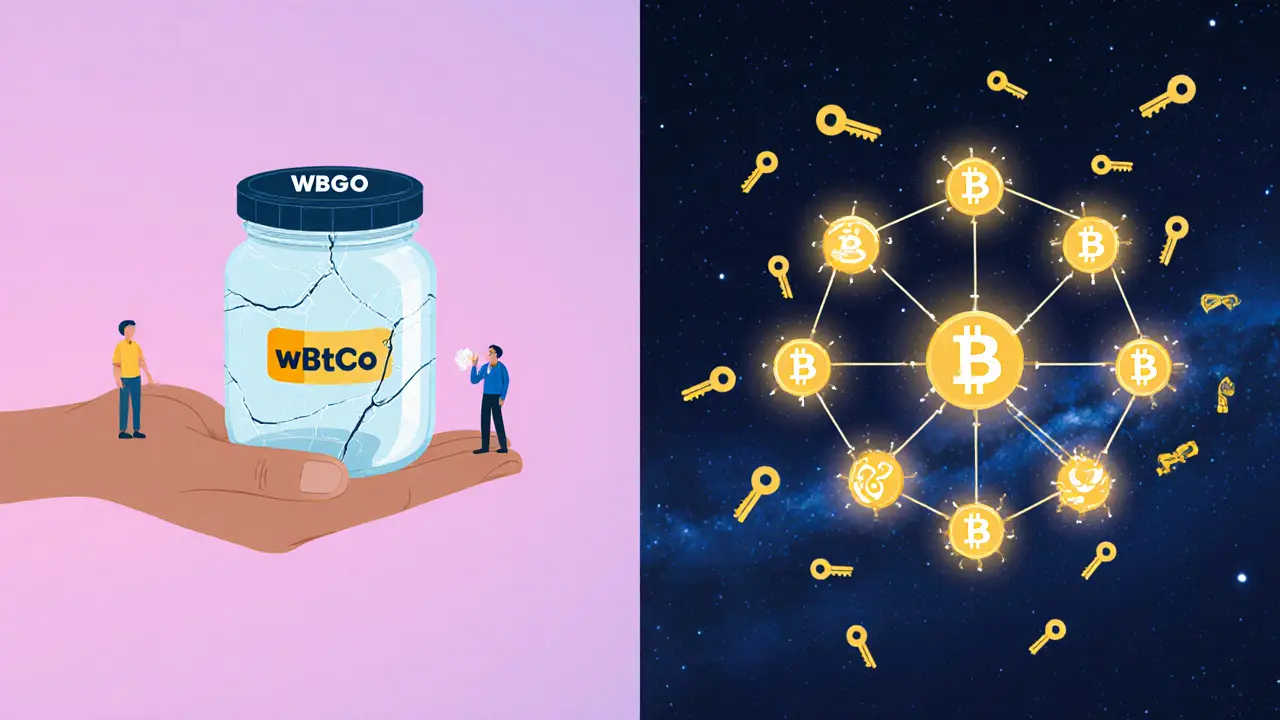
Why Institutions Love Wrapped Tokens (And Why You Should Be Skeptical)
BlackRock invested $500 million in WBTC-backed lending protocols. Why? Because WBTC is regulated, audited, and compliant. Institutions need KYC. They need audited reserves. They need a legal entity to sue if things go wrong. That’s why 87% of WBTC is held in institutional wallets, according to Nansen. Retail users? They’re fleeing to renBTC and tBTC. In Q3 2023, renBTC’s retail user base grew 43%. Why? Because retail doesn’t care about compliance. They care about control. But here’s the catch: institutions are betting on centralized custody because it’s easier. Not because it’s safer. And if those institutions pull out? The whole WBTC ecosystem could collapse overnight.What You Can Do: Reduce Your Risk
If you’re using wrapped tokens, you’re taking on custodial risk. You can’t eliminate it-but you can reduce it:- Don’t put all your BTC into WBTC. Split across WBTC (62.5% market share), tBTC (12.8%), and sBTC (9.3%). If one custodian fails, you’re not wiped out.
- Use decentralized alternatives for small amounts. If you’re wrapping under $5,000, try renBTC. The fees are higher, but you’re not trusting a single company.
- Understand withdrawal limits. BitGo caps daily withdrawals at 100 BTC without special approval. If you hold 20 BTC, you can’t pull it all out in one day.
- Track custodian audits. WBTC publishes monthly attestations. Check them. If the BTC reserves drop suddenly, get out.
- Never use wrapped tokens for critical DeFi positions. If you’re borrowing against WBTC to buy more crypto, you’re doubling down on risk. If the custodian freezes, your loan gets liquidated.

The Future: Will Custodial Risk Ever Go Away?
The industry knows the problem. Chainlink’s CCIP, launched in October 2023, uses Proof-of-Reserve oracles to verify asset backing without custodians. It’s still small-only $420 million locked-but it’s the first real alternative. BitGo’s partnership with Fireblocks in August 2023 added biometric access and geographically distributed key shards. More security-but still centralized. The WBTC DAO raised their multisig threshold from 8/15 to 12/18. Better, but still a single point of control. The Ethereum Foundation’s roadmap includes native cross-chain verification. That means one day, you might wrap Bitcoin without a custodian at all. Just cryptographic proofs. No middleman. But that day isn’t here yet. And until it is, every wrapped token you hold is a gamble. You’re betting that a company, not code, will always act in your interest.Bottom Line: Wrapped Tokens Are Not Bitcoin
Bitcoin’s value comes from decentralization. Wrapped tokens destroy that. They take the most censorship-resistant asset in history and lock it behind a corporate firewall. If you want Bitcoin, hold Bitcoin. If you want DeFi yield, use native Ethereum assets like ETH or stETH. If you insist on using wrapped tokens, treat them like cash in a bank-not like digital gold. Know the risks. Diversify your exposure. Never trust more than you can afford to lose.Because when the custodian falls, the blockchain won’t save you.

Comments
Vidyut Arcot
Been holding WBTC for yield farming, but this post made me double-check my custodian. Turned out I had 80% in WBTC. Splitting now - 50% renBTC, 30% WBTC, 20% ETH. Better safe than sorry.
Also, checked BitGo’s last attestation - reserves are still 1:1. But I’m not sleeping easy anymore.
Jay Weldy
Really appreciate how you laid this out. It’s easy to get sucked into the DeFi hype without thinking about the middlemen. I used to think ‘blockchain = trustless’ but now I get it - wrapped tokens are just crypto IOUs with fancy names.
Thanks for the wake-up call.
Melinda Kiss
Thank you for writing this. So many people treat WBTC like it’s Bitcoin. It’s not. It’s a financial instrument with counterparty risk - just like a bond.
I’ve been telling my friends this for months. If you want Bitcoin, hold Bitcoin. If you want yield, use ETH or stETH. No compromises.
Greer Dauphin
soooo… wait. you’re telling me i’ve been holding ‘fake bitcoin’ this whole time?? 😅
my bad. i thought wbtc was just bitcoin on eth. turns out it’s more like ‘bitcoin on loan from a guy who might not give it back’
renBTC it is. even if it takes 4 hours to unwrap. at least i won’t wake up to ‘under review’
Bhoomika Agarwal
Westerners cry about ‘custodial risk’ like it’s some new invention. In India, we’ve been dealing with banks freezing accounts since the 90s. This is just crypto’s version of NPA.
But hey, at least BitGo isn’t a public sector bank. Still, if you’re dumb enough to trust a company with your BTC, you deserve to lose it.
Shari Heglin
While the risks are real, the article overstates the case. WBTC has undergone over 20 independent audits. Its multisig structure is among the most robust in the space. The 72-hour pause was precautionary, not indicative of insolvency.
Comparing it to renBTC’s sMPC ignores the trade-offs in speed, cost, and usability. Not all decentralization is optimal.
Ivanna Faith
obviously if you’re using wrapped tokens you’re already in the ‘I want crypto but also want my mom to understand it’ phase 🤷♀️
so yeah, you’re not holding bitcoin. you’re holding a digital IOU from a company that probably has a compliance officer named Greg.
but hey - at least Greg doesn’t live in a basement. probably.
Akash Kumar Yadav
WBTC? More like WB-‘Where’s My Bitcoin?’
USA thinks it’s smart to trust corporations. India knows better. We’ve seen banks collapse, brokers vanish, and governments freeze assets. This is just crypto’s version of demonetization with a whitepaper.
renBTC? sBTC? No. Only real BTC. No middlemen. No ‘under review.’
alex bolduin
It’s funny how we treat Bitcoin as this sacred decentralized asset but then turn around and wrap it in corporate chains like it’s a gift box
we’re not just trusting a custodian - we’re trusting the idea that capitalism will always be benevolent. and that’s the real risk.
maybe the answer isn’t better custodians. maybe it’s no custodians at all.
Philip Mirchin
As someone who’s lived in both the US and India, I’ve seen how different cultures approach risk. Americans want convenience and compliance. Indians want control and sovereignty.
That’s why WBTC thrives in the West. renBTC is growing in emerging markets. It’s not just tech - it’s culture.
Lawal Ayomide
You think BitGo is bad? Try Nigerian crypto exchanges. They vanish with your BTC and send you a WhatsApp voice note saying ‘sorry bro.’
At least WBTC has auditors. At least you can file a complaint. In Lagos? You’re just another ghost in the blockchain.
justin allen
Oh wow, so now we’re supposed to be scared of custodians? What’s next? Are we gonna panic about banks holding our USD? Or Apple holding our iCloud keys?
People forget - every financial system has a central point. Bitcoin was meant to remove that. But we’re just replacing one middleman with another and calling it ‘innovation.’
Wake up. It’s all centralized. Just with more buzzwords.
ashi chopra
This hit me hard. I’ve been using WBTC for my staking pool and never thought about the human side - the person who might be stuck because of a gas spike or a policy delay.
It’s not just about money. It’s about trust. And when trust breaks, it’s not just your portfolio that suffers - it’s your faith in the whole system.
Darlene Johnson
Did you know BitGo is backed by Goldman Sachs? And the DAO members? All ex-Big Tech execs. This isn’t DeFi. It’s Wall Street in hoodies.
The real question isn’t ‘what if they freeze?’ - it’s ‘who decided they should have control in the first place?’
They’re not protecting your assets. They’re protecting their power.
samuel goodge
Let’s not forget the philosophical layer: Bitcoin’s value is not in its scarcity, but in its sovereignty. Wrapped tokens invert that. They make Bitcoin a liability - something you borrow, not something you own.
It’s like owning a house… but only if the landlord lets you live in it. And he can revoke your lease at any time.
Is that freedom? Or just a very expensive leasehold?
Katherine Alva
Thank you for this. I’ve been saying this for years - WBTC is not Bitcoin. It’s a derivative. And derivatives are risky.
My rule: if you can’t hold the private keys, you don’t own it. Period.
Also - love the renBTC tip. I switched 10% of my holdings last month. Took 3 hours to unwrap. Worth every second. 🌱
Maggie Harrison
Y’all are overcomplicating this. If you want yield, use ETH. If you want Bitcoin, hold BTC. Don’t mix them. Don’t wrap them. Don’t pretend you’re being ‘smart’ by using WBTC.
It’s not DeFi. It’s a bank. Just with more emojis. 💸
Stop trying to have your cake and eat it too.
Nelia Mcquiston
This is exactly why I left WBTC. I realized I was using it because everyone else was - not because it made sense.
Now I use ETH for yield, BTC for long-term, and only small amounts of renBTC for experimental DeFi. No custodians. No surprises.
It’s not glamorous. But it’s mine.
Mark Stoehr
you people worry too much. if you cant handle risk dont play. wbtc is fine. bitgo is fine. you just dont like that someone else has the keys. grow up.
also 100btc daily limit? that’s more than you’ll ever need. chill.
Reggie Herbert
Let’s clarify the terminology: WBTC is a collateralized stablecoin analog. It’s not a tokenized asset - it’s a credit instrument. The real issue isn’t custody - it’s the misrepresentation of WBTC as ‘Bitcoin.’
That’s the fraud. Not the custodian. The branding.
Murray Dejarnette
My buddy lost $22k because BitGo paused withdrawals during a gas spike. He was trying to repay a loan. Got liquidated. No warning. No mercy.
And now he’s trying to ‘move on.’ Like it’s just a bad date.
It’s not. It’s theft by policy. And nobody’s getting arrested for it.
Sarah Locke
To anyone new to crypto: this is your first lesson in risk. Not volatility. Not hacks. Not scams.
It’s trusting the wrong people.
Don’t let FOMO make you forget: if you don’t hold the keys, you don’t hold the asset. Ever.
Take your time. Learn. Then act.
Mani Kumar
WBTC is for institutions. renBTC is for degens. sBTC is for blockchain purists. BTC is for everyone else.
If you’re retail and using WBTC, you’re already playing the wrong game. You’re not a participant - you’re a liquidity provider for hedge funds.
Tatiana Rodriguez
I’ve been thinking about this for weeks. It’s not just about custody - it’s about identity. When you wrap BTC, you’re not just giving up control of your coins - you’re surrendering your autonomy as a Bitcoiner.
Every time you use WBTC, you’re saying: ‘I trust the system more than the protocol.’
And that’s a quiet, slow erosion of everything Bitcoin stood for.
It’s not just financial. It’s existential.
Britney Power
The entire narrative is flawed. Wrapped tokens are not ‘dangerous’ - they are the inevitable evolution of cross-chain interoperability. The real problem is the lack of regulatory clarity and the irrational fear of centralized entities among crypto fundamentalists.
WBTC is audited, insured, and compliant. It enables institutional adoption. That is not a bug - it is a feature.
Those who refuse to adapt will be left behind as the market matures.
Vidyut Arcot
Just checked my portfolio. I moved the last 10% of WBTC to renBTC. Took 3 hours. Paid 0.7%. Worth it.
BitGo’s audit came out today - reserves are still 1:1. But I’m not waiting for the next ‘pause.’
Trust, but verify. And then verify again.