
FATCA & FBAR Reporting Calculator
Calculate Your Reporting Requirements
This tool helps you determine if you need to file FATCA (Form 8938) and/or FBAR (Form 114) based on your citizenship status and foreign asset values.
⚠️ Note: This calculator only determines reporting requirements. It does not replace tax advice.
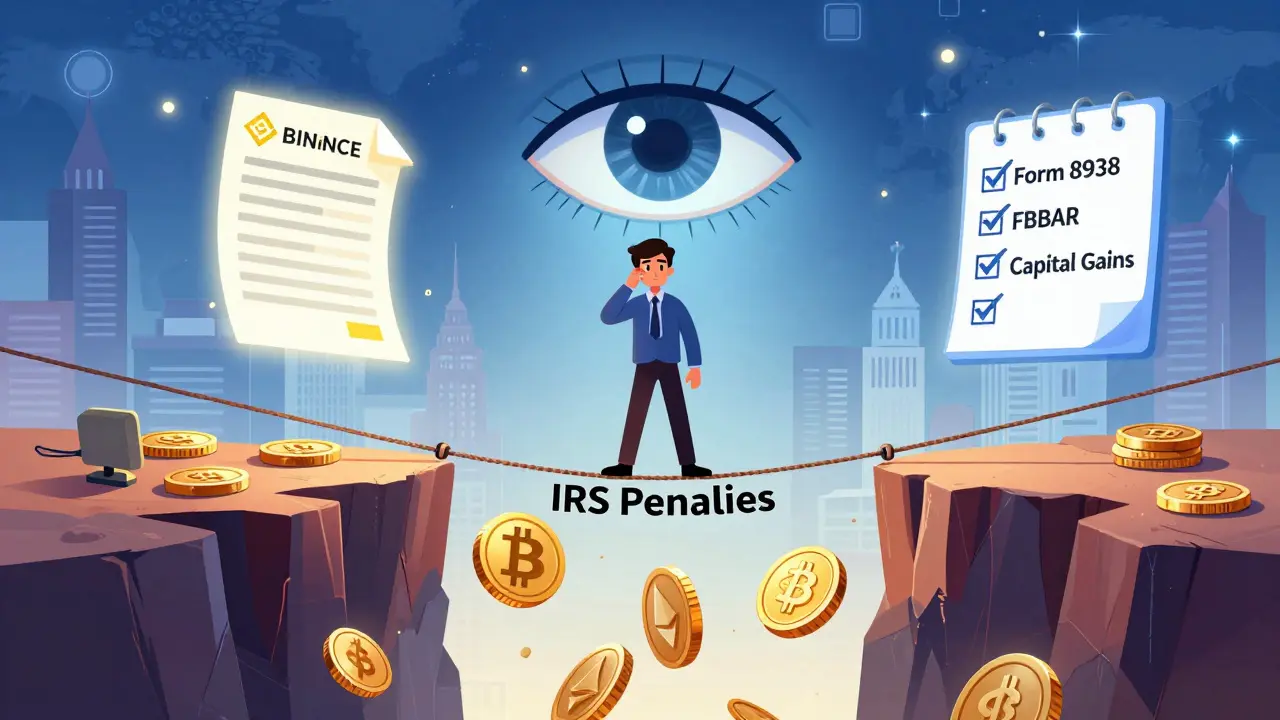
If you're a U.S. citizen holding cryptocurrency on a foreign exchange, you're likely already walking a tightrope between compliance and confusion. The IRS doesn’t send reminders. No one calls to warn you. And if you’re unsure whether your Bitcoin, Ethereum, or Solana accounts abroad need to be reported under FATCA, you’re not alone - but you’re also at risk.
What FATCA Actually Requires
FATCA, or the Foreign Account Tax Compliance Act, was passed in 2010 to stop U.S. taxpayers from hiding money offshore. It forces foreign banks and financial institutions to report accounts held by Americans to the IRS. If you’re a U.S. citizen - even if you live in New Zealand, Canada, or Singapore - and you hold financial assets overseas, you might need to file Form 8938 with your tax return.The rules aren’t simple. For someone living in the U.S. and filing as single, you must report if your foreign assets were worth more than $50,000 on the last day of the year, or more than $75,000 at any point during the year. Married couples filing jointly have higher thresholds: $100,000 on the year-end date, or $150,000 at any time during the year. If you live abroad, the thresholds jump significantly - but you still need to check them every year.
Form 8938 isn’t optional. It’s attached to your Form 1040. Miss the deadline, and penalties start at $10,000. If you ignore it after being notified by the IRS, penalties can climb to $50,000. That’s not a typo. That’s real money.
Cryptocurrency Is a Foreign Financial Asset - Probably
Here’s where things get messy. The IRS hasn’t issued a clear, official rule saying: "Crypto on Binance or Kraken counts as a foreign financial asset under FATCA." But they don’t need to. The law already covers it.FATCA defines "specified foreign financial assets" broadly. It includes any financial account held with a foreign financial institution - and that’s where crypto fits. If you hold Bitcoin on a foreign exchange like Binance, Bybit, or KuCoin, and that platform is registered under FATCA (which most major ones are), then your account is reportable. Even if the exchange doesn’t send you a 1099 or a bank statement, the IRS still considers it a foreign financial account.
What if you hold crypto in a non-custodial wallet? If the wallet is on a foreign platform that doesn’t act as a custodian - like a self-hosted Ledger or Trezor - it likely doesn’t count. But if you use a foreign exchange that holds your private keys for you, you’re in reporting territory. The key question isn’t whether you own the crypto. It’s whether a foreign company controls access to it.
Foreign Exchanges Are Reporting You - Even If You Didn’t Know
You might think you’re invisible if you don’t file. But the truth is, the foreign exchange you use might already be telling the IRS about you.Under FATCA, foreign financial institutions must register with the IRS. Over 300,000 institutions worldwide are registered. Major crypto exchanges like Binance (outside the U.S.), Kraken, and Bitstamp have registered as FFIs (Foreign Financial Institutions). That means they’re legally required to report your name, address, taxpayer ID, account number (or login details), and account balance to the IRS.
So even if you skip Form 8938, the IRS already has a copy of your account data. The question isn’t whether they know - it’s whether you’re caught in the gap between what they know and what you admit.
FBAR Is Coming for Crypto Too
FATCA isn’t the only rule you need to worry about. There’s also FBAR - the Foreign Bank and Financial Account Report (FinCEN Form 114). For years, crypto was excluded. But in 2024, FinCEN proposed new rules that would include cryptocurrency accounts under FBAR reporting.If those rules are finalized (and they likely will be in 2025), you’ll need to file FBAR if your foreign crypto holdings exceed $10,000 at any time during the year. That’s a lower threshold than FATCA. And FBAR is filed separately - online through the BSA E-Filing System - not with your tax return.
Failure to file FBAR can cost you up to $10,000 per violation. If the IRS decides you acted willfully, penalties can reach 50% of your account balance per year. That’s not a mistake. That’s a financial disaster.
How to Value Your Crypto for Reporting
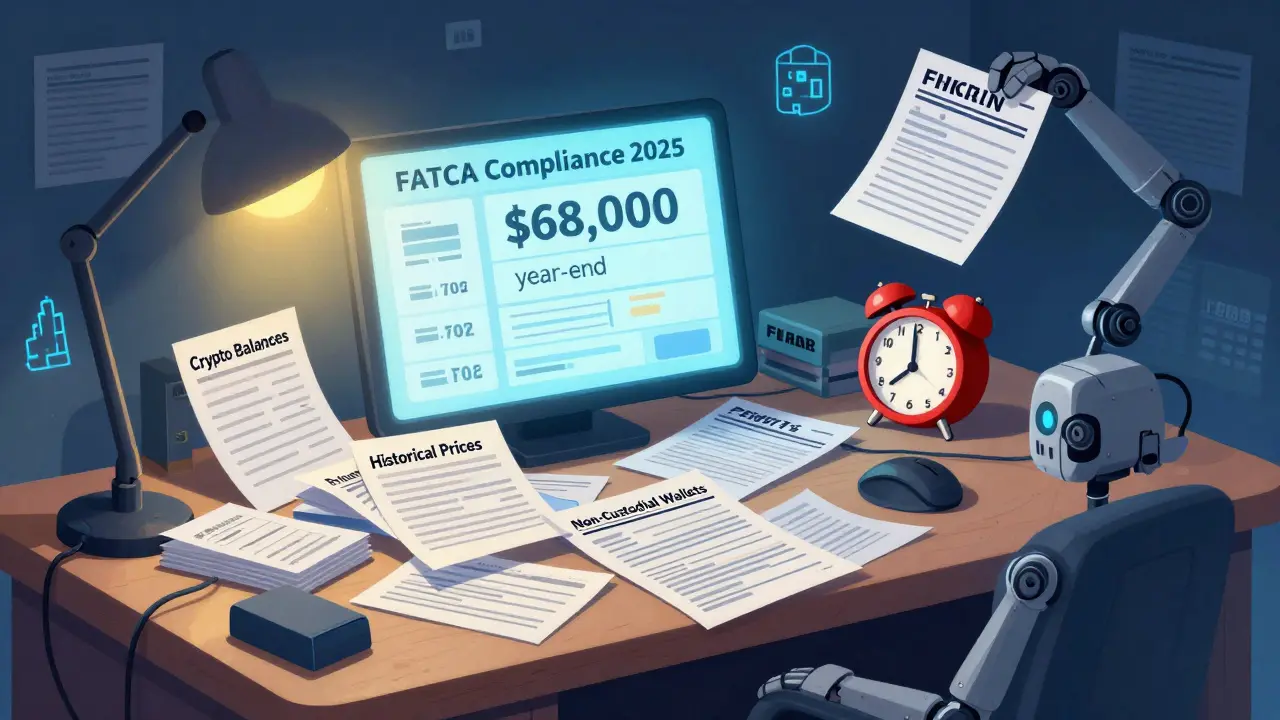
Valuing crypto is tricky. Bitcoin can swing 20% in a day. Ethereum might drop 30% in a week. So what value do you use on Form 8938?The IRS hasn’t specified a method, but tax professionals agree: use the fair market value at year-end. If your portfolio was worth $68,000 on December 31, 2024, that’s the number you report. If it hit $85,000 in June but dropped back to $52,000 by December, you only report $52,000 - unless you’re above the threshold at any point during the year, which triggers reporting anyway.
Don’t guess. Use a reputable exchange’s historical price data. Most platforms let you download transaction history with timestamps. Use that. If your exchange doesn’t provide it, use CoinMarketCap or CoinGecko’s historical data - and keep a screenshot as proof.
What If Your Exchange Doesn’t Give You Account Details?
Some crypto platforms don’t issue account numbers. They don’t send statements. They just give you a login. What then?The IRS says: use what you’ve got. List the exchange name. Write "Login: [your email]" in the account number field. For the address, write "Unknown" or the exchange’s headquarters location (e.g., "Registered in Malta"). You’re not required to have perfect documentation - just good-faith effort.
Don’t leave fields blank. Don’t say "I don’t know." That’s not compliance. It’s negligence. The IRS expects you to try. And if you try, you’re protected.

Don’t Forget Your Capital Gains
FATCA and FBAR are about disclosure. But they’re not the whole story. Every time you sell, trade, or spend crypto, you trigger a taxable event. You must report those on Form 8949 and Schedule D.Even if you swapped Bitcoin for Ethereum, that’s a taxable sale. The IRS treats crypto like property - not currency. So if you bought BTC for $20,000 and traded it for ETH worth $25,000, you owe tax on $5,000 in capital gains.
And yes, the IRS uses FIFO (first-in, first-out) by default. If you bought BTC in 2020 and 2023, and you sold some in 2024, they assume you sold the oldest coins first - unless you specifically identify which units you sold. That’s hard to do without specialized software.
What Should You Do Right Now?
If you have crypto on a foreign exchange and you haven’t filed Form 8938 or FBAR:- Don’t panic. But don’t wait.
- Calculate your highest balance for 2024. If it exceeded $50,000 (FATCA) or $10,000 (FBAR), you likely owe filings.
- Gather your transaction history from all foreign platforms.
- Use a tax software like Koinly or CoinTracker to map your gains and losses.
- File amended returns for the past three years if you missed reporting.
The IRS has a Streamlined Filing Compliance Procedure for people who didn’t know they were supposed to report. It lets you catch up without penalties - if you’re honest, complete, and timely. But if you wait until they come to you, you lose that option.
The Bottom Line
FATCA and cryptocurrency reporting isn’t about suspicion. It’s about transparency. The U.S. government knows you have foreign crypto. They’re just waiting for you to admit it.Ignoring the rules won’t make them go away. The penalties are real. The audits are happening. And the IRS is getting better at connecting the dots between foreign exchanges, blockchain data, and taxpayer identities.
Don’t risk $50,000 in penalties because you thought crypto was "too new" to matter. It’s not new anymore. It’s regulated. And if you’re a U.S. citizen with foreign crypto - you’re part of the system now.
File. Disclose. Document. Then sleep easy.
Do I need to report crypto on FATCA if I live outside the U.S.?
Yes. If you’re a U.S. citizen, your location doesn’t exempt you from FATCA. The thresholds are higher if you live abroad - $200,000 on the last day of the year or $300,000 at any time during the year - but you still must report foreign crypto holdings that meet those levels. The IRS cares about your citizenship, not your address.
What if my crypto is on a U.S.-based exchange like Coinbase?
Then you don’t need to report it under FATCA. FATCA only applies to foreign financial institutions. Coinbase, Kraken (U.S. entity), and Gemini are U.S.-based and don’t trigger FATCA reporting. But you still need to report capital gains from trades on your tax return.
Can I just ignore FATCA if my crypto balance is below $50,000?
If your foreign crypto holdings never exceeded $50,000 (or $75,000) during the year, you’re not required to file Form 8938. But if you also held other foreign assets - bank accounts, stocks, mutual funds - you need to combine their values. The $50,000 threshold applies to your total foreign financial assets, not just crypto.
Is there a way to avoid FATCA reporting on crypto?
Only one: move your crypto to a U.S.-based platform or take full custody using a non-custodial wallet you control (like Ledger or Trezor) with no foreign intermediary. But even then, you still need to report capital gains. There’s no legal way to hide crypto from the IRS - only to comply properly.
What happens if I file late or miss a year?
You’ll face penalties - $10,000 for late or missing Form 8938, up to $50,000 if the IRS notifies you and you still don’t file. For FBAR, penalties start at $10,000 per violation and can hit 50% of your account balance if deemed willful. But if you file voluntarily through the IRS Streamlined Procedure, you can avoid penalties if you’re honest and complete your filings.

Comments
Nelson Issangya
I know this stuff is overwhelming, but honestly? Just get it done. I filed my Form 8938 last year after sweating bullets for months. The IRS didn’t bite. I’m alive, taxes paid, and I can sleep now. You’re not alone in this.
Use Koinly. It’s $50 well spent. Stop stressing over perfect numbers - use year-end values, screenshot everything, and move on. The goal isn’t perfection. It’s compliance.
jonathan dunlow
Look, I get it - crypto feels like the Wild West, but the IRS isn’t playing around anymore. They’ve got algorithms crawling through blockchain data faster than your neighbor’s smart fridge connects to Wi-Fi. I used to think, ‘Oh, it’s just Bitcoin, they don’t care.’ Wrong. I got a letter last year because Binance reported my account - even though I never filed Form 8938. Turns out, they already had my name, email, and balance. I had to amend three years of returns. Cost me $12k in penalties and accountant fees. Don’t be me. File now. Even if you’re under the threshold, document everything. You’ll thank yourself when the audit notice comes - and it will come. The only question is whether you’re ready for it.
Chris Mitchell
FATCA isn’t about punishing you. It’s about transparency. If you hold assets overseas - crypto or not - you’re part of a global system. The IRS doesn’t need your permission to know. They already know. Your job isn’t to hide. It’s to disclose. Do it right, and you’re free. Do it wrong, and you’re on the hook for decades.
rita linda
Let’s be real - if you’re holding crypto on a foreign exchange and you think you’re somehow ‘exempt’ because you’re ‘tech-savvy’ or ‘anti-establishment,’ you’re not just naive. You’re a liability to every other American taxpayer. This isn’t a debate. It’s law. And if you’re too lazy to file Form 8938, you’re not a crypto pioneer - you’re a tax evader in a hoodie. Wake up. The system isn’t broken. You’re just not playing by the rules.
Martin Hansen
I’m sorry, but if you’re still asking whether crypto counts under FATCA in 2025, you’re either lying to yourself or you’ve been living under a rock since 2018. The IRS has been tracking crypto since 2014. Binance reported millions of U.S. users in 2023. You think you’re invisible? You’re not. You’re just the guy who got caught because he waited until the last minute. And now you’re gonna pay for it. Congrats.
Scott Sơn
I’m not just filing Form 8938 - I’m throwing a funeral for my crypto anonymity. 🕯️ I used to think my Ledger was my castle. Turns out, it’s just a tiny house in a neighborhood where the IRS has a satellite camera pointed at every door. My Binance account? Gone. My Kraken history? Archived. My peace of mind? Sold for $500 in tax software and two hours of crying over Excel sheets. But hey - at least I’m not the guy getting audited next year with a $47k penalty because he thought ‘it’s just crypto.’
Sandra Lee Beagan
As someone living in Canada, I can confirm: yes, U.S. citizens here are getting hit with FATCA notices left and right. The Canadian banks don’t care - they’re just following the law. But the IRS? They’re relentless. I helped a friend file last year. We used CoinTracker, downloaded all trade histories, and listed every exchange with ‘Login: [email]’ in the account field. It was messy. But it worked. Don’t overthink it. Just do the work. You’re not alone. We’re all just trying to survive this system. 🤝
Ben VanDyk
You say 'use year-end value.' But what if you had $80k in June and $45k in December? Do you report $45k? Or do you report the $80k because it was higher during the year? The IRS doesn’t clarify this. And the instructions on Form 8938 are written like a legal loophole manual. This isn’t tax advice - it’s a puzzle with no solution.
Barb Pooley
I’ve been waiting for this. The IRS is using AI to track crypto. They’re cross-referencing IP addresses, wallet addresses, and exchange logins. They already know who you are. They just need you to admit it so they can charge you. This isn’t about taxes. It’s about control. They want you scared. Don’t be. Just delete your accounts. Go full Hodl. Live off cash. Burn your laptop. The system can’t touch you if you don’t exist.
Shane Budge
If I hold crypto in a non-custodial wallet on a U.S. server, do I still need to report it?
sonia sifflet
You people are acting like this is the first time anyone ever tried to hide money. The IRS has been chasing offshore accounts since the 1970s. Crypto is just the new Swiss bank. If you think you’re smarter than the government, you’re not. You’re just behind the curve. File. Now. Or get ready to explain to your kids why you lost your house.
Chris Jenny
They’re watching us... they’re always watching... Binance? Kraken? All of them are controlled by the deep state... they’re using blockchain data to track our movements... they’re linking our wallets to our social security numbers... I saw a video... it was leaked... they’re using AI to predict our next trade... I’m deleting everything... I’m moving to the jungle... they can’t find me there...
Uzoma Jenfrancis
I don’t care what the law says. I’m Nigerian. I don’t owe the U.S. anything. If they want my crypto, they can come get it. I’m not filing. I’m not paying. I’m not apologizing. You think you’re safe because you’re in America? You’re just another pawn.
Elizabeth Miranda
I’ve been holding crypto since 2017 and never filed. I’m not proud of it. But I’m not a criminal. I just didn’t know. Now I do. I’m using the Streamlined Procedure. Took me three weeks. Paid a CPA $800. Filed all three years. No penalties. Just paperwork. I’m not trying to be a hero. I just want to stop looking over my shoulder.
Chloe Hayslett
Oh wow, so the government wants you to report your crypto? How… revolutionary. Next they’ll ask you to report your Netflix password. Maybe they’ll send a form to your toaster. 🤡
Jonathan Sundqvist
I got a letter last month. Said I owed $12k for 2022. I didn’t even know I had to file. I just thought I was being smart by keeping it offshore. Now I’m stuck with a bill I can’t pay. If you’re reading this and you haven’t filed - stop scrolling. Go to irs.gov. Right now. Don’t wait. Don’t think. Just do it.
Thomas Downey
The fact that people still question whether crypto is reportable under FATCA in 2025 is a testament to the tragic decline of civic responsibility in America. The law is clear. The penalties are severe. And yet, here we are - a nation of willfully ignorant citizens, clinging to the illusion that digital assets exist beyond the reach of statutory authority. You are not a disruptor. You are a delinquent. And the IRS is not your enemy - your apathy is.
Annette LeRoux
I filed my FBAR last year with a screenshot of my Binance balance on Dec 31 and a note saying 'No account number - login: [email protected]'. The system accepted it. 🤷♀️ I didn’t get audited. I didn’t get fined. I just did the thing. And now I sleep better. You can too. Just… do the thing. 💚
Jerry Perisho
Use CoinGecko historical prices. Download the CSV. Save it as 'FATCA_2024_Binance.csv'. That’s your proof. Don’t overcomplicate it. The IRS just wants to see you tried. You don’t need a CPA. You need a spreadsheet.
Manish Yadav
If you are not reporting your crypto, you are stealing from the country. You are a bad person. You are not a patriot. You are a thief. The government gives you schools, roads, police. You owe them. File. Now. Or go to jail.