

What is DeFi, really?
DeFi stands for Decentralized Finance. It’s not a bank. It’s not an app your bank gave you. It’s a system where money moves directly between people using code-no middlemen, no branch offices, no waiting for Monday to transfer cash. Instead of your bank holding your money, you hold it yourself using a digital wallet. Everything happens on a blockchain, mostly Ethereum, and it runs 24/7, no matter where you are in the world.
By January 2026, over $112 billion was locked in DeFi protocols. That’s not play money. That’s real value moving through smart contracts-self-executing pieces of code that automatically handle loans, trades, and savings. You don’t need permission to join. You don’t need a credit score. You just need an internet connection and a wallet.
Why DeFi? The real advantages
If you’ve ever been stuck with a bank account paying 0.01% interest, DeFi feels like a breath of fresh air. On platforms like Aave or Compound, you can earn 2% to 5% annual interest just by depositing stablecoins like USDC or DAI. That’s 200 to 500 times better than most savings accounts.
And it’s global. If you’re in New Zealand, Indonesia, or Nigeria, you can lend, borrow, or swap tokens the same way someone in New York can. No gatekeepers. No currency conversion fees from your bank. You can even earn yields in assets that don’t exist in your country’s traditional banking system.
But here’s the catch: there’s no FDIC insurance. If you mess up, lose your private key, or send funds to the wrong address, there’s no customer service line to call. You’re responsible. That’s the trade-off for freedom.
What you need to get started
You don’t need a fancy computer or a PhD in coding. Here’s what you actually need:
- A smartphone or laptop with internet access
- A non-custodial wallet (you control the keys)
- A small amount of cryptocurrency to pay for transactions (gas fees)
- 15 to 90 minutes of your time
Most beginners start with MetaMask, the most popular wallet. It’s free, works on mobile and desktop, and connects to almost every DeFi app. If you’re on Solana, Phantom is simpler and cheaper to use. Both are easy to install-just search for them in your app store.
For safety, if you plan to hold more than $500, get a hardware wallet like Ledger. It costs $79-$129, but it keeps your keys offline, away from hackers. For starters, your phone wallet is fine.
Step-by-step: Your first DeFi move
Follow these steps. Don’t skip any. Do them slowly.
- Install MetaMask (or Phantom if you’re on Solana). Create a new wallet. Write down your 12-word recovery phrase-on paper, not on your phone. This is your only way back in if you lose your device.
- Buy ETH or SOL. Use MetaMask’s built-in buy feature (if available in your country) or buy on Coinbase, Binance, or Kraken, then send it to your wallet. Start with $20-$50. Don’t go all in.
- Switch to a Layer 2 network. Ethereum fees can be $5-$15. That’s too high for a beginner. In MetaMask, switch to Arbitrum or Optimism. Fees drop to pennies. Solana users already pay $0.00025 per transaction-no need to switch.
- Swap your ETH or SOL for USDC. Go to Uniswap (on Arbitrum) or Raydium (on Solana). Swap a small amount-say $10-into USDC. This is your stablecoin. It’s worth $1, always.
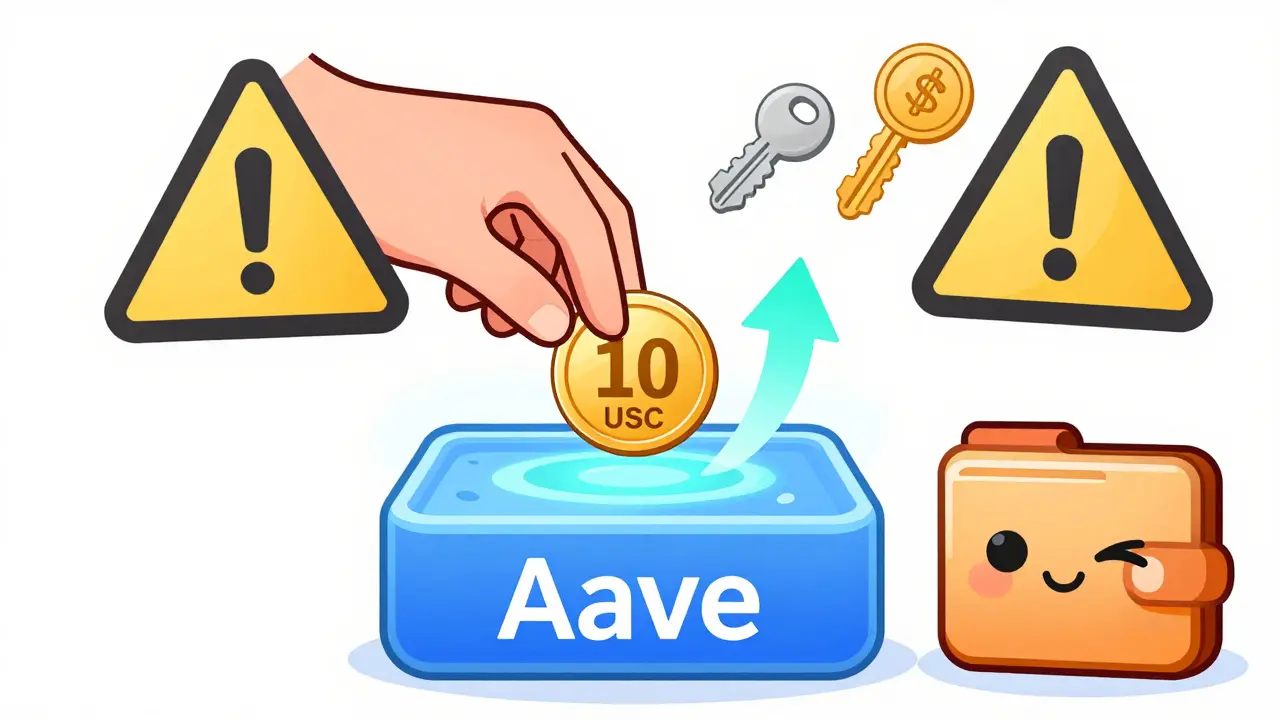
- Deposit USDC into a lending pool. Go to Aave or Compound. Click “Deposit.” Enter $10. Confirm. You’ll start earning interest within minutes. Check your balance in 24 hours. You’ll see a tiny bit more.
That’s it. You’ve just done your first DeFi transaction. No bank. No forms. No waiting.
Where beginners mess up (and how to avoid it)
Most losses don’t come from hacks. They come from mistakes. Here’s what goes wrong:
- Accidental token approvals: You click “Approve” on a token, and suddenly a scam site can drain your whole wallet. Always check what you’re approving. Never approve more than you’re using.
- Ignoring gas fees: You think you’re paying $1, but the network is busy and it’s $12. Use Etherscan or DeFi Saver to check real-time fees before confirming.
- Confusing testnets with mainnets: Testnets are fake money. If you send real ETH to a testnet address, it’s gone forever. Always double-check the network name.
- Using unknown tokens: If you see a token with a weird name and no website, don’t touch it. 90% of DeFi losses are from tokens nobody’s heard of.
Use tools like SafeSwap (from Cow.fi) or Uniswap’s new “Learn Mode.” They show warnings before you click. They explain what each step does. Use them.
Ethereum vs. Solana: Which should you pick?
Most DeFi lives on Ethereum. But Solana is growing fast-and it’s way cheaper.
| Feature | Ethereum (Arbitrum) | Solana |
|---|---|---|
| Average transaction fee | $0.02-$0.15 | $0.00025 |
| Popular wallets | MetaMask | Phantom |
| APY on stablecoins | 2.1%-4.7% | 8.5%-12.3% |
| Security track record | Strong (Ethereum since 2015) | Good, but newer (launched 2020) |
| Beginner friendliness | Good, with Layer 2 | Excellent |
If you want safety and stability, start on Ethereum with Arbitrum. If you want speed, low fees, and higher yields, try Solana. Both work. Neither is “wrong.”
What’s changed in 2026?
DeFi isn’t the wild west it was in 2022. Big improvements have made it safer and easier:
- Account abstraction (EIP-3074): Lets you recover your wallet with a friend’s phone, not just a 12-word phrase. No more panic if you lose your paper.
- Beginner Vaults (Aave): Automatically picks the safest yield for you. No need to understand liquidity pools or impermanent loss.
- Real-time tooltips (Uniswap): Hover over any button, and it tells you what it does in plain English.
- Regulatory clarity: The EU has rules. The US is starting to define boundaries. It’s still messy, but less chaotic.
Dr. Sarah Chen from Stanford says the learning curve dropped 65% since 2022. That’s huge. You don’t need to be a coder anymore. You just need to be careful.
Who’s using DeFi-and why?
By 2026, DeFi users aren’t just crypto bros. They’re:
- Students in Kenya earning 5% interest on their phone
- Freelancers in Brazil avoiding 10% currency conversion fees
- Retirees in Canada looking for better returns than bonds
63% of users are male, 34% female. Most are between 25 and 34. But the fastest-growing group? People over 50. They’re tired of zero-interest accounts and are learning, slowly, with patience.
Reddit user u/DeFiNewbie2026 summed it up: “Started with $50 on Orca, now have $53 after two weeks-small but better than my bank’s 0.01% interest, and the interface is surprisingly clean.”
Is DeFi right for you?
DeFi isn’t for everyone. Ask yourself:
- Do you want to control your own money, even if it means more responsibility?
- Are you okay with no customer service if something goes wrong?
- Can you spend 3-5 hours learning before you put in your first dollar?
- Do you understand that you could lose everything if you click the wrong thing?
If you answered yes to all four, start small. Try $10. Use a Layer 2 network. Stick to USDC and Aave. Watch how it works. Don’t chase 20% APYs. Don’t try to “farm” tokens. Just earn 4% safely.
If you answered no to any of them, wait. There’s no rush. The system won’t disappear. You’ll still be able to join next year. And by then, it’ll be even easier.
Final thought: DeFi is a tool, not a gamble
It’s not a get-rich-quick scheme. It’s not a lottery ticket. It’s a new way to save, lend, and move money-faster, cheaper, and without middlemen. The tech is solid. The risks are real. But for the first time in history, anyone with a phone can access financial tools once reserved for banks and billionaires.
Start small. Stay cautious. Learn as you go. And remember: your money, your keys, your rules.

Comments
Rob Duber
Okay so I just deposited $10 into Aave on Arbitrum and now my phone is vibrating like it’s got a hive of bees in it. I didn’t even do anything! My wallet just started making money?? I feel like I hacked the system. Or maybe the system hacked me. Either way, I’m hooked. This is better than my Netflix subscription.
Gary Gately
wait so u just swap eth for usdc and then deposit?? no like… gas fees?? i thought u had to pay like 5 bucks each time??
Joshua Clark
I just want to say, as someone who’s been in crypto since 2017, I remember when you had to compile your own wallet from GitHub, manually edit JSON files to add RPCs, and pray to the blockchain gods that your transaction didn’t get stuck for three days - and now? You can literally tap a button, swap a token, and earn interest while you’re waiting for your coffee to brew. The democratization of finance isn’t a buzzword anymore - it’s a lived reality, and it’s beautiful. We’re not just building apps; we’re rewriting the social contract around money.
Brandon Vaidyanathan
You people are so naive. You think earning 4% is ‘safe’? You’re just feeding liquidity to a black hole. Aave’s TVL dropped 18% last month. The ‘beginner vaults’? They’re just fancy wrappers for leveraged yield farms. And don’t get me started on Layer 2s - they’re centralized proxies with a blockchain-shaped sticker on them. You’re not owning your money. You’re renting it from a tech bro with a hoodie.
Gareth Fitzjohn
Interesting overview. The step-by-step is clear and practical. I appreciate the emphasis on Layer 2s - too many guides still push Ethereum mainnet like it’s 2021. The fee comparison table is especially useful. Well done.
Katie Teresi
If you're not using Solana, you're wasting your time. Ethereum is a bloated relic. Solana’s fees are 1/1000th and yields are double. Stop romanticizing centralized L2s. You're still trusting someone else's servers. Real DeFi is permissionless, not permissioned-with-a-credit-card.
Moray Wallace
I like how this guide doesn’t sugarcoat the risks. The part about losing your keys? That’s the real deal. I’ve seen people cry because they sent funds to a testnet address. No one’s coming to fix it. That’s not a bug - it’s the feature. You’re trading convenience for sovereignty. Just don’t forget what you’re trading.
Aaron Poole
For anyone from India or Nigeria reading this - you’re not behind. You’re ahead. While folks in the US are debating whether to use MetaMask or Phantom, people in Lagos are using DeFi to pay for school fees, send money home, and start small businesses without a bank account. This isn’t speculative finance - it’s survival infrastructure. And it’s working. Keep going. You’re not late. You’re right on time.
Sunil Srivastva
I started with $5 on Solana two weeks ago. Used Phantom, swapped for USDC, deposited on Raydium. Earned $0.07 in interest. Felt like I won the lottery. My cousin in Delhi just did the same. We compare our balances every Sunday. It’s not about the money. It’s about knowing we can do this. No permission needed.
Elizabeth Jones
There’s something profoundly human about this shift. We’ve spent centuries outsourcing our financial agency to institutions - banks, governments, brokers - and now, for the first time, we’re reclaiming it not through protest, but through code. It’s not just about interest rates. It’s about dignity. The ability to say, ‘I am the custodian of my own value.’ That’s not finance. That’s philosophy in motion.
Pamela Mainama
I’m 58 and I did this last week. Took me three days to get past the fear. Now I check my balance every morning like it’s a prayer. Small wins matter. This isn’t about getting rich. It’s about not being powerless anymore.
Rachel Stone
Wow. A DeFi guide that doesn’t say ‘HODL’ once. Revolutionary.
Nickole Fennell
I just want to say - if you’re using MetaMask on your phone, you’re already compromised. I’ve seen the screenshots. You’ve got your seed phrase saved in Notes. You’ve got your wallet open on Chrome. You’re not a pioneer. You’re a walking exploit. Wake up.
Gurpreet Singh
I helped my mom set this up last weekend. She was scared. Said, ‘What if someone steals my money?’ I told her: ‘No one can steal it unless you give them the key. And you’re not giving it to anyone.’ She now earns more in interest than her pension fund. She calls it ‘my little digital garden.’ I cried.
Will Pimblett
You think Solana’s cheap? Try using it during a meme coin pump. Your $0.00025 transaction just cost you $1.20 in failed retries. And don’t even get me started on the 3am network outages. Ethereum’s L2s are boring - but boring is what keeps your money alive.
Raymond Pute
Let’s be honest - this guide is for peasants. Real DeFi isn’t about USDC on Aave. It’s about deploying your own ERC-721 liquidity pool with dynamic fee tiers, integrating with EigenLayer for restaking, and using a ZK-rollup to reduce MEV exposure while maintaining composability across 17 protocols. If you’re using a ‘beginner vault,’ you’re not in DeFi - you’re in DeFi-adjacent kindergarten. Go read the yellow paper before you touch a wallet.
Calvin Tucker
The real question isn’t whether DeFi is accessible - it’s whether we’re ready for the moral weight of financial autonomy. If you can lose everything in a click, then you must also accept that you are not a victim - you are the architect of your own ruin. This isn’t a tool. It’s a mirror. And most people don’t like what they see in it.