

Have you ever stumbled upon a cryptocurrency with a name that sounds like a superhero movie but has almost no information backing it up? That is exactly the situation with ThreatSlayerAI, also known as the SLAYER token. It sits within the broader Virtuals ecosystem, a network often associated with AI-driven virtual agents and decentralized applications. But if you are looking for a whitepaper, a detailed roadmap, or a clear explanation of how this project makes money, you will likely hit a wall. Instead, you find a micro-cap token trading on decentralized exchanges with extreme volatility and very low liquidity.
This article breaks down what we actually know about SLAYER, where it trades, and why most investors should approach it with extreme caution. We will look at the numbers, the technology behind it, and the red flags that define this specific corner of the crypto market.
The Basics: What Is SLAYER?
At its core, SLAYER is a cryptocurrency token built on the Base blockchain, designed to operate within the Virtuals protocol ecosystem. The name "ThreatSlayerAI" suggests a focus on cybersecurity or AI-based threat detection. In theory, this could mean the token is used to pay for security services, stake in AI models, or govern decisions within a virtual agent network. However, there is currently no public documentation that confirms these use cases.
The token operates as an ERC-20 compatible asset on Base, which is a Layer 2 scaling solution for Ethereum. This means transactions are faster and cheaper than on the main Ethereum network, but it still requires users to hold ETH for gas fees when interacting with the network. The total supply is fixed at 1 billion tokens, and all of them are currently in circulation. There are no vesting schedules or locked tokens mentioned in available data, which is unusual for early-stage projects that typically lock team allocations to prevent dumping.
| Attribute | Value |
|---|---|
| Token Name | ThreatSlayerAI by Virtuals |
| Ticker Symbol | SLAYER |
| Blockchain | Base (Layer 2) |
| Total Supply | 1,000,000,000 (1 Billion) |
| Circulating Supply | 1,000,000,000 (100%) |
| Primary Exchange | Uniswap V2 (Decentralized) |
| Market Cap Rank | #5174 (Micro-Cap) |
Market Reality: Liquidity and Volatility
If you check the price of SLAYER on different platforms, you might see conflicting numbers. This is not a glitch; it is a feature of illiquid markets. On LiveCoinWatch, the price might show $0.000070, while TradeSanta lists it at $0.00004095. These discrepancies happen because there are very few buyers and sellers. When someone wants to sell a large amount, the price crashes instantly because there isn't enough depth in the order book to absorb the trade.
The market capitalization hovers between $29,670 and $40,948. To put that in perspective, many established startups raise millions in their first round. A market cap under $50,000 places SLAYER in the "dust" tier of cryptocurrencies. The 24-hour trading volume is often less than $123. This means if you tried to invest $1,000, you would likely move the entire market, causing massive slippage. You might buy at one price and be unable to sell at any reasonable price later.
The all-time high was $0.0048899. Current prices are down over 98% from that peak. While some traders look for "bottom fishing" opportunities, a drop of this magnitude usually indicates that the initial hype has died out, or worse, that the project failed to deliver on its promises. The Fear & Greed Index recently registered 60, indicating "Greed," which can sometimes signal a short-term pump in speculative assets, but it is not a reliable indicator for long-term value.
Technical Analysis: Reading the Charts
For those who rely on technical indicators rather than fundamentals, the picture is mixed. CoinCodex reports a Relative Strength Index (RSI) of 49.24, which is neutral territory. An RSI below 30 suggests oversold conditions, while above 70 suggests overbought. At 49, the token is neither extremely cheap nor expensive relative to recent momentum.
The 50-day Simple Moving Average (SMA) stands at $0.00005372. If the current price is above this line, it suggests short-term bullish momentum. However, without a 200-day SMA available due to limited history, we cannot determine the long-term trend. The volatility index sits at 16.06% over the past month, which is high even for altcoins. This means the price swings wildly day-to-day, making it unsuitable for risk-averse investors.
Some forecasting models, such as those from LiteFinance and TradingBeasts, predict average values around $0.000073 for mid-2025. More aggressive models from CoinCodex suggest a potential rise to $0.000209. However, these predictions are based on mathematical algorithms that extrapolate past patterns. They do not account for fundamental shifts, such as the team abandoning the project or regulatory changes. Treat these numbers as hypothetical scenarios, not financial advice.

The Virtuals Ecosystem Connection
SLAYER does not exist in a vacuum. It is tied to the Virtuals Protocol, which focuses on creating autonomous AI agents that can interact on social media and other platforms. The logic here is that as AI agents become more popular, they will need economic incentives to operate. Tokens like SLAYER could serve as the fuel for these agents, paying for compute resources or rewarding user interactions.
However, the connection between SLAYER specifically and the core Virtuals infrastructure is unclear. Is SLAYER a governance token? A utility token for a specific AI service? Or just a meme coin leveraging the Virtuals brand? The lack of clarity is a significant risk. In successful ecosystems, each token has a distinct role. For example, Ethereum (ETH) pays for gas, while UNI governs Uniswap. SLAYER’s role remains undefined in public documentation.
The Base blockchain provides a solid foundation for low-cost transactions, which is essential for micro-transactions involving AI agents. But being on Base doesn’t guarantee success. Thousands of tokens launch on Base every week, and the vast majority fail to gain traction. The advantage of Base is speed and cost; the disadvantage is that it is crowded with speculative assets.
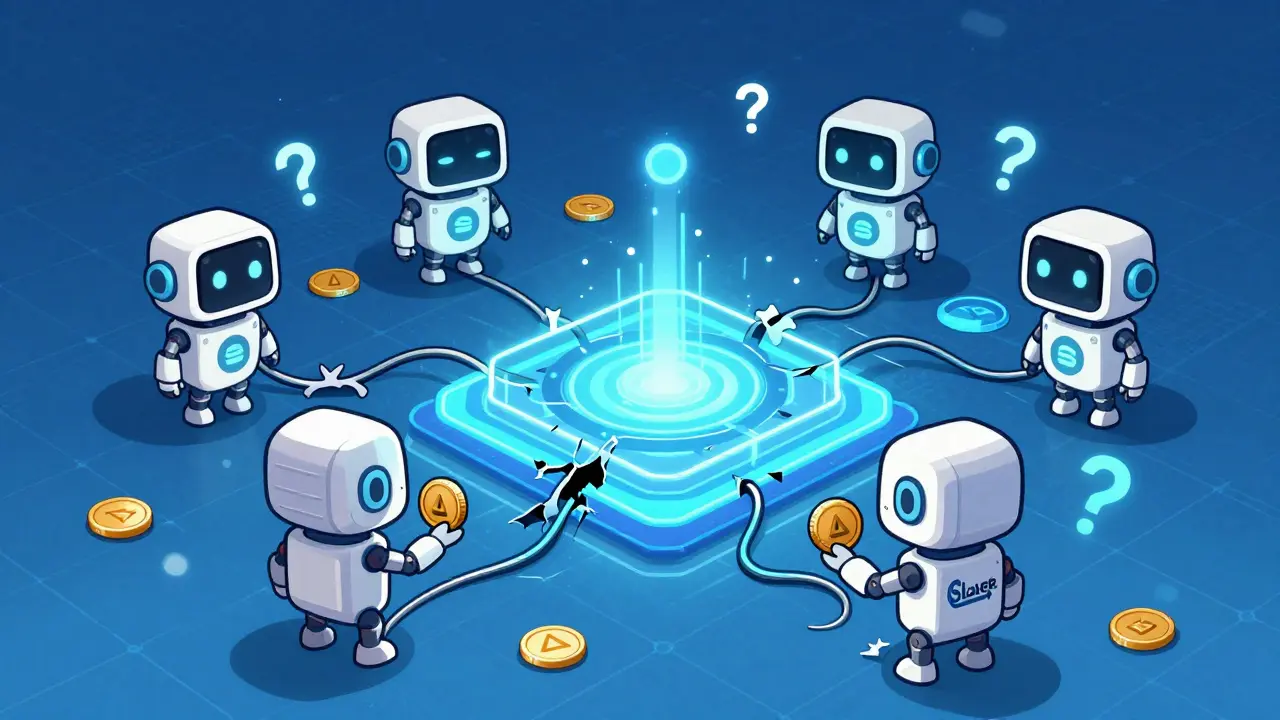
Risks and Red Flags
Before considering any investment, you must understand the risks. Here are the critical issues with SLAYER:
- No Team Information: There is no publicly verified team behind the project. Anonymous teams are common in crypto, but they increase the risk of rug pulls, where developers abandon the project and take the liquidity.
- Low Liquidity: With daily volumes under $123, exiting a position can be difficult. You might get stuck holding tokens you cannot sell.
- Lack of Documentation: No whitepaper, no roadmap, and no technical audits are readily available. This makes it impossible to verify the security of the smart contract.
- Extreme Volatility: Prices can drop 20% or more in a single day. This is not suitable for savings or long-term holding unless you have a very high risk tolerance.
- Community Silence: There is minimal discussion on Reddit, Twitter, or Discord. A healthy project usually has an active community providing updates and feedback. Silence often indicates disinterest or abandonment.
How to Trade SLAYER (If You Choose To)
If you decide to proceed despite the risks, you will need to use a decentralized exchange (DEX). The primary venue is Uniswap V2 on the Base network. Here is the process:
- Set Up a Wallet: Use a non-custodial wallet like MetaMask or Rabby. Configure it to connect to the Base network.
- Acquire ETH: Buy Ethereum on a centralized exchange like Coinbase or Binance, then withdraw it to your wallet address on the Base network. You need ETH to pay for gas fees.
- Bridge to Base: If your ETH is on the Ethereum mainnet, use a bridge like the official Base Bridge to move it to Layer 2.
- Connect to Uniswap: Go to app.uniswap.org and connect your wallet. Ensure you are on the Base network.
- Add the Token Contract: Since SLAYER is not listed by default, you will need to paste the official contract address. Be careful to verify this address from multiple sources to avoid scam tokens.
- Swap: Enter the amount of ETH you want to swap for SLAYER. Set your slippage tolerance higher than usual (e.g., 5-10%) to account for volatility, though this increases the risk of front-running bots.
Note that buying on a DEX means you are responsible for your own security. If you send funds to the wrong address, there is no customer support to help you recover them.
Conclusion: Speculation vs. Investment
ThreatSlayerAI (SLAYER) is a high-risk, low-information asset. It fits the profile of a micro-cap speculative token rather than a mature investment vehicle. The association with the Virtuals ecosystem and AI narrative gives it a thematic hook, but without concrete utility, team transparency, or strong community engagement, it remains largely unproven.
For experienced traders who understand how to navigate decentralized exchanges and manage extreme risk, SLAYER might offer short-term trading opportunities based on technical movements. For everyone else, it is safer to stick to established cryptocurrencies with clear use cases and deep liquidity. Always remember: in crypto, if something seems too obscure to find information about, there is usually a good reason for that obscurity.
Is SLAYER a safe investment?
No, SLAYER is considered highly risky. It has a very low market capitalization, extremely low liquidity, and lacks transparent team information. These factors make it susceptible to rapid price drops and potential scams. Only invest money you can afford to lose entirely.
Where can I buy SLAYER tokens?
SLAYER is primarily traded on Uniswap V2, a decentralized exchange operating on the Base blockchain. You will need a Web3 wallet like MetaMask, ETH for gas fees, and the correct contract address to execute the swap.
What is the Virtuals ecosystem?
The Virtuals ecosystem is a platform focused on building and deploying autonomous AI agents. These agents can interact on social media and perform tasks. SLAYER is associated with this ecosystem, though its specific utility within it is not clearly defined in public documents.
Why is the price of SLAYER so volatile?
Volatility is driven by low liquidity. With daily trading volumes often under $123, small buy or sell orders can significantly impact the price. Additionally, the lack of fundamental value anchors the price purely to speculation and sentiment.
Does SLAYER have a whitepaper?
As of now, there is no widely accessible or verified whitepaper for ThreatSlayerAI. The absence of technical documentation is a major red flag for investors seeking to understand the project's long-term viability and technology.

Write a comment