
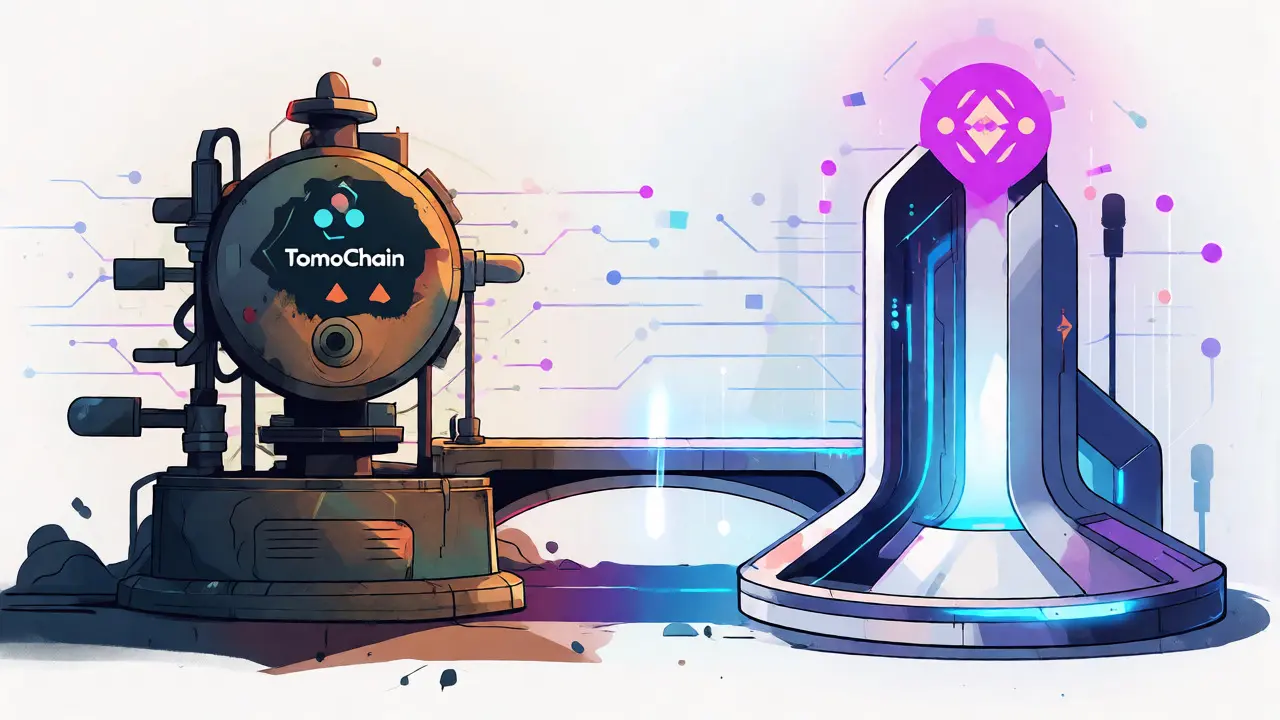
Imagine you’ve been running a successful local café for five years. Suddenly, you decide to change the name, the logo, and the vibe-but keep the same espresso machine, the same recipes, and the same staff. That’s essentially what happened with Viction. Formerly known as TomoChain, this EVM-compatible layer-1 blockchain underwent a massive identity shift in late 2023, aiming to pivot from pure tech metrics to a "people-centric" narrative. But if you’re looking at the charts today, September 2026, you might be scratching your head. The price has plummeted, liquidity is thin, and the project sits deep in the small-cap rankings. So, what exactly is Viction, and does it have a future beyond its dramatic rebrand?
| Feature | Detail |
|---|---|
| Original Name | TomoChain (Launched 2018) |
| Rebrand Date | November 2023 |
| Native Token | VIC (formerly TOMO) |
| Max Supply | 210,000,000 VIC |
| Circulating Supply | ~128-130 Million VIC (Sept 2026) |
| Consensus Model | Masternode-based Proof-of-Stake variant |
| Ecosystem Backer | Coin98 Group |
The Great Rebrand: From TomoChain to Viction
If you held TOMO tokens back in 2023, you didn’t lose your money-you just got a new ticker symbol. The transition was designed to be seamless. On November 1, 2023, the team announced that TomoChain was becoming Viction, a portmanteau of "Vision" and "Victory." They promised this wasn’t just a cosmetic facelift but a strategic evolution toward real-world utility and human-focused values.
Here’s the crucial part: the underlying technology didn’t change overnight. The smart contract addresses remained identical. If you were holding TOMO on Ethereum or BNB Chain, those wrapped versions kept their old names for a while, but the native chain token swapped to VIC at a strict 1:1 ratio. Major exchanges like Binance, Bitget, and BTSE completed the swap by late November 2023. For developers, the technical migration involved renaming token standards from TRC20 to VRC20, but since Viction is EVM-compatible, existing Solidity code still works. You don’t need to learn a new programming language; you just need to update your configuration files.
How Does Viction Work? Tech and Security
Viction isn’t trying to reinvent the wheel. It’s an Ethereum Virtual Machine (EVM) compatible Layer-1 blockchain. This means it speaks the same language as Ethereum, making it easy for developers to port dApps (decentralized applications) without rewriting everything from scratch. But why use Viction instead of Ethereum or Polygon? The pitch rests on two pillars: speed and cost.
The network utilizes a masternode-driven security model. Unlike permissionless blockchains where anyone can validate blocks with enough hardware, Viction relies on a selected group of masternodes. To run one of these nodes, you must stake VIC tokens. These nodes produce blocks and secure the network. In return, they earn rewards. This setup allows for faster finality-meaning transactions are confirmed quicker-compared to older generation chains.
The team also highlights "zero-gas" capabilities. While most blockchains require users to pay gas fees in ETH or SOL, Viction aims to abstract this away for end-users through sponsored transactions. This feature is critical for their target audience: everyday users who find crypto wallets intimidating. By removing the friction of buying native tokens just to pay for transaction fees, Viction hopes to onboard non-crypto natives more easily.
Tokenomics: What Does VIC Do?
Every cryptocurrency needs a reason to exist. For Viction, the VIC token serves three primary functions:
- Gas Fees: It pays for computational resources on the network.
- Staking: Holders stake VIC to become masternodes or delegate to them, securing the chain and earning yield.
- Governance: VIC holders vote on protocol upgrades and treasury decisions.
The supply is capped at 210 million VIC. As of September 2026, approximately 128 to 130 million coins are circulating. This leaves room for future emissions, though the exact inflation schedule depends on staking rewards and ecosystem incentives. The team frames VIC as the "lifeblood" of an ownership economy, suggesting that holding the token gives you a say in what gets built next. However, in practice, governance activity often lags behind marketing promises in smaller cap projects, so it’s wise to check recent voting participation before assuming your vote carries heavy weight.
Market Reality Check: The 2025-2026 Drop
Let’s address the elephant in the room. If you bought VIC in early 2025, you’re likely underwater. In March 2025, Viction traded around $0.25 USD with a market cap of roughly $30 million. Fast forward to September 2026, and the price hovers between $0.0041 and $0.0049 USD. That’s a decline of nearly 98%.
Why such a sharp drop? Several factors play into this. First, the broader crypto market has seen capital rotate toward newer narratives like AI tokens, DePIN (Decentralized Physical Infrastructure Networks), and modular blockchains. Older Layer-1s that lack explosive growth metrics often get left behind. Second, liquidity is thin. Data from CoinGecko shows daily trading volumes on major pairs like VIC/USDT on MEXC hovering around $50,000 to $55,000. Low volume means high slippage-if you try to sell a large amount of VIC, you’ll move the price against yourself significantly.
This volatility makes VIC a risky asset for traders but potentially interesting for long-term believers in the Coin98 ecosystem. It’s not a blue-chip safe haven like Bitcoin or Ethereum. It’s a speculative niche play.
The Coin98 Connection: Strategy and Synergy
You can’t understand Viction without understanding Coin98. The Vietnamese tech company Coin98 Group backs Viction. In fact, the rebrand was partly about merging the platforms of Coin98 and TomoChain. Coin98 has a strong presence in Southeast Asia and offers a suite of tools including wallets, swaps, and analytics.
By aligning Viction with Coin98’s user base, the project gains immediate access to millions of potential users and integrated tooling. Imagine using a Coin98 wallet that natively supports Viction swaps without needing to bridge assets manually. This synergy is Viction’s strongest competitive advantage. While it may not compete with Ethereum on developer mindshare globally, it dominates in specific regional markets where Coin98 has brand loyalty.
Pros and Cons: Should You Care?
Before you buy, weigh the realities.
| Pros | Cons |
|---|---|
| Strong backing from Coin98 ecosystem | Extremely low market cap and ranking (#2229+) |
| EVM compatibility eases development | Thin liquidity leads to high slippage |
| Focus on zero-gas UX for beginners | Price down ~98% from 2025 highs |
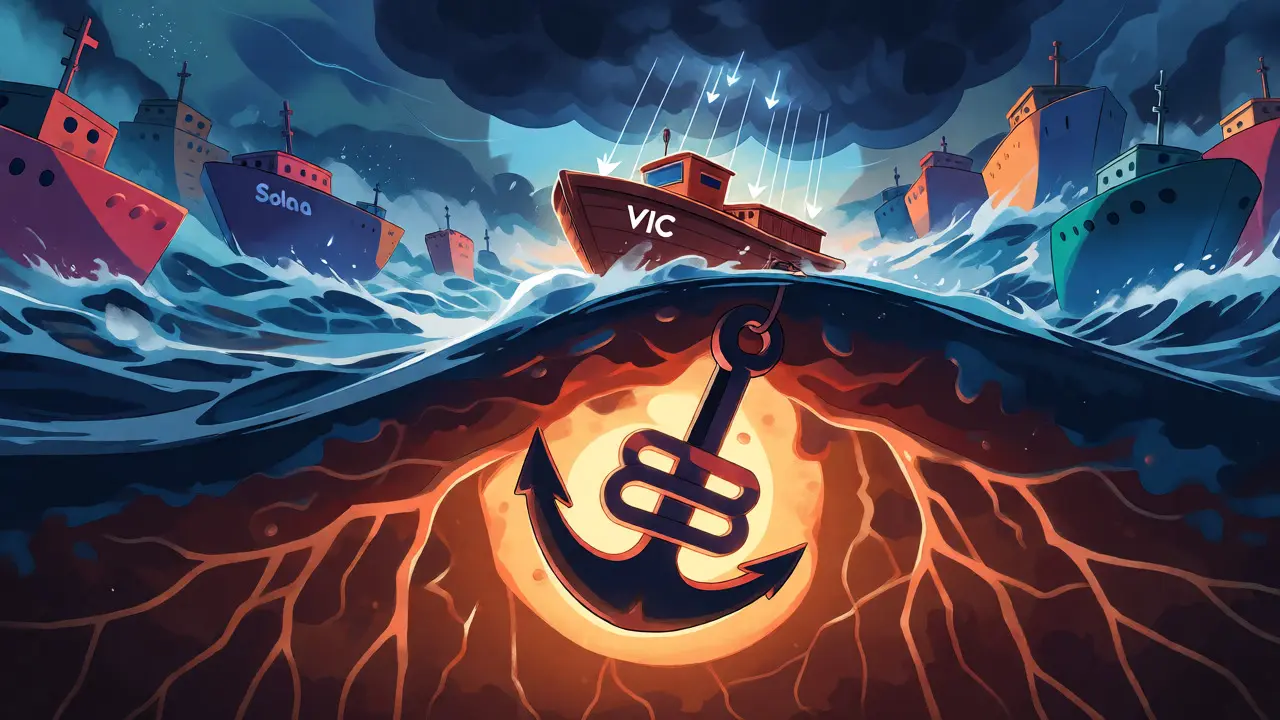
| Established history since 2018 | Competitive pressure from Solana, Sui, Aptos |
The pros highlight stability and integration. The cons highlight market irrelevance in the current cycle. If you’re looking for quick flips, the low volume might trap you. If you believe in the "ownership economy" narrative and want exposure to the Coin98 ecosystem, it’s a viable entry point.
How to Buy and Use Viction
Getting started is straightforward because of the EVM compatibility. Here’s the typical path:
- Purchase VIC: Buy on centralized exchanges like Binance, MEXC, Bitget, or Bybit. MEXC currently has the highest volume.
- Withdraw to Viction Network: Ensure you select the correct network when withdrawing. Sending VIC to the wrong chain (like sending ERC-20 VIC to the native chain address without bridging) can result in lost funds.
- Connect Wallet: Add the Viction mainnet to MetaMask or Trust Wallet. RPC details are available on the official Viction website.
- Interact: Stake your VIC, vote in governance, or use dApps within the ecosystem.
For developers, deploying contracts is as simple as changing the network ID in your Hardhat or Truffle config. No new compilers needed.
Final Verdict: Is Viction Dead or Sleeping?
Is Viction dead? Technically, no. It’s alive, operating, and backed by a significant entity. But is it thriving? Not really. It’s a legacy chain trying to survive in a crowded field. The rebrand gave it a fresh coat of paint, but the market hasn’t rewarded it with renewed interest yet. The focus on "human values" and "victory" is nice branding, but crypto ultimately runs on liquidity and adoption.
If you’re a speculator, wait for volume spikes. If you’re a builder, consider if the Coin98 distribution channels offer better reach than Ethereum’s L2s. For now, Viction remains a high-risk, low-liquidity asset that requires patience and a strong stomach for volatility.
Did I lose my tokens during the TomoChain to Viction rebrand?
No. The rebrand was purely symbolic regarding the ticker and name. The exchange rate was strictly 1 TOMO = 1 VIC. Smart contract addresses remained unchanged, so your holdings were automatically converted to VIC without any action required from you, provided you held them on supported exchanges or the native chain.
Is Viction the same as Ethereum?
Viction is EVM-compatible, meaning it uses similar technology to Ethereum, allowing Ethereum dApps to run on it. However, it is a separate Layer-1 blockchain with its own consensus mechanism (masternodes) and token (VIC). It generally offers lower fees and faster transaction times compared to the Ethereum mainnet.
Where can I buy VIC coins?
You can purchase VIC on several centralized exchanges. As of late 2026, the most active venues include MEXC, Binance, Bitget, Bybit, and BTSE. MEXC typically records the highest trading volume for the VIC/USDT pair.
What is the maximum supply of VIC?
The maximum supply of Viction (VIC) is fixed at 210,000,000 tokens. Approximately 128 to 130 million VIC are currently in circulation, depending on the data provider and snapshot time.
Who backs the Viction project?
Viction is closely associated with and backed by the Coin98 Group, a prominent Vietnamese blockchain technology company. The strategy involves integrating Viction’s infrastructure with Coin98’s existing wallet, swap, and analytics products to drive adoption.

Write a comment