
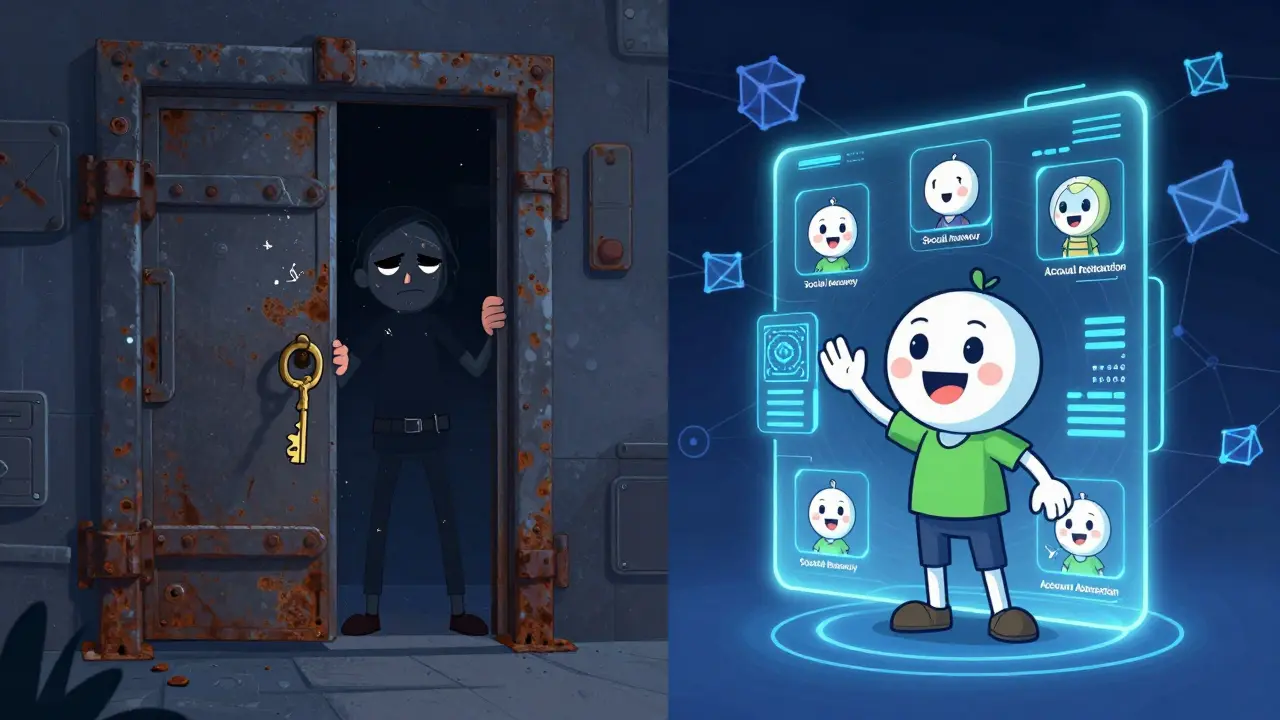
Imagine losing the keys to your house. In the physical world, you call a locksmith. You show ID, maybe pay a fee, and get back in. Now imagine that same scenario with your cryptocurrency wallet. If you lose your private key-the digital equivalent of that house key-there is no locksmith. There is no customer support. Your funds are gone forever, locked behind a cryptographic door that only you could open.
This is the harsh reality of Traditional Blockchain Accounts, also known as Externally Owned Accounts or EOAs. They are simple, secure in theory, but brutally unforgiving in practice. Enter Account Abstraction, a technological shift that turns these rigid keys into programmable, recoverable, and user-friendly smart contracts. It’s not just an upgrade; it’s a fundamental change in how we interact with decentralized networks.
The Limitations of Traditional Accounts (EOAs)
To understand why account abstraction matters, we first need to look at what we’re moving away from. Most people starting their crypto journey use wallets like MetaMask. Under the hood, MetaMask creates an EOA. This account type is controlled entirely by a single private key. It’s binary: you have the key, you have control. You lose the key, you lose everything.
EOAs have three major flaws that make them terrible for mainstream adoption:
- No Recovery Options: If you forget your password or your device breaks, there is no "Forgot Password" button. The blockchain doesn’t care about your circumstances. It only cares about the signature.
- Inflexible Security: You can’t set up multi-signature requirements easily. You can’t say, "Only allow transactions under $100 without my phone approval." You’re stuck with one key doing all the work.
- Gas Friction: To send any transaction, even a small one, you must hold the native token of that network (like ETH on Ethereum) to pay for gas fees. New users often get stuck because they don’t have enough ETH to buy the tokens they actually want.
These limitations create a high barrier to entry. For developers, building apps on top of EOAs means forcing users to manage complex cryptography while trying to build a seamless experience. It’s like asking someone to drive a car by manually controlling every spark plug ignition.
What Is Account Abstraction?
Account abstraction removes the requirement for a single private key to control an account. Instead, it treats the wallet itself as a Smart Contract. This isn’t just a cosmetic change; it allows logic to be embedded directly into the wallet’s code.
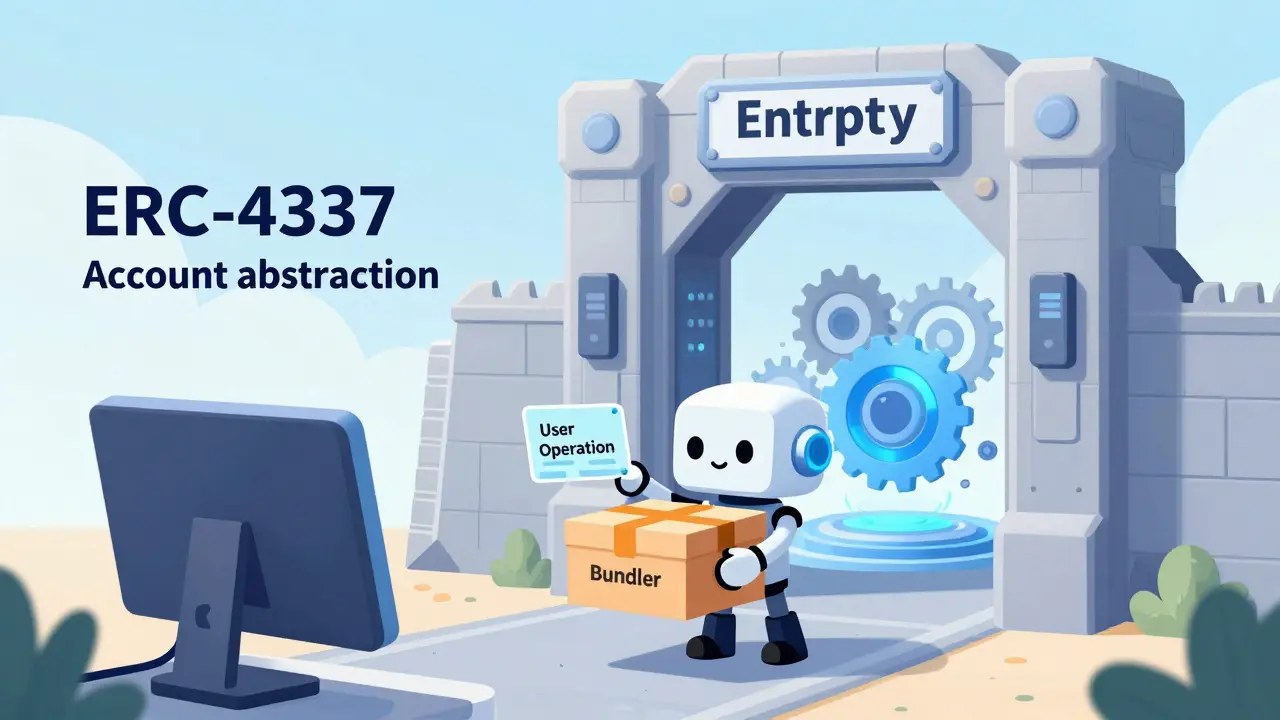
The most widely adopted standard for this on Ethereum is ERC-4337. Unlike earlier proposals that required changes to the core Ethereum protocol (which are slow and difficult), ERC-4337 operates as a layer on top of the existing infrastructure. It introduces a new actor called the Bundler, which collects user operations and packages them into regular transactions for miners to process.
By turning wallets into smart contracts, we unlock features that were previously impossible or extremely cumbersome:
- Social Recovery: You can designate trusted contacts (friends, family, or legal guardians) who can help you regain access if you lose your primary key.
- Session Keys: Grant temporary permissions to dApps. For example, a game can spend up to $5 of your assets per day without asking for permission for every single move.
- Gas Sponsorship: Third parties can pay your transaction fees, allowing users to interact with apps without holding native tokens.
Security: From Single Points of Failure to Programmable Defense
Security is often cited as the biggest concern with smart contracts. After all, if the wallet is code, can’t it be hacked? The answer is nuanced. Traditional EOAs are vulnerable to phishing, malware, and human error. Account abstraction shifts the attack surface but offers superior defensive tools.
With Multi-Signature Wallets enabled via account abstraction, you can require two out of three devices to approve a large transfer. If one device is compromised, your funds remain safe. This is something you cannot do natively with an EOA without wrapping it in a separate contract, which adds complexity.
Consider the "dead man’s switch" feature. You can program your wallet to automatically transfer your assets to a designated beneficiary if no activity is detected for a year. This solves the inheritance problem that plagues crypto estates today. Additionally, Signature Abstraction allows users to log in using biometrics (FaceID, fingerprint) or email verification instead of managing hex strings of private keys. Services like UniPass Wallet demonstrate this by letting users authenticate via Gmail, removing the mental load of key management entirely.
User Experience: The Path to Invisible Blockchain
The ultimate goal of account abstraction is "invisible blockchain." Users shouldn’t know they’re interacting with a distributed ledger. They should expect the same ease as using a credit card or logging into Facebook.
Let’s look at Sui Blockchain, which has built account abstraction into its core architecture. Sui uses zkLogin, allowing users to log in with social credentials while maintaining privacy through zero-knowledge proofs. Transactions are sponsored, meaning the app pays the gas, not the user. This removes the friction of buying ETH or SOL just to test a new app.
Similarly, SKALE Network offers zero gas fees for end-users by having validators cover the costs. With throughput reaching up to 700 transactions per second, SKALE demonstrates how account abstraction principles can scale beyond Ethereum’s constraints. These platforms prove that when you remove the technical barriers, user engagement skyrockets.
Technical Implementation: ERC-4337 and Beyond
While the concept is universal, the implementation varies. On Ethereum, ERC-4337 is the de facto standard. It doesn’t change the base layer, which ensures maximum compatibility with existing tools like MetaMask and hardware wallets. However, it does introduce a new flow:
- User Operation: The user signs a "UserOperation" rather than a standard transaction.
- Bundler: A specialized node collects these operations, validates them against mempool rules, and bundles them.
- EntryPoint: The bundler sends the bundle to the EntryPoint smart contract, which executes the logic.
This model requires developers to build "Smart Contract Wallets" (SCWs). Popular implementations include Safe (formerly Gnosis Safe) and Argent. These wallets act as the interface for the abstracted account, handling the complexity behind the scenes.
On other chains, the approach differs. The Move Programming Language, used by Sui and Aptos, structures resources differently, making account abstraction more natural and less reliant on external standards like ERC-4337. This highlights a trend: newer blockchains are designing account abstraction from the ground up, while legacy chains like Ethereum are retrofitting it.
| Feature | Traditional EOA | Abstracted Smart Account |
|---|---|---|
| Recovery | None (Permanent loss if key lost) | Social recovery, multi-sig, backups |
| Authentication | Private Key / Seed Phrase | Biometrics, Email, Social Login, Passkeys |
| Gas Fees | User must hold native token | Can be sponsored by apps or paid in stablecoins |
| Security Logic | Static (One key, one rule) | Programmable (Time locks, spending limits) |
| Complexity | Low for devs, High for users | High for devs, Low for users |

Challenges and Considerations
Account abstraction isn’t a magic bullet. It introduces new complexities. The primary challenge is centralization risk in the bundling layer. If a few bundlers dominate the market, they could censor transactions or prioritize certain users unfairly. However, competition among bundlers and transparent validation rules mitigate this risk.
Another issue is fragmentation. Not all dApps support ERC-4337 yet. Users may find themselves switching between traditional wallets and smart wallets depending on the application. As the ecosystem matures, this friction will decrease, but right now, it requires conscious effort from both developers and users.
Finally, there’s the learning curve for developers. Writing secure smart contract wallets is harder than integrating an EOA SDK. Bugs in wallet logic can lead to irreversible fund losses. Therefore, rigorous auditing and standardized libraries are critical for widespread adoption.
The Future of Digital Identity
We are moving toward a future where your wallet is your identity. Account abstraction enables this by allowing wallets to store off-chain data, verify credentials, and manage reputation scores. Imagine applying for a loan where your wallet proves your creditworthiness without revealing your personal details, thanks to zero-knowledge proofs integrated into the smart account.
As platforms like Coinmetro and Blockchain App Factory note, this technology is essential for mainstream adoption. It bridges the gap between the rigid, technical world of blockchain and the flexible, user-centric expectations of the internet. The transition won’t happen overnight, but the direction is clear. The era of the single private key is ending, replaced by intelligent, recoverable, and accessible digital identities.
Is account abstraction safer than traditional wallets?
Yes, generally. While smart contracts can have bugs, account abstraction allows for multi-signature setups, social recovery, and session keys, which reduce the risk of total loss due to a single compromised key. Traditional EOAs offer no recovery options.
Do I need to learn coding to use an abstracted wallet?
No. The coding happens at the developer level. As a user, you interact with intuitive interfaces that might ask for FaceID or email confirmation instead of seed phrases. The complexity is hidden behind the scenes.
What is ERC-4337?
ERC-4337 is the Ethereum standard for account abstraction. It allows smart contract wallets to operate without changing the core Ethereum protocol, enabling features like gas sponsorship and social recovery through a layer of bundlers and entry points.
Can I still use MetaMask with account abstraction?
MetaMask primarily manages EOAs. However, many new wallets built on ERC-4337 integrate with MetaMask for signing or offer similar browser-extension experiences. Some hybrid solutions allow MetaMask users to sign operations for smart contract wallets.
Why do some blockchains like Sui prefer native account abstraction?
Native implementation avoids the overhead and complexity of layering standards like ERC-4337 on top of the chain. It allows for better performance, simpler developer models, and inherent support for features like zkLogin and sponsored transactions without external dependencies.

Write a comment