
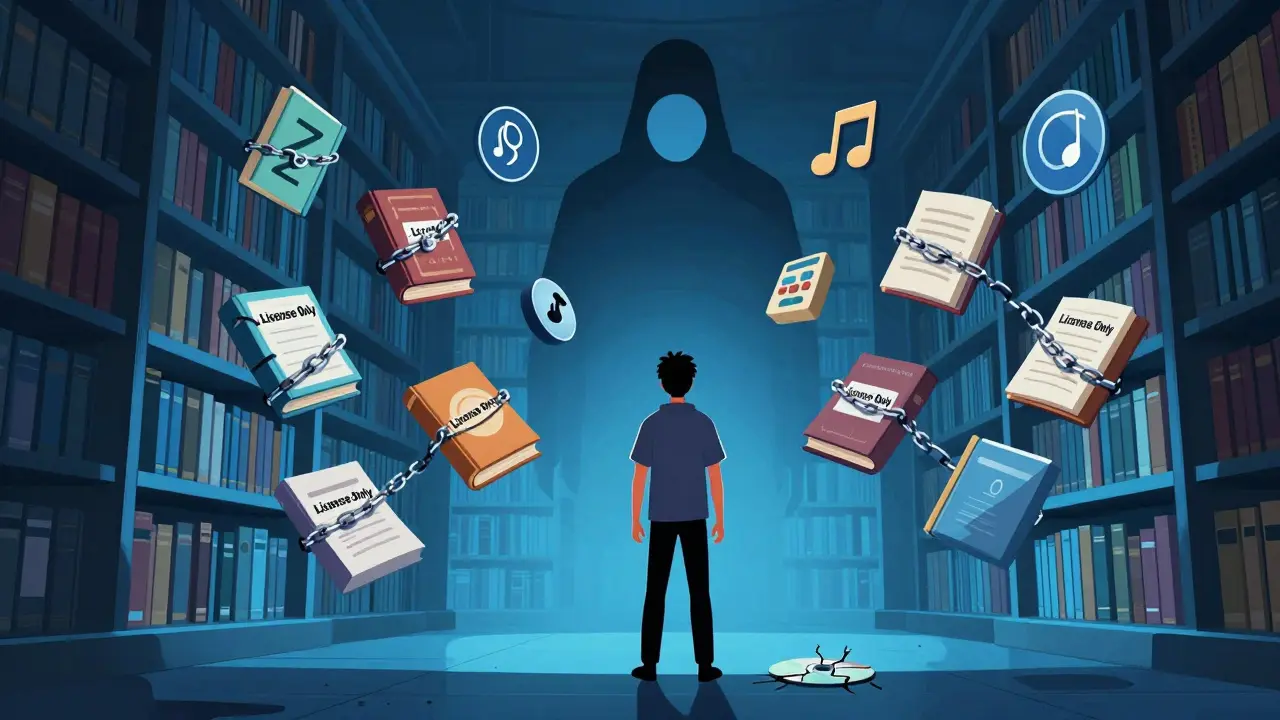
When you buy a game on Steam, an ebook from Amazon, or a song on iTunes, do you actually own it? Most people think yes. The truth? You don’t. Not really. What you’re buying is a license-a permission slip to use something someone else still controls. And if that company changes its mind, deletes your account, or shuts down the server, your ‘purchase’ vanishes. No refunds. No recourse. Just gone.
What’s the Difference Between Owning and Licensing?
Think of physical stuff. You buy a CD. You can lend it to a friend. You can sell it at a garage sale. You can even smash it if you hate the music. That’s ownership. The first sale doctrine lets you do that with physical goods under U.S. copyright law. Now try that with a digital game. You can’t resell it. You can’t lend it. You can’t even transfer it to a new device without jumping through hoops. Why? Because you never owned it. You were granted a license. And that license can be revoked. The courts have confirmed this. In Vernor v. Autodesk (2010), a man tried to resell used AutoCAD software. The court ruled he didn’t own it-he just had a license. Same thing happened in Capitol Records v. ReDigi (2018), where a company tried to build a marketplace for used digital music. The court said: nope, first sale doesn’t apply to files. This isn’t just about games. It’s your ebooks, your movies, your apps, your digital art. Every time you click ‘Buy Now,’ you’re agreeing to terms most people never read. And those terms? They’re designed to keep you locked in.How Licensing Works in Practice
Digital licensing isn’t one-size-fits-all. It’s a patchwork of rules that vary by platform, product, and country. Here’s how it breaks down:- Time-limited licenses: Like .eth domain names on Ethereum. You pay yearly to keep it. Miss a payment? It reverts to the pool. No ownership, just rental.
- Perpetual licenses with restrictions: Most Steam games. You can play forever-as long as Steam stays up, your account isn’t banned, and the publisher doesn’t pull the license.
- Revocable licenses: Amazon’s Kindle library. In 2009, Amazon remotely deleted copies of George Orwell’s books from users’ devices after a licensing dispute. No warning. No apology.
- Commercial use licenses: Rare. Bored Ape Yacht Club NFTs let owners make merch, movies, and games. That’s ownership-like. But it’s the exception, not the rule.
Why This Matters to Real People
It’s not theoretical. People lose things they paid for. All the time. In 2023, Reddit user u/GamerDave92 lost access to every game he’d bought on Steam-$1,200 worth-after his account got banned for violating a rule he didn’t even know existed. He didn’t cheat. He didn’t hack. He just used a third-party tool to track his playtime. Steam’s terms said that was grounds for permanent deletion. He got zero warning. No appeal. Just erased. EA’s Origin platform removed 15 classic games from users’ libraries in 2023. One person wrote: ‘I’ve owned Command & Conquer since 1995. Now I can’t play it because EA changed the licensing terms.’ He didn’t lose the disc. He lost the digital copy he paid for in 2018. Amazon’s Cloud Drive shut down in 2022. Millions lost access to movies and music they’d bought. No refunds. No alternatives. Just a notice: ‘Your content is no longer available.’ A 2023 Morgan Lewis survey found 78% of consumers believed they owned their digital purchases. Only 12% understood they had a license. That’s not ignorance-it’s deception. Companies profit from the illusion of ownership.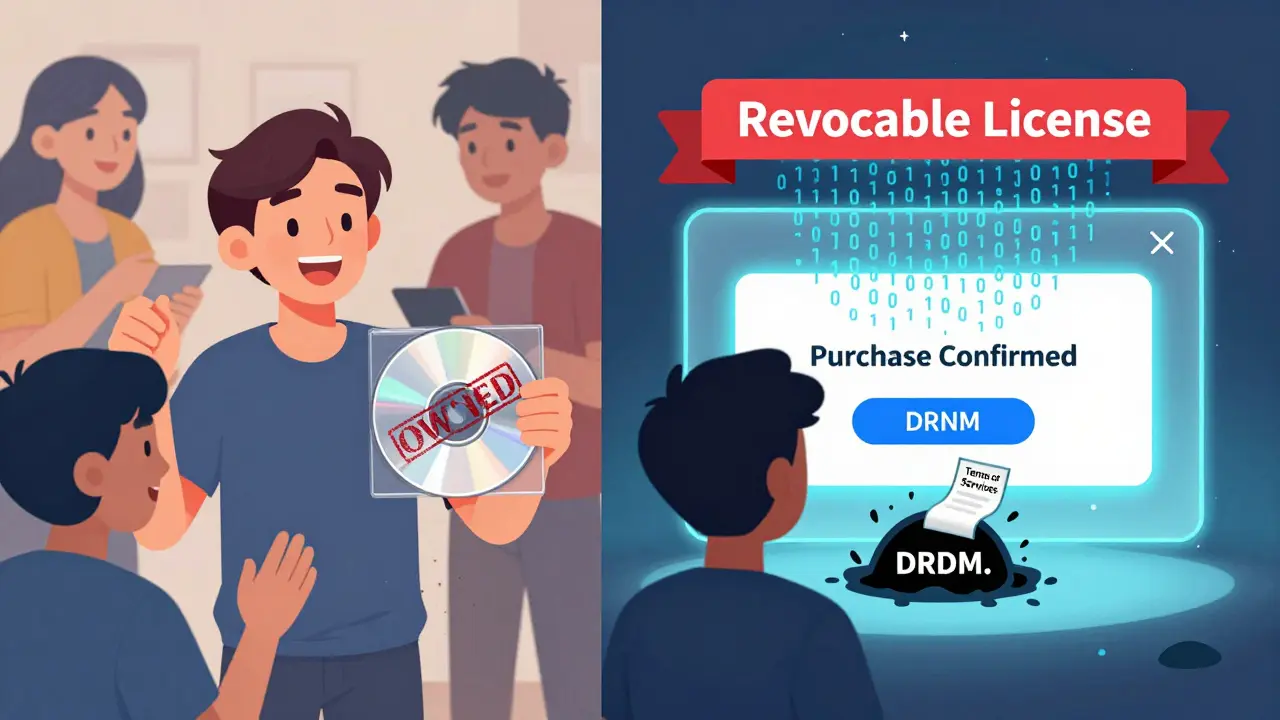
California’s New Law: A Glimmer of Transparency
On January 1, 2024, California passed AB 2426-the first U.S. law forcing companies to be honest. If you’re selling digital goods in California, you must clearly state: This is a license, not ownership. The law doesn’t give you ownership. But it forces companies to stop hiding the truth. The disclosure must be:- Visible-contrasting color, bold font, near the buy button
- Accessible-linked to full terms, or a QR code you can scan
- Plain language-no legalese buried in 20-page PDFs
Blockchain and the Promise of Real Ownership
NFTs were supposed to fix this. And in some cases, they did. Ethereum Name Service (ENS) lets you buy a .eth domain. Once you own it, it’s yours forever. No renewal fees. No middleman. The blockchain holds the record. No company can take it away. Over 5.2 million .eth domains have been registered since 2017. NFTs like Bored Apes don’t just prove ownership-they grant commercial rights. If you own one, you can make a T-shirt, a movie, or a comic. That’s not licensing. That’s copyright transfer. But here’s the catch: most NFTs still come with vague licenses. Many projects say you can ‘use’ the image for personal stuff, but not for merch. Others change terms after you buy. The blockchain holds the token. The license? Still written by a lawyer in a corporate office. True digital ownership means the rights are encoded in the blockchain-not in a Terms of Service document. That’s the future. But right now, it’s rare.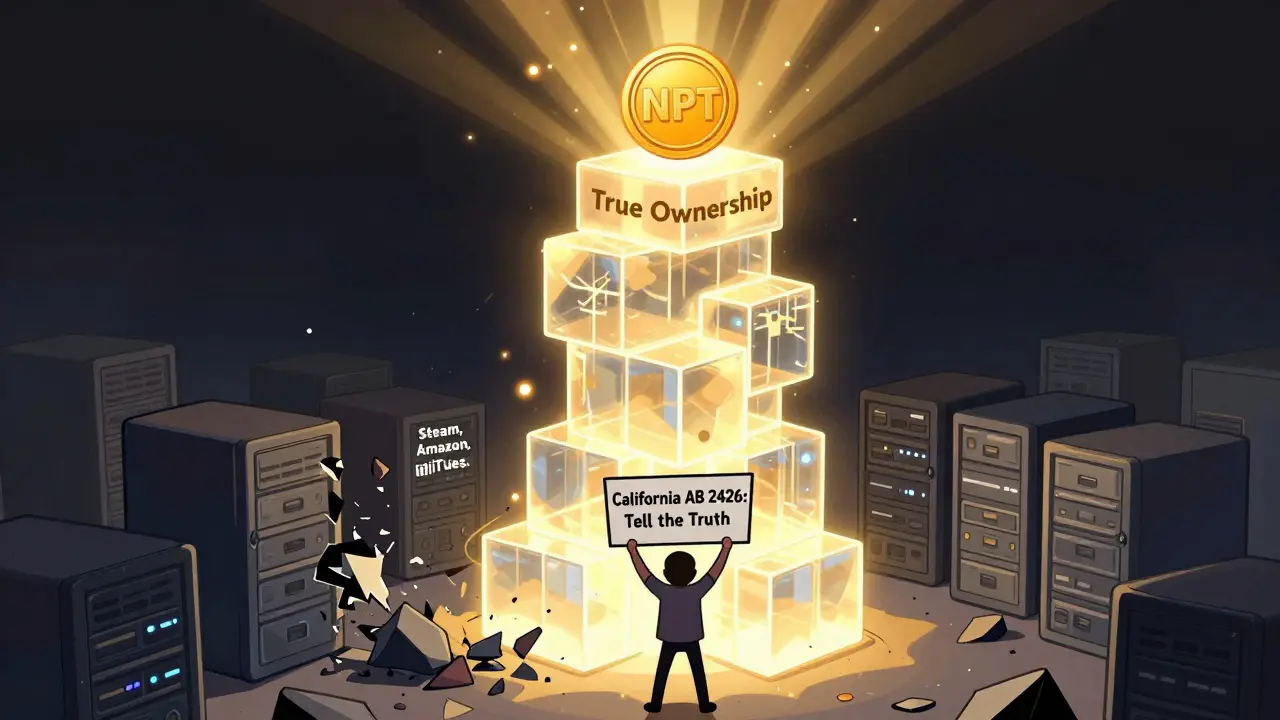
The Bigger Picture: Who Benefits?
Companies love licensing. Why?- You can’t resell, so they get repeat sales.
- You’re locked in. Switching platforms means losing everything.
- They can update, change, or remove content without liability.
- They control the data. Every click, every minute played, every purchase-it’s tracked.
What You Can Do
You can’t change the system alone. But you can protect yourself.- Read the terms. Seriously. Look for ‘license,’ ‘revocable,’ ‘non-transferable.’ If you see it, you don’t own it.
- Support platforms that offer real ownership. Buy NFTs with clear on-chain rights. Buy from Bandcamp, not Spotify. Buy physical media when possible.
- Ask for transparency. If a platform doesn’t clearly state ‘this is a license,’ complain. Leave a review. Tell others.
- Backup your content. Download files you can store locally. Even if you can’t play them without DRM, you’ve preserved the data.
- Support legislation. California’s law is a start. Push for similar rules in your state or country.
The Future Is Unclear-But Changing
The U.S. Copyright Office announced in September 2024 it’s reopening the debate on digital first sale. Public hearings are coming in 2025. The EU is already pushing for ‘equivalent rights’ for digital and physical goods. That could force platforms to let you resell your digital games. Gartner predicts a ‘hybrid ownership’ model by 2027-where blockchain verifies ownership and lets you resell with royalties going to creators. That’s not fantasy. It’s possible. But until then, remember: when you click ‘Buy,’ you’re not buying a thing. You’re buying a promise. And promises can be broken.Real ownership means control. Real ownership means you can pass it on. Real ownership means no one else gets to take it away.
Right now, most digital goods don’t offer that. And until companies are forced to be honest, you should never assume you own what you’ve paid for.

Comments
Janet Combs
I just bought a game on Steam last week and now I'm terrified to open it. What if they ban me for accidentally using a mod? I didn't even know I wasn't owning it. This post made my stomach drop.
Like... I paid $60. That's groceries for a week. And now I'm just borrowing it?
Feels like renting a car that can be towed anytime.
Welp. Back to vinyl and books for me.
Dan Dellechiaie
Let’s be real - this isn’t about ownership, it’s about control architecture. Companies have optimized for sticky ecosystems, not consumer rights. DRM? That’s not anti-piracy tech, it’s anti-resale infrastructure. The first-sale doctrine was designed for physical scarcity. Digital doesn’t degrade. So why should the law? The courts are still stuck in the 20th century while corporations run on blockchain-enabled rent-seeking models. Wake up. You’re not a customer. You’re a data node in a subscription funnel.
Radha Reddy
In India, we often buy pirated DVDs because we can’t afford official releases. But now I realize - even if we could afford them, we wouldn’t own them. This is a global issue. Digital goods should be treated like any other purchase. If I pay, I should be able to pass it on to my child. Not have some corporate server decide I’m no longer ‘authorized’.
Thank you for writing this. I’ll share it with my students.
Grace Simmons
Oh please. This is why America is falling behind. You people whine about losing your digital junk while China builds the future. If you can’t handle licensing, don’t buy tech. Get a life. You want ownership? Buy a hammer. Not a video game. Grow up.
Megan O'Brien
DRM. Licensing. First-sale doctrine. So... what? I’m supposed to care? I just want to play my games. If Steam goes down, I’ll buy a PS5. Same thing. Chill out. It’s not like I’m losing my house.
Melissa Black
Ownership is a legal fiction. Even physical property is governed by zoning laws, taxes, and eminent domain. The only true ownership is control over the means of reproduction. That’s why NFTs matter - not because they’re ‘blockchain magic’ but because they shift control from corporate servers to cryptographic keys. The real revolution isn’t in the file - it’s in the protocol. If your rights are encoded in the chain, not in a EULA, then you’re not a licensee. You’re a stakeholder. That’s the future. The rest is theater.
Sophia Wade
There’s a quiet tragedy here. We’ve traded the tactile - the weight of a book, the crackle of a vinyl - for the illusion of convenience. We think we’ve upgraded. But we’ve surrendered autonomy for convenience. A digital library is a ghost library. You can’t smell it. You can’t hold it. You can’t lend it. And if the ghost in the machine decides you’re no longer worthy - poof. Gone. We’re not consumers anymore. We’re tenants in a digital mansion we never bought.
And the landlord? He’s never home. But he’s always watching.
Brian Martitsch
LMAO. You paid $60 for a game and now you’re mad you can’t resell it? You’re not a collector. You’re a kid with a Nintendo Switch. Get over yourself. The future is streaming. Get used to it. 🤡
Rebecca F
They deleted Orwell. They deleted my games. They deleted my music. They deleted my photos. They deleted my life. I don’t own anything anymore. I’m just a user. A number. A data point. And they’re laughing. They’re all laughing. This isn’t about rights. It’s about power. And we’re the ones who gave it to them. We clicked ‘I Agree.’ We handed them the keys. And now we cry when they lock us out. Pathetic.
Vyas Koduvayur
Let’s break this down statistically. According to Steam’s 2023 transparency report, 0.03% of accounts are terminated for ToS violations - most of which are false positives from automated systems. Meanwhile, 87% of users who lost access did so because they shared accounts, used third-party mods, or violated regional restrictions. The real issue isn’t licensing - it’s user ignorance. You think you’re entitled to something you didn’t read the fine print for? That’s not corporate malice. That’s personal negligence. And let’s not forget - 92% of users who bought games on Steam never even opened the license agreement. So stop pretending you’re a victim. You just didn’t do your homework. Also, DRM prevents cheating. Which is why your ‘$1,200 loss’ is actually a feature, not a bug. You wanted to cheat. You got caught. Welcome to the internet.
Jake Mepham
Here’s what you can do right now: buy from Bandcamp. Buy physical copies. Use Archive.org to back up your digital stuff. And if you’re into games - get a Raspberry Pi and set up a local server for your indie games. You can run Steam games offline if you disable cloud saves and enable local files. It’s not perfect, but it’s better than nothing. Also - support California’s law. Tell your reps. This isn’t just about games. It’s about digital rights as human rights. We’re not asking for much. Just honesty. And a little control.
Cathy Bounchareune
I remember when I bought my first CD in 1998. I played it so much the case cracked. I gave it to my cousin. I sold it at a flea market. I made a mixtape from it. That was ownership. Now I buy a song on Apple Music and it’s tied to my account like a leash. I can’t even play it on my car stereo without Bluetooth. It’s not progress. It’s regression. We traded soul for speed. And now we’re surprised when the soul vanishes.
Sheila Ayu
Wait - so you’re saying I don’t own my Kindle books? But I paid for them! And I can’t transfer them? But I bought them on Amazon! That’s not fair! And what about my iTunes library? I’ve had it since 2007! What if Apple shuts down? What if I die? Who gets my music? My kids? My cat? Can my cat inherit my digital assets?!!!
Shubham Singh
It is a well-established legal principle in common law jurisdictions that intangible property is not subject to the doctrine of first sale. The notion of ‘ownership’ of digital content is a consumer myth propagated by media outlets seeking clicks. The courts have consistently upheld licensing models as lawful. To argue otherwise is to misunderstand the nature of intellectual property. You do not own a file. You are granted a non-exclusive, non-transferable right to access it. This is not a flaw. It is the system. Accept it. Or return to analog.
Charles Freitas
Oh, so now you care about ownership? You didn’t care when EA was selling loot boxes for $100 a pop. You didn’t care when Spotify paid artists 0.003 cents per stream. You didn’t care when Netflix removed 200 shows because of ‘licensing changes.’ You only care now because it’s YOUR stuff being taken. That’s not principled. That’s selfish. You want to be outraged? Start with the real exploitation - the gig workers, the factory laborers, the content moderators who see child abuse all day. Then come back to your $60 game.
Sarah Glaser
There’s a quiet dignity in digital ownership - not in the file, but in the right to preserve. I keep local copies of every ebook, game, and song I’ve ever bought. I archive them. I label them. I back them up. Not because I expect to play them forever - but because I refuse to let corporations decide what I remember. This isn’t about money. It’s about memory. And memory should be ours to keep.
Jayakanth Kesan
My dad bought a Sony Walkman in 1985. He still has it. It works. He plays his cassettes. He doesn’t need the internet. He doesn’t need an account. He doesn’t need to agree to terms. He just presses play. I think we lost something when we traded that for convenience. Not just music. Just… presence.
Helen Pieracacos
So you’re telling me I can’t sell my digital art collection? But I spent $50,000 on it. And now I can’t even give it to my niece? That’s not a license. That’s theft. And if you think I’m going to let a corporation decide what my daughter inherits… you don’t know me.
Dustin Bright
i just bought a game on steam and now i'm scared to turn on my pc 😭 but like... i guess i should've read the tos? i'm so dumb. also i love my cat. he's fluffy. 🐱
Naman Modi
Blockchain doesn’t solve anything. NFTs are just new scams with fancy graphics. The license is still in a PDF. The metadata is hosted on a centralized server. The ‘ownership’ is a token pointing to a link. If the link dies, you own nothing. The blockchain is just a ledger. It doesn’t store your game. It doesn’t store your art. It doesn’t store your life. You’re still renting. You’re just renting from a blockchain instead of a corporation. Same cage. Different lock.