
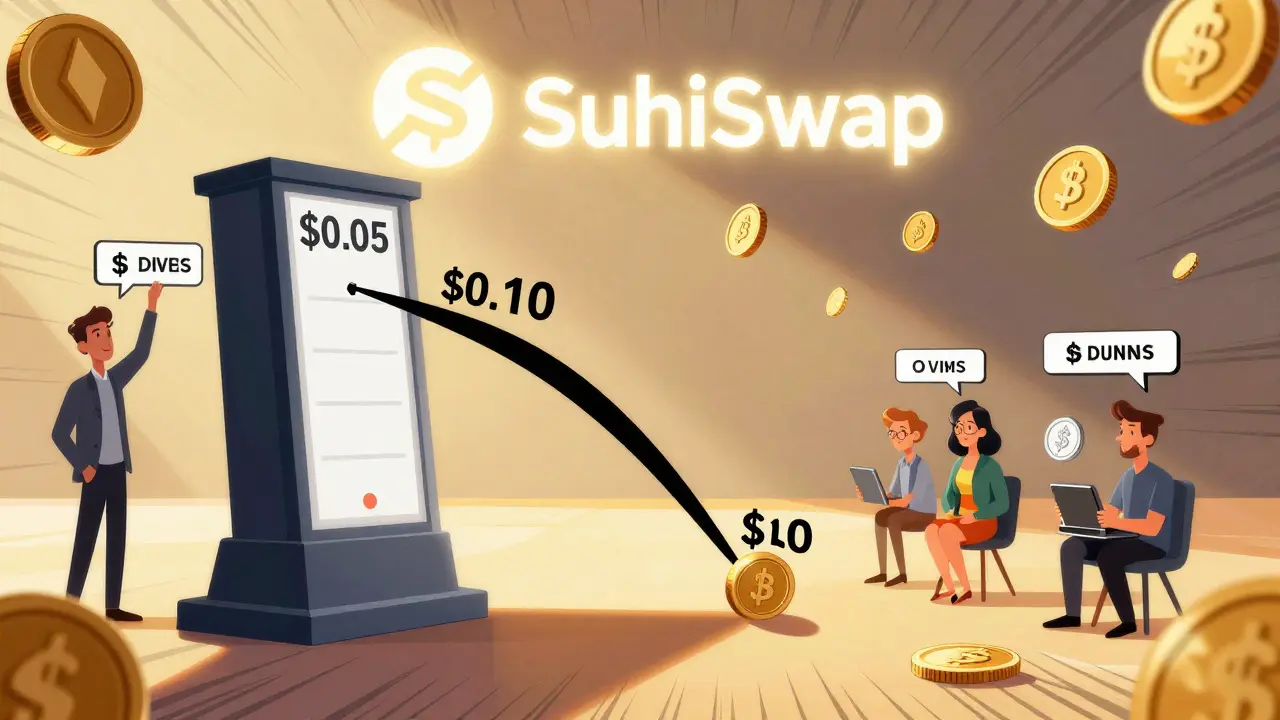
There’s a lot of talk online about a Divergence airdrop, but the truth is simpler than you might think. Divergence (DIVER) didn’t run a traditional airdrop where tokens are handed out for free just for signing up or holding a wallet. Instead, it used a Dutch auction - a fair, open sale - to distribute its tokens. If you’re looking for a free DIVER token giveaway, you won’t find one. But if you’re interested in how real community rewards work on this platform, there’s still value to uncover.
How Divergence Actually Distributed Its Tokens
The Divergence team didn’t go the usual route of giving away tokens to early adopters or social media followers. Instead, they launched a Dutch auction for their DIVER token. This means the price started high - $0.10 per token - and dropped over time until all 20 million tokens were sold. The auction ended at a final price of around $0.05, with a total raised of about $1 million. This system was designed to prevent bots and whales from dominating the sale. Anyone with a wallet and some ETH or stablecoins could participate, and the price settled based on real demand.This wasn’t a fundraiser for insiders. It was a public sale open to everyone, with no whitelist, no private rounds, and no pre-sale allocations for venture funds. The entire supply was sold through this single auction, and the proceeds went directly into a liquidity pool on SushiSwap. That’s where DIVER is traded today.
Where DIVER Tokens Trade Today
As of March 2026, DIVER trades at approximately $0.010686. That’s down from the original auction price, but not unusual for a DeFi project in its early stages. The majority of the tokens sold in the auction were added to a SushiSwap liquidity pool, which now serves as the main trading pair for DIVER/ETH. This pool is locked and managed by the protocol itself, meaning liquidity is permanent and can’t be pulled out by the team. It’s one of the few DeFi projects that actually did this right - no rug pulls, no hidden reserves.Some of the remaining proceeds were kept by the team for future exchange listings. Plans are underway to list DIVER on larger centralized exchanges like KuCoin or Gate.io, which would make it easier for new users to buy in without needing a wallet or DeFi knowledge. But as of now, trading is still mostly confined to decentralized exchanges.
How You Can Earn DIVER Tokens - No Airdrop Needed
Even though there’s no official airdrop, Divergence does reward users who help the platform grow. This isn’t a one-time giveaway. It’s an ongoing system built into the protocol. Here’s how you can earn DIVER tokens:- Provide liquidity to options markets - When you deposit assets into Divergence’s volatility pools, you earn a share of trading fees. These fees are paid out in DIVER tokens.
- Trade synthetic binary options - Every time you place a bet on whether a DeFi asset’s price will go up or down, you pay a small fee. That fee is redistributed to liquidity providers and active traders in DIVER.
- Hold DIVER for governance - Holding tokens lets you vote on protocol upgrades, fee structures, and new asset listings. The more you hold, the more influence you have.
This system turns users into stakeholders. You’re not just waiting for a free token - you’re building something real. If you’re active on the platform, you’ll slowly accumulate DIVER over time. It’s not instant, but it’s sustainable.
What Divergence Actually Does
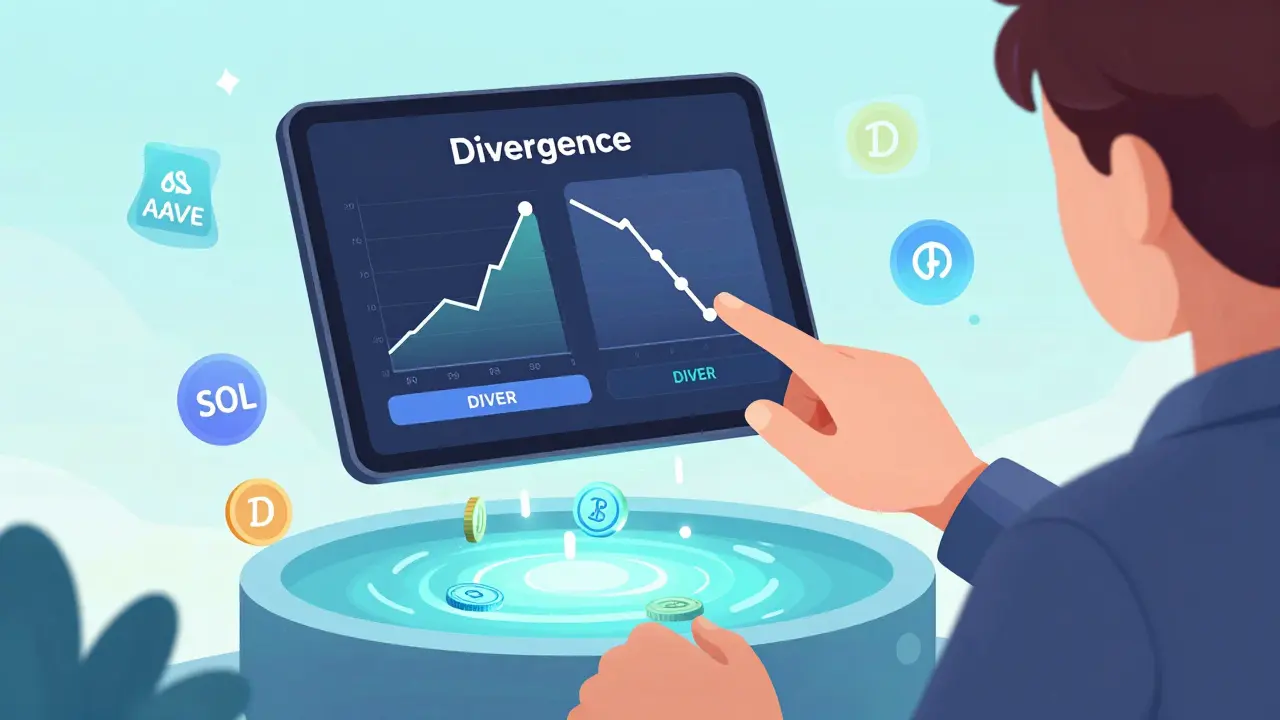
To understand how rewards work, you need to know what the platform does. Divergence lets you hedge or speculate on the volatility of DeFi assets like ETH, SOL, or AAVE. Think of it like betting on whether a crypto’s price will swing wildly in the next 24 hours - not whether it goes up or down, but how much it moves. These are called synthetic binary options.Traditional options are complicated and usually require centralized brokers. Divergence removes all of that. You can set up a bet in seconds using a wallet. No KYC. No paperwork. Just connect, choose your asset, pick your volatility range, and place your trade. The platform matches your bet with someone else’s - and the fees from both sides go into the reward pool.
This is useful for traders who want to protect themselves from sudden price swings. For example, if you’re holding a lot of SOL and fear a 20% drop, you can buy a volatility hedge on Divergence. If the price crashes, your hedge pays out in DIVER tokens - offsetting your loss.
Risks You Should Know
Before you jump in, understand the risks. This isn’t a bank. It’s a DeFi protocol built on smart contracts. That means:- Smart contract risk - Bugs could lead to lost funds. While Divergence’s code has been audited, no audit guarantees safety.
- Market risk - If you’re trading volatility, you can lose your entire position if your bet is wrong.
- Liquidity risk - If the DIVER/ETH pool dries up, trading could get expensive or slow.
- Price risk - DIVER’s price has dropped 89% since its IDO. It could go lower.
Don’t invest more than you can afford to lose. Treat this like high-risk trading, not a get-rich-quick scheme.
Why There’s No Traditional Airdrop
Many projects use airdrops to build hype. They give away tokens to thousands of wallets to create the illusion of mass adoption. Divergence chose a different path. They wanted real users - not fake accounts. Their Dutch auction ensured that only people willing to pay for the token got it. That filtered out speculators and attracted serious participants.They also didn’t reserve tokens for team members or investors. Everything was sold publicly. That’s rare. Most projects keep 15-30% for themselves. Divergence didn’t. That’s why the community trusts the project more than most.
What’s Next for Divergence
The team is working on a few key upgrades:- Listing on centralized exchanges to make buying easier
- Adding more DeFi assets to the volatility markets (like LINK, DOT, and MATIC)
- Introducing staking for DIVER holders to earn extra rewards
- Building a mobile app for easier trading on the go
There’s no official announcement about a future airdrop. If one comes, it’ll likely be tied to new features - like rewarding users who migrate from other platforms or invite others to try the protocol. But right now, the only way to earn DIVER is by using it.
How to Get Started
If you want to try Divergence:- Get a wallet like MetaMask or Trust Wallet.
- Buy some ETH or USDC.
- Go to app.divergence.finance (always double-check the URL).
- Connect your wallet.
- Either trade options or provide liquidity to a pool.
- Watch your DIVER balance grow over time.
You don’t need to be an expert. The interface is simple. Start with small amounts. Learn how the markets move. Then scale up if it makes sense.
Is there a Divergence (DIVER) airdrop happening right now?
No, there is no active airdrop for DIVER tokens. The project distributed its tokens through a Dutch auction, not a free giveaway. Any website or social media post claiming to offer free DIVER is likely a scam. Only earn DIVER by using the official platform - providing liquidity or trading synthetic options.
How can I earn DIVER tokens without buying them?
You can earn DIVER by providing liquidity to the platform’s volatility markets or by actively trading synthetic binary options. Every time someone pays a trading fee, a portion is distributed to participants who help keep the market running. Holding DIVER also lets you vote on governance proposals, which can lead to future rewards.
Why is the DIVER token price so low?
The DIVER token started at $0.10 during its Dutch auction and settled around $0.05. As of March 2026, it trades at $0.010686. This drop reflects typical DeFi market behavior - early buyers often sell after the initial hype. The low price doesn’t mean the project is dead. It means the token is now accessible to more people. Value will grow if usage increases.
Can I trade DIVER on centralized exchanges like Binance?
Not yet. As of now, DIVER only trades on decentralized exchanges like SushiSwap. The team has announced plans to list on major centralized exchanges like KuCoin or Gate.io, but no dates have been confirmed. Until then, you’ll need a wallet and some ETH to trade.
Is Divergence safe to use?
Divergence’s smart contracts have been audited by third-party firms, which is a good sign. But DeFi is inherently risky. You can lose money from price swings, smart contract bugs, or poor liquidity. Never invest more than you can afford to lose. Always use official links and never share your private key. Treat it like trading options - not like saving money.

Comments
Marc Morgan
Honestly? This is one of the few DeFi projects that didn't suck. No pre-sale shenanigans, no team tokens locked away like a dragon's hoard. Just a clean Dutch auction and real utility. I've been trading volatility on Divergence for months. It's not glamorous, but it works. And yeah, DIVER's price is trash right now, but so was ETH in 2016. You gotta play the long game.
Elizabeth Kurtz
I love how this project actually rewards participation instead of just handing out free tokens to bots. Most airdrops are just marketing gimmicks. Here, if you're active, you earn. I started with $50 in liquidity and now I've got enough DIVER to vote on the next asset listing. It feels like I'm part of something real.
Sarah Zakareckis
The liquidity pool design here is textbook. Locked, transparent, no admin keys. That's the gold standard. Most projects say they're decentralized but still have a backdoor. Divergence? No. And the fee redistribution model is elegant - traders pay, providers earn. It's circular, sustainable, and honestly, kind of beautiful.
Heather James
No airdrop. Good.
Henrique Lyma
Look, I get that some people think this is 'fair' because there was no airdrop, but let's be real - only people with ETH and a gas budget could even participate. That's not inclusion, that's gatekeeping disguised as meritocracy. Meanwhile, the team didn't even reserve a single token for devs? That's not noble, it's just dumb. How are they supposed to hire talent? You don't build a protocol on altruism and hope.
Christopher Hoar
dude the price is 0.01 wtf why are we still talking about this like its the next bitcoin? it's a glorified options market for degens who think they're hedge funders. i lost 3 eth on a sol volatility bet last week. i'm not even mad. it's funny. like watching a clown car crash.
Kira Dreamland
I came in after the auction and thought I missed out. But then I started providing liquidity on the ETH/DIVER pool and realized I wasn't just waiting - I was building. The fees add up slowly, but steadily. I've earned more in 3 months than I did from any airdrop I ever joined. It's not flashy, but it's honest.
john peter
The notion that this project is somehow 'pure' because it avoided airdrops is a fantasy constructed by those who confuse austerity with virtue. True innovation does not emerge from austerity - it emerges from strategic allocation. By refusing to retain even a sliver of tokens for development, the team has effectively committed financial suicide. The protocol may be 'trustless,' but its sustainability is a house built on sand. One cannot maintain a complex DeFi system on the goodwill of altruistic traders.
Robert Kunze
i just wanna say i tried it. i deposited 0.1 eth into the usdc volatility pool. got 20 diver in 2 weeks. not much, but it's real. i didn't have to follow a twitter account or join a discord. i just used it. and now i have a little stake. that feels better than any free token ever did.
shreya gupta
I find it fascinating how Western communities romanticize 'no airdrop' as ethical, while ignoring that this model still favors those with capital. In India, most people can't even afford the gas fees to participate. So yes, it's 'fair' - if you live in a country with access to USD, ETH, and stable internet. This isn't decentralization. It's exclusion with a fancy name.
Shreya Baid
I appreciate the transparency. The audit reports are public. The liquidity is locked. The team hasn't touched their own funds. That level of integrity is rare. I’ve been burned before - rug pulls, fake liquidity, silent devs. This is different. It’s not perfect, but it’s trying. And that’s more than most.
Jerry Panson
The Dutch auction mechanism, while theoretically elegant, introduces a significant asymmetry in participant access. Those with superior technical infrastructure - MEV bots, low-latency connections, and advanced wallet configurations - are inherently advantaged. The claim of 'fairness' is thus a semantic illusion. The auction may have been open, but it was not equitable. This is not a flaw in execution - it is a structural defect in design.
Sarah Hammon
I was skeptical at first, but after I started trading the BTC volatility options, I got hooked. The interface is clean, the fees are low, and the DIVER rewards are automatic. I didn’t even realize I’d earned 50 tokens until I checked my wallet. It’s like passive income without the hype. No scams. No drama. Just code doing its thing.
Anastasia Thyroff
I cried when I saw the price drop to $0.01. I thought I’d been scammed. Then I realized - I wasn't holding a token. I was holding a *tool*. I use it to hedge my SOL portfolio. Every time the market goes wild, I make back what I lost. This isn't about getting rich. It's about not getting wiped out. And that? That's worth more than any airdrop.
Derek Lynch
You're still here? Good. That means you get it. This isn't about quick cash. It's about building something that lasts. The team didn't take the easy path. They didn't pump and dump. They didn't bribe influencers. They built a tool. And if you're using it, you're part of the team now. So keep trading. Keep providing liquidity. Keep voting. The next upgrade? It's yours. We're not waiting for a handout - we're building the future. And it's ugly, messy, and real. Welcome to the revolution.