
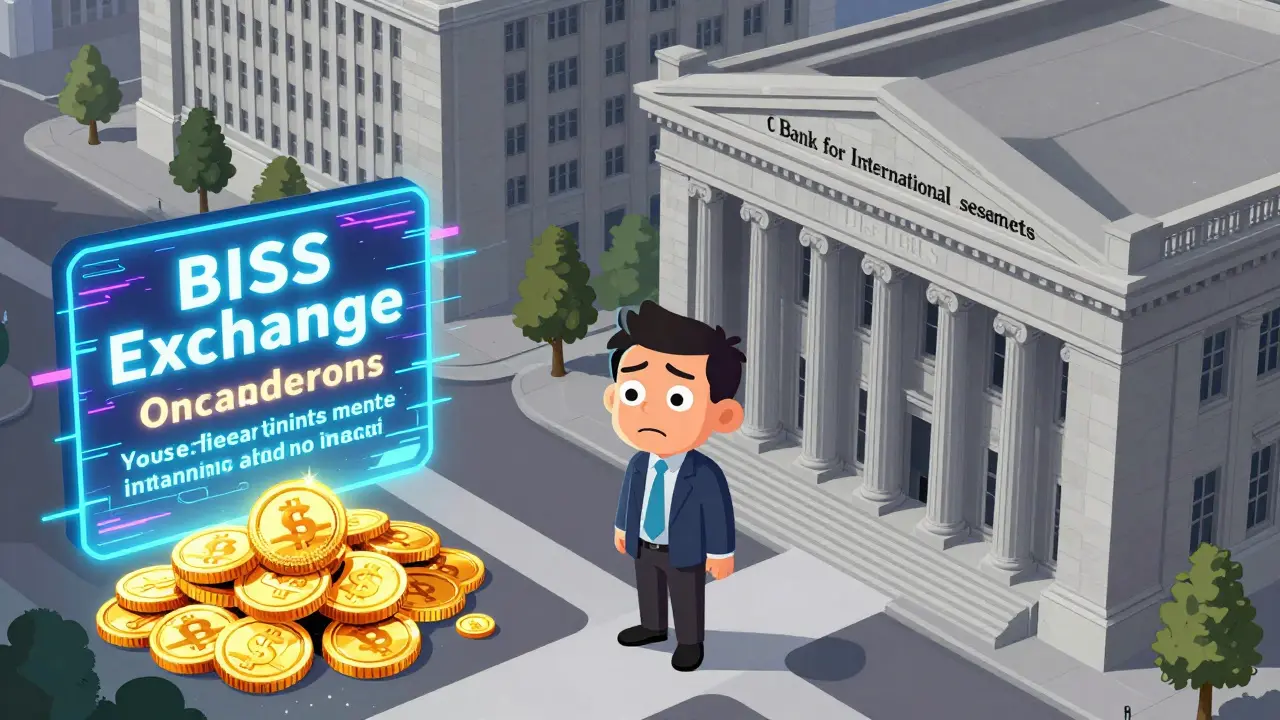
You might have come across a mention of BISS crypto exchange and you're wondering if it's a reliable place to trade your digital assets. Here is the blunt truth: there is no legitimate, documented cryptocurrency exchange by the name of BISS. If you've seen an ad or a website claiming to be a "BISS Exchange," you are likely looking at a phishing site or a sophisticated scam designed to steal your funds.
Most people searching for BISS are actually confusing it with the BIS Bank for International Settlements. While the names sound almost identical, they couldn't be more different. The BIS is a massive international financial institution owned by 63 central banks and based in Basel, Switzerland. It does not provide trading accounts for individuals, it does not have a "sign up" button for traders, and it certainly doesn't let you deposit Bitcoin to earn a quick profit. It is a forum for central banks to cooperate on global financial stability, not a commercial trading platform.
Common Red Flags and the BISS Confusion
It's easy to see how the mix-up happens. Scammers often use names that sound like authoritative bodies to trick people into feeling safe. By mimicking the "BIS" branding, a fake platform can create a false sense of legitimacy. If a site claims to be backed by the Bank for International Settlements to lure you into a BISS crypto exchange account, run the other way. Real central bank institutions don't operate retail trading apps.
When you're looking for a real exchange, a few things should always be present. Legitimate platforms have transparent ownership, clear terms of service, and a history of public audits. If you find a platform that promises guaranteed returns or has a "secret" association with a global bank, it's a classic sign of a rug pull or a Ponzi scheme. In the real world, the BIS actually publishes reports warning *against* the systemic risks of crypto, including the dangers of validator centralization and the lack of oversight in DeFi.
How Real Exchanges Compare to the BIS Framework
Since you're likely looking for a safe place to trade, it helps to understand what actual regulators-and the BIS-look for in a healthy exchange. The Bank for International Settlements has developed specific frameworks to measure how "safe" an exchange actually is, focusing heavily on Anti-Money Laundering (AML) compliance.
| Compliance Level | Requirement | Risk Level |
|---|---|---|
| Strong | Allow list: Only KYC-compliant addresses permitted | Very Low |
| Intermediate | Criteria based: Tokens must be held for over 6 months | Moderate |
| Weak | Deny list: Only blocks known illicit addresses | High |
If you are choosing between platforms like Binance or Coinbase, you'll notice they lean toward the "Strong" or "Intermediate" levels. They require identity verification (KYC) because that's the only way to satisfy global regulators and avoid the kind of collapse we saw with FTX, which left an $8 billion hole in customer funds.
The Danger of Centralized vs. Decentralized Trading
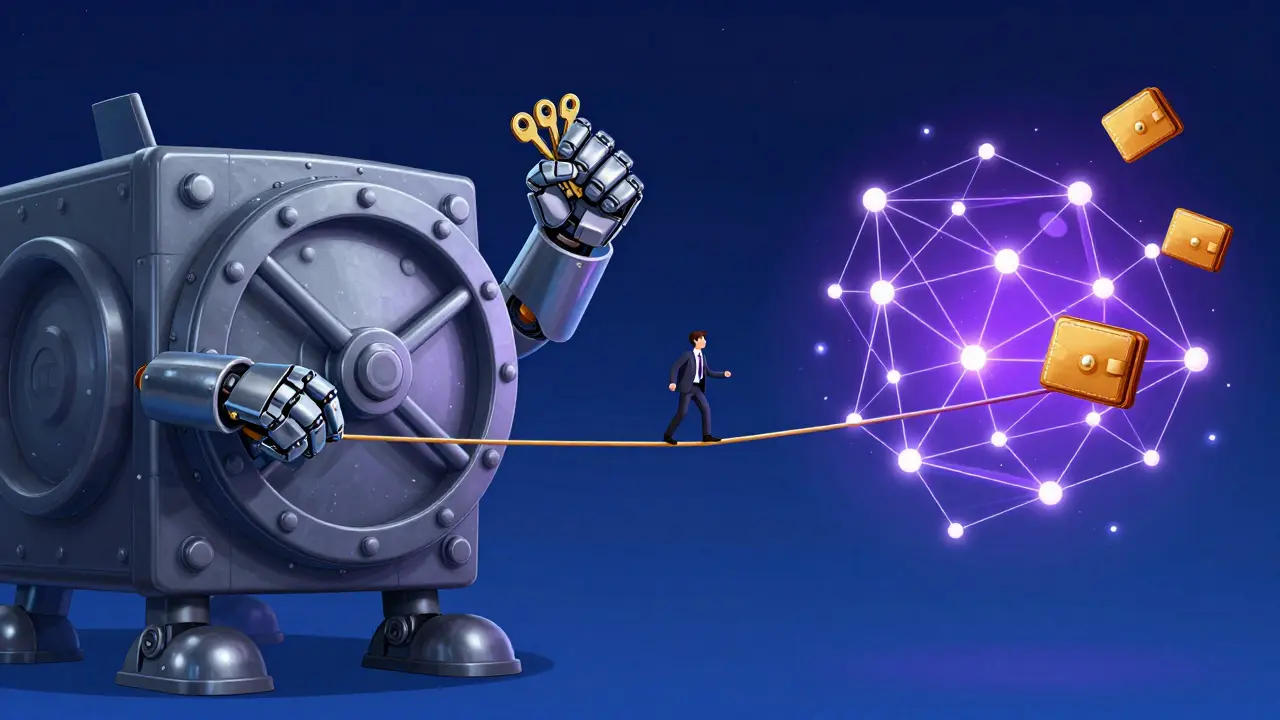
If you're avoiding fake sites like "BISS," you'll eventually have to choose between a Centralized Exchange (CEX) and a Decentralized Exchange (DEX). Each has a different risk profile. CEXs act like banks; they hold your keys for you. This is convenient but creates a "single point of failure." If the exchange is hacked or the owners disappear, your money goes with them.
DEXs, on the other hand, let you trade directly from your own wallet. While this removes the "middleman" risk, it introduces new technical dangers. The BIS has noted that in DeFi settings, the anonymity of users can increase the incentive for malicious behavior. Without a central authority to freeze stolen funds, once your crypto is gone from a DEX, it's usually gone forever.
Security Checklist for Your Digital Assets
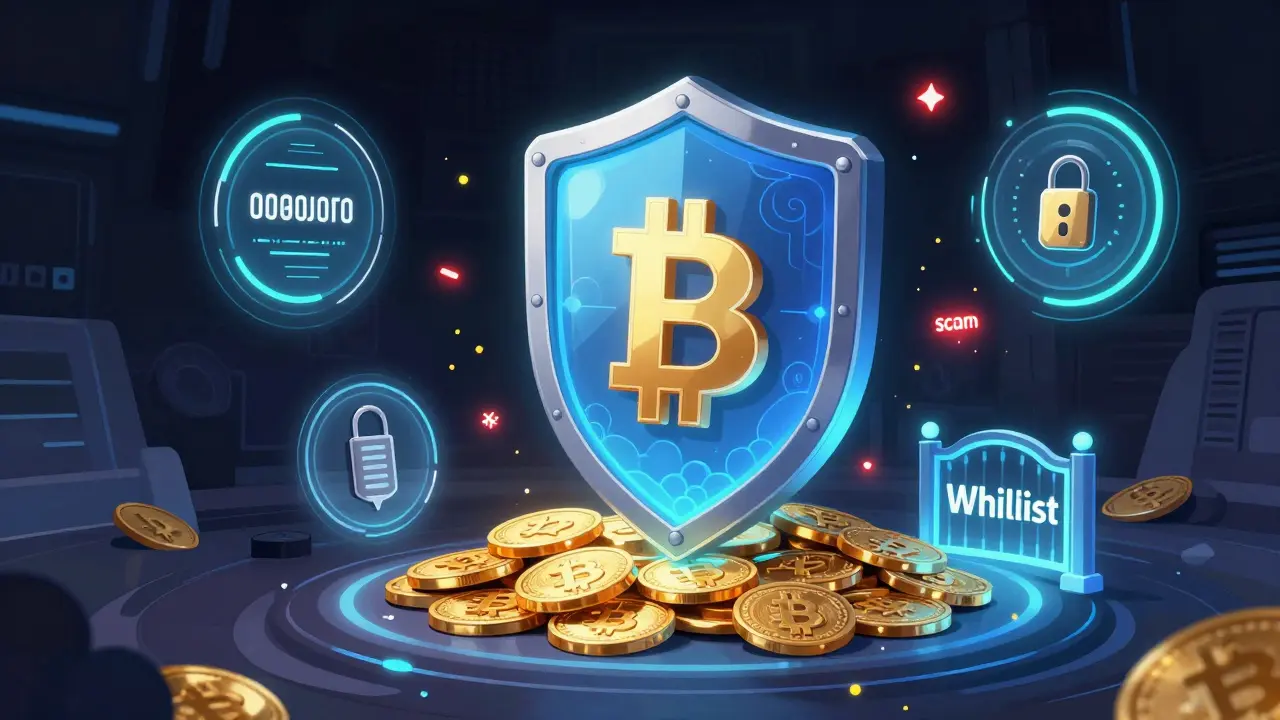
Since there is no such thing as a safe "BISS" exchange, the best way to protect your money is to follow industry-standard security protocols. Most account hacks aren't caused by genius hackers, but by simple mistakes. For instance, data shows that 92% of account compromises happen because people reuse passwords across different websites. Here is how you can actually secure your funds:
- Stop using the same password: Use a unique, complex password for every single exchange.
- Enable Hardware 2FA: Don't rely on SMS codes, which can be intercepted via SIM swapping. Use an app like Google Authenticator or, better yet, a physical security key.
- Use Cold Storage: Keep less than 5% of your total assets in "hot wallets" (on the exchange). Move the rest to a hardware wallet like Ledger or Trezor.
- Setup Withdrawal Whitelists: Only allow your funds to be sent to a few pre-approved addresses. This prevents a hacker from draining your account even if they get your password.
- Verify Proof of Reserves: Only use exchanges that provide third-party audited proof that they actually hold the assets they claim to have for their users.
Why You Should Be Wary of "New" High-Yield Exchanges
The crypto market is full of platforms that appear overnight, promising 20% or 30% annual returns. These are almost always traps. The BIS research into the FTX collapse highlighted how interconnectedness and lack of transparency lead to disaster. When a platform offers yields that are significantly higher than the market average, they are likely using new investor money to pay old investors.
If you encounter a platform claiming to be a "BISS" derivative or promising "guaranteed" profits through a special algorithm, remember that the real financial world doesn't work that way. Even the most stable assets have volatility. Any platform that claims to have "eliminated risk" is lying to you.
Is BISS a legitimate cryptocurrency exchange?
No. There is no evidence of a legitimate, regulated cryptocurrency exchange called BISS. It is highly likely a confusion with the BIS (Bank for International Settlements), which is a central bank organization and not a trading platform. Any site claiming to be "BISS Exchange" should be treated as a scam.
What is the difference between BISS and BIS?
BISS is a non-existent or fraudulent entity often searched for by mistake. BIS stands for the Bank for International Settlements, an international financial institution based in Switzerland that serves as a bank for central banks and conducts research on financial stability.
How can I tell if a crypto exchange is a scam?
Watch for red flags such as: guaranteed high returns, lack of a physical address or verifiable team, pressure to deposit money quickly to "unlock" a bonus, and claims of being backed by institutions that don't actually provide retail services (like the BIS).
What is a 'Proof of Reserve' audit?
A Proof of Reserve (PoR) audit is a public verification process where an exchange proves that it holds the actual assets of its customers in its reserves, ensuring they aren't lending out user funds without permission or operating a fractional reserve.
Are decentralized exchanges (DEX) safer than centralized ones?
It depends on your priority. DEXs are safer from "exchange bankruptcy" because you hold your own keys. However, they are often riskier in terms of smart contract bugs and a lack of customer support to help you recover funds if you make a mistake.

Comments
Greg Reynolds
Most people treat Proof of Reserves as a gold standard, but it is fundamentally flawed since it often ignores the liabilities side of the balance sheet. A snapshot of assets means nothing if the exchange has uncollateralized loans or hidden debts. It's a psychological security blanket rather than a true financial audit.
Yvette P
Oh, honey, imagining that a basic PoR audit actually mitigates systemic counterparty risk is just precious.
In reality, the latency between the snapshot and the public disclosure allows for massive wash trading and temporary liquidity infusions that would make a seasoned quant blush. It's essentially financial theater for the masses who can't distinguish between a hot wallet and a hole in the ground. We're basically pretending that a glorified spreadsheet is a cryptographic proof of solvency while the CEXs continue to operate like high-stakes casinos with an opaque house edge. Honestly, the sheer level of naive trust in these 'audits' is the real comedy here.
Jason M
While I agree that audits aren't perfect, we cannot let the perfect be the enemy of the good! For someone just starting out, having any level of transparency is a massive leap forward from the dark ages of FTX. I urge everyone to start with a hardware wallet immediately-do not leave your life savings on any platform, no matter how many audits they claim to have!
Benjamin Forg
bis is just a front for the globalists anyway they dont want you in crypto because it breaks their leash and they create these fake biss sites to track who is trying to escape the system and flag them for the coming crackdown its all a game of psychological warfare
Sara Ellis
money is just a vibe anyway why worry about where it sits as long as the energy is right
Ellie Drews
It is so important to stay vigilant with our security. Thanks for the reminder about the withdrawal whitelists; that's a step a lot of people forget until it's too late.
Mary Tawfall
I love how this breakdown simplifies the CEX vs DEX struggle. It makes the whole process feel much less intimidating for those of us who aren't tech geniuses.
Liz Ariza
Using a hardware wallet is a total game changer! 🛡️ It's like putting your gold in a vault instead of leaving it on the sidewalk. Keep those assets sparkly and safe! ✨
Tara Aman
I'm totally on board with the security checklist provided here. We should all be pushing for more education on this so fewer people get rugged!
Kyle Bush
WHO CARES ABOUT THE BIS?! 🇺🇸 America leads the way in innovation and we don't need some Swiss bank telling us how to trade! 🚀💰 Smash those scams and keep the gains coming! 🇺🇸🇺🇸
Gloris Young
Good tips. Keeping things simple is usually the best way to avoid mistakes.
Jennifer L
Oh my goodness, the thought of people losing their hard-earnnd money to a simple typo is just absoluteley heartbraking!
It is so cruell that scammers prey on people who are just tryng to improve their financial situatons. My heart truly goes out to anyone who has fallan for these tricks. We must all be more careful and look out for one another in this laandscape of deception!
Candace Sherrard
The intersection of linguistic ambiguity and financial fraud is a fascinating study in human psychology. When a name like BISS is used, it isn't just a mistake; it's a calculated exploit of the brain's tendency to seek patterns and authority. We trust the sounds we recognize, and that cognitive shortcut is exactly what the predator utilizes. It makes one wonder if we will ever truly move past this reliance on perceived institutional legitimacy, or if the decentralized nature of crypto will eventually force us to evolve a new, more rigorous way of validating truth that doesn't rely on a name or a logo. Perhaps the only real security is the total abandonment of trust in any singular entity, which is a terrifying prospect for the average person who just wants to store some value for the future.