
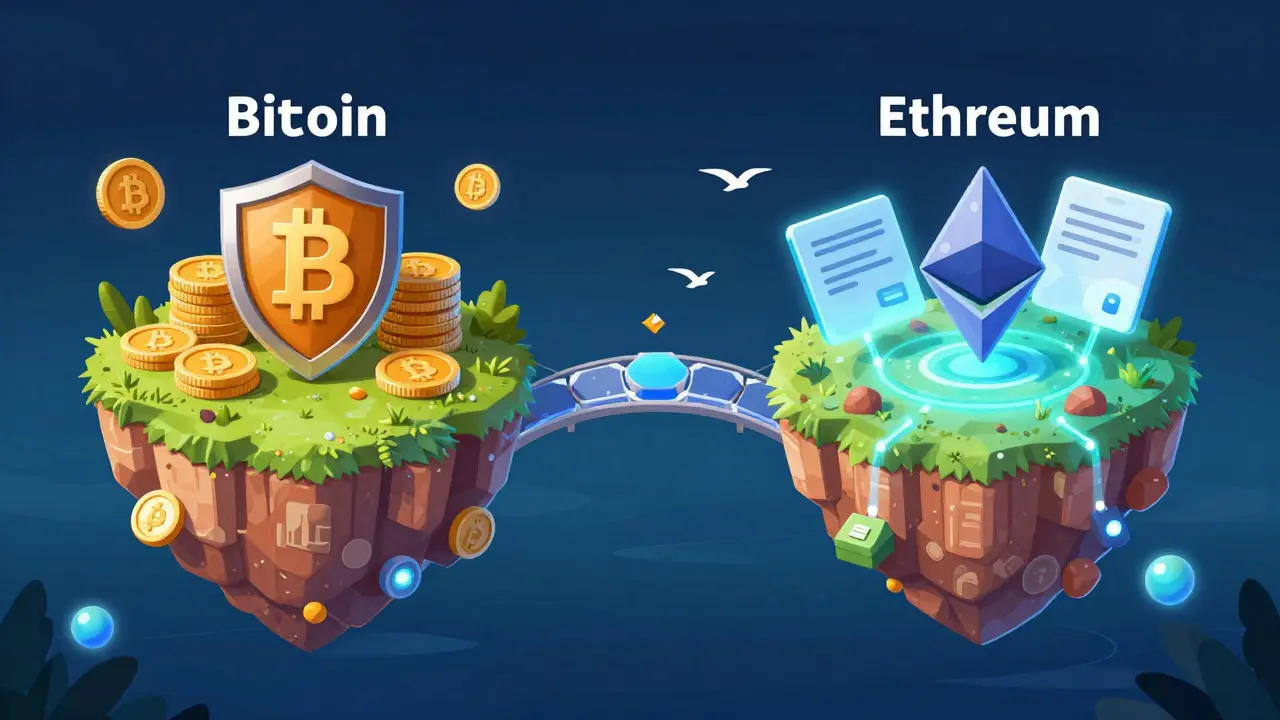
Imagine you have money in Bitcoin, but you want to use it to borrow funds on a DeFi platform built on Ethereum. Or you own an NFT on Solana and want to trade it for a token on Polygon. Without blockchain interoperability, this is impossible. Each blockchain operates like its own island - isolated, secure, but useless when you need to move value or data across networks. That’s where cross-chain communication comes in.
Why Blockchains Need to Talk to Each Other
Early blockchains were designed to be independent. Bitcoin doesn’t know what Ethereum is. Solana doesn’t care about Cosmos. This isolation was intentional - security through separation. But as the number of chains exploded, users got stuck. To move assets between chains, you had to use centralized exchanges: sell Bitcoin on Coinbase, buy Ethereum, then send it to your wallet. It’s slow, expensive, and defeats the whole point of decentralization. Interoperability changes that. It lets blockchains exchange data and value directly, without middlemen. This isn’t just about sending tokens. It’s about letting smart contracts on one chain trigger actions on another. A loan on Avalanche could be secured by collateral on Bitcoin. A game on Polygon could pull real-time price data from Chainlink on Ethereum. Without interoperability, the blockchain ecosystem stays fragmented. With it, you get a true web of blockchains - one that works like the internet, but for value.How IBC Makes Chains Talk Safely
The Inter-Blockchain Communication (IBC) protocol is the gold standard for secure cross-chain communication. It’s used by Cosmos, Osmosis, Juno, and over 50 other chains. Unlike bridges that rely on custodians or oracles, IBC is built on trustless verification. Each chain runs a light client - a tiny copy of the other chain’s state - that checks if incoming data is valid without trusting anyone. Here’s how it works in four steps:- OpenInit: Chain A says, "I want to talk to Chain B. Here’s my public key and block hash."
- OpenTry: Chain B checks Chain A’s data using its light client. If it matches, Chain B replies: "I accept. Here’s my info."
- OpenAck: Chain A verifies Chain B’s response. If valid, it confirms: "Connection accepted."
- OpenConfirm: Chain B locks in the connection. Now, they can send packets back and forth.
CCIP: The Secure Bridge for Any Chain
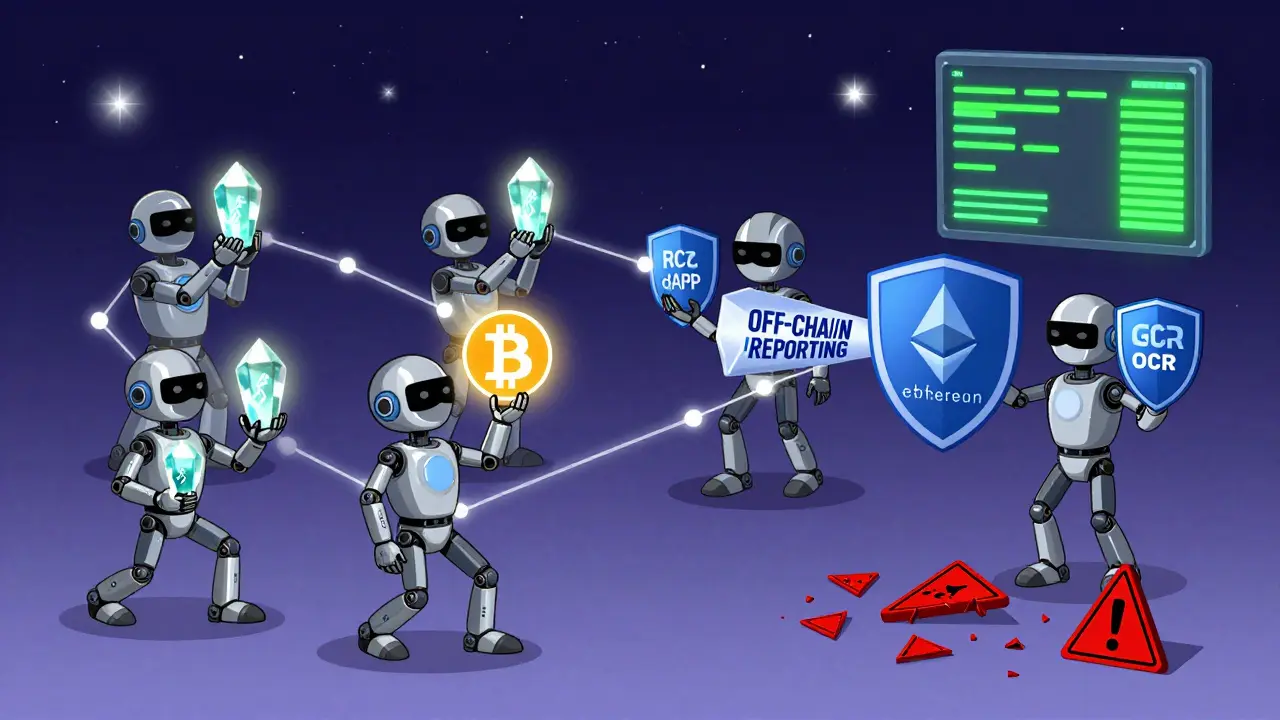
While IBC works best between similar chains (like those using Tendermint consensus), not every blockchain can run light clients. That’s where Chainlink’s Cross-Chain Interoperability Protocol (CCIP) comes in. CCIP is designed to connect any chain - Bitcoin, Ethereum, Solana, you name it - using a decentralized oracle network. CCIP doesn’t rely on chains trusting each other. Instead, it uses a network of independent node operators who verify events on one chain and relay them to another. These nodes are selected based on their performance history. They don’t just send data - they sign it cryptographically and submit it to a secure, tamper-proof system called Off-Chain Reporting (OCR). This same system has already secured over $100 billion in DeFi transactions. CCIP handles three types of cross-chain actions:- Token transfers: Send ETH from Ethereum to MATIC on Polygon.
- Arbitrary messaging: Trigger a smart contract on Solana from a contract on Avalanche.
- Programmable bridges: Set rules like, "Only send 100 USDC if the price of BTC is above $60,000."
What’s Actually Being Transferred?
Cross-chain communication isn’t just about sending coins. The real power lies in transferring data. A packet - the basic unit of cross-chain communication - contains:- Sender address
- Recipient address
- Amount or data payload
- Timestamp and sequence number
- Proof of origin (via light client or oracle signature)
- Use your Bitcoin as collateral for a loan on a DeFi app running on Terra.
- Claim an NFT minted on Ethereum after paying with Solana tokens.
- Run a decentralized insurance contract that pays out if a weather event is recorded on a separate oracle chain.
Benefits You Can Feel
Interoperability isn’t just a technical win - it changes how you use crypto:- More innovation: Developers can mix the best features of different chains. Use Bitcoin’s security with Ethereum’s smart contracts.
- Lower fees: Instead of paying high gas fees on Ethereum, you can do your transaction on a cheaper chain and still interact with Ethereum-based apps.
- Better UX: No more switching wallets or using centralized exchanges. One wallet, all chains.
- Scalability: Load gets spread out. If Ethereum is congested, your transaction can route through Polygon or Arbitrum without you even noticing.

What’s Still Hard?
Interoperability isn’t magic. It’s complex. Setting up IBC requires deep technical knowledge. You need to deploy light clients, manage channel lifecycles, and handle packet timeouts. CCIP is easier for users, but building on it still needs solid smart contract skills. Security is the biggest hurdle. Even with IBC and CCIP, there are risks:- Malicious relayers could delay or drop packets.
- Flawed smart contracts could let attackers drain funds.
- Chain reorgs (rare, but possible) could break trust assumptions.
Where This Is All Heading
The future isn’t one chain to rule them all. It’s a web of chains - each optimized for a specific job. Bitcoin for value storage. Ethereum for DeFi. Solana for fast payments. Cosmos for modular apps. And interoperability is the glue. In the next five years, we’ll see:- Standardized APIs for cross-chain smart contracts.
- Wallets that auto-route transactions to the cheapest or fastest chain.
- Insurance protocols that cover cross-chain bridge failures.
- Regulatory frameworks that treat cross-chain activity as a single, unified transaction.
Can Bitcoin communicate directly with Ethereum?
Not natively. Bitcoin’s design doesn’t support light clients or smart contracts needed for protocols like IBC. But through bridges like CCIP or wrapped tokens (like wBTC), Bitcoin’s value can be represented on Ethereum. This isn’t direct communication - it’s a pegged representation. True direct communication would require Bitcoin to adopt new consensus features, which is unlikely.
Is IBC better than CCIP?
It depends. IBC is more secure because it uses on-chain light clients and doesn’t rely on oracles. But it only works between compatible chains (like those using Tendermint). CCIP works across any chain - even Bitcoin and Solana - but depends on decentralized oracles. If you’re on Cosmos, use IBC. If you need to connect wildly different chains, use CCIP.
Are cross-chain bridges safe?
Many aren’t. Over $1.2 billion has been lost to bridge exploits since 2022. Most hacks happened because bridges used centralized validators or weak signature schemes. IBC and CCIP are designed to avoid these flaws. IBC uses trustless verification. CCIP uses decentralized oracles with verifiable track records. Stick to protocols with strong security audits and decentralized infrastructure.
Do I need a special wallet for cross-chain transfers?
No, but you need a wallet that supports the protocols you’re using. Most modern wallets like MetaMask, Phantom, and Keplr already support IBC and CCIP. You just need to connect to the right network and use the correct bridge interface. The wallet doesn’t change - the backend does.
What happens if one chain gets hacked?
It depends on the protocol. With IBC, if Chain A is compromised, Chain B won’t accept its data because the light client will detect invalid blocks. With CCIP, the oracle network can pause transfers if it detects abnormal activity. Neither protocol lets a hacked chain automatically control another. That’s the point of trustless design.
Can I send crypto without paying gas on both chains?
Yes, through fee abstraction. Some protocols, like LayerZero and CCIP, let you pay gas in one chain’s token while executing on another. For example, you can pay in USDC to send ETH from Ethereum to Polygon. The protocol handles converting and paying the gas fee on the destination chain automatically.

Comments
Jordan Fowles
It's wild how we've gone from 'blockchains are islands' to 'blockchains are a neural network.' The real breakthrough isn't the tech-it's the mindset shift. We stopped treating chains as competitors and started seeing them as specialties. Bitcoin holds value. Ethereum runs logic. Solana moves fast. And now? They're talking to each other like old friends who finally got a group chat.
Steve Williams
One must acknowledge the profound implications of this technological convergence. The architectural integrity of decentralized systems is being redefined not through centralization, but through interoperable trustlessness. This is not merely an enhancement-it is a foundational evolution in digital sovereignty.
nayan keshari
IBC? CCIP? More like IBCY (I'm Bored Can't You) and CCIP (Can't Connect If You're Poor). All this fancy talk and I still have to pay $20 in gas to move $50 from Ethereum to Polygon. Where's the real win?
Bianca Martins
Love how you broke this down-seriously, this is the clearest explanation I’ve seen. I used to think cross-chain was just a bridge for whales, but now I get it: it’s about freedom. No more juggling 7 wallets. One wallet, all chains. 🙌
Alexandra Wright
Oh wow, so now we're pretending Bitcoin can 'talk' to Ethereum? Cute. It's still just wrapped tokens and oracles doing the heavy lifting. You didn't solve anything-you just added another layer of abstraction to hide the fact that Bitcoin doesn't want to play.
Michelle Slayden
The elegance of IBC lies not in its complexity, but in its minimalism: no oracles, no custodians, no intermediaries. The light client model is a triumph of cryptographic minimalism-each chain verifies the other without delegation. This is the purest form of decentralized coordination yet devised.
Mike Reynolds
Honestly, I just want to send my ETH to Solana and not have to think about it. I don’t care if it’s IBC or CCIP or magic fairy dust. Just make it work. I’ve lost more time figuring out bridges than I have making money.
dayna prest
Interoperability? More like inter-opportunity-for hackers. You think CCIP’s secure? Last year, a guy in a Discord server found a way to front-run a token transfer by 0.3 seconds using a bot that sniffed IBC packet headers. The ‘trustless’ system just got owned by a 19-year-old with a Raspberry Pi and too much caffeine.
Brooklyn Servin
Y’all are missing the point. It’s not about bridges or light clients-it’s about *agency*. I used to have to trust a centralized exchange to move my NFTs. Now? I can send my Solana NFT to a DeFi pool on Ethereum and borrow against it-without giving up custody. That’s not tech. That’s liberation. 💥
Phil McGinnis
Let’s be honest. This whole ‘web of chains’ is a distraction. The U.S. dollar is the only true interoperable asset. Everything else is crypto theater. Why are we building bridges between digital toys when the real economy runs on Fedwire?
Ian Koerich Maciel
...I just want to say... thank you... for writing this... with such clarity... and care... I’ve read dozens of articles... and none... made me feel... like I actually understood... until now... 🙏
Andy Reynolds
This is the kind of post that makes me believe in crypto again. We’re not just building apps-we’re building a new kind of internet. One where your money, your data, your identity-all of it-can move freely. No gatekeepers. No borders. Just code doing what it’s supposed to do: connect people.
Ryan Husain
Interoperability is inevitable. The question isn't whether it will happen-it's whether we'll build it with integrity or let it be hijacked by venture capital and rushed to market. IBC and CCIP are the first real attempts at responsible design. Let's not squander that.
Rajappa Manohar
ibc is cool but how about btc to eth direct? no wrap? no oracle? just like send btc to eth address? plz explain
Abhisekh Chakraborty
Y’all are so naive. You think these protocols are secure? They’re just new ways for the same people to steal your money. I’ve seen it. I’ve lost it. You’re all just chasing ghosts.
Josh Seeto
So… you’re telling me I can now use Bitcoin as collateral on a DeFi app… and pay gas in USDC… and still not have to trust anyone? …Cool. So why does my wallet still crash every time I try?
rachael deal
YES. YES. YES. This is the future. No more jumping through hoops. One wallet. All chains. I’m so ready for this. Let’s gooooo!! 🚀
Adam Hull
Interoperability? More like interoperable vulnerability. Every new bridge is a new attack surface. You’re not building a web-you’re building a honey trap for every script kiddie with a GPU farm and a GitHub account. And you call this innovation?
Bruce Morrison
Good summary. The real win is user experience. No more switching wallets. Just send. That’s all most people need.