
On March 10, 2022, something unusual happened in the crypto world. A record label didn’t drop an album - it dropped MND tokens. Mind Music, claiming to be the world’s first crypto-powered record label, launched a massive airdrop through CoinMarketCap, handing out 30 trillion MND tokens to 15,000 lucky participants. Each winner could walk away with up to 2 billion MND tokens. That’s not a typo. This wasn’t a small test. It was a full-scale attempt to merge music and blockchain - and it worked, at least for a while.
How the MND Airdrop Actually Worked
The airdrop wasn’t hidden behind a complicated website or a private Discord. It was live on CoinMarketCap’s official airdrop page, where millions of crypto users already checked prices and market data. All you had to do was connect your wallet - no KYC, no fees, no long forms. Just sign in with MetaMask, Trust Wallet, or any EVM-compatible wallet, and you were entered.
The total supply distributed was 30,000,000,000,000 MND. That’s 30 trillion. Divided evenly, each of the 15,000 winners got 2 billion tokens. But it wasn’t perfectly even. Some got more, some got less, based on how early they joined and how active they were on CoinMarketCap’s platform. The system used a random selection algorithm, but participation history mattered. If you’d been tracking crypto projects on CoinMarketCap for months, you had a better shot.
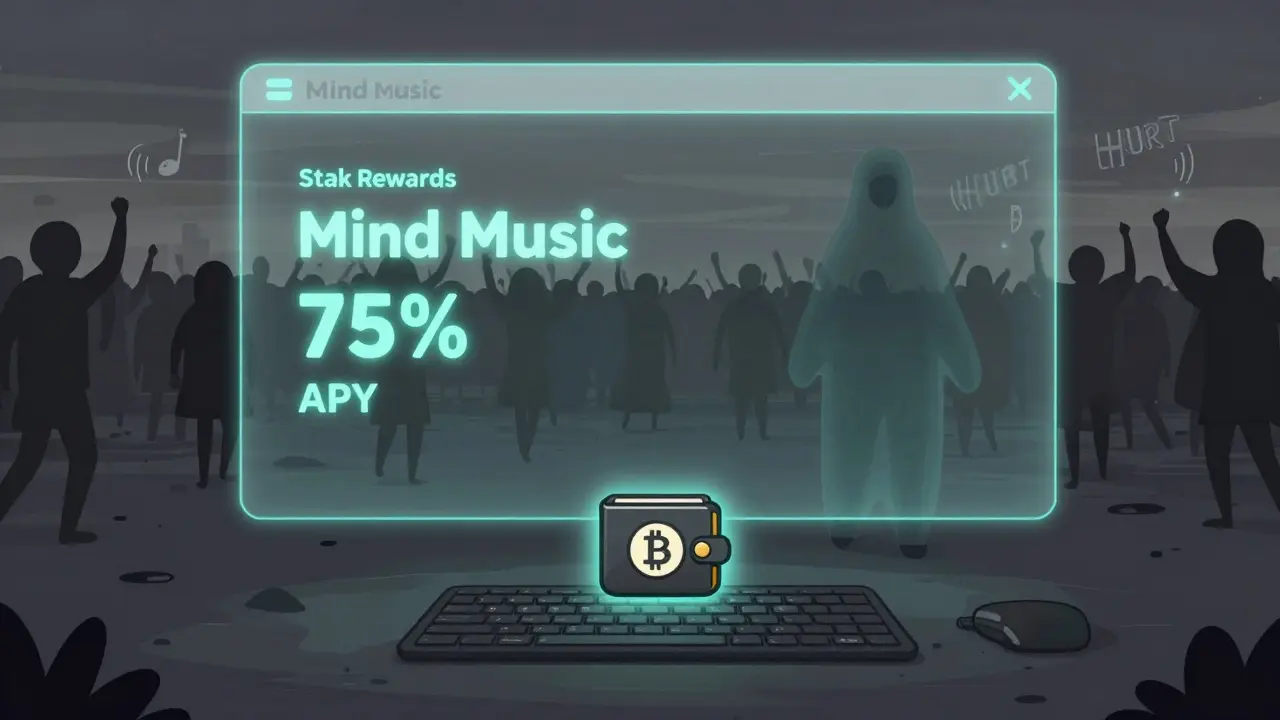
Unlike many airdrops that just hand out tokens and vanish, Mind Music built immediate utility. Right after the airdrop, they opened staking pools with up to 75% APY. That’s not a typo either. If you held even 100 million MND tokens, you could earn 75 million more in a year just by locking them up. It was a powerful incentive to hold - and not sell immediately.
Why This Airdrop Was Different
Most crypto airdrops target speculators. Mind Music targeted music lovers. The project didn’t just talk about blockchain - it released real music. Its debut single, ‘HURT,’ hit Spotify, YouTube, TikTok, and Instagram. Within months, it had tens of thousands of Spotify streams, hundreds of thousands of YouTube views, and over 10 million total streams across social platforms. It even won the UK Song Contest in the Music Aid category. That’s not something you fake. That’s proof people were listening - not just holding tokens.
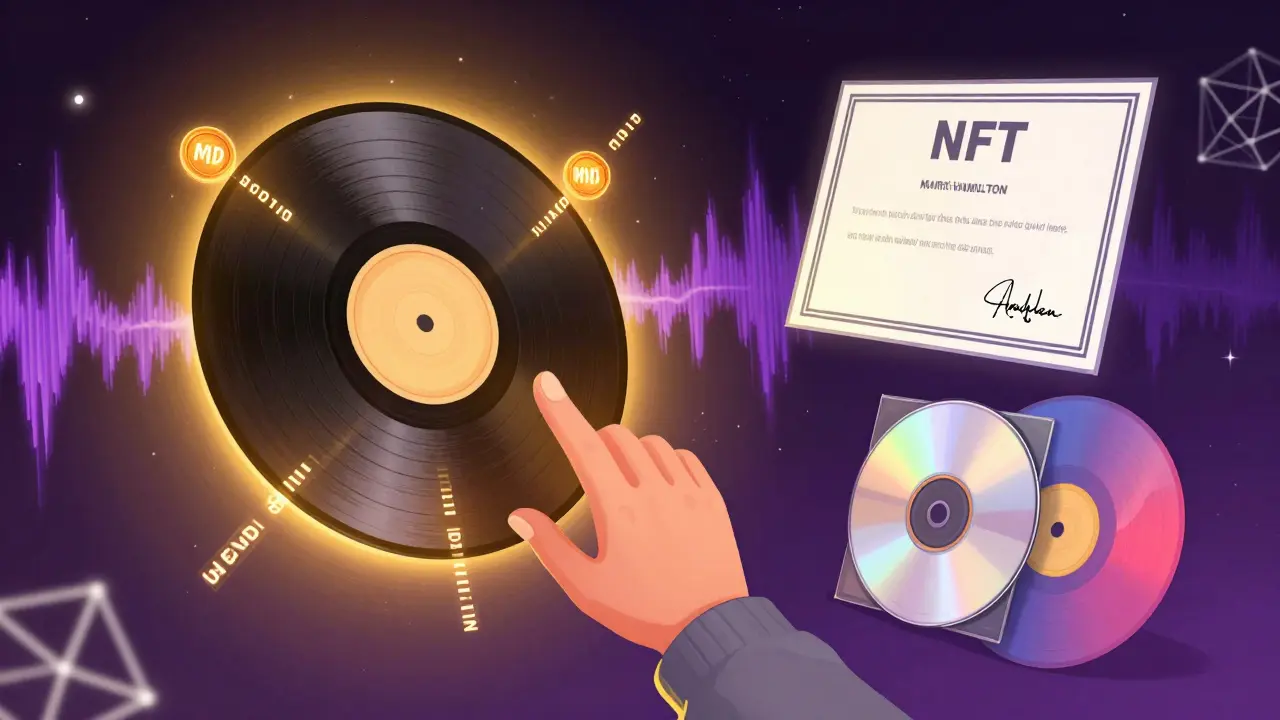
The project didn’t stop at streaming. It planned NFTs tied to physical goods. Buy an NFT from Mind Music, and you got a numbered colored vinyl, a CD, and a digital download - all signed by Mark Hamilton, the label’s founder. This wasn’t just digital collectibles. It was a bridge between the blockchain and the real world of music collecting. You could stream the song, hold the token, and own the physical record. That kind of integration was rare in 2022.
What Happened After the Airdrop
Right after the airdrop, Mind Music got listed on Coin Tiger, a centralized exchange. That meant you could actually trade MND for other coins - not just hold it. Trading volume spiked. The token’s price moved. For a brief moment, MND had real market activity. But then, things quieted down.
There were no major updates after mid-2022. No new artist signings. No NFT drops. No press releases. The website still existed, but updates stopped. The staking pools? Still active for a while, but rewards dropped as the token’s value fluctuated. The 75% APY was never sustainable. Most airdrop recipients cashed out early. The token’s price dropped below $0.0000001. Today, it’s nearly worthless on major exchanges.
But here’s the thing: the campaign still worked. Mind Music didn’t need to last forever to make an impact. It proved that a crypto project could launch with real music, real listeners, and real marketing - not just whitepapers and Discord bots. It showed that if you give people music they like, and tokens they can use, even a short-lived project can leave a mark.
The Bigger Picture: Crypto Meets Music
Mind Music wasn’t the first crypto music project, but it was one of the most ambitious. It didn’t just create a token. It built a whole ecosystem: music distribution, staking, NFTs, physical merchandise, and a global airdrop. It used CoinMarketCap’s platform to reach users who had never heard of blockchain before. That’s a masterclass in user acquisition.
Other projects tried similar things. Some failed. Some succeeded. But Mind Music’s approach - combining measurable music success with crypto mechanics - was different. It didn’t rely on hype. It relied on data: streams, views, contest wins. That’s why it stood out.
Even today, if you dig into the numbers, ‘HURT’ still gets plays. The YouTube video still has comments. The NFTs still exist on OpenSea, even if they’re unsold. The airdrop didn’t vanish - it just changed form. It became a case study.
What You Can Learn From MND’s Airdrop
If you’re thinking about launching your own token or airdrop, here’s what Mind Music got right:
- Use a trusted platform. CoinMarketCap gave them instant access to millions. Don’t build from zero.
- Give real utility. Staking, NFTs, music - they weren’t just buzzwords. They were features people could use.
- Measure real-world impact. Spotify streams, TikTok views, contest wins - these mattered more than Twitter followers.
- Don’t overpromise. The 75% APY was too good to last. Sustainable rewards beat short-term spikes.
And here’s what went wrong:
- No long-term roadmap. After the launch, silence. No updates. No new music. People moved on.
- Token supply too large. 30 trillion tokens is a lot. Without demand, the value collapses.
- Too much focus on distribution, not retention. They got users in - but didn’t keep them.
Is MND Still Worth Anything Today?
As of February 2026, MND has no listing on Binance, Coinbase, or Kraken. It’s only available on tiny decentralized exchanges with almost no trading volume. The token price is near zero. If you got MND in the airdrop, it’s unlikely you’ll cash out at anything meaningful.
But the story isn’t over. The music still exists. The NFTs are still out there. The campaign proved that crypto can work with music - if you do it right. Mind Music didn’t last. But it showed how it could be done.
What was the total number of MND tokens distributed in the airdrop?
A total of 30,000,000,000,000 MND tokens (30 trillion) were distributed during the campaign. These were allocated among 15,000 winners, with each winner eligible to receive up to 2,000,000,000 MND tokens. The exact amount per winner varied slightly due to the random selection process used by CoinMarketCap.
How could users participate in the MND airdrop?
Participants needed to have a compatible crypto wallet (like MetaMask or Trust Wallet) and visit the official Mind Music airdrop page on CoinMarketCap. After connecting their wallet, they simply clicked to join. No purchase, KYC, or deposit was required. Early participants had a slightly higher chance of selection due to CoinMarketCap’s internal weighting system.
Did the MND airdrop include any staking rewards?
Yes. Immediately after the airdrop, Mind Music launched staking pools offering up to 75% Annual Percentage Yield (APY). Users had to connect their wallet and lock MND tokens into the staking contract to earn rewards. This was designed to encourage holders to keep their tokens instead of selling them right away.
What happened to the Mind Music project after the airdrop?
After the initial launch in March 2022, Mind Music gained traction with music releases, an NFT plan, and a listing on Coin Tiger exchange. But by late 2022, updates stopped. No new artists were signed, no further NFT drops occurred, and the project’s online presence became inactive. The staking rewards faded as token demand dropped. Today, the project is considered dormant, though its music and NFTs still exist.
Was the MND token listed on any major exchanges?
Yes. Mind Music secured its first centralized exchange listing on Coin Tiger shortly after the airdrop. This allowed users to trade MND for other cryptocurrencies like ETH and USDT. However, it was never listed on major exchanges like Binance, Coinbase, or Kraken. Trading volume was low, and the token has since been delisted from Coin Tiger.
Can I still claim MND tokens from the 2022 airdrop?
No. The airdrop campaign ended in April 2022. All tokens were distributed, and the claiming period is long closed. Even if you participated, you would have needed to claim your tokens within the window provided by CoinMarketCap. There is no way to claim MND tokens now.
Did Mind Music release any NFTs after the airdrop?
Yes. Mind Music announced plans to release an NFT collection shortly after the airdrop. Each NFT came with a physical package: a limited edition colored vinyl, a CD, and a digital download of ‘HURT’ - all signed by Mark Hamilton. However, the NFT drop never fully materialized. A few were minted and listed on OpenSea, but the full collection was never released.
Why did the MND token lose value so quickly?
Three main reasons: First, 30 trillion tokens were too many - supply vastly outpaced demand. Second, most airdrop recipients sold immediately instead of holding. Third, the project stopped updating after mid-2022, so there was no new reason for people to keep using or buying MND. Without ongoing utility or marketing, the token had no foundation to hold its value.
Is Mind Music still active today?
As of 2026, Mind Music is not actively operating. The website remains online but hasn’t been updated since late 2022. No new music has been released. No staking rewards are being distributed. The team has not responded to public inquiries. The project is considered inactive, though its legacy as one of the first crypto-music hybrids remains.
What can we learn from the MND airdrop today?
The MND airdrop teaches two key lessons: First, real-world utility - like music streams and physical merchandise - matters more than hype. Second, massive token supply without demand leads to collapse. Projects that focus on building a real audience, not just distributing tokens, have a better chance of lasting. Mind Music didn’t fail because it was bad - it failed because it didn’t keep going.
The MND airdrop didn’t change the world. But it proved something simple: if you give people music they love, and a token that actually does something, they’ll pay attention - even if just for a moment. That’s more than most crypto projects manage.

Comments
Alan Enfield
Man, I remember when this dropped. I was just scrolling through CoinMarketCap like always, thought it was another scam, but hey - free tokens, right? Connected my wallet, didn’t even read the whitepaper. Got my 2 billion MND. Thought I was rich. Then I saw the APY. 75%? I laughed out loud. But I staked anyway. Lost my ass when the rewards dropped to 2%. Still have the NFT vinyl somewhere. At least I got ‘HURT’ on repeat that summer.
Real talk: this was the first time crypto felt like culture, not just gambling. Even if it died, it mattered for a minute.
george chehwane
Let’s be real - 30 trillion tokens is a mathematical joke. You can’t have utility when your supply is larger than the GDP of half the planet. This wasn’t a music project. It was a liquidity trap disguised as a cultural movement. The 75% APY? That’s not an incentive. That’s a Ponzi siren song wrapped in Spotify playlists.
They didn’t build a ecosystem. They built a time bomb with a guitar pick on top. And now? The only thing still streaming is the irony.
Lisa Parker
I cried when I saw the airdrop. Not because I got rich - I didn’t. But because ‘HURT’ was the first song that made me feel something in years. My therapist asked me why I was listening to a crypto song on loop. I told her it felt real. She didn’t get it.
I still play it when I’m sad. The token’s worthless. The music isn’t.
Nova Meristiana
Oh wow. A crypto project that actually released music? 🤮
How quaint. Did they also give out free hugs and handwritten letters from Mark Hamilton? Next they’ll be selling autographed NFTs of their cat. This isn’t innovation - it’s performance art for degens who think ‘stream count’ equals legitimacy.
Pathetic. And yet… somehow, I’m still here. 🤷♀️
Aileen Rothstein
Look, I know everyone’s quick to call this a failure - and yeah, the token tanked. But let’s not erase what it did right.
They used CoinMarketCap. They didn’t need 100 Discord mods. They made music people actually listened to. They didn’t just sell a dream - they gave you a record you could hold. That’s more than 90% of Web3 projects ever do.
Yes, the staking was unsustainable. Yes, the supply was insane. But they proved it’s possible to hook people on art, not just ROI. That’s the real win. The rest? That’s just how crypto evolves - messy, loud, and sometimes beautiful.
JJ White
THIS WAS A SCAM. A BEAUTIFUL, ARTISTIC, SMOKE-AND-MIRRORS SCAM.
They knew exactly what they were doing. 30 TRILLION TOKENS? That’s not a mistake - that’s a weapon. They flooded the market so NO ONE could ever make money. Then they released music so people would feel guilty for selling.
They didn’t want to build a company. They wanted to build a MEMORY. And damn it if it didn’t work.
I sold my MND for 0.00000003. I still have the vinyl. I still play ‘HURT’ at parties. I still tell people I was part of the revolution.
They didn’t fail. They transcended.
Nicole Stewart
30 trillion tokens. 75% APY. Music on Spotify. NFTs that never dropped. All of it. Done. Over. No one cares anymore. Move on.
Jennifer Riddalls
Hey, I just wanted to say - if you got MND and kept even a little bit, don’t feel bad. I did too. I didn’t cash out. I just held it. Not because I thought it’d rise - but because I liked the song.
It’s okay if projects don’t last. What matters is what they left behind. ‘HURT’ still plays in my playlist. That’s worth more than any token.
Thanks, Mind Music. You gave us something real.
Kyle Tully
Let me tell you something - I was there. I was one of the first 500 to connect my wallet. I thought I was a genius. I posted on Twitter about how this was the future. I even bought a shirt with ‘MND’ on it.
Then I realized - no one else cared. The staking rewards vanished. The NFTs gathered dust. The website looked like a 2015 Geocities page.
But you know what? I still smile when ‘HURT’ comes on. That’s the thing nobody talks about. They didn’t sell tokens. They sold a feeling. And that? That’s the only thing that lasts.
kieron reid
Analysis: 30T supply = 0.0000001 value. 75% APY = unsustainable. NFTs never launched = false promise. Music success = coincidental. CoinMarketCap listing = free exposure. Team vanished = classic rug. No audits. No roadmap. No team updates. Zero accountability.
Conclusion: This wasn’t crypto music. It was a marketing experiment that accidentally made good art. The art survived. The project didn’t. That’s the irony. And it’s hilarious.
Avantika Mann
I’m from India, and I still remember the first time I heard ‘HURT’ on YouTube. I didn’t know what MND was. I just liked the melody. Then I saw the airdrop - thought it was a joke. But I joined anyway. Got 1.2 billion tokens. Didn’t trade them. Still have them.
What I learned? Crypto can be cold. But music? Music is warm. This project gave me both. Even if the token’s dead, the song lives. And that’s enough for me.
If you’re reading this - play ‘HURT’ today. Let it remind you that sometimes, beauty doesn’t need a whitepaper.
yogesh negi
Friends, let me tell you - this is not just a story about tokens or airdrops. This is a story about hope.
When the world felt heavy, Mind Music gave us something light. A song. A vinyl. A chance. We didn’t need to be rich. We just needed to feel something. And we did.
Yes, the APY was too high. Yes, the supply was too big. But they tried. And in crypto, trying is rare. Most just take. Mind Music gave.
I still listen to ‘HURT’ every Sunday morning. It’s my peace. My prayer. My reminder that even in chaos, beauty can bloom.
Thank you, Mark. Thank you, MND. You didn’t build a coin. You built a moment.
Nikki Howard
While the narrative is romanticized, the economic reality is clear: a token with 30 trillion supply and zero utility beyond speculation is fundamentally flawed. The staking mechanism was a liquidity illusion. The NFTs were a marketing afterthought. The music, while competent, was not enough to sustain a blockchain project.
It’s a cautionary tale for Web3 founders: emotion doesn’t replace economics. Art doesn’t compensate for unsustainable tokenomics.
Do not replicate this model. It failed. Statistically. Mathematically. Practically.
Tarun Krishnakumar
Let me ask you something - who really owned CoinMarketCap’s airdrop page in 2022? Who controlled the random algorithm? Was it CoinMarketCap? Or was it someone behind the scenes? Think about it. 15,000 winners. Exactly. Not 14,999. Not 15,001.
And then - boom - Coin Tiger listing. Then silence. No audits. No transparency. No team verification.
What if this wasn’t a music project at all? What if it was a pump-and-dump disguised as an art movement? What if ‘HURT’ was just a Trojan horse to get millions to connect their wallets? What if the real goal was harvesting wallet data? What if the NFTs were never meant to be released?
I’m not saying it. I’m just asking. And I’ve seen too many of these.
andy donnachie
As someone who’s been in crypto since 2017, I’ve seen hundreds of airdrops. This one stood out because it didn’t feel like crypto. It felt like a band you discovered on Bandcamp. The token was secondary. The music was the product.
Most projects try to make you feel like you’re investing. This one made you feel like you were part of something. Even if it didn’t last - it mattered. That’s rare.
Dominica Anderson
USA made music. Crypto made money. Europe made art. This? This was a glitch in the matrix. And I’m not impressed.
sruthi magesh
30 trillion tokens? Only in America. We in India know value. This was a scam dressed as a symphony. Music? A distraction. The real target? Wallets. The real payout? Data. The real artist? The algorithm.
Paul David Rillorta
yo so like i heard this thing about mind music and i was like huh? then i saw the 75% apy and i was like ohhh yeahhh lets go
then i got my 2 bil mnd and i staked it and i was like wow this is the future
then it crashed and i was like… wait what
but i still have the vinyl
so i guess it was worth it? 🤷♂️
jennifer jean
Just played ‘HURT’ for the first time in months. It’s still beautiful. Still haunting.
Token’s worth nothing. But the song? Still everything. 🎧💖