

Have you ever tried to swap tokens on a decentralized exchange, only to watch your funds vanish into thin air due to high slippage or hidden fees? You are not alone. The world of Decentralized Finance (DeFi) is full of promises about low costs and high yields, but the reality can be messy. Today, we are looking closely at KyberSwap Elastic, specifically its version running on the Arbitrum blockchain. This platform claims to offer better rates and higher efficiency than the giants like Uniswap. But does it actually deliver, or is it just another complex protocol waiting to bite you?
I’ve spent weeks testing KyberSwap Elastic on Arbitrum, digging into its security records, and comparing its performance against other top-tier DEXs. What I found is a tool that is incredibly powerful for experienced users but potentially dangerous for beginners. Let’s break down exactly how it works, where it shines, and where you need to tread carefully.
What Exactly Is KyberSwap Elastic?
To understand KyberSwap Elastic, you first need to know what it isn’t. It is not a traditional centralized exchange like Binance or Coinbase where a company holds your money. Instead, it is a Decentralized Exchange (DEX) that operates as an Automated Market Maker (AMM).
Kyber Network was founded in 2017 by Loi Luu and Victor Tran, with early mentorship from Vitalik Buterin, the creator of Ethereum. They raised $52 million in their initial coin offering, which gave them the resources to build something ambitious. KyberSwap Elastic launched on Arbitrum in August 2022. Arbitrum is a Layer 2 solution, meaning it sits on top of Ethereum to make transactions faster and cheaper-often reducing gas fees by up to 97% compared to the main Ethereum network.
The "Elastic" part refers to its use of Concentrated Liquidity. In older AMMs, your liquidity was spread across all possible price ranges. With Elastic, you choose a specific price range. If the token price stays within that range, you earn significantly more fees. If it leaves your range, you stop earning. This sounds simple, but it requires active management and carries higher risks, which we will discuss later.
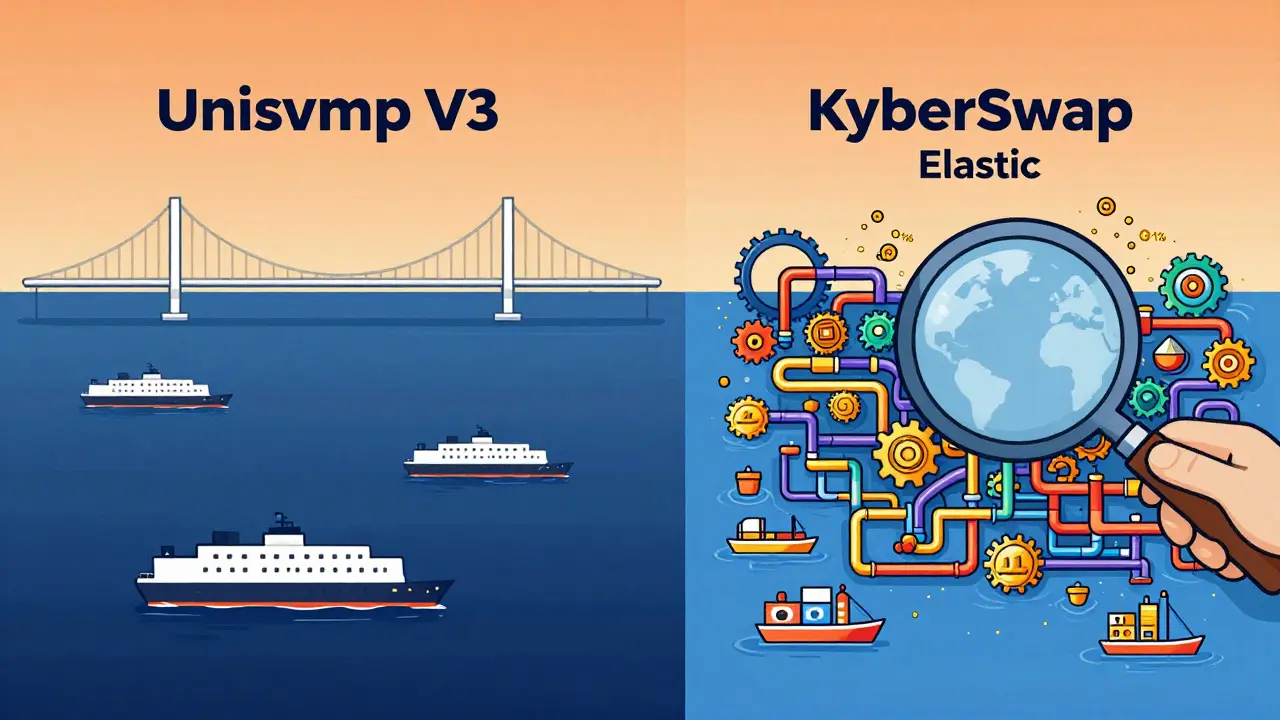
How Does It Compare to Uniswap V3?
You might be asking, "Why not just use Uniswap?" Uniswap V3 also uses concentrated liquidity and is the market leader. So, why does KyberSwap exist?
| Feature | KyberSwap Elastic | Uniswap V3 |
|---|---|---|
| Liquidity Source | Aggregates from 70+ DEXs | Own pool only |
| Best For | Stablecoin swaps, obscure tokens | Major pairs (ETH/USDC), high volume |
| User Interface | Complex, data-heavy | Cleaner, more intuitive |
| Capital Efficiency | High (for LPs) | High (for LPs) |
| Market Share (Arbitrum) | ~0.8% | ~42.3% |
The key difference is aggregation. KyberSwap acts as both a DEX and a DEX Aggregator. When you want to swap Token A for Token B, KyberScan searches across over 70 different decentralized exchanges to find you the best rate. Uniswap only looks at its own pools. If the token you want is illiquid on Uniswap but has deep liquidity on SushiSwap or Camelot, KyberSwap will route your trade through those platforms automatically.
This makes KyberSwap particularly strong for stablecoin swaps (like USDC to FRAX) and less common trading pairs. However, for major pairs like ETH/USDC, Uniswap’s sheer volume often means tighter spreads and deeper liquidity, making it the safer bet for large trades.
Performance and Liquidity: The Real Numbers
Let’s talk numbers. As of mid-2023, KyberSwap Elastic on Arbitrum reported a Total Value Locked (TVL) exceeding $17 million. While this sounds substantial, it is a fraction of Uniswap’s TVL on the same chain. More importantly, look at the daily volume. Reports showed a 24-hour trading volume of around $526 for specific Elastic pools, which is extremely low compared to Uniswap’s hundreds of millions.
Why does this matter? Low volume means low liquidity depth. If you try to swap a large amount-say, $10,000 worth of a lesser-known token-you might experience significant Slippage. Slippage is the difference between the expected price of a trade and the price at which the trade is executed. On KyberSwap, slippage can exceed 1.5% for transactions over $1,000 on low-liquidity pairs. For context, major pairs on Uniswap often have slippage under 0.1%.
However, for small to medium swaps under $500, especially involving stablecoins, KyberSwap’s aggregator engine often finds rates that are 0.01% to 0.03% better than competitors. That might sound tiny, but if you are a frequent trader, those fractions add up.
Safety First: Security Audits and Past Incidents
In crypto, trust is earned, not given. KyberSwap’s smart contracts have been audited by reputable firms like OpenZeppelin and PeckShield. These audits check the code for vulnerabilities that hackers could exploit. Passing these audits is a good sign, but it is not a guarantee.
We must address the elephant in the room. In May 2023, CoinGecko documented a security incident that prompted the KyberSwap team to advise users to withdraw their funds as a precaution. While the specific details were not fully disclosed publicly, such warnings are serious. Any time a protocol asks users to pull out money, it indicates a potential vulnerability or a glitch in the system.
Since then, the protocol has continued to operate, and no massive hacks have been reported. However, this event highlights a critical risk: Smart Contract Risk. Even with audits, bugs can slip through. Always start with small amounts when trying a new DEX. Never put more money into a platform than you are willing to lose while testing its reliability.
Who Should Use KyberSwap Elastic?
Based on my analysis, KyberSwap Elastic is not a one-size-fits-all solution. Here is who should and shouldn’t use it:
- Use it if: You are swapping stablecoins or niche tokens that have poor liquidity on Uniswap. The aggregator feature will likely save you money on fees and slippage.
- Use it if: You are an experienced DeFi user who understands concentrated liquidity and wants to provide liquidity for higher yields. The Elastic model can offer up to 35% higher fees per dollar committed compared to standard AMMs.
- Avoid it if: You are a beginner. The interface is cluttered, and the concept of setting price ranges for liquidity is complex. Misconfiguring your range can lead to impermanent loss.
- Avoid it if: You are making large trades (over $5,000) on volatile pairs. The lower liquidity depth means you will get worse prices than on Uniswap or Camelot.

Practical Tips for Using KyberSwap on Arbitrum
If you decide to give KyberSwap Elastic a try, follow these steps to minimize risk and maximize efficiency:
- Connect a Secure Wallet: Use MetaMask or WalletConnect. Ensure your private keys are never shared.
- Check Gas Fees: Since it runs on Arbitrum, fees should be negligible (often less than $0.10). If you see high fees, double-check you are on the Arbitrum network, not Ethereum Mainnet.
- Set Slippage Tolerance: For stablecoin swaps, set slippage to 0.5%. For volatile tokens, you may need to increase it to 1.0% or higher to ensure the transaction goes through.
- Start Small: Test with $10-$50 before committing larger sums. This helps you verify that the UI works as expected and that there are no hidden issues with your wallet connection.
- Monitor Your Positions: If you provide liquidity, check your position daily. If the price moves out of your selected range, you stop earning fees. You may need to adjust your range manually, which costs gas.
Final Verdict
KyberSwap Elastic on Arbitrum is a sophisticated tool in the DeFi arsenal. It excels at finding the best rates for fragmented liquidity and offers high capital efficiency for liquidity providers. However, it suffers from lower overall volume and a steeper learning curve than its competitors. The past security warning serves as a reminder that in DeFi, you are always responsible for your own safety.
For most casual users, sticking to Uniswap V3 or PancakeSwap on Arbitrum is easier and safer. But for power users who need to swap obscure tokens or optimize stablecoin routes, KyberSwap Elastic remains a valuable option. Just remember: do your own research, start small, and never ignore security alerts.
Is KyberSwap Elastic safe to use in 2026?
KyberSwap Elastic has undergone audits by firms like OpenZeppelin and PeckShield. However, there was a security incident in May 2023 that required users to withdraw funds. While no major hacks have occurred since, DeFi protocols always carry smart contract risks. It is considered relatively safe for small to medium transactions, but you should never invest more than you can afford to lose.
What is the difference between KyberSwap Classic and Elastic?
KyberSwap Classic uses traditional liquidity pools where your assets are spread across all price ranges. KyberSwap Elastic uses concentrated liquidity, allowing you to specify a price range. This makes Elastic more capital-efficient (you earn more fees with less money) but requires active management and carries higher risk if the price moves out of your range.
Why is KyberSwap better for stablecoin swaps?
KyberSwap acts as a DEX aggregator, searching over 70 different exchanges for the best rate. Stablecoins like USDC, USDT, and DAI often have fragmented liquidity across many platforms. KyberSwap combines these sources to offer tighter spreads (lower slippage) than single-platform DEXs like Uniswap, especially for smaller trade sizes.
Can I use KyberSwap Elastic on mobile devices?
Yes, KyberSwap is accessible via mobile web browsers. You can connect wallets like MetaMask or Trust Wallet directly from your phone. However, the interface is complex, so managing concentrated liquidity positions on a small screen can be difficult and prone to errors.
What happens if the token price leaves my liquidity range?
If the price moves outside your selected range, your liquidity position stops earning trading fees. Your assets will be converted entirely into the token that has decreased in value relative to your range. You will still own the assets, but you are not earning yield until you adjust your position or the price returns to your range.

Write a comment