

When Ethereum switched from Proof of Work to Proof of Stake in September 2022, many thought the blockchain world had finally solved its energy problem. But right after, a new wave of fear spread online: Proof of Stake is less secure. That it’s just a fancy way for the rich to control everything. That it’s vulnerable to attacks no one can stop. Some of these claims are outright false. Others are half-truths wrapped in technical jargon. Let’s cut through the noise.
Myth: PoS Is Just Centralized Control for the Wealthy
It’s true that to become a validator on Ethereum, you need 32 ETH. At today’s prices, that’s around $80,000. So yes, you need money. But that doesn’t mean only the ultra-rich run the network. Thousands of everyday people stake smaller amounts through liquid staking providers like Lido, Coinbase, or Kraken. These services let you deposit even 0.1 ETH and get back a token (like stETH) that represents your share of the rewards. As of late 2023, over 67% of stakers used these services, according to Lido’s own survey. That’s not centralization-it’s accessibility. The real question isn’t who has money. It’s who controls the majority of staked ETH. Even if one entity owned 20% of all ETH, they’d still need over 51% of the *staked* ETH to launch a successful attack. That’s not 20% of the total supply-it’s 20% of the 24.7% already staked. That’s less than 5% of all ETH in circulation. Getting that much ETH locked up in one place? Extremely expensive. And if you tried? You’d lose it all the moment you got caught.Myth: PoS Is Vulnerable to ‘Nothing-at-Stake’ Attacks
This one used to be a real concern. Back in the early days of PoS, critics said validators could support multiple blockchain forks at once-because there’s no cost to do it. No mining rigs to run, no electricity to pay for. Why not bet on every chain? That’s the ‘nothing-at-stake’ problem. But that was fixed years ago. Ethereum’s Casper FFG protocol introduced slashing: if a validator signs two conflicting blocks, their entire stake gets burned. Not a little bit. All of it. Since The Merge, over 3,217 validators have been slashed, totaling 1,842.5 ETH-worth roughly $3.2 million at the time. That’s not a theoretical risk. It’s real, automatic punishment. You don’t get to cheat and get away with it. The protocol doesn’t care if you’re a whale or a solo staker. If you break the rules, you lose.Myth: PoS Can’t Handle a 51% Attack
People compare PoS to Bitcoin’s Proof of Work and say, “Bitcoin needs 51% of hash power. PoS needs 51% of staked coins. So it’s easier to attack.” But that’s misleading. In Bitcoin, you’d need to buy or rent $10 billion worth of ASIC miners and run them nonstop. In Ethereum PoS, you’d need to buy 51% of all staked ETH. That’s not just expensive-it’s self-defeating. If you bought half of all staked ETH, you’d drive the price up massively. Then you’d have to pay for the attack. And if you succeeded? The network would immediately crash in value. Your own stake would be worth pennies. The attacker doesn’t win-they’re the biggest loser. This is called economic finality. Security isn’t about brute force. It’s about incentives. The cost to attack is higher than the reward. Always.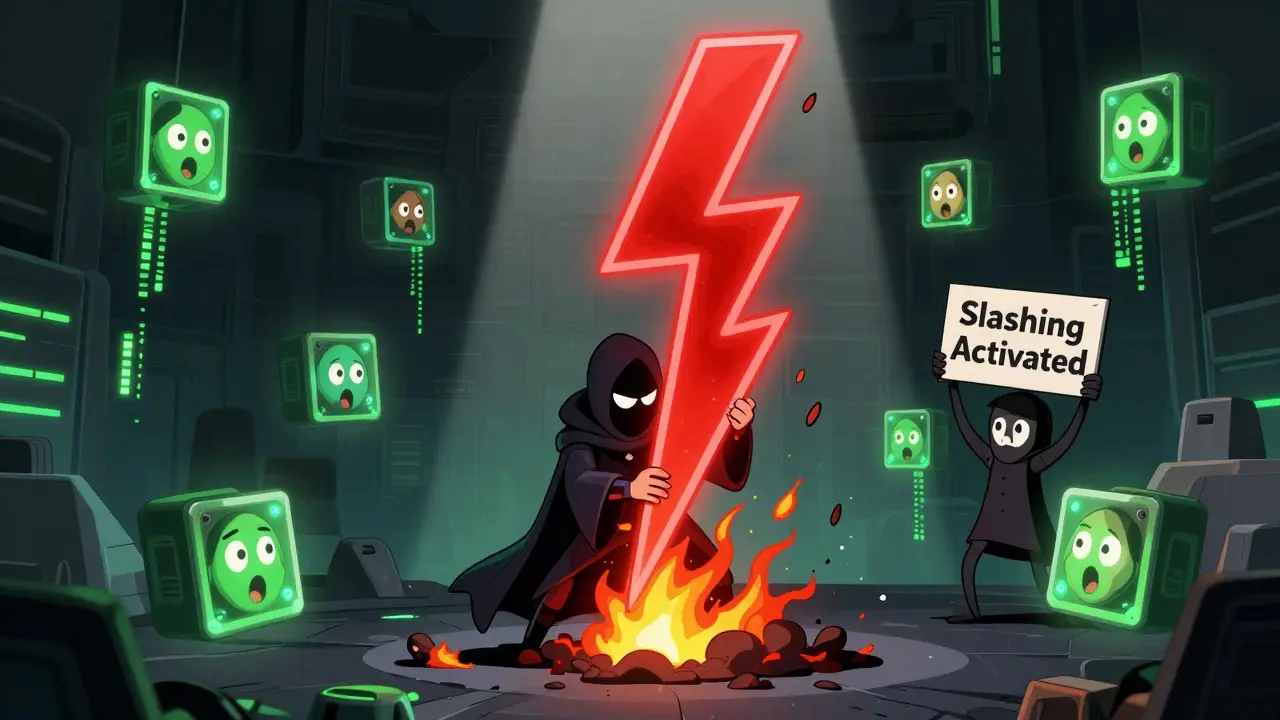
Myth: PoS Is Less Proven Than PoW
Bitcoin’s been running for 15 years. Ethereum PoS? Just over two. So, the argument goes, it hasn’t been tested. But that’s ignoring what’s actually happened. Ethereum’s Beacon Chain-the PoS backbone-ran for over a year before merging with the main chain. It processed millions of blocks without a single successful attack. Since The Merge, it’s handled over 150 million blocks. Slashing mechanisms have worked exactly as designed. Validator clients like Prysm and Lighthouse have cut critical bugs from 12 in 2020 to just 2 in 2023, according to Snyk’s security reports. Meanwhile, PoW networks like Bitcoin have faced their own issues: 51% attacks on Bitcoin Gold and Verge, where attackers temporarily took over mining power and double-spent coins. PoS doesn’t eliminate risk. But it makes attacks economically irrational. That’s a stronger form of security.Myth: PoS Is Easy to Run-No Technical Skills Needed
This one trips up a lot of new stakers. You see ads: “Earn 4% passive income with one click!” But running a validator node isn’t like buying a stock. It’s like running a small server. You need to keep your machine online 24/7. Update software regularly. Protect your private keys. One misstep-and you get slashed. Reddit’s r/ethstaker community has over 215,000 members. A quarter of the top troubleshooting posts are about accidental slashing. One user forgot to update their client. Another lost their withdrawal key. Another’s server crashed during a network upgrade. These aren’t edge cases. They’re common. The Ethereum Foundation says even experienced users need 4-8 hours to set up correctly. For beginners? It’s a full-time learning project. That’s why institutions like Coinbase Cloud report 99.98% uptime across 56,000 validators. They have teams of engineers. They use redundant systems. They monitor everything. For most people, using a trusted staking provider isn’t a compromise-it’s the smart choice.Myth: PoS Is Insecure Because of Liquid Staking
Liquid staking lets you stake ETH and get a token in return. That’s great for liquidity. But critics say it creates a single point of failure. If Lido or Coinbase gets hacked, does the whole network collapse? No. Liquid staking tokens (like stETH) are just claims on your staked ETH. Even if Lido went offline tomorrow, your ETH would still be locked in the Ethereum network. You’d just have to wait to withdraw it. The underlying PoS consensus doesn’t rely on any single provider. The protocol doesn’t care who runs the node. It only cares that the validator signs correctly. The real risk isn’t technical-it’s trust. If you use a centralized provider, you’re trusting them not to be hacked, not to censor transactions, not to disappear. That’s a human risk, not a protocol risk. And it’s why many advanced users still run their own nodes. But again-that’s a choice. Not a flaw in PoS itself.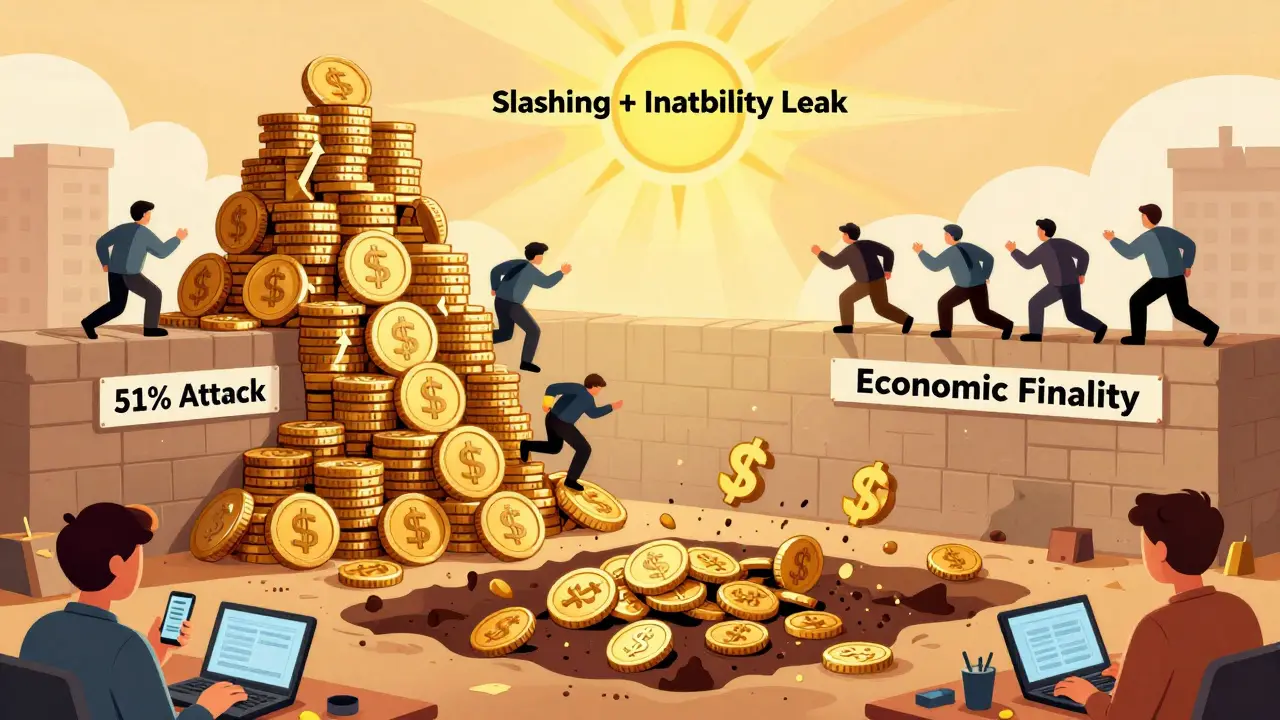
Myth: PoS Can’t Scale or Adapt
Some say PoS is stuck. That it can’t evolve like PoW. But look at what’s coming. Ethereum’s upcoming Verkle Tree upgrade, planned for 2025, will reduce validator hardware needs by 90%. That means you could run a node on a Raspberry Pi. That’s not just scaling-it’s decentralizing further. Then there’s EigenLayer, a new protocol that lets you “restake” your ETH to secure other applications. It’s a game-changer. But it also introduces new risks: if one app gets hacked, could it drag down the whole network? That’s being studied. But the fact that developers are building on top of PoS shows it’s not stagnant. It’s a platform. And it’s growing.Reality: PoS Security Is About Incentives, Not Hardware
The biggest misunderstanding about Proof of Stake is that it’s supposed to be like Proof of Work. It’s not. PoW is about computational power. PoS is about economic alignment. The network doesn’t pay you to solve puzzles. It pays you to behave. And if you don’t? You lose everything. Ethereum’s security doesn’t come from the most powerful computers. It comes from the fact that attacking it costs more than you’ll ever make. The slashing mechanism, the economic finality, the inactivity leak-all of it is designed to make dishonesty a losing strategy. That’s not just clever. It’s elegant. And it’s working. Over $142 billion is locked in PoS networks as of late 2023. Ethereum alone holds $52 billion. That’s not because people are naive. It’s because they’ve seen the math. They’ve seen the slashing events. They’ve watched the network stay up through market crashes, software bugs, and global outages.What You Should Do Now
If you’re thinking about staking:- Use a trusted staking provider if you’re not technical. Coinbase, Kraken, or Lido are fine.
- Never share your withdrawal key. Ever.
- Don’t panic if your staked ETH drops in value. That’s normal. Your rewards are in ETH, not USD.
- If you want to run your own node, start with a testnet. Practice first.
- Remember: PoS isn’t perfect. But it’s the most secure, efficient, and scalable system we’ve ever built for decentralized networks.
Proof of Stake isn’t a gamble. It’s a contract. And so far, everyone’s kept their word.
Is Proof of Stake really more secure than Proof of Work?
Yes, in practice. PoW relies on hardware and electricity-attackers can rent computing power. PoS relies on economics: attacking it means losing your own money. Ethereum’s slashing system has already burned over $3 million in staked ETH for misbehavior. The cost to attack is higher than the reward, making PoS more secure per dollar spent.
Can I get slashed for running a PoS validator?
Yes, if you make certain mistakes. Signing two blocks at once, going offline too long, or misconfiguring your validator client can trigger slashing. Ethereum has three main slashing conditions. Penalties range from losing 0.5 ETH to losing your entire stake. Most slashing cases are due to human error, not protocol flaws.
Do I need 32 ETH to stake on Ethereum?
You need 32 ETH to run your own validator node. But you can stake any amount using liquid staking services like Lido or Coinbase. These platforms pool your ETH with others to meet the 32 ETH requirement. You get a token (like stETH) representing your share and earn proportional rewards.
Is staking ETH safe?
The Ethereum network itself is very secure. But your personal safety depends on how you stake. If you use a reputable exchange or staking provider, your risk is low. If you run your own node, you’re responsible for security: keeping keys safe, updating software, and avoiding downtime. The biggest risk isn’t hacking-it’s losing your withdrawal key or misconfiguring your validator.
What’s the biggest threat to Proof of Stake?
The biggest threat isn’t a technical attack-it’s stake centralization. If too much ETH gets controlled by a few large staking pools, the network becomes vulnerable to collusion. That’s why Ethereum encourages decentralization through lower hardware requirements and tools like EigenLayer. Long-term, the challenge is keeping the distribution of staked ETH broad and diverse.

Comments
Steve B
It’s fascinating how we’ve replaced physical mining with financial mining. The same power structures just got a blockchain coat of paint. Who really benefits? Not the guy in Lagos trying to buy his first ETH. The system rewards those who already have, then calls it ‘decentralized.’
And don’t get me started on ‘economic finality.’ That’s just a fancy way of saying ‘you’ll lose your money if you try to cheat.’ So we’re secure because greed is punished? That’s not security-that’s extortion with a whitepaper.
Brian Martitsch
LOL. ‘Liquid staking = accessibility.’ Bro, you’re not staking-you’re renting your ETH to a corporation. You’re not a validator. You’re a customer. And customers don’t own the network.
Also, ‘$3.2M slashed’? Cute. That’s pocket change for a whale. They laugh while you cry.
Sarah Glaser
There’s a deeper truth here: security isn’t just about protocols. It’s about trust in systems designed by humans. PoS doesn’t eliminate human failure-it just shifts where it happens.
The real innovation isn’t slashing. It’s making participation possible without owning a data center. That’s revolutionary. Even if you use Lido, you’re still part of a global, permissionless network. That matters.
roxanne nott
lol the author thinks ‘67% use liquid staking’ means it’s decentralized. nah. it means 67% are too lazy to run a node. and now they’re trusting a single point of failure called ‘lido’ like it’s a bank.
also ‘elegant’? this system is a house of cards built on gas fees and delusions.
Jayakanth Kesan
Man, I staked 0.5 ETH on Lido last year. Got stETH, got my rewards, slept well. No server, no drama. If this is ‘centralization,’ then I’m all for it.
Meanwhile, my cousin in India mines crypto on his phone. He doesn’t care about ‘validators.’ He just wants to eat. PoS lets him do that. That’s the real win.
Naman Modi
So PoS is ‘more secure’ because you lose money if you cheat? That’s not security. That’s a casino.
And ‘economic finality’? That’s just ‘we hope no one gets greedy.’ What if someone is? What if a sovereign wealth fund buys 51%? You think the market will save you?
Bitcoin’s 51% attack is expensive. PoS’s is just… cheaper. And more likely.
Aaron Heaps
‘Slashing burned $3.2M’ - wow. That’s like saying ‘the bank lost $3.2M in fraud, so it’s safe.’ No. That’s proof it’s being attacked. Constantly.
And ‘inactivity leak’? That’s a backdoor for the rich to steal from small stakers who miss a single update. You call that ‘elegant’? It’s predatory.
Amit Kumar
Bro, you think you’re safe because you use Coinbase? You’re not. You’re a tenant. The real power? It’s in the hands of the top 10 staking pools. They control 60% of staked ETH. That’s not decentralization. That’s oligarchy with a blockchain logo.
And don’t tell me about ‘economic finality’-when the price crashes, and everyone tries to exit at once? Who’s gonna pay for the liquidity? You? Me? The protocol? Nah. It’s all smoke and mirrors.
Mmathapelo Ndlovu
I love how this post tries to sound so calm and rational… but it’s still defending a system where your money gets burned if you sneeze wrong. 😔
I get it-PoS is efficient. But efficiency shouldn’t come at the cost of vulnerability. What if your node goes down because your power went out? You lose everything. That’s not fair. That’s not secure. That’s just… cruel.
Collin Crawford
It is imperative to note, with the utmost rigor, that the assertion of ‘economic finality’ as a security mechanism is not only conceptually unsound but empirically unverified under conditions of extreme market volatility or coordinated state actor intervention. The entire framework presumes rational actors, which is a fallacy rooted in classical economic theory, long since discredited by behavioral finance.
Furthermore, the notion that ‘$3.2 million slashed’ constitutes a deterrent is statistically negligible when measured against the $52 billion in staked assets. The risk-reward calculus is inverted. One must conclude: the system is not secure-it is merely opaque.
chris yusunas
They say PoS is for the people. But if you ain’t got 32 ETH or a bank account, you’re just a spectator. The rich get to vote. The rest of us just watch the show.
And don’t get me started on ‘liquid staking’-it’s like giving your keys to your neighbor and calling it ‘homeownership.’
Still… at least it’s not burning the planet. So I’ll take it. But don’t call it fair.
Lloyd Yang
Let’s be real-this whole debate is missing the forest for the trees. PoS isn’t about whether you can attack it. It’s about whether you’d want to. The real genius isn’t slashing. It’s that every single validator, whether they’re a billionaire or a college student using Lido, has skin in the game. Their financial interest is aligned with the network’s survival.
And that’s the opposite of PoW, where miners just want to sell their hardware and cash out. They don’t care if Bitcoin survives. They just want to get paid. But in PoS? If the network dies, you lose everything. That’s not a bug. That’s the entire design.
Look at the data: over 150 million blocks processed. Zero successful consensus attacks. Slashing has worked exactly as intended-punishing bad actors, not innocent ones. The fact that people still fear it says more about their misunderstanding than the tech’s flaws.
And yes, running your own node is hard. But that’s why we have tools, communities, and providers. No one expects you to build a rocket ship in your garage. You don’t need to be an engineer to ride a train. Just don’t stand on the tracks.
Also, the idea that liquid staking is a ‘single point of failure’ is laughable. If Lido went dark tomorrow, your stETH wouldn’t vanish. It’s still backed by ETH locked in the protocol. The token is just a receipt. You can still withdraw. It’s not magic. It’s math.
And yes, there are risks. But they’re human risks-not protocol risks. The same way your bank account is safe from hacking… until you click a phishing link. That’s not the bank’s fault. That’s yours.
Finally, the claim that PoS can’t scale? Look at Verkle Trees. Look at EigenLayer. PoS is a platform. PoW is a dead end. Bitcoin’s energy use is a moral crisis. Ethereum’s is a blueprint for the future.
This isn’t about ‘trust.’ It’s about incentives. And so far, the incentives are working. The network is alive. The validators are honest. The attacks are expensive. And the people? They’re still staking. Not because they’re dumb. Because they’re smart.
Zavier McGuire
So you’re telling me I need to run a server 24/7 or I lose money? And if I mess up I get punished? That’s not security. That’s a trap for the poor.
Why should I care about a network that punishes me for being human?
Bitcoin’s simple. Mine or don’t. No drama. No slashing. No stress.
Just say no to PoS. It’s not for regular people.
Jordan Renaud
It’s easy to fear what you don’t understand. PoS isn’t perfect, but it’s the best we’ve got. It’s efficient. It’s scalable. It’s alive.
And for every person who says ‘it’s centralized’-look around. You’re reading this on a device powered by a global network that runs on less energy than a toaster.
That’s not magic. That’s progress.
Luke Steven
People keep comparing PoS to PoW like they’re the same thing. They’re not. PoW is a race to burn electricity. PoS is a game of alignment.
The network doesn’t pay you to compute. It pays you to be honest. And if you’re not? You lose everything.
That’s not a weakness. That’s a strength.
And yes, it’s new. But new doesn’t mean broken. It means evolving.
Don’t fear the change. Be part of it.
Ellen Sales
ohhh so now we’re supposed to be impressed that the rich get to control everything… and we call it ‘accessibility’?? 😂
liquid staking = trust the bank again. just with more crypto buzzwords.
and ‘slashing’? yeah cool, you burn 3 mil… but only if you’re dumb enough to get caught. the whales? they’re laughing.
poor people get slashed. rich people get rewarded. classic.
Dan Dellechiaie
Let’s not confuse liquidity with decentralization. Lido controls 32% of staked ETH. That’s not a feature-it’s a systemic risk. And when the next black swan hits, and everyone tries to withdraw at once, you’ll see how ‘secure’ this system really is.
Also, ‘economic finality’ is just a euphemism for ‘we hope the market doesn’t crash.’
And you call this ‘elegant’? It’s a house of cards built on fiat-backed optimism.
Radha Reddy
I appreciate the clarity in this post. Many misunderstand PoS as a replacement for PoW. But it’s not. It’s an evolution. The incentives are clearer. The energy use is lower. The security model is more aligned with human behavior.
Yes, there are risks. But they’re manageable. And they’re far less catastrophic than the environmental cost of PoW.
For those who say ‘it’s not proven’-look at the data. 150 million blocks. No consensus failures. That’s not luck. That’s design.
Shubham Singh
Proof of Stake is a Ponzi scheme dressed in whitepaper. The 32 ETH requirement is a gate. The liquid staking providers are the gatekeepers. The slashing mechanism is a threat. The ‘security’ is a mirage.
Bitcoin is the only true decentralized network. Everything else is a corporate fantasy.
Charles Freitas
‘Elegant’? More like ‘elegant exploitation.’
You say ‘attacking costs more than it’s worth’-but what if you’re a nation-state? What if you don’t care about profit? What if you just want to break it?
And ‘slashing’? That’s not punishment. That’s extortion. You’re forced to trust a system that can erase your life savings for a typo.
This isn’t security. It’s psychological warfare.
Rachel McDonald
They say ‘use a staking provider’ like it’s no big deal. But what if Coinbase gets hacked? What if they freeze withdrawals? What if they get regulated out of existence?
You’re not staking. You’re gambling.
And the fact that people call this ‘safe’? That’s the real scam.
Vijay n
PoS is a controlled demolition of decentralization disguised as innovation
the 32 eth requirement is a gate the rich built
liquid staking is a trap for the naive
slashing is a weapon
and you call this progress
they took the power from miners and gave it to banks
and you clapped
Alison Fenske
I just want to say… I started staking because I believed in this. Not because I understood the tech. But because I believed in the people behind it.
And yeah, I’m scared sometimes. But I’m more scared of a world where crypto is just for the rich. Where the only way to participate is to own a server or a fortune.
So I use Lido. I don’t run a node. But I still feel like I’m part of something bigger.
That’s worth something.
Grace Simmons
Let me be clear: America built the internet. America built Bitcoin. And now we’re letting foreign entities control the future of finance through ‘liquid staking’? This isn’t innovation. It’s surrender.
If we don’t demand sovereign staking, we’re handing our digital sovereignty to China, India, and Nigeria.
Wake up.
Steve B
Interesting. You say PoS is ‘elegant.’ But elegance without justice is just beauty with a knife.
What if the rich collude? What if they control the majority of validators through a few pools? The protocol doesn’t care. It just sees signatures.
And then what? The network runs… but it’s no longer decentralized. It’s just… managed.
That’s not security. That’s control.
Sarah Glaser
You’re right to worry about centralization. But the solution isn’t to go back to PoW-it’s to build better tools.
Lower hardware requirements. More open-source clients. Incentives for small validators. That’s what’s coming.
And yes, Lido is big. But so was Amazon. And then came Shopify. And then came alternatives.
Decentralization isn’t a state. It’s a process.
And we’re still in the early chapters.