
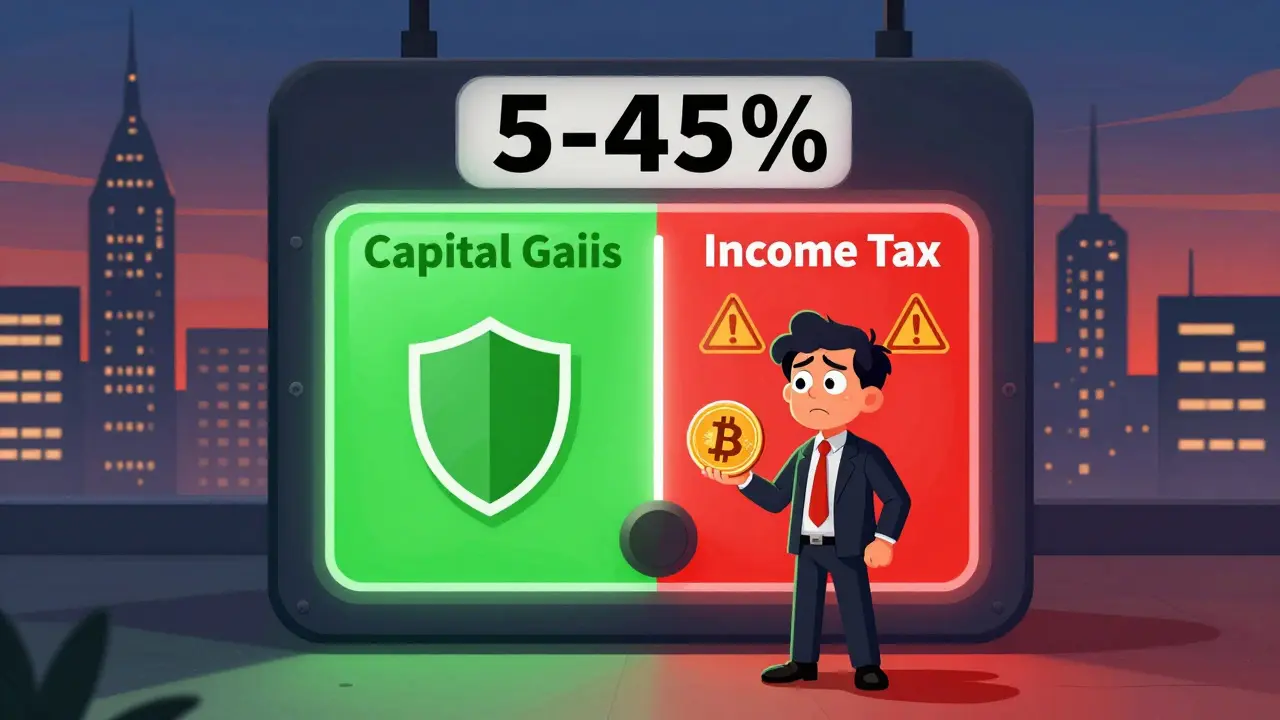
You’ve likely seen headlines screaming about South Korea taxing crypto profits at rates between 5% and 45%. It sounds terrifying if you’re holding a bag of Bitcoin or Ethereum. But here is the reality check that most clickbait articles skip: that wide range isn’t a single flat rate applied to everyone. It’s a complex mix of two different tax buckets-capital gains and ordinary income-and a generous exemption threshold that protects most casual investors.
As we move through 2026, the landscape has shifted significantly. The government delayed the full implementation of these taxes until January 2027 following political negotiations in late 2024. This delay gives traders breathing room, but it also means compliance preparation is critical right now. If you are earning crypto in South Korea, understanding whether your profit counts as a 'gain' or 'income' will determine whether you pay a flat 20% or up to nearly 50%.
The 20% Capital Gains Tax: The Standard Rule
For the vast majority of retail investors who buy low and sell high, the relevant tax is the Capital Gains Tax (CGT). This applies to profits from selling or trading cryptocurrencies like Bitcoin, Ethereum, or Solana against fiat currency (KRW) or other assets.
Here is the key detail that changes everything: the exemption threshold. You only pay this tax if your total annual cryptocurrency gains exceed 50 million Korean Won (approximately $35,900 USD). If your profits stay below this number, your capital gains tax is effectively zero.
If you cross that 50 million KRW line, the rate is set at 20%. However, you must add local inhabitant taxes, which typically bring the effective rate to 22%. This rate is relatively moderate compared to some global jurisdictions that treat all crypto gains as regular income subject to higher marginal rates.
| Tax Category | Applicable Scenario | Rate / Threshold | Effective Rate (with Local Tax) |
|---|---|---|---|
| Capital Gains Tax | Selling/trading crypto for profit | 20% on gains over 50M KRW/year | ~22% |
| Income Tax | Mining, staking, airdrops, payments | Progressive brackets (6.6% - 49.5%) | Varies by total income |
| Value-Added Tax (VAT) | Crypto transactions | Not applicable | 0% |
Where the "Up to 45%" Comes From: Income Tax
The upper end of that scary "5-45%" range comes from how South Korea treats active earnings versus passive investment growth. If you receive crypto not by buying it, but by earning it, it falls under Ordinary Income Tax. This includes rewards from mining, staking, yield farming, airdrops, or getting paid for services in cryptocurrency.
This is classified as "other income" and is taxed according to South Korea’s progressive individual income tax brackets. These brackets range from 6% to 45%, plus local taxes that can push the top marginal rate to 49.5%. This explains the high-percentage figures circulating online. If you are a high earner receiving significant staking rewards or working as a freelancer paid in USDT, those rewards are added to your total annual income and taxed at your highest bracket.
Unlike capital gains, there is no specific exemption threshold for this type of income. Even small amounts of staking rewards technically need to be declared, though minor incidental income might fall under general de minimis rules depending on your overall financial profile.

The 2027 Delay: Why It Matters Now
In December 2024, the ruling People Power Party (PPP) and the opposition Democratic Party of Korea (DPK) reached a compromise that postponed the mandatory crypto tax reporting and payment system until January 2027. Initially scheduled for 2022, then delayed to 2025, this latest pushback reflects the political sensitivity of regulating the digital asset market.
Why did they delay? Industry advocates argued that premature implementation would stifle innovation and drive investors offshore. For you, the investor, this means you have more time to organize your records. However, do not mistake this delay for an exemption. The National Tax Service (NTS) continues to issue clarifications, such as the July 2025 ruling requiring residents to report comprehensive income tax on virtual assets received from foreign corporations.
The delay also highlights the complexity of enforcement. Blockchain transparency makes transactions traceable, but distinguishing between a taxable trade and a non-taxable transfer across your own wallets remains administratively challenging for both users and the government.
Compliance Reality: Tracking Your Cost Basis
When the 2027 deadline arrives, the burden of proof will be on you. South Korea does not offer automatic data sharing with exchanges in the same way some European countries do, but the NTS expects accurate self-reporting. The biggest hurdle for traders is calculating the cost basis for every transaction.
Consider this scenario: You bought Bitcoin in 2021, sold half in 2022, and staked the rest in 2023. To calculate your 2027 capital gains, you need to know exactly which coins you sold and what their purchase price was in KRW at that moment. Crypto-to-crypto trades are treated as taxable events. Selling ETH for BTC triggers a capital gain calculation based on the KRW value of the ETH at the time of the swap.
Tax professionals estimate that active traders need 10-20 hours of initial setup to organize historical data, followed by monthly maintenance. You will need:
- Detailed transaction histories exported from every exchange used.
- Timestamps for every buy, sell, and swap.
- The KRW value of each asset at the exact time of transaction.
- Clear documentation of transaction purposes (e.g., "investment," "payment for service").
DeFi activities complicate this further. Yield farming rewards and liquidity pool fees are often taxed as ordinary income, not capital gains. Without clear guidance on valuing complex DeFi positions, many users rely on specialized crypto tax software to generate reports compatible with Korean tax forms.

Foreign Investors and Non-Residents
If you are not a tax resident of South Korea, the rules change slightly. Foreign individuals and corporations disposing of crypto assets may face an 11% withholding tax on the transfer price or a 22% tax on net capital gains. This distinction is crucial for international traders using Korean exchanges or interacting with Korean entities. Always consult a local tax advisor to determine your residency status and applicable treaty benefits.
Practical Steps for 2026 Preparation
Even though the major enforcement date is 2027, you should start preparing now. Here is a checklist to ensure you are ready when the clock starts ticking:
- Consolidate Wallets: Reduce the number of exchanges and self-custody wallets you use. Fewer sources mean fewer export files to manage.
- Label Transactions: Manually tag transactions in your ledger or spreadsheet as "Trade," "Income," or "Transfer." This distinction determines whether you face the 22% CGT or the progressive income tax.
- Monitor the 50M KRW Threshold: Keep a running tally of your realized gains. If you are close to the limit, consider tax-loss harvesting strategies to offset profits before the year ends.
- Separate Business vs. Investment: If you are running a node or providing professional trading services, keep separate accounting. Mixing personal investments with business income can lead to misclassification and higher tax liabilities.
The South Korean approach aims to balance investor protection with revenue generation. While the rates sound high, the high exemption threshold for capital gains ensures that casual holders remain largely unaffected. The real risk lies in misclassifying income or failing to track cost basis accurately. By staying organized and understanding the difference between gains and income, you can navigate the upcoming regulatory changes without panic.
Is crypto tax-free in South Korea?
No, it is not entirely tax-free. However, capital gains are exempt from tax if your annual profits are below 50 million KRW (approx. $35,900 USD). Above this threshold, a 20% tax (plus local taxes) applies. Income from mining or staking is always taxable.
When does the crypto tax start in South Korea?
The full implementation of the crypto tax framework is scheduled for January 2027. This date was confirmed after political negotiations in late 2024, delaying previous plans for 2022 and 2025.
How much tax do I pay on staking rewards?
Staking rewards are considered ordinary income, not capital gains. They are taxed at your progressive income tax rate, which ranges from 6.6% to 49.5% including local taxes, depending on your total annual income.
Do I pay VAT on crypto transactions?
No. Cryptocurrencies are not treated as goods or services under South Korean law, so Value-Added Tax (VAT) is not imposed on crypto-to-crypto or crypto-to-fiat transactions.
What happens if my gains are under 50 million KRW?
If your total annual capital gains from selling or trading crypto are below 50 million KRW, you do not pay any capital gains tax. This exemption protects smaller retail investors from the 20% levy.

Write a comment