
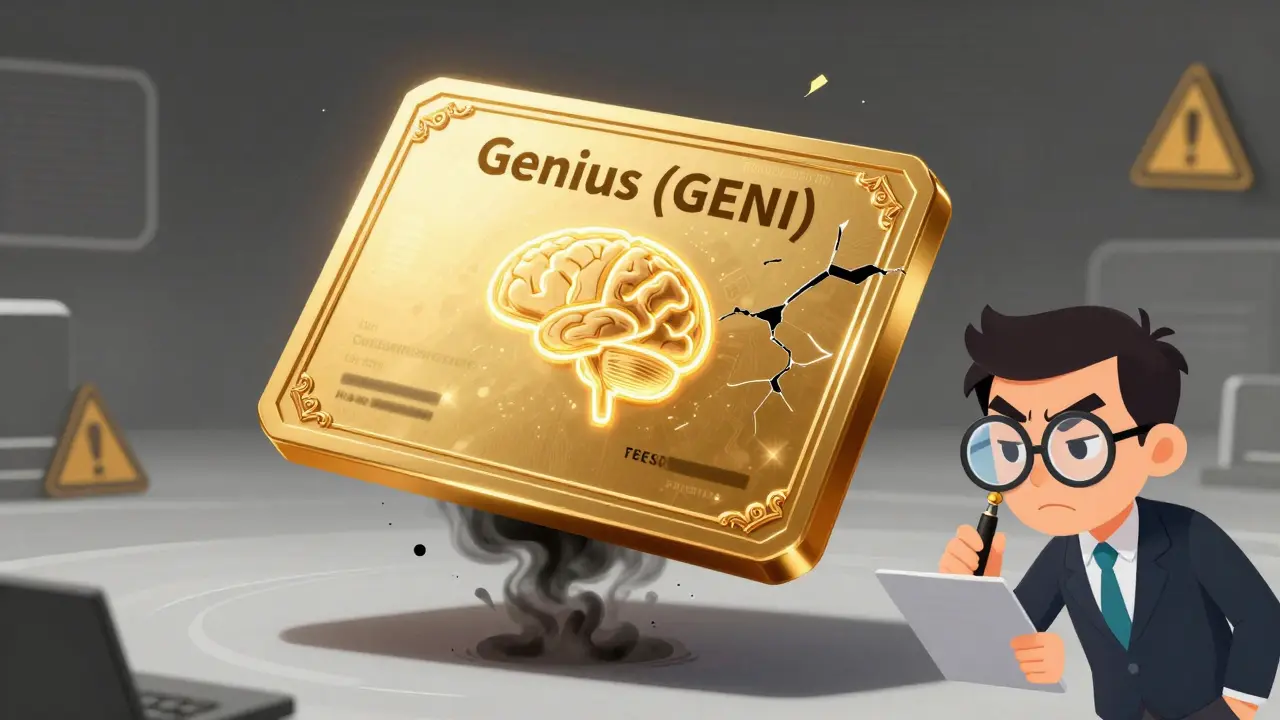
Have you seen a crypto coin promising "hyper-yield" returns powered by artificial intelligence? If so, you’ve likely stumbled across Genius (GENI), described as the first hyper-yield, A.I. driven blockchain Certificate of Deposit. The pitch sounds too good to be true: passive income, AI optimization, and blockchain security all wrapped into one token. But before you click "buy," you need to understand what this project actually is-and more importantly, what it isn’t.
In the world of cryptocurrency, marketing buzzwords often hide thin fundamentals. Genius (GENI) is no exception. While the name suggests intelligence and innovation, the market data tells a story of extreme volatility, negligible liquidity, and significant information gaps. This guide breaks down the reality behind the GENI token, helping you decide whether it belongs in your portfolio or your "avoid at all costs" list.
What Is the Genius (GENI) Token?
To understand Genius, we have to look past the flashy terminology. The project positions itself as a Blockchain Certificate of Deposit that uses artificial intelligence to optimize yield generation. In traditional banking, a Certificate of Deposit (CD) is a savings account with a fixed term and interest rate. You lock up your money, and the bank pays you interest.
Genius attempts to replicate this on the blockchain. Instead of locking funds in a bank, you hold GENI tokens. The promise is that an AI algorithm manages these assets to generate "hyper-yields." However, there is a critical distinction here: holding a token is not the same as holding a secure, insured deposit. In fact, most "yield-generating" tokens in crypto are highly speculative instruments rather than safe savings vehicles.
The core value proposition relies on two main pillars:
- AI-Driven Yield Optimization: The claim that artificial intelligence actively trades or allocates assets to maximize returns.
- Passive Income Generation: The idea that simply holding the token appreciates its value or generates staking rewards without active effort.
While these concepts sound appealing, the execution details are scarce. There is no public whitepaper detailing the specific AI models used, nor are there transparent reports on how yields are generated. Without transparency, "AI-driven" becomes a vague marketing term rather than a technical feature.
Market Data: The Numbers Behind the Hype
Let’s look at the hard data. As of mid-2026, Genius (GENI) sits firmly in the category of micro-cap cryptocurrencies. These are tokens with extremely small market capitalizations, making them highly susceptible to manipulation and rapid price swings.
| Metric | Value / Range | Context |
|---|---|---|
| Price (USD) | ~$0.000001 | Extremely low unit price; requires buying millions of tokens for meaningful exposure. |
| Market Cap | $287,000 - $311,500 | Ranks between #4907 and #7334 globally; indicates very small investor base. |
| Daily Volume | $1,100 - $2,877 | Critically low liquidity; large buys/sells will drastically move the price. |
| Circulating Supply | ~308-310 Billion | Massive supply dilutes individual token value significantly. |
| All-Time High | $0.00014178 | Current price is ~99% below ATH; shows severe historical depreciation. |
The daily trading volume is perhaps the most alarming statistic. With less than $3,000 in daily trades, the market is essentially illiquid. This means if you decide to sell your GENI tokens during a downturn, you might not find enough buyers to execute your order at a fair price. Slippage-the difference between the expected price and the executed price-could wipe out a significant portion of your investment.
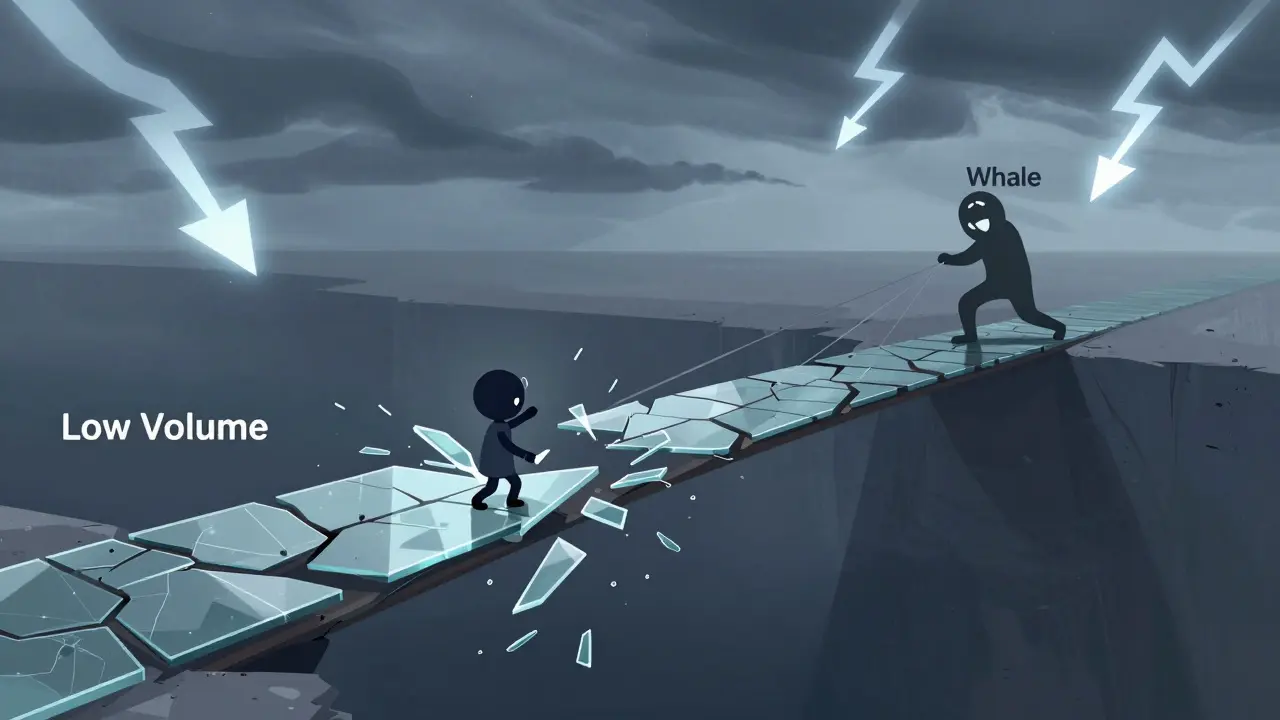
The Liquidity Trap: Why Low Volume Matters
Liquidity is the lifeblood of any financial asset. For major coins like Bitcoin or Ethereum, you can buy or sell millions of dollars worth instantly without moving the needle. For Genius (GENI), the opposite is true.
Imagine trying to sell a rare painting in a town where only three people know about it. You won’t get a fair market price because there’s no competition among buyers. Similarly, GENI’s low volume creates a "liquidity trap." Here’s why this matters for you:
- Exit Risk: If the project fails or news turns negative, you may be unable to sell your tokens quickly. The order book is too thin to absorb large sell orders.
- Price Manipulation: With such low volume, a single whale (a large holder) can manipulate the price. They can buy up available supply to spike the price, attract retail investors, and then dump their holdings, crashing the price back down. This is known as a "pump and dump" scheme.
- Exchange Delisting: Many tracking platforms report inconsistent data, with some stating GENI is "not traded anywhere." This suggests the token may have been delisted from reputable exchanges due to lack of activity or compliance issues.
If you’re looking for passive income, remember that you cannot earn yield on an asset you cannot easily exit. Illiquidity is a silent killer of crypto investments.
Red Flags: Missing Transparency and Technical Gaps
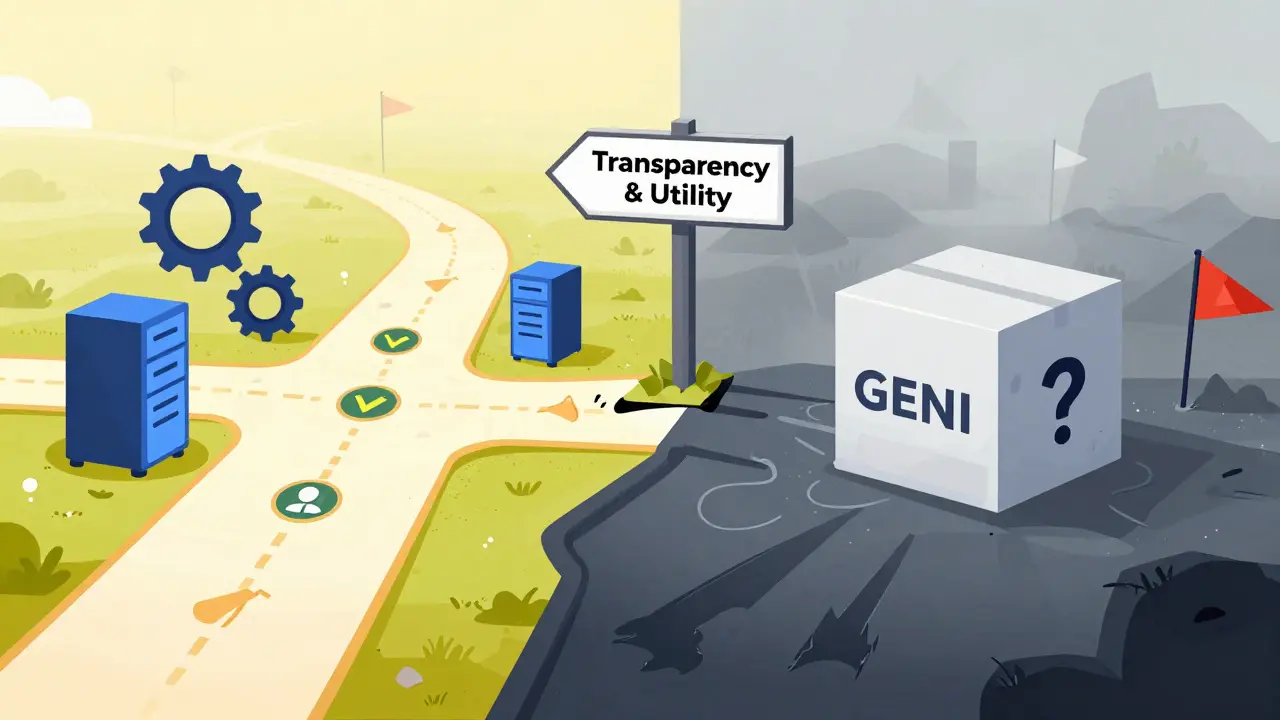
When evaluating a crypto project, especially one claiming advanced technology like AI, transparency is non-negotiable. Genius (GENI) falls short in several critical areas.
1. Lack of Technical Documentation There is no readily available whitepaper or technical audit detailing how the "AI" works. Does it use machine learning algorithms to trade? Is it a decentralized autonomous organization (DAO)? Or is it simply a smart contract that redistributes tokens? Without code repositories or open-source audits, you are trusting the developers’ word alone.
2. Anonymous or Unverified Team Reputable projects disclose their team members’ identities and professional backgrounds. Genius (GENI) has minimal online presence beyond basic social media links (@Genicrypto on Twitter). There are no LinkedIn profiles, no public interviews, and no track record of previous successful projects. An anonymous team increases the risk of a "rug pull," where developers abandon the project and take the remaining funds.
3. Vague Value Proposition The term "Certificate of Deposit" implies regulatory compliance and insurance, similar to FDIC-insured accounts in the US. However, crypto tokens are not insured. If the smart contract has a bug or is hacked, your funds are gone forever. Using banking terminology for unregulated crypto assets can be misleading and potentially deceptive.
4. Inconsistent Market Data Different platforms show conflicting information. Some list GENI with slight gains, others show steep declines, and some indicate no trading activity at all. This inconsistency suggests the token is not listed on major, regulated exchanges but rather on obscure or decentralized platforms with poor oversight.
How Does GENI Compare to Established AI Cryptos?
To put GENI in perspective, let’s compare it to established players in the AI-crypto space. Projects like Fetch.ai (FET), Render (RNDR), and SingularityNET (AGIX) have clear use cases, active development teams, and substantial liquidity.
| Feature | Genius (GENI) | Established AI Tokens (e.g., FET, RNDR) |
|---|---|---|
| Market Cap | ~$300k | $1B+ (Top 100 rankings) |
| Liquidity | Very Low (<$3k/day) | High (Millions per day) |
| Technical Docs | Missing/Vague | Comprehensive Whitepapers & Audits |
| Team Visibility | Anonymous/Low Profile | Public, Verified Teams |
| Risk Level | Extreme (Speculative) | Moderate to High (Growth) |
The contrast is stark. Established AI cryptos solve real problems: FET provides automated agent services, RNDR offers GPU rendering power, and AGIX democratizes access to AI models. GENI, by comparison, offers a vague promise of "hyper-yield" without a clear utility or product. Investing in GENI is closer to gambling than investing in technology.
Who Should Avoid Genius (GENI)?
This token is not suitable for the average investor. Specifically, you should avoid GENI if:
- You seek safety: If you want to preserve capital, GENI’s volatility and lack of insurance make it a dangerous choice.
- You need liquidity: If you might need to sell quickly, the low volume will prevent you from exiting at a fair price.
- You prefer transparency: If you require audited code, verified teams, and clear roadmaps, GENI does not meet these standards.
- You are new to crypto: Micro-cap tokens are complex and risky. Beginners should stick to top-tier assets like Bitcoin or Ethereum until they gain experience.
Even experienced traders should approach GENI with extreme caution. The potential for high returns exists, but so does the potential for total loss. The asymmetry of risk heavily favors the downside.
Final Thoughts: Proceed with Extreme Caution
Genius (GENI) presents itself as an innovative blend of AI and blockchain finance. However, the reality is a micro-cap token with negligible liquidity, missing technical documentation, and an anonymous team. The "hyper-yield" claims are unsubstantiated, and the "Certificate of Deposit" analogy is misleading in an unregulated context.
In the crypto market, if something sounds too good to be true, it usually is. The combination of AI buzzwords and passive income promises is a common tactic used by speculative projects to attract inexperienced investors. Before allocating any funds, ask yourself: Do I trust the team? Can I exit my position easily? Is the technology transparent? For GENI, the answers are largely no.
Investing is about managing risk, not just chasing returns. With GENI, the risks far outweigh the potential benefits. Consider sticking to well-established projects with proven track records, clear utilities, and strong community support. Your capital deserves better than a gamble on a token with no visible foundation.
Is Genius (GENI) a legitimate cryptocurrency?
While GENI is listed on some tracking platforms, its legitimacy is questionable due to the lack of transparency, anonymous team, and extremely low liquidity. It operates in the gray area of micro-cap speculation rather than established financial products. Always verify projects through multiple independent sources before investing.
Where can I buy Genius (GENI) tokens?
Trading GENI is difficult due to limited exchange listings. Some sources indicate it is not traded on major centralized exchanges. You may find it on smaller decentralized exchanges (DEXs), but beware of high slippage and potential scams. Never connect your wallet to unofficial sites.
What is the all-time high of GENI?
The all-time high for Genius (GENI) was approximately $0.00014178 USD. As of mid-2026, the price is around $0.000001, representing a decline of over 99% from its peak. This highlights the extreme volatility and depreciation typical of such micro-cap tokens.
Does GENI really use AI to generate yield?
The project claims to be AI-driven, but there is no public technical documentation, whitepaper, or audit confirming how this AI functions. Without verifiable proof, the "AI" label should be treated as marketing hype rather than a functional feature. Be skeptical of yield claims without transparent mechanisms.
Is it safe to invest in Genius (GENI)?
No, it is not considered safe. The token has extremely low liquidity, meaning you may not be able to sell when needed. Additionally, the lack of team transparency and technical details increases the risk of fraud or project failure. Only invest what you can afford to lose entirely, and consider safer alternatives.

Comments
Caique Muniz
lol another "ai" coin that is just a rug pull waiting to happen. the liquidity is so low u cant even sell it without crashing the price by 50%. typical scam.
Gavin Wonnacott
You are all wasting your time reading this garbage. The people who actually make money in crypto don't post on reddit begging for validation. Genius (GENI) is a pathetic attempt at mimicking real financial instruments. It's insulting to call it a CD. A CD has legal standing, insurance, and actual yield sources. This token has nothing but a twitter account and a dream of being listed on a tier-3 exchange. Stop falling for these marketing buzzwords. You're not investing; you're donating to someone's yacht fund.
Samara McCallum
i mean its funny how everyone thinks ai is magic but really its just math and most of these projects are just wrappers around random number generators. maybe the genius part is that they know we will buy it anyway because we want to believe in the future. or maybe we are just lonely and need something to talk about online
Sheldon Friesen
Let me be very clear here! This analysis is spot on!! If you see a token with $300k market cap and $1k volume, run away!!! Fast!!! Do not look back!!! The lack of a whitepaper is not just a red flag; it is a flashing neon sign saying 'SCAM'!!! Why would anyone trust an anonymous team with their life savings??? It makes absolutely no sense!!! Stay safe out there!!!
Tricia Alach
its interesting how the word genius is used so much in crypto but rarely does it apply to the devs. i think true genius is knowing when to walk away from a bad deal. this one seems pretty bad if you ask me. hope everyone stays safe though!
Jan Gilmore
I've been tracking micro-caps since 2017 and let me tell you, GENI fits the classic pump-and-dump profile perfectly. The circulating supply of 300 billion tokens is absurdly high for such a small market cap. That means even a 10x increase gets you pennies. Real AI projects like FET or RNDR have actual utility, partnerships, and code repositories. GENI has none of that. It's a ghost town with a fancy name. Don't touch it.
robert Whitehead
The moral decay of this industry is staggering. People are literally throwing their hard-earned money into black holes because they can't read a basic liquidity chart. It's disgusting. These developers prey on the ignorant and the greedy. I feel sick every time I see another 'AI' coin launched with zero transparency. You should be ashamed of yourselves for even considering buying this trash. It's not investing; it's gambling on a rigged game where the house always wins.
Mike S
Oh wow, what a disaster. Just a total catastrophe waiting to happen. The audacity to call this a 'Certificate of Deposit' is laughable. It's like calling a bicycle a Ferrari because it has wheels. The liquidity trap mentioned in the article is understated. It's a liquidity vacuum. You put money in, and it vanishes into the ether. Typical crypto nonsense. Absolutely pathetic.
H F
Wow, that table comparing GENI to established tokens is eye-opening! It really shows how far off the mark these hype coins are. I was tempted by the 'hyper-yield' promise too, but seeing the numbers puts things in perspective. Thanks for breaking this down clearly! It’s better to lose interest than lose capital, right? Let’s keep supporting projects with real fundamentals!
Michael Berggren
This is a great reminder to do our own research! 🧐 Always check the liquidity and team background before diving in. The comparison with FET and RNDR is super helpful 👍. It’s sad to see how many scams exist, but staying informed is key! 💪 Keep spreading the truth! 🚀
Ankush Pokarana
the essence of value is not in the token but in the trust placed within the system which is entirely absent here as there is no transparency nor accountability from the creators who remain hidden behind screens while profiting from the ignorance of others thus creating a cycle of exploitation that continues until the last victim falls into the trap of believing in false promises of wealth generation through artificial intelligence which is merely a tool misused for deception rather than innovation
Bianca Vilas Boas Lourenço
Ugh, why do I even bother reading these threads? 😒 Everyone is so quick to jump on the bandwagon and then cry when they get burned. It’s just drama after drama. I’m tired of seeing people get scammed over and over again. It’s exhausting. 🙄
Yash Lodha
Have you considered that the 'lack of transparency' is actually a feature, not a bug? Perhaps the anonymity is designed to protect the developers from regulatory scrutiny while they orchestrate a controlled collapse of the asset class. The low liquidity isn't an accident; it's a mechanism to ensure that only the insiders can exit. The entire narrative of 'AI optimization' is a smokescreen to distract from the fact that this is a closed-loop system designed to extract value from retail investors. Wake up.
Jesse Alston
Thanks for sharing this detailed breakdown! It’s really important to understand the risks involved with low-cap tokens. The point about slippage is crucial-many new investors don’t realize how hard it is to sell large amounts of illiquid assets. Always stick to reputable exchanges and projects with verified teams. Stay safe! 👍