
You hand over your credit card at a coffee shop, and within seconds, the transaction clears. You trust the bank to keep the money safe. Now, imagine sending that same amount in Bitcoin. There is no bank manager checking your ID. No centralized server logging your balance. Just code, math, and a global network of computers. How does anyone know you actually own the funds? And more importantly, how do we stop hackers from stealing them?
The answer lies in encryption. But not the kind of password protection you use for your email. We are talking about complex mathematical locks that make it virtually impossible to forge ownership or alter history. This article breaks down exactly how these cryptographic mechanisms work, why they are harder to crack than traditional banking systems, and what happens when you click "send" on your wallet.
The Two Keys That Rule Them All
To understand cryptocurrency security, you first need to forget everything you know about symmetric encryption-the old-school method where one key locks a box and the same key opens it. If someone steals that key, they have full access. Crypto uses something much smarter called asymmetric encryption.
In this system, you get two keys that are mathematically linked but functionally different:
- The Private Key: Think of this as your secret PIN or the physical key to your house. It proves you own the assets. If you lose it, your money is gone forever. If someone else gets it, they can spend your money.
- The Public Key: This is like your bank account number or email address. You can share it with anyone. They can send value to this address, but without your private key, they cannot move anything out.
This relationship relies on elliptic curve cryptography (ECC), specifically algorithms like secp256k1 used by Bitcoin. ECC generates these key pairs using complex geometric shapes on a graph. The magic is that while it is easy to derive a public key from a private key, doing the reverse-calculating the private key from the public key-is computationally impossible with current technology. It would take supercomputers billions of years to guess a single private key.
Signing Off: Proving Ownership Without Revealing Secrets
When you initiate a transaction, you aren't just typing a password. You are creating a digital signature. Here is how that process works in real-time:
- You open your wallet app and enter the recipient's address and amount.
- Your wallet takes the transaction data and runs it through a hash function.
- It then encrypts that hash with your private key.
- This encrypted hash becomes the digital signature attached to the transaction.
Why go through all this trouble? Because the digital signature provides three critical guarantees:
- Authorization: Only the holder of the private key could have created this signature.
- Non-repudiation: You cannot later claim you didn't send the funds. The math proves you did.
- Integrity: If anyone tries to change the amount or the recipient after you sign, the signature becomes invalid. The network rejects the tampered transaction instantly.
Network nodes (the computers running the software) verify this signature using your public key. They don't need to see your private key. They just need to confirm that the signature matches the public key associated with the funds. It is a perfect proof of ownership without exposing sensitive data.

The Fingerprint of Truth: Hashing and Merkle Trees
Signed transactions are only half the battle. Once thousands of transactions are broadcast to the network, they need to be organized into blocks. This is where hashing comes in. Specifically, Bitcoin uses SHA-256 (Secure Hash Algorithm 256-bit).
A hash function takes any input-a sentence, a file, or a block of transactions-and converts it into a fixed-length string of characters. Even if you change one comma in the original text, the resulting hash looks completely different. This property is called the "avalanche effect."
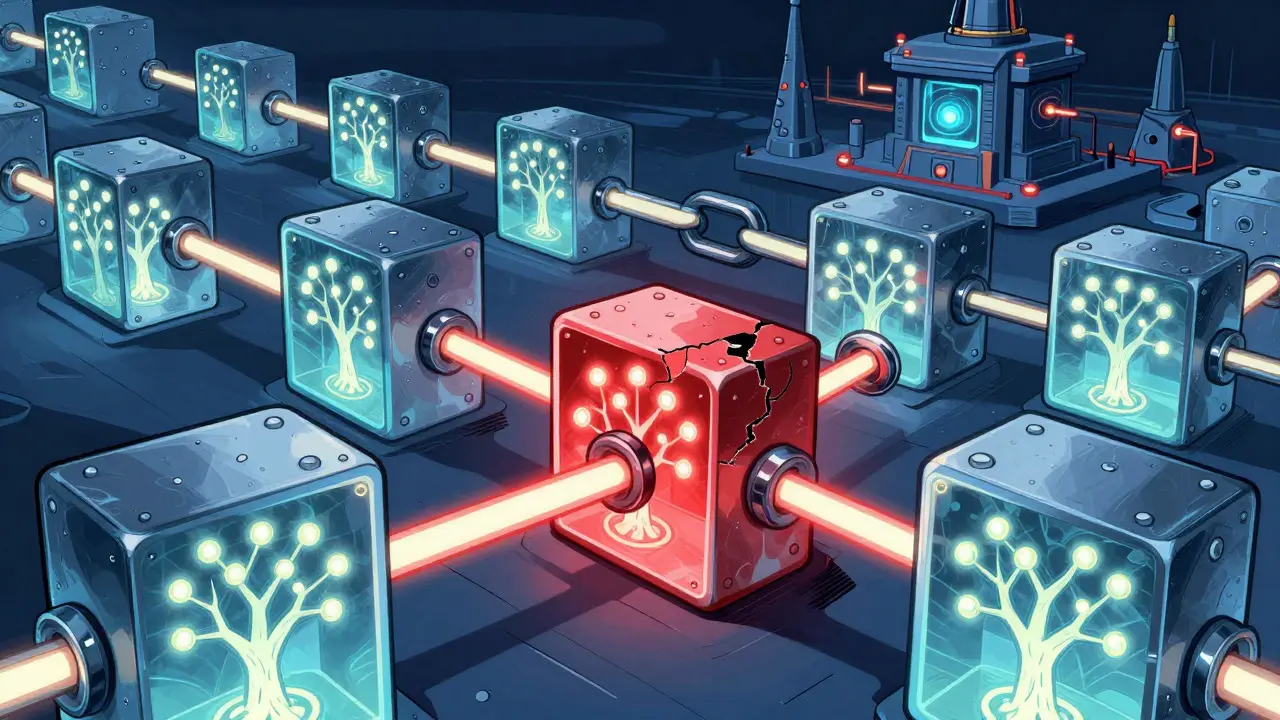
Inside every block, transactions are arranged in a structure called a Merkle tree. Each pair of transactions is hashed together, then those hashes are paired and hashed again, until a single "root hash" remains. This root hash is stored in the block header. Why does this matter? Because it allows any node to quickly verify if a specific transaction is included in a block without downloading the entire chain. It also makes tampering obvious. If a hacker changes one transaction deep in the tree, the root hash changes, breaking the link to the rest of the blockchain.
Chaining History: Immutability Through Proof-of-Work
So far, we have secured individual transactions and grouped them into blocks. But how do we secure the entire history? The answer is linking blocks together via their hashes.
Every new block contains the hash of the previous block. Imagine a chain where each link is welded shut with a unique chemical seal. If you try to alter a transaction in Block 100, the hash of Block 100 changes. Consequently, the hash recorded in Block 101 no longer matches. Block 101 becomes invalid. Then Block 102, and so on, up to the present day.
To fix this, an attacker would need to recalculate the hashes for every subsequent block faster than the honest network is adding new ones. This is prevented by Proof-of-Work (PoW). Miners compete to solve a difficult mathematical puzzle to add a block. This requires massive amounts of computational power and electricity. To rewrite history, an attacker would need to control more than 51% of the network's total computing power-a feat that is economically and logistically prohibitive for major networks like Bitcoin.
| Feature | Cryptocurrency (Bitcoin) | Traditional Banking |
|---|---|---|
| Ownership Verification | Cryptographic Digital Signature (Private Key) | Centralized Database Record |
| Data Integrity | SHA-256 Hashing & Merkle Trees | Internal Audits & Logs |
| History Alteration | Computationally Impossible (Requires 51% Attack) | Possible by Admins or Court Orders |
| Trust Model | Mathematical Certainty (Code) | Institutional Trust (People/Laws) |
Human Error vs. Mathematical Flaws
If the math is unbreakable, why do people still lose crypto? The weak link is rarely the encryption itself; it is human behavior. Losing your private key means losing access to your funds permanently. Unlike a bank, there is no "forgot password" button because no central entity holds your key.
To mitigate this risk, advanced users employ multi-signature wallets. A multi-sig setup requires multiple private keys to authorize a single transaction. For example, a corporate treasury might use a 2-of-3 scheme, meaning two out of three executives must sign off before funds move. This adds a layer of operational security on top of the cryptographic foundation.
Another emerging concern is quantum computing. Current ECC algorithms could theoretically be broken by sufficiently powerful quantum computers. However, experts estimate this threat is decades away. In the meantime, research into post-quantum cryptography is ongoing, ensuring that future upgrades can patch vulnerabilities before they become exploitable.
Conclusion: Trusting the Code
Cryptocurrency encryption transforms trust from institutions to mathematics. By combining elliptic curve cryptography for identity, digital signatures for authorization, and SHA-256 hashing for integrity, blockchain networks create a financial system that is transparent yet private, decentralized yet secure. While user error remains a challenge, the underlying cryptographic protocols have proven resilient against attacks for nearly two decades. As long as you safeguard your private keys, the math has your back.
Can cryptocurrency encryption be hacked?
The core encryption algorithms (like ECC and SHA-256) have never been mathematically broken. Most "hacks" occur due to poor user practices, such as phishing scams, malware stealing private keys, or exchanges being compromised, rather than flaws in the blockchain's cryptography itself.
What is the difference between a public key and a private key?
Your public key is like an email address; you share it to receive funds. Your private key is like a password; you keep it secret to send funds. The private key generates the digital signature that proves ownership, while the public key allows the network to verify that signature.
How does a digital signature work in crypto?
A digital signature is created by encrypting a hash of the transaction data with your private key. Network nodes then decrypt this signature using your public key to verify that the transaction was authorized by the owner and hasn't been altered since signing.
Why is SHA-256 important for Bitcoin?
SHA-256 creates unique fingerprints (hashes) for every block and transaction. It ensures data integrity by making any alteration immediately detectable. It is also the basis for Bitcoin's Proof-of-Work consensus mechanism, securing the network against double-spending and history rewriting.
Is my cryptocurrency safe from quantum computers?
Currently, yes. Existing quantum computers are not powerful enough to break elliptic curve cryptography. However, researchers are developing post-quantum cryptographic standards to ensure future-proof security once quantum technology advances significantly.

Write a comment