

When you buy Bitcoin on a spot market, you expect to get it right away. No waiting. No contracts. Just pay, and the coins show up in your wallet. That’s the whole point of a spot market - immediate exchange at the current price. But here’s the catch: spot market liquidity decides whether that trade happens smoothly or gets stuck in a mess of slippage and delayed fills.
Liquidity isn’t just a buzzword. It’s the real measure of how easily you can trade without moving the price. Think of it like a highway. A busy highway with lots of cars? You can change lanes fast, no problem. A nearly empty road? One car slows down, and everyone behind it gets stuck. Spot markets work the same way. High liquidity means tight spreads, fast fills, and minimal price impact. Low liquidity? You’re asking for trouble.
What Makes a Spot Market Liquid?
Liquidity in spot markets comes down to two things: volume and bid-ask spread. Volume tells you how much is being traded. The higher the volume, the more buyers and sellers are active. The bid-ask spread is the gap between the highest price someone is willing to pay (bid) and the lowest price someone is willing to sell for (ask). In highly liquid markets like EUR/USD or BTC/USDT, that spread can be as narrow as 0.1 pips or 0.01%. In thin markets - say, a low-cap altcoin - the spread might jump to 2% or more. That’s not just a cost. It’s a hidden tax on your trade.
Take Bitcoin. On major exchanges like Binance or Coinbase, you can trade $10 million in BTC/USDT in seconds without the price moving more than 0.05%. Why? Because there are hundreds of market makers feeding liquidity. They’re constantly quoting bids and asks, ready to take the other side of your trade. Now try the same on a small exchange with low volume. You’ll see your order eat through layers of bids, and by the time it’s filled, you’ve paid 0.5% more than you expected. That’s slippage. And it’s not rare.
Why Liquidity Matters for Execution
Execution is where the rubber meets the road. You think you’re buying BTC at $68,000. The chart says $68,000. But if the order book only has $50,000 in bids at that price, and you’re trying to buy $200,000 worth? You’re going to push the price up. That’s execution risk. High liquidity means your order gets absorbed without disturbing the market. Low liquidity? You’re the one making the market move.
Professional traders watch order depth like a radar. They don’t just look at the top bid and ask. They check how much volume sits at the next 5 levels. If there’s a wall of 500 BTC at $67,990, they know they can sell into it without a problem. If there’s only 10 BTC? They wait. Or they use limit orders. Retail traders often ignore this. They place market orders and wonder why they got a bad fill. It’s not the exchange’s fault. It’s liquidity.
Liquidity Differences: BTC vs. Altcoins vs. Forex
Not all spot markets are created equal. The top 5 Forex pairs - EUR/USD, USD/JPY, GBP/USD, AUD/USD, USD/CAD - make up nearly 70% of global spot volume. Their average bid-ask spread? Around 0.6 pips. That’s $0.60 per $10,000 traded. Bitcoin? On major platforms, it’s often under 0.01%. But drop down to a lesser-known altcoin like SHIB or DOGE on a small exchange? Spreads can hit 5% or more. That’s not trading. That’s gambling.
Here’s the truth: most retail traders lose money not because they’re wrong about direction. They lose because they trade illiquid assets. A 2023 study of 12,000 retail crypto traders showed that those who traded only BTC, ETH, and SOL lost 32% less than those who chased low-volume tokens. Why? Better execution. Tighter spreads. Less slippage.
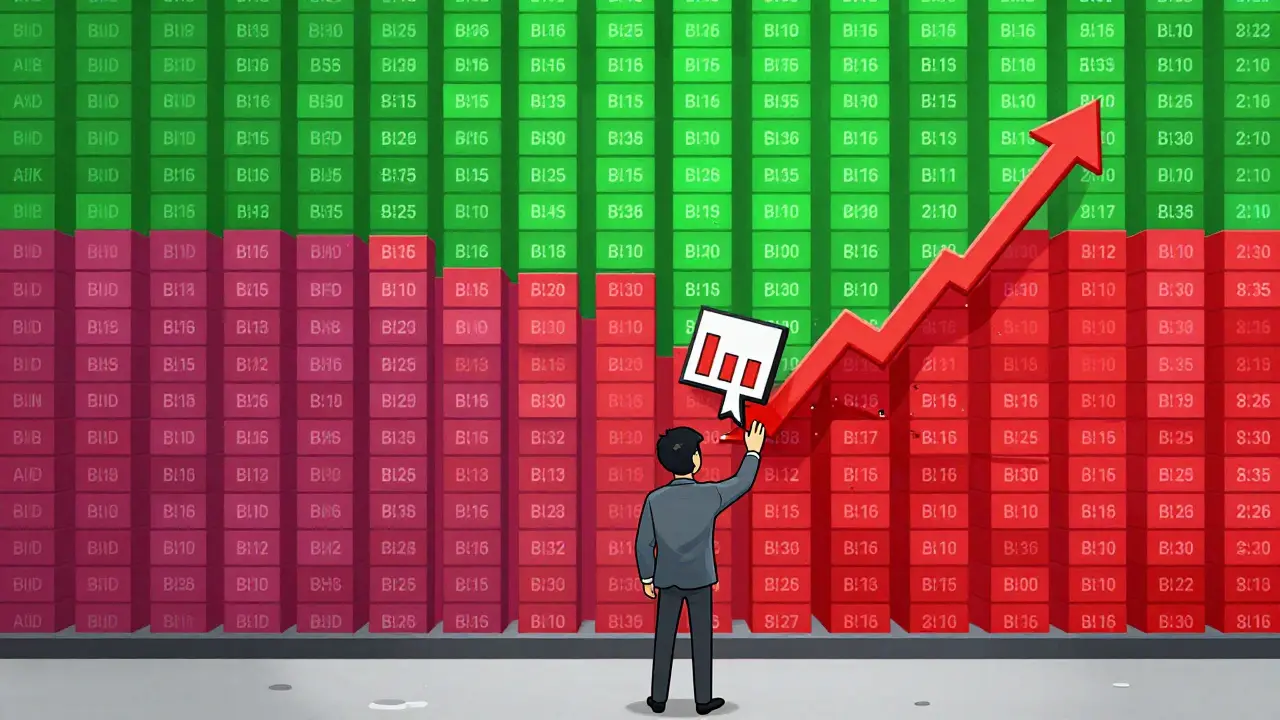
When Liquidity Vanishes
Liquidity isn’t constant. It dries up during holidays, weekends, and major news events. Friday night in New York? Volume drops 87% until Sunday night. The Bank of England drops a rate decision at 12 PM GMT? Liquidity evaporates for 15 minutes. That’s when spreads blow out. That’s when market orders turn into nightmares.
One trader on Reddit reported selling 50 BTC of BTC/USDT during a Fed announcement. The spread jumped from 0.03% to 1.2%. His order filled at 1.8% below his target. He didn’t get a bad broker. He got bad timing. The market just wasn’t there.
That’s why smart traders avoid trading 30 minutes before and after major economic releases. They use calendars. They know when liquidity is low. They wait. Or they use limit orders to control their entry and exit prices. Market orders have no place in volatile conditions.
How to Trade Spot Markets Like a Pro
Here’s what actually works:
- Trade only high-volume pairs - BTC/USDT, ETH/USDT, EUR/USD, USD/JPY. Avoid anything with daily volume under $50 million.
- Check the order book before you hit buy or sell. Look at the depth. Is there enough volume to absorb your order? If not, split it.
- Use limit orders - especially during news events. Don’t trust market orders.
- Trade during peak hours - London-New York overlap (2 PM-5 PM UTC) has the highest liquidity in Forex. For crypto, it’s 12 PM-8 PM UTC when U.S. and Asian traders are both active.
- Avoid holidays - Christmas, New Year’s, Thanksgiving. Volume crashes. Spreads widen. Slippage spikes.
Professional traders don’t just react to price. They read liquidity. They know where the big orders are hiding. They know when the market is thin. And they wait.

The Future of Spot Market Liquidity
Liquidity is changing. New platforms like CME’s FX Link are connecting institutional liquidity to retail traders. AI-driven systems like JPMorgan’s LOXM are predicting where liquidity will be 30 seconds ahead - and routing trades accordingly. In crypto, decentralized exchanges (DEXs) are starting to pool liquidity across chains using bridges and aggregators like 1inch and Matcha.
But here’s the reality: no tech fixes bad behavior. If you keep trading low-volume tokens with market orders during quiet hours, no algorithm can save you. Liquidity is a discipline. It’s about patience, timing, and choosing the right markets. The best traders aren’t the ones who predict the next 10x. They’re the ones who avoid losing money on bad execution.
Final Thought
Spot markets are supposed to be simple. Buy low. Sell high. Get it done fast. But if the market doesn’t have enough buyers and sellers, that simplicity turns into a trap. Liquidity isn’t optional. It’s the foundation. Without it, even the best strategy fails. Learn to read it. Respect it. And never trade when it’s gone.
What is spot market liquidity?
Spot market liquidity is how easily an asset can be bought or sold without causing a big change in price. High liquidity means tight bid-ask spreads and high trading volume, so orders fill quickly at expected prices. Low liquidity leads to slippage, wide spreads, and delayed fills.
How do you measure spot market liquidity?
You measure it using two key metrics: bid-ask spread and trading volume. A narrow spread (like 0.1 pips in EUR/USD) and high volume (billions traded daily) indicate high liquidity. A wide spread (over 1%) and low volume mean low liquidity. Order book depth also shows how much volume exists at different price levels.
Why does liquidity matter for crypto traders?
In crypto, low liquidity means your market order can trigger slippage - you think you’re buying BTC at $68,000, but you end up paying $68,500 because there aren’t enough sellers at that price. High liquidity lets you enter and exit positions quickly without moving the market, which is essential for day traders and swing traders alike.
When is spot market liquidity the lowest?
Liquidity is lowest during weekends (after Friday NY close until Sunday night), holidays, and 15 minutes before and after major economic news events like Fed announcements or central bank decisions. Volume can drop by 60-87% in these periods, causing spreads to widen dramatically.
How can I avoid bad execution in spot markets?
Use limit orders instead of market orders, especially during volatile times. Trade only high-volume pairs like BTC/USDT or EUR/USD. Avoid trading right before or after news events. Check the order book depth before placing large orders. And never trade during holidays or weekend gaps.

Comments
Paul Gariepy
Spot liquidity isn't just about volume, it's about who's trading. I've seen BTC/USDT on Binance move 0.3% on a $2M order because the order book had a gap between 68k and 68.1k. No one was quoting. Just silence. That's when you realize liquidity is an illusion until you need it.
Most retail guys think they're smart because they caught a 10% dip. But they don't see the 5% slippage they took on entry. It's like buying a car and not checking the tire pressure until you're 200 miles down the highway.
Trade high-volume pairs. Period. No exceptions. If your coin has less than $50M daily volume, you're not trading-you're playing roulette with leverage.
I used to chase Shiba flips. Now I only trade BTC, ETH, SOL. My win rate doubled. My stress level? Cut in half. Liquidity isn't sexy. But it's the only thing that keeps your account alive.
mahikshith reddy
Everyone's obsessed with liquidity like it's a religion. Newsflash: liquidity is a tool. Not a virtue. If you're waiting for perfect spreads before you trade, you're already losing.
Markets don't care about your feelings. They don't care if you're 'patient.' They move. And if you're not moving with them, you're dead weight.
Stop romanticizing 'high-volume pairs.' That's just where the whales dump their bags. You think you're safe? You're just the next sucker in line.
Brendan Conway
Man I used to be all over altcoins. Thought I was a genius. Then I tried to sell 0.5 ETH on a small exchange and it took 12 minutes to fill at 8% below market. I just stared at my screen like a dumbass.
Now I only trade BTC on Binance. Simple. No drama. I check the order book before I click. If there's less than 100 BTC at my price? I wait. Or I use a limit order.
It's not exciting. But it's the only way I haven't lost my shirt.
Katie Haywood
Oh so now we're all financial philosophers? 'Liquidity is the foundation.' Wow. Deep. Next you'll tell me water is wet.
Real talk: if you're still using market orders during a Fed announcement, you're not a trader. You're a liability. And your broker is probably laughing at your account balance.
Also, 'avoid holidays'? Bro. I made 12% last Thanksgiving because everyone else was too busy eating turkey to trade. Liquidity vanishes. So do the suckers.
Matt Smith
LIQUIDITY IS A LIE. 😈
Every 'high liquidity' market is just a trap set by hedge funds. They pump volume, make it look safe, then pull the rug when retail jumps in.
Look at BTC on Binance. Looks liquid? Nah. That 'tight spread' is just bots feeding fake orders. Real liquidity? It's in dark pools. And you're not invited.
Stop trusting exchanges. They're casinos with better UI.
orville matibag
I'm from the Philippines. We don't have access to Binance or Coinbase here. We trade on local exchanges with 3% spreads. You think I don't know slippage?
I've bought ETH at 30% over the market because there was no choice. No one talks about this. The post is written for Americans with bank accounts.
Liquidity isn't a concept. For most of the world, it's a luxury. And yeah, we still trade. Because we have to.
Joshua Herder
You talk about liquidity like it's some objective, measurable force. But it's not. Liquidity is perception. It's the illusion of safety created by algorithmic market makers who are paid to appear present.
Think about it: when you see a $100M order book on BTC/USDT, what percentage of that is real? Maybe 10%. The rest is spoofing. Ghost orders. Bots pretending to be buyers.
And then you have the institutional players who route trades through OTC desks and never touch the public order book at all. So who are you really trading with?
The whole idea that 'high volume = safety' is a narrative designed to make retail feel secure while the real players move unseen. You're not reading liquidity. You're reading a marketing brochure.
And when the market cracks? All those 'deep' order books evaporate. Like smoke. Because they were never there.
The real skill isn't avoiding illiquid assets. It's knowing when the liquidity you think you have is about to vanish. And that? That's not taught in any guide. That's learned through loss.
And most people? They never learn. They just keep blaming the exchange. The broker. The algorithm. Never themselves.
That's why 90% of traders lose. Not because they're bad at predicting price. But because they're blind to the machinery behind the curtain.
Liquidity isn't a foundation. It's a mirage. And you're the one walking toward it.
Michael Sullivan
Liquidity? Pfft. You're all missing the point. The real problem isn't slippage. It's the fact that retail traders think they can outsmart institutions. 🤡
Every time you place a market order, you're basically handing your money to a quant with a $200M budget and a team of 12 engineers.
And you wonder why you keep losing? Because you're not trading against the market. You're trading against a supercomputer that knows your order size before you hit 'buy'.
Stop pretending this is a level playing field. It's not. It's a rigged game. And your 'limit orders' are just fancy ways of saying 'please take my money'.
perry jody
Good post. Seriously. I've been trading for 5 years and this is the clearest explanation I've seen.
I used to think 'just trade BTC' was boring. Now I see it's the only smart move. My account grew 40% last year just by avoiding altcoins.
Also, check the order book. It's not hard. Takes 5 seconds. But 99% of people don't do it. That's why they get wrecked.
Stay calm. Stay patient. Stay in the big pairs.
Paul Jardetzky
I used to be a 'chase the moon' guy. Now I'm a 'wait for the tide' guy.
Biggest change? I stopped using market orders. Ever. Even for $100 trades.
Limit orders don't guarantee fill. But they guarantee control. And control is everything.
Also, weekends? I don't even look at my screen. Let the whales fight. I sleep.
Simple. Effective. Revolutionary.
Josh Flohre
Your entire post is a textbook example of retail trader delusion.
You claim liquidity is 'the foundation'-yet you never define who creates it. Or how it's manipulated. Or that 80% of 'volume' on major exchanges is wash trading.
You say 'avoid altcoins'-but fail to mention that 95% of them are rug pulls disguised as projects. You're not helping. You're enabling.
And you say 'use limit orders'-as if that's some genius insight. It's the bare minimum. The fact that you have to spell this out means you're talking to children.
Stop pretending this is education. It's a sales pitch for Binance.
Olivette Petersen
I love how this post breaks it down so clearly. I used to think I was a genius for catching a 500% altcoin pump. Turns out I just got lucky.
Now I stick to BTC and ETH. I check the order book before every trade. I avoid news times. And guess what? My stress levels dropped. My wins went up. My sleep improved.
Liquidity isn't glamorous. But it's the quiet hero of trading.
Thanks for the clarity. I needed this.
Michelle Anderson
Oh sweet baby Jesus, another 'trade only BTC' cultist.
You think liquidity is safe? You think Binance is your friend? You're a walking wallet.
I made 200% last month trading a $2M market cap coin with a 4% spread. Why? Because I knew the whales were dumping. I front-ran them.
Liquidity is for sheep. Risk is for wolves.
Stop preaching safety. Start teaching how to eat.
Robin Ødis
You think liquidity is about volume? Nah. It's about control. And who has it.
I used to think the same as you. Until I lost $18k on a 'high liquidity' altcoin during a weekend. The exchange froze withdrawals. The order book vanished. The devs disappeared.
Now I only trade on centralized exchanges with SEC oversight. Because I'm not here to be a martyr for 'decentralization.' I'm here to keep my money.
And no, I don't trust Binance. But I trust their compliance team more than some anonymous Dev team in the Philippines.
Stop romanticizing risk. Start protecting capital.
And if you're still trading Shiba on a DEX? You're not brave. You're just stupid.
And yes, I'm gonna say that to your face.
Brittany Novak
EVERYTHING YOU SAID IS A LIE.
Liquidity doesn't exist. It's a hallucination created by central banks, exchanges, and hedge funds to keep you trading.
That 'tight spread' on BTC? It's a trap. The moment you place a large order, the bots detect it, front-run you, then collapse the order book.
And you think weekends are low liquidity? Try trading during a Fed meeting. That's when the real slaughter happens.
They're not just taking your money. They're taking your identity. Your belief that you're in control.
You're not trading crypto. You're feeding the machine.
Brittany Coleman
I appreciate the clarity. Honestly, I've been trading for years and this was the first time someone put it into simple terms.
I used to think I was smart for trading altcoins. Now I just trade BTC on Binance during US hours.
It's boring. But it works.
Thanks for not yelling. Just telling it like it is.
Molly Andrejko
Just wanted to say thank you. I'm a single mom working two jobs. I trade $500 at a time. I don't have time to study order books.
But I follow your 5 rules. High volume. Limit orders. No holidays. No altcoins.
My account grew 12% last quarter. Not because I'm smart. Because I followed simple rules.
You made this feel possible. Not like a casino. Like a job.
Thank you.
Alisha Arora
Why are you all acting like this is some deep secret? It's not. It's basic.
If you're trading a coin with less than $50M volume, you're not a trader. You're a donation.
And if you're using market orders? You're begging to be ripped off.
Stop making it complicated. Just do the basics. Like your dad told you to clean your room.
Reda Adaou
I'm new to this. Came from stocks. Thought crypto was the same.
Then I lost $3k on a market order for a $10M market cap coin. Never again.
Now I only trade BTC/USDT. I use limit orders. I check the depth. I avoid news.
It's not exciting. But I'm still here.
And that's the win.
Jim Laurie
Liquidity is the silent killer. You don't see it. Until it kills you.
I used to be a 'HODL everything' guy. Then I got caught in a flash crash on a DEX. 47% slippage on a $5k trade. My whole month's profit gone.
Now I only trade on CEXs. Only BTC/ETH. Always limit orders. Always check depth.
It's not glamorous. But it's sustainable.
And honestly? That's the only win that matters.
Paul Gariepy
Just read the comment from 1804. That's the real truth. Liquidity isn't a number. It's a game of mirrors.
I used to think the same as this post. Then I saw a $100M bid disappear the second I placed a $2M sell.
It's not about avoiding illiquid assets. It's about avoiding the illusion of liquidity.
That's the real edge.