
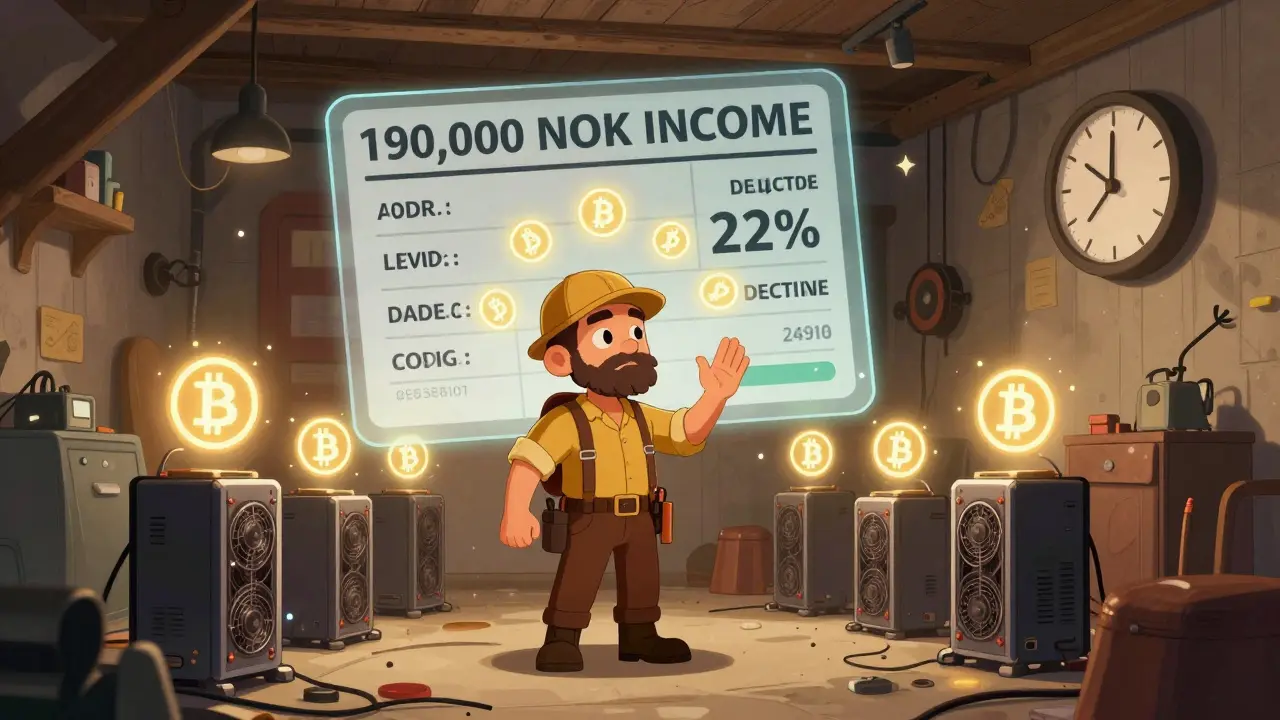
There’s a lot of noise online about Norway suddenly pulling tax breaks for crypto mining. You’ve probably seen headlines claiming the country shut down the industry or crushed profits overnight. But here’s the truth: Norway never had special tax incentives for crypto mining to begin with. What’s changing isn’t the removal of a perk-it’s the clarification of rules that were always there.
How Crypto Mining Was Always Taxed in Norway
Since the first Bitcoin miner turned on a rig in Oslo, Norway has treated crypto mining as regular business income. There was no 0% tax rate, no energy subsidies tied to mining, and no tax holiday for early adopters. Instead, the Norwegian Tax Administration (Skatteetaten) applied the same 22% flat income tax rate to mining rewards as it does to salaries, freelance work, or consulting fees. When you mine cryptocurrency in Norway, you don’t pay tax when you sell your Bitcoin or Ethereum. You pay tax the moment you receive it. The value is calculated in Norwegian kroner (NOK) based on the market price at the exact time the coins hit your wallet. If you mined 0.5 BTC on March 12, 2024, and the price was 380,000 NOK per BTC, you reported 190,000 NOK as income that year-even if you never sold it. This isn’t unique. Countries like the U.S., Germany, and Australia do similar things. But Norway adds one important detail: you can deduct real business expenses. That means you can write off the cost of your ASIC miners, cooling systems, software licenses, and even your electricity bill. The tax agency allows a 30% annual depreciation on mining hardware. So if you bought a new mining rig for 200,000 NOK, you can deduct 60,000 NOK each year for the next few years until the value hits zero.Why People Thought There Were Incentives
The confusion comes from Norway’s cheap, clean energy. The country gets over 90% of its electricity from hydropower. That means electricity prices are among the lowest in Europe-sometimes as low as 0.05 NOK per kWh in winter. For miners, that’s a huge advantage. A rig that costs $1,200 a year to run in Texas might only cost $300 in Norway. Some people mistook low energy costs for a government incentive. They assumed the state was subsidizing mining. But Norway doesn’t give miners a discount on power. The low rates are a side effect of geography and renewable infrastructure, not a targeted policy. When global energy prices rose in 2022, miners in Norway felt the pinch-but so did everyone else. No special exemptions were offered.What Actually Changed in 2025
The real shift in 2025 wasn’t about removing tax breaks. It was about closing a loophole in reporting. Before 2025, some miners treated their operations like hobbies. They didn’t track the exact timestamp of when they received coins. They used average prices for the month. They didn’t file quarterly reports. The tax agency didn’t chase them-because the industry was small, and enforcement was low-priority. In 2025, Skatteetaten started enforcing existing rules with new precision. They began cross-referencing blockchain data with bank transfers and utility bills. They sent letters to mining pool operators asking for participant lists. They required miners to keep detailed logs: time, coin type, NOK value, and transaction ID for every reward. It wasn’t a new tax. It was better enforcement. And it hit hard. Many small-scale miners who were barely breaking even suddenly found themselves owing thousands in back taxes. One miner in Tromsø, who ran two rigs in his garage, received a notice for 87,000 NOK in unpaid income tax and penalties after the agency traced 14 months of unreported mining rewards.
Who Got Hit the Hardest
The biggest impact wasn’t on big mining farms-it was on individuals and small co-ops. Large operations had accountants, compliance teams, and cloud-based tracking tools. They were already reporting correctly. But the guy mining Bitcoin on a spare GPU in his basement? He didn’t know he needed to track every single reward. He thought if he didn’t cash out, he didn’t owe anything. The tax agency didn’t target him because he was a miner. They targeted him because he didn’t report income. The same rule applies to freelance designers who get paid in crypto. If you earn it, you report it. No exceptions. In 2024, Norway had about 12,000 registered crypto mining operations. By mid-2025, over 3,000 had shut down-not because taxes went up, but because they couldn’t keep up with record-keeping demands. The cost of compliance-hiring a bookkeeper, buying mining software, paying for audit services-now outweighed the profit for many small operators.What’s Still Allowed
Crypto mining is still legal in Norway. You can still buy hardware. You can still plug it in. You can still earn rewards. The tax rate hasn’t changed. The deductions are still there. What changed is the expectation that you’ll do it legally-and that the government will notice if you don’t. If you’re still mining, here’s what you need to do:- Record the exact date and time you receive each mining reward.
- Track the NOK value of each coin at the moment it arrives in your wallet (use a reliable exchange like Nordax or BitPanda as your source).
- Keep receipts for all mining equipment, electricity bills, and software subscriptions.
- Report mining income on your annual tax return (Form 1) under “Other Income.”
- Claim equipment depreciation at 30% per year using Skatteetaten’s approved method.

Comments
Sammy Tam
So let me get this straight - Norway didn’t remove any tax breaks, they just started enforcing the rules everyone ignored? That’s not a crackdown, that’s just adulthood kicking in. I’ve seen so many crypto bros act like mining in Norway was some kind of free money loophole, when really it was just cheap power and wishful thinking. The real story here is how fast people forget basic accounting when crypto’s involved.
Patricia Amarante
So they just started doing their job. Cool.
Elvis Lam
Let’s be real - the people who got hit weren’t ‘persecuted.’ They were just lazy. If you’re earning income, you track it. Period. Whether it’s crypto, freelance gigs, or selling stuff on eBay. The fact that people thought they could just ignore tax rules because it was ‘digital’ shows how detached this whole industry is from reality. The tax agency didn’t change anything. They just stopped pretending no one was cheating.
Madhavi Shyam
Hydropower arbitrage + regulatory clarity = sustainable crypto infrastructure. The real innovation isn’t mining, it’s the tax alignment with real-world asset accounting. Most jurisdictions still treat crypto as a speculative asset class, but Norway treats it as income. That’s institutional maturity.
Jonny Cena
For anyone thinking this is about ‘cracking down on crypto’ - stop. This is about basic financial responsibility. If you’re making money, you report it. It’s not about being anti-crypto, it’s about being pro-integrity. The people who left weren’t crushed - they just weren’t ready to run a business. And that’s okay. Not everyone should be mining. But if you are, do it right. The tools are there. The guidance is clear. You just have to show up.
Timothy Slazyk
What’s fascinating here isn’t the tax enforcement - it’s the cognitive dissonance of the crypto community. They scream about decentralization, autonomy, and freedom from state control… then act shocked when a government actually enforces its own laws. Norway didn’t invent taxation. They just stopped letting people pretend the rules don’t apply to them. The real tragedy isn’t the 3,000 shutdowns - it’s that so many thought they were entitled to operate in a legal gray zone because ‘the blockchain doesn’t care.’ But people do. And laws do. And eventually, so does the IRS - or in this case, Skatteetaten.
Tom Joyner
How quaint. A nation with 5 million people and 90% renewable energy dares to enforce income tax on crypto. The audacity. I suppose next they’ll require miners to wear socks. Truly, the decline of Western civilization is upon us.
Bradley Cassidy
bro i just mined 0.3 btc last month and never filed anything… i thought it was like gambling?? like if you win at poker you dont pay taxes until you cash out?? am i the only one?? 😅
Rebecca Kotnik
The philosophical underpinning of this shift is not merely fiscal - it is epistemological. Norway, by enforcing the principle that income is taxable at receipt regardless of conversion, affirms a ontological stance: cryptocurrency is not a speculative instrument divorced from economic reality, but a tangible medium of value exchange, subject to the same metaphysical laws of accounting as fiat currency. The miner who believes their reward exists in a liminal space between asset and abstraction is not merely noncompliant - they are epistemologically incoherent. The state’s action is not punitive, but corrective - a reassertion of the primacy of measurable economic activity over digital mysticism. In this light, the shutdowns are not losses, but purifications - a natural selection of those who can reconcile their actions with the structure of reality.
Samantha West
Actually, I think Norway’s approach is deeply unethical. You can’t just go after people who didn’t know the rules - especially when the tax agency didn’t even send out clear guidelines until 2025. That’s predatory enforcement. People aren’t accountants. They’re hobbyists trying to learn something new. This isn’t justice - it’s exploitation disguised as compliance. And now you’ve destroyed a community that was actually doing something environmentally sustainable. How is that progress?
Sean Kerr
YESSSS!!! 😭👏👏👏 finally someone gets it - mining isn’t a free pass, it’s a BUSINESS. I’ve been filing since 2021 with Koinly and it’s a breeze. Stop acting like the government is the villain. You’re not being persecuted - you’re being asked to do your taxes like a grown-up. 🙏💸
Kelsey Stephens
It’s sad how many people took this personally. The tax agency didn’t target miners - they targeted unreported income. That’s not anti-crypto. That’s pro-accountability. If you’re earning something, you owe taxes on it. That’s not Norway being mean. That’s just… how the world works. You don’t need a special rule to make that true.
Abby Daguindal
People who didn’t report their mining income are the same people who thought NFTs were ‘investments’ and bought bored apes with rent money. This isn’t a crackdown. It’s karma.
Mark Cook
So you're telling me the government didn't give them a free pass... but they still got to use cheap power? 😂 I guess that's just capitalism, huh? 🤷♂️
SeTSUnA Kevin
The Norwegian Tax Administration’s 2025 enforcement protocol constitutes a paradigmatic shift in digital asset jurisprudence, aligning blockchain-derived income with the classical fiscal doctrine of realization at receipt. Notably, this reaffirms the ontological equivalence of crypto-assets and fiat-denominated remuneration under the principle of fungibility. The resultant attrition of noncompliant actors is not a policy failure, but a market correction.
Jack Daniels
I just lost everything... my rigs, my dreams, my sanity... they took my Bitcoin... and my soul... why did they have to be so cold? 😭