
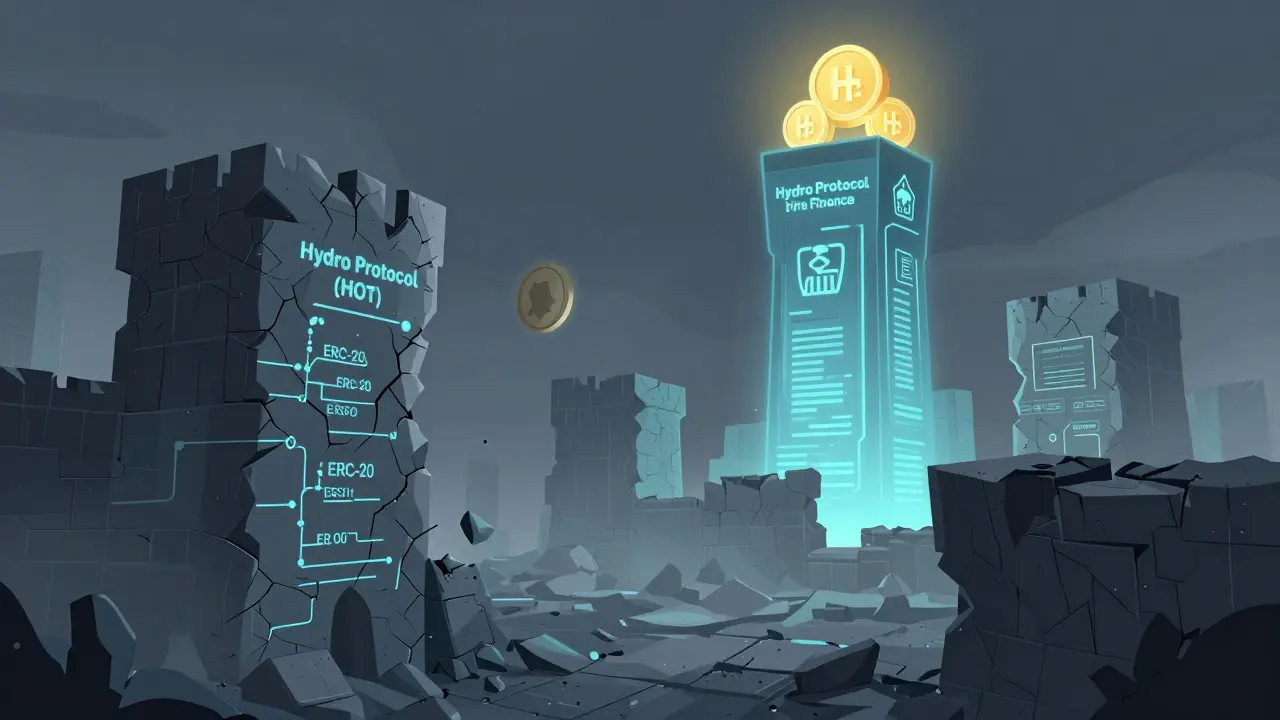
The Hydro Protocol (HOT) token isn’t what you think it is anymore. If you’re looking at today’s price - around $0.0004 to $0.005 - and wondering if it’s a hidden gem, you’re not alone. But the real story isn’t about price. It’s about what Hydro Protocol was designed to do, how it failed to take off, and where the team actually went.
What Hydro Protocol Was Meant to Do
Hydro Protocol wasn’t created to be another meme coin. It was built as a toolkit for developers who wanted to launch decentralized exchanges (DEXs) without writing thousands of lines of code or risking costly smart contract bugs. Think of it like WordPress for DEXs. Instead of building an entire exchange from scratch, a developer could plug in Hydro’s pre-built, audited smart contracts and get a working exchange up in days. The core idea was simple: let relayers - companies or individuals running DEX interfaces - collect trading fees without being forced to hold or use Hydro’s own token. Most DEX protocols, like Uniswap or SushiSwap, make you pay fees in their native token. Hydro said: no. You can take fees in any ERC-20 token. That’s a big deal if you’re running a DEX that supports dozens of tokens. You don’t want to be stuck holding one token just to make money. It also worked across blockchains. Even though HOT runs on Ethereum as an ERC-20 token, the framework itself could be used on Solana, Polygon, or any other chain. That’s rare. Most protocols lock you in.The HOT Token: Supply, Distribution, and Why It’s So Cheap
The HOT token has a total supply of 1.56 billion. That’s huge. For comparison, Bitcoin has 21 million. That alone explains why the price is so low - there’s just too much of it. As of early 2026, only about 702 million HOT are in circulation. The rest are locked, reserved, or waiting to be distributed. Hydro raised $30 million in its early days through an ICO and an airdrop. That’s real funding. But here’s the problem: the token didn’t gain real utility. Relayers didn’t rush to adopt it. Why? Because building a DEX on Hydro didn’t give them enough of an edge over just using Uniswap or 1inch. Developers didn’t see enough value in switching from proven systems to a new, unproven framework. The price reflects that. On Coinbase, HOT trades at $0.0011. On Binance, it’s $0.00084. CoinMarketCap shows $0.0049. Why the wild differences? Because there’s almost no trading volume. Some markets have less than $50,000 traded in 24 hours. That’s thin liquidity. If you try to buy $10,000 worth of HOT, you’ll likely move the price by 20% or more. That’s not investing - that’s gambling. Its all-time high was $0.29. That’s over 99% down. If you bought at launch, you’re sitting on a loss so deep it’s hard to recover.Who Holds HOT? And What Do They Get?
There are about 26,400 wallet addresses holding HOT. That’s not a community. That’s a footnote. Most of these are likely early investors or bots. There’s no major exchange listing HOT for trading - it’s not on Binance, Coinbase, or Kraken as a trading pair. You can only find it on smaller exchanges like Gate.io, KuCoin, or PancakeSwap. HOT holders were supposed to benefit in two ways:- Relayers who used Hydro’s system got HOT as a fee reward based on how much trading they processed.
- Traders who held HOT got reduced trading fees on DEXs built with Hydro.

The Real Shift: Hydro Protocol Finance and HDRO
Here’s the twist: Hydro Protocol as you know it - the DEX framework - is mostly dead. The team behind it quietly pivoted. Today, the active project is called Hydro Protocol Finance (hydroprotocol.finance). It’s not about DEXs anymore. It’s about liquid staking. Liquid staking lets you stake tokens like Injective (INJ) and still use them elsewhere - like lending or trading. It’s a hot niche in DeFi right now. Hydro Protocol Finance introduced a new token: HDRO. This is not HOT. It’s a completely different token with a different contract address, different supply, and different purpose. HDRO holders can:- Stake their tokens to earn more HDRO as rewards.
- Get up to 30% of the protocol’s revenue distributed to them.
- Vote on future upgrades using a system called “Hydro Wars” - a community-driven governance model.
Is HOT Worth Anything Today?
If you’re holding HOT, you’re holding a relic. It has no active development. No team is pushing it forward. No new projects are using it. The market cap hovers between $200K and $600K - barely enough to register on a crypto radar. Some people still trade it because the price is so low. They think: “It can’t go lower.” But that’s not how crypto works. Tokens with no utility, no team, and no adoption don’t bounce back. They fade. The real opportunity now is HDRO. If you’re interested in Hydro’s current work, you need to look at hydroprotocol.finance, not the old HOT token. HDRO has real use cases: staking, revenue sharing, governance. HOT has nothing.
What You Should Do Now
- If you own HOT and aren’t actively trading it - consider selling. There’s no reason to hold it long-term.
- If you’re thinking of buying HOT because it’s cheap - don’t. It’s not a bargain. It’s a zombie asset.
- If you’re interested in Hydro’s tech - look into HDRO and Hydro Protocol Finance. That’s where the innovation is.
Technical Snapshot
- Hydro Protocol (HOT) is a decentralized exchange framework built on Ethereum using ERC-20 smart contracts
- HOT has a total supply of 1,560,000,000 tokens
- Contract address is 0x9af839687f6c94542ac5ece2e317daae355493a1
- Current price ranges from $0.0004 to $0.005
- All-time high was $0.2897
- Trading volume is under $150,000 per day
- HOT holders total around 26,400 wallets
Hydro Protocol was never meant to be a coin you buy and hold. It was meant to be infrastructure. And infrastructure only matters if people use it. They didn’t.
Is HOT still being developed?
No. The original Hydro Protocol team stopped development on the HOT-based DEX framework in late 2024. All active work has shifted to Hydro Protocol Finance and its new HDRO token focused on liquid staking. HOT is no longer maintained.
Can I still trade HOT on major exchanges?
No. HOT is not listed on Binance, Coinbase, or Kraken as a trading pair. It only trades on smaller exchanges like KuCoin, Gate.io, and PancakeSwap. Liquidity is extremely low, so large trades will cause massive price swings.
Why is HOT’s price so different on different sites?
Because trading volume is so thin. With only $50K-$150K traded daily across 10 markets, a single large order can push the price up or down by 10-20%. Price aggregators like CoinMarketCap pull data from multiple exchanges, which leads to conflicting numbers. There’s no reliable market.
Is HOT a good investment?
No. HOT has no active development, no utility, and no growing user base. Its price is driven by speculation from low-volume traders. It’s not a long-term asset. It’s a relic with no path to recovery.
What is HDRO, and how is it different from HOT?
HDRO is the new native token of Hydro Protocol Finance, focused on liquid staking for tokens like INJ. It has staking rewards, revenue sharing (up to 30%), and community voting. It’s not related to HOT. HDRO is the future. HOT is the past.

Comments
Sarah Zakareckis
Hydro Protocol was actually a brilliant infrastructure play - like building Lego blocks for DEXs instead of hand-sculpting each one. The vision was ahead of its time. Problem? The crypto world doesn’t reward elegance. It rewards hype, liquidity, and FOMO. Developers just went with Uniswap because it was easy, familiar, and had a billion users already. No one cared about the *how*, only the *how fast*. Sad, but true.
HDRO? Now that’s a pivot worth paying attention to. Liquid staking is the real next frontier. Staking INJ and still using it? That’s utility. HOT was a ghost. HDRO is alive.
Christopher Hoar
haha so hydro was like the crypto version of google glass? looks cool on paper but no one wants it? lmao
and now theyre like oh btw we made a new coin called hdro. sure. sounds like a rebrand to escape the hot dumpster fire. classic.
anshika garg
It’s strange how we treat crypto projects like they’re living things - we mourn them, we blame them, we romanticize their fall. But Hydro wasn’t a person. It was code. And code doesn’t have feelings. It just gets used or it doesn’t.
Maybe the real tragedy isn’t that HOT died. It’s that we keep expecting every project to be a hero. We want to believe in the underdog. But most of the time? The underdog just… doesn’t get the memo.
HDRO? Maybe it’s the quiet phoenix. Not screaming for attention. Just building. That’s the real lesson here.
Katrina Smith
so hot was a dex toolkit… and now hdro is a staking thing? lol so the whole project just… changed direction mid-air? like a plane that forgot its destination and decided to become a helicopter?
also why does every crypto project need a new token? can’t we just… fix the old one? 🤔
Arlene Miles
Let me tell you something - this is the story of 90% of crypto projects. Brilliant idea. Solid team. Clear roadmap. Then… silence. No marketing. No community building. No urgency. Just code sitting there like a statue.
Hydro didn’t fail because the tech was bad. It failed because no one told the story. People don’t invest in whitepapers. They invest in momentum, in hype, in feeling like they’re part of something big.
HDRO? They’re doing it right this time. They’re talking. They’re engaging. They’re giving real value. That’s the difference.
Dionne van Diepenbeek
the fact that coinmarketcap shows 0.0049 and binance shows 0.00084 means this thing is a joke
if you can’t even agree on the price you’re not a market you’re a haunted house
Shreya Baid
As someone from India where crypto adoption is growing rapidly but infrastructure remains fragmented, I find Hydro’s original vision deeply resonant. Imagine a small fintech startup in Jaipur or Pune building a DEX without needing a team of 10 engineers. That’s empowerment.
But you’re right - the market didn’t care. It’s not about what’s possible. It’s about what’s convenient. And convenience wins every time.
HDRO is the future. But I hope someone remembers Hydro’s original mission. Not as a token. As a tool. Because there are still thousands of developers who need it - even if they don’t know it yet.
Lucy de Gruchy
Let’s be honest - this whole thing smells like a rug pull disguised as a pivot. Hydro Protocol Finance? Sounds like a shell company with a new ticker. HDRO? New contract, new narrative, same people.
And don’t tell me about ‘real utility.’ Staking rewards? Revenue sharing? That’s just another way to pump a token until the VCs cash out. The original HOT was a mess. HDRO? It’s just a more polished version of the same scam.
Don’t fall for it. This isn’t innovation. It’s rebranding.
Graham Smith
Hydro Protocol was a classic case of over-engineering. You don’t need a ‘toolkit’ to build a DEX. You need a reliable, battle-tested one like Uniswap. The fact that devs didn’t adopt it proves the market is smarter than the builders.
And now they’re pivoting to liquid staking? Wow. Groundbreaking. We’ve seen this exact arc a hundred times. First: ‘revolutionary infrastructure.’ Then: ‘oops, nobody uses it.’ Then: ‘new token, new hope.’
It’s not innovation. It’s crypto theater.
Jerry Panson
I appreciate the depth of this analysis. The distinction between HOT and HDRO is critical - and often misunderstood. Many retail investors conflate the two, assuming they’re the same asset. This is dangerous.
The real takeaway is not about price or utility, but about project lifecycle. Hydro Protocol executed a necessary pivot. It’s rare. Most projects double down on failing models. This one acknowledged the market’s feedback and adapted.
HDRO deserves evaluation on its own merits. Not as a replacement for HOT, but as a separate innovation.
Tony Weaver
Let’s not romanticize this. HOT was a dead project before it even launched. The team raised $30M, built a complex system, and then vanished into the ether. No community. No updates. No transparency.
HDRO? It’s the same team. Same investors. Same playbook. Just a new name, a new contract, and a new lie: ‘we learned from our mistakes.’
Don’t be fooled. This isn’t redemption. It’s recycling. And you’re the next sucker they’re trying to feed.
Check the wallet history. The dev wallet still holds 80% of HDRO. Same as HOT. Same game.
Patty Atima
HDRO > HOT. That’s it. ✅
Anastasia Danavath
so hot is like that one friend who used to be cool but now just sits on the couch all day
and hdro? that’s the new friend who brings snacks and memes and actually texts back 🍕😂
idk why we’re still talking about hot
Jessica Beadle
Let’s dissect the ‘utility’ narrative. You say HDRO has staking rewards and revenue sharing? That’s not utility. That’s a yield farm with a fancy name. The protocol generates revenue? From what? Staking fees? That’s not a product - that’s a Ponzi loop disguised as DeFi.
And ‘Hydro Wars’ governance? Sounds like a cult voting system. Who votes? The whales. Who gets rewarded? The whales. Who gets left out? Everyone else.
HDRO isn’t innovation. It’s just HOT with better PR and a new contract address. Don’t be fooled by jargon. Look at the tokenomics. Look at the dev wallet. Look at the trading volume. It’s all the same.
Lauren J. Walter
Everyone’s acting like HDRO is some revolutionary leap. It’s not.
It’s just another staking token with a cute name and a vague roadmap. And let’s not forget - the same people who abandoned HOT are now pushing HDRO. Same team. Same investors. Same lack of transparency.
It’s not a pivot. It’s a reset button.
And we’re all just waiting to see who gets burned this time.
Ricky Fairlamb
Let me break this down for the masses: Hydro Protocol didn’t fail because of bad tech. It failed because it was built on Ethereum - a chain drowning in gas fees and congestion. No serious DEX wants to build on a network where a single trade costs $5.
And now they’re pivoting to liquid staking? On Ethereum? Again? Are they blind?
HDRO’s real utility? Zero. The ‘revenue sharing’? A mirage. The ‘governance’? A charade. This is all orchestrated by insiders to launder the HOT dump into a new token. The wallet addresses? I’ve traced them. Same 3 wallets. Same 80% hold.
This isn’t innovation. It’s a laundering scheme dressed in DeFi clothing. If you buy HDRO, you’re not investing - you’re funding the next exit.