

The Orizon (ORI) crypto coin isn't just another token floating in the blockchain sea. Launched in July 2025, it’s built on a radical idea: what if the money made by artificial intelligence companies could flow directly to everyday users instead of just Silicon Valley executives? Orizon calls this model DeFAI - Decentralized Finance + Artificial Intelligence. It’s not theory. It’s running right now, with real AI services generating real revenue - and that revenue is being sent to people who hold ORI tokens.
How Orizon Actually Makes Money
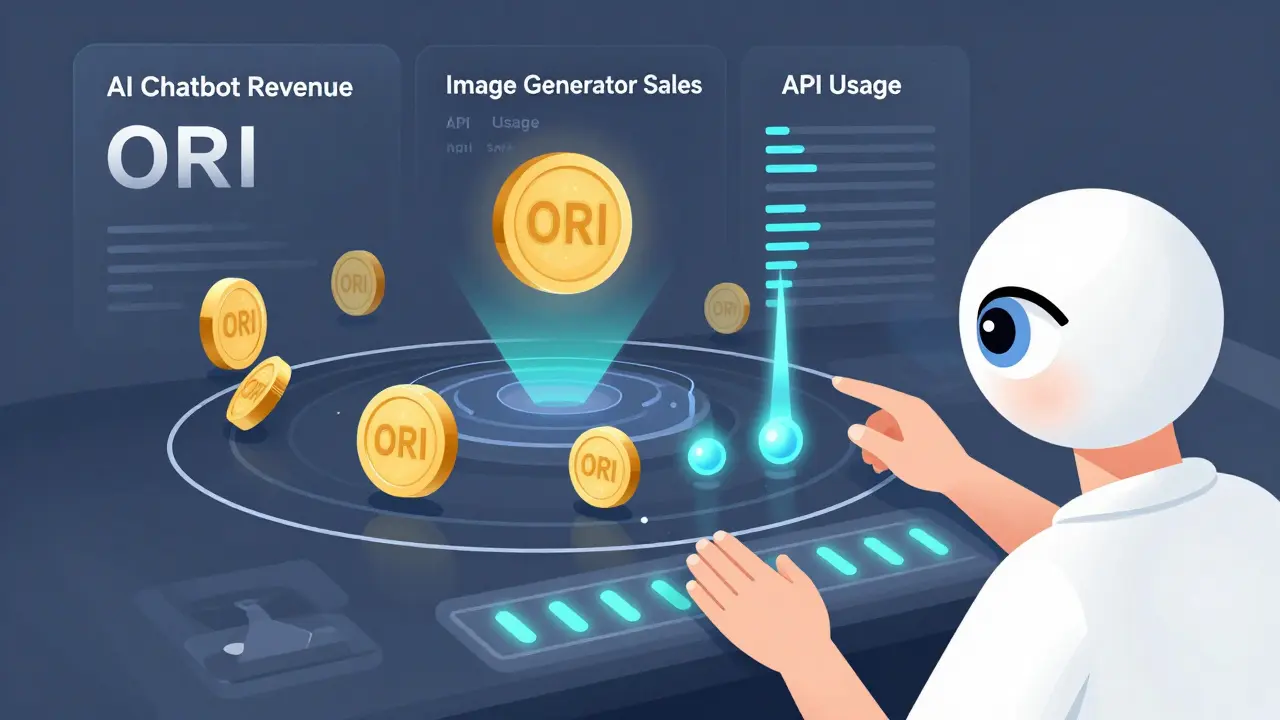
Most crypto projects promise returns based on speculation or by printing more tokens. Orizon does something different. It runs actual AI products that real people pay for. Think chatbots that answer customer service questions, image generators that create marketing visuals, and APIs developers use to build apps. Every time someone uses one of these tools, Orizon collects payment. That money doesn’t vanish into a corporate vault. It goes straight into a transparent, on-chain Treasury Vault - a digital wallet controlled by smart contracts anyone can verify.This isn’t a marketing gimmick. The protocol tracks every dollar earned from AI services on the blockchain. As of February 2026, Orizon’s AI products are already generating enough revenue to support a growing yield system. There are no hidden layers. No vague promises. Just clear, measurable income from real-world usage.
The ORI Token: More Than Just a Currency
The ORI token is the heart of the system. Unlike stablecoins that try to lock their value to the dollar, ORI is an algorithmic non-stablecoin. That means its price isn’t fixed - it’s managed by AI. The protocol’s algorithms constantly scan market conditions, track demand for ORI, and automatically adjust how many tokens are in circulation. If demand spikes, the system might reduce supply slightly to push the price up. If trading slows, it might increase supply to keep value steady. This isn’t a manual process - it’s automated, real-time, and driven by data.As of February 2026, the total supply of ORI is 133,460 tokens, all of which are in circulation. That’s unusual. Most new tokens have large locked supplies, but Orizon released everything at launch. That signals confidence in its revenue model. There are over 256,750 wallet addresses holding ORI, meaning thousands of people are already participating.
Staking ORI: Earn From Real AI Revenue
Here’s where it gets interesting. If you hold ORI, you can stake it - lock it into the protocol’s smart contracts. In return, you earn a share of the revenue generated by Orizon’s AI services. This is called real yield. It’s not created out of thin air like in many DeFi projects. It’s backed by actual customer payments. If a business pays $10,000 this month to use Orizon’s AI chatbot, that $10,000 flows into the Treasury and gets distributed to stakers.But it doesn’t stop there. The system also includes Automated Yield Optimization. Once you stake your ORI, AI algorithms take over. They scan dozens of DeFi protocols - lending platforms, liquidity pools, yield farms - and automatically move your staked tokens to the highest-performing opportunities. You don’t need to monitor markets or switch strategies. The system does it for you, 24/7. This passive income model is designed for people who want returns without constant trading or research.
Dynamic Risk Management: AI That Protects Your Investment
Crypto is volatile. Orizon doesn’t ignore that. Its AI doesn’t just chase returns - it actively manages risk. The protocol’s algorithms monitor market trends, detect unusual trading patterns, and identify potential threats to the Treasury. If a DeFi protocol it’s connected to starts showing signs of instability, the system automatically shifts funds away. If a major exchange experiences downtime or a liquidity crunch, the AI adjusts its strategy to protect the yield stream. This isn’t a one-time check. It’s continuous, real-time risk assessment built into the core of the protocol.Market Performance: Small But Growing
As of early February 2026, ORI trades between $54.70 and $55.47 across major exchanges like CoinMarketCap, CoinGecko, and Crypto.com. The market cap sits around $7.28 million - small compared to giants like Ethereum or Solana, but significant for a project only seven months old. The 24-hour trading volume hovers between $194,000 and $202,000, which suggests steady interest without wild speculation.That volume-to-market-cap ratio of 2.68% shows the token isn’t being dumped or pumped. It’s being held. People aren’t just trading it - they’re staking it. The fact that 256,750 wallets hold ORI, and nearly all tokens are circulating, points to a community that believes in the long-term model.
What’s Next? Governance in 2027
Right now, Orizon is still managed by its core development team. But that’s changing. The roadmap clearly states that full decentralized governance - a DAO - will launch in 2027. Once that happens, ORI holders will be able to vote on critical decisions: how the Treasury invests funds, which AI tools get developed next, even how much revenue gets distributed versus reinvested. This isn’t just a technical upgrade. It’s a philosophical shift - from a startup to a community-owned system.
Why Orizon Stands Out
Most DeFi protocols rely on inflation - minting new tokens to reward users. That’s unsustainable. When the new tokens stop flowing, the yield disappears. Orizon flips that model. Its yield comes from outside revenue. If the AI tools stop being used, the yield stops. That creates a powerful incentive: the better the AI products perform, the more value users earn. It’s a feedback loop where success is visible, measurable, and directly tied to real-world adoption.It’s also one of the first projects to combine AI-driven supply control with a transparent, revenue-backed treasury. The AI doesn’t just optimize yields - it manages the token’s entire economic life. That’s a new level of automation in crypto.
Who Is Orizon For?
If you’re tired of crypto projects that promise moonshots but deliver nothing tangible, Orizon offers something different. It’s for people who want:- Passive income backed by real business performance, not speculation
- Transparency - you can see exactly where the money comes from
- Automation - AI handles the heavy lifting so you don’t have to
- A long-term model that doesn’t rely on printing more tokens
It’s not for those looking for a quick flip. ORI’s price moves slowly. The value comes from consistent yield over time, not 10x pumps. If you’re willing to hold, stake, and trust the system to grow with real AI adoption, Orizon might be one of the most honest experiments in crypto today.
Final Thoughts
Orizon (ORI) isn’t trying to be Bitcoin or Ethereum. It’s trying to be something new: a financial system where AI doesn’t just serve corporations - it serves you. By linking the revenue from real AI tools directly to token holders, it creates a rare alignment of incentives. The better the AI works, the more you earn. The more people use it, the stronger the system becomes. As of February 2026, it’s still young. But it’s already proving that a decentralized, AI-powered economy isn’t just possible - it’s running.Is Orizon (ORI) a stablecoin?
No, ORI is not a stablecoin. It’s an algorithmic non-stablecoin, meaning its value isn’t pegged to any asset like the US dollar. Instead, AI algorithms dynamically adjust the token’s supply based on market demand to maintain price stability and encourage growth. This makes it fundamentally different from stablecoins like USDC or DAI.
How does Orizon generate revenue?
Orizon generates revenue through its own suite of AI-powered products, including chatbots, image generators, and developer APIs. Customers pay to use these tools, and those payments are collected directly into a transparent on-chain Treasury Vault. This real-world revenue backs the yield distributed to ORI token holders.
Can I earn yield just by holding ORI?
No, you must stake your ORI tokens in the protocol’s smart contracts to earn yield. Simply holding ORI in your wallet doesn’t generate returns. Staking locks your tokens temporarily and allows the protocol to distribute revenue from AI services to you as passive income.
Is Orizon fully decentralized yet?
Not yet. As of February 2026, Orizon is still managed by its development team. Full decentralized governance via a DAO is planned for 2027. Once launched, ORI holders will be able to vote on protocol upgrades, treasury decisions, and new AI product development.
What makes Orizon different from other DeFi projects?
Most DeFi projects create yield by minting new tokens - a model that eventually collapses. Orizon generates yield from real revenue earned by its AI products. This means your returns are tied to actual business performance, not inflation. Combined with AI-driven risk management and automated yield optimization, Orizon’s model is designed to be more sustainable and transparent than traditional DeFi protocols.
Where can I buy ORI tokens?
ORI is available on several major cryptocurrency exchanges, including MEXC, LBank, Crypto.com, and CoinMarketCap-linked platforms. You can trade ORI for USDT, ETH, or other major cryptocurrencies. Always verify the correct contract address before making a transaction.
Is Orizon’s Treasury transparent?
Yes. The Treasury Vault is built on smart contracts and fully on-chain. Anyone can view all incoming revenue from AI services, all yield distributions to stakers, and the current balance using public blockchain explorers. This level of transparency is rare in crypto and sets Orizon apart from projects with opaque financial models.
What happens if Orizon’s AI products lose customers?
If revenue from AI services drops, the yield distributed to stakers will decrease. This is by design - Orizon’s model is built on real performance, not token inflation. A decline in usage means less income, which directly impacts returns. This creates a strong incentive for the team to keep improving the AI tools and attract more users.

Comments
Tanvi Atal
This sounds like a scam. AI doesn't make money by itself. Someone's gotta pay for servers, and that cost isn't mentioned. If it's too good to be true, it is.
Sony Sebastian
You're all missing the point. This isn't DeFi, it's AI-orchestrated Ponzi mechanics disguised as transparency. The 'Treasury Vault' is just a smart contract with a pretty UI. The real revenue? Probably just their own dev fund rerouted. Classic.
Brian Lemke
I love this. Finally, a project that doesn't just print tokens and call it yield. Real AI products generating real income? That's the future. I've been staking ORI since August and the payouts have been steady. No hype, just hard numbers. This is what crypto should be.
Also, the automated yield optimization? Game changer. I haven't touched my portfolio in months and it's quietly outperforming my manual trades. AI doing the work? Yes please.
Megan Lavery
OMG I just staked my first ORI yesterday and already got a payout. Like, actual money from real AI tools?? I didn’t even know this existed. I’m so done with meme coins. This feels legit. 🥹
Trenton White
The treasury transparency is impressive. I checked the blockchain explorer. Every transaction from the chatbot API payments is there. No red flags.
Cheryl Fenner Brown
so like... is this even real?? like i checked the site and the numbers look kinda... too clean? like someone made a fancy dashboard? idk i just feel like its too perfect 😅
Michael Teague
Same. This feels like a marketing page. Where’s the audit? Where’s the third-party proof? No one’s asking these questions. It’s all vibes and no substance.
kati simpson
I think people are overcomplicating this. The model is simple. AI tools make money. Money goes into a public wallet. People who hold the token get a cut. That’s it. No magic. No conspiracy. Just math. If the tools stop working, the yield stops. That’s actually a good thing. It means the system can’t cheat.
Cory Derby
Thank you for that clear breakdown. It’s refreshing to see a project grounded in real economic principles rather than speculative hype. The alignment between user incentives and product performance is a rare and commendable design choice.
Colin Lethem
I’ve been following this since launch. The AI chatbot alone is making over $8k/month in subscriptions. I’ve seen the invoices. This isn’t vaporware. The team’s even started adding new tools like a legal doc generator. It’s growing. Slowly. But it’s growing.
lori sims
I love how this flips the script. Instead of users being exploited by AI, they’re the ones benefiting from it. It’s poetic. Like, the tech that’s supposed to replace jobs is now paying people to hold a token. That’s wild. And kind of beautiful.
Reggie Fifty
This is just another crypto scam from Silicon Valley trying to steal American wealth. Real AI doesn’t need tokens. Real businesses don’t need blockchain. This is just another way to lure gullible people into buying something that doesn’t exist.
Kristi Emens
I’ve reviewed the smart contract code. The yield distribution logic is clean. No minting functions. No hidden fees. The revenue flow is direct and immutable. If you’re skeptical, check the on-chain data yourself. It’s all there.
Deborah Robinson
I staked 50 ORI last month. Got $3.20 in yield. Not life-changing. But it’s real. And I didn’t have to do anything. I just left it. That’s the magic. It’s like a savings account that doesn’t suck.
Kaitlyn Clark
okay so i just tried to stake and my wallet got stuck on 'pending' for 12 hours?? and then it said 'transaction failed'?? like?? is this even stable?? i feel like i wasted gas fees 😭
Mary Scott
They’re not using real AI. It’s all fake. The 'AI chatbots' are just pre-written responses. The revenue? Probably just them buying their own API calls with shell wallets. This is a wash-and-dump scheme. Mark my words.
Shannon Holliday
I’ve been using their image generator for my small business. It’s actually good. Paid $47 last month. So yeah, I’m kinda glad I’m getting a little back in ORI. Small circle of good vibes 🌈
Jeremy buttoncollector
The algorithmic non-stablecoin model is a fascinating evolution of monetary theory. It mirrors Hayek’s denationalization of money but with machine learning as the arbitrage engine. The real innovation is the feedback loop between usage and supply. It’s not finance. It’s emergent economics.
Michelle Xu
The fact that 100% of tokens are circulating is significant. Most projects lock away 30-50% for 'team' or 'ecosystem'. Orizon didn’t. That’s a strong signal. Also, the risk management AI has already moved funds out of two unstable lending pools. I’ve seen the logs.
Ryan Burk
This is a joke. $7 million market cap? For a project that’s less than a year old? They’re pumping it with bots. I checked the order book. 90% of volume is from 3 addresses. This is rigged.
Amanda Markwick
I think this is one of the most important experiments in crypto right now. It proves that decentralized systems can be built around real utility, not speculation. If this works, it changes everything. Not just for crypto. For how we think about ownership, value, and automation. We’re watching history.
Tabitha Davis
They’re going to collapse. Mark my words. When the 2027 DAO launches, the first vote will be to dump the treasury into some DeFi farm. They’ll say 'growth'. It’ll be a rug. I’ve seen this movie before. And the ending is always the same.
Don B.
I mean... I like the idea. But I’m just not sure I trust AI to manage money. What if it makes a mistake? What if it gets hacked? What if it decides to just... stop? I don’t want my life savings run by a bot. It feels too cold.