
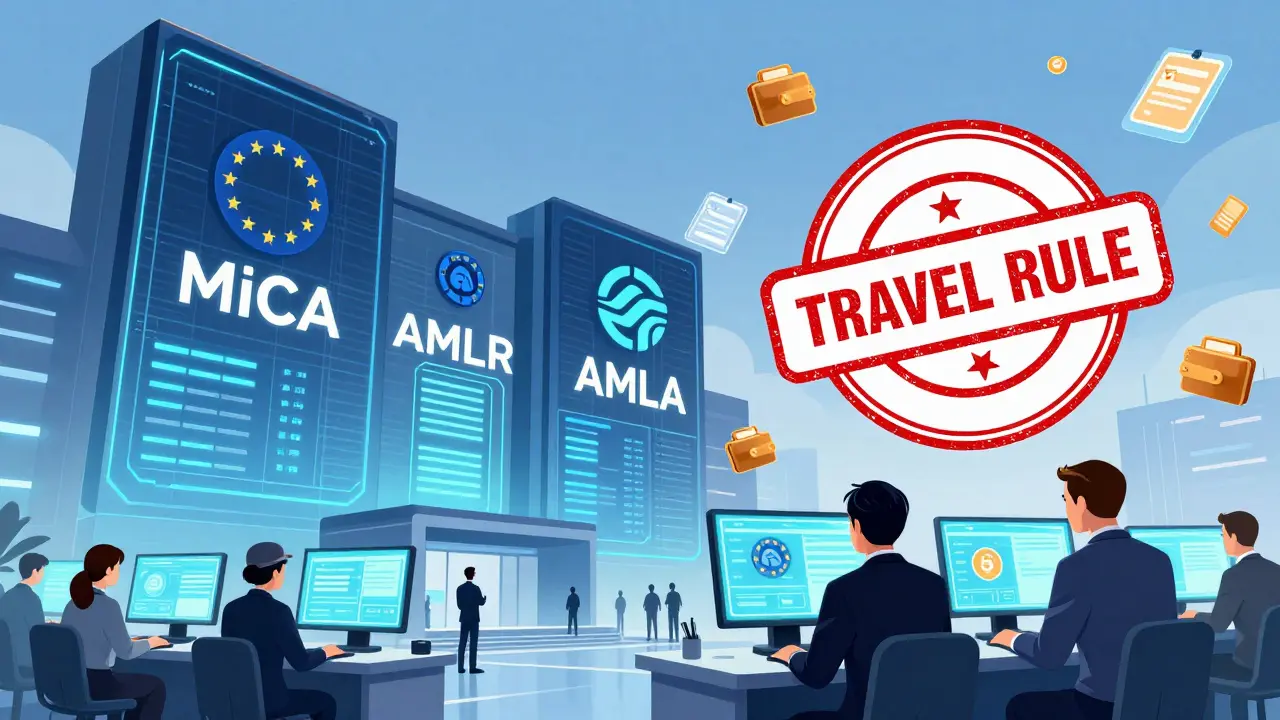
If you're running a crypto business in the European Union, you're not just dealing with code and wallets-you're navigating one of the strictest financial compliance systems in the world. The rules aren't suggestions. They're legally binding, enforced across all 27 member states, and backed by a new EU-wide authority that can shut you down if you slip up. This isn't about fear. It's about survival. In 2025, if your crypto exchange, wallet provider, or trading platform isn't fully compliant with EU AML rules, you're already operating illegally.
What Changed in 2025? The New EU Crypto Rulebook
The EU didn't just update its crypto rules in 2025-it rebuilt them. The old patchwork of national laws is gone. In its place is a single, unified system built on three pillars: MiCA, the AML Regulation (AMLR), and the newly launched Anti-Money Laundering Authority (AMLA).MiCA, which became fully active in 2024, is the license that lets you operate across the EU. Before MiCA, you had to apply for separate licenses in Germany, France, Spain, and so on. Now, one license from one EU country lets you serve customers everywhere. But getting it isn't easy. The average cost to set up compliance for a full MiCA license is between €350,000 and €500,000. The process takes 9 to 12 months. And you need at least three full-time compliance staff just to get through the application.
Then there's AMLR-the new regulation that replaces the old AML directives. It takes effect July 1, 2027, but its rules are already shaping how businesses act today. AMLR introduces a Europe-wide cash payment cap of €10,000 for business transactions. Any cash payment over €3,000 must be verified. And crucially, financial intelligence units (FIUs) now have a strict five-working-day deadline to respond to your requests. No more waiting six weeks for an answer from a slow national agency.
And then there's AMLA. This is the EU's new financial crime watchdog. Headed by Bruna Szego, AMLA doesn't just supervise-it coordinates. It can launch cross-border investigations, demand records from any crypto firm in the EU, and even override national regulators if they're too lenient. In 2025, AMLA began its first coordinated review of crypto businesses, focusing on two things: the Travel Rule and who actually owns the company.
The Travel Rule: No Exceptions, No Minimums
The Travel Rule is the most talked-about rule in crypto compliance today. In the U.S., you only need to share customer data if a transaction is over $3,000. In the EU? It applies to every single transfer-no matter how small.For every crypto transaction, you must collect and verify six pieces of information:
- Originator’s full name
- Originator’s account number or wallet ID
- Originator’s physical address or date of birth
- Beneficiary’s full name
- Beneficiary’s account number or wallet ID
- Beneficiary’s physical address
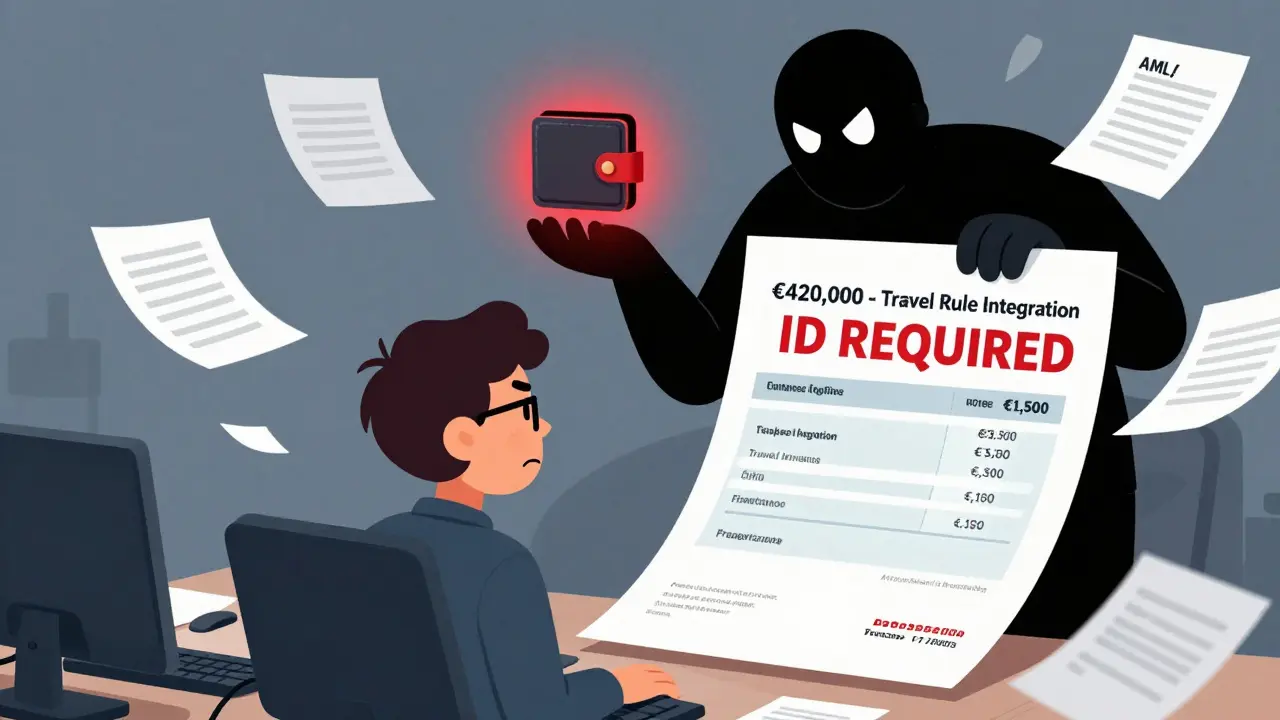
And here’s the catch: if the transaction goes to or from a self-hosted wallet (like MetaMask or Ledger), you must verify the wallet owner’s identity if the amount is over €1,000. That means if someone sends you €1,500 from their personal wallet, you have to ask for their ID. No exceptions. No loopholes.
Companies like Kraken spent over €2.1 million just to connect to all 28 national FIUs across the EU. Smaller firms tried to cut corners by using third-party platforms like Traveler, which cut integration time from six months to eight weeks-but even that cost €420,000. There’s no cheap way out.
Customer Due Diligence: Tiered, Not One-Size-Fits-All
You can't treat every customer the same. AMLA requires a risk-based approach with three levels of verification:- Basic (under €1,000): Name and address confirmation. No ID needed.
- Enhanced (€1,000-€10,000): Valid government ID (passport, driver’s license) plus proof of address (utility bill or bank statement).
- Strict Enhanced (over €10,000): Full source of funds verification. You must prove where the money came from. Was it from a salary? A property sale? A previous crypto sale? You need documentation. And senior management must approve the transaction.
One Estonian firm got caught in 2024 processing €187 million in transactions through a Gibraltar entity to avoid stricter Estonian rules. Both countries fined them. AMLA stepped in. The company lost its license. That’s the kind of example regulators use to scare others into compliance.
Who’s Really in Charge? Beneficial Ownership Rules
The EU doesn’t just care about your customers. They care about you. Who owns your company? Who controls the money? Who’s hiding behind shell companies?AMLR and MiCA require you to identify and verify the ultimate beneficial owners (UBOs) of your business. That means if you’re using a Dutch foundation or a Maltese holding company to obscure ownership, you’re already breaking the rules. AMLA has documented multiple cases where firms used complex corporate structures to hide control. In one case, a crypto firm in Cyprus had 11 layers of ownership between the CEO and the legal entity. AMLA traced it all-and shut them down.
There’s no such thing as anonymous ownership in the EU. If you’re trying to keep your identity hidden, you’re not being smart-you’re being reckless.
DeFi Is Still a Gray Zone
Here’s the big problem: the EU’s rules were built for centralized companies. They assume someone is in charge. Someone who can be fined. Someone who can be sued.Decentralized Finance (DeFi) protocols don’t have CEOs. They don’t have offices. They run on code. And that’s exactly where criminals are going.
German regulators (BaFin) reported a case in early 2025 where a DeFi protocol was used to launder €42 million through a series of automated swaps. No one was named. No one was contacted. No one could be held accountable. The EU doesn’t have a solution yet. But they’re working on one.
AMLA announced in September 2025 that it will release new guidance in Q1 2026 specifically targeting privacy-enhancing technologies-like mixers and privacy coins-that make transactions untraceable. Expect stricter rules on these tools soon.
Training, Reporting, and Internal Controls
You can’t just hire one compliance officer and call it done. You need a full system.- Every compliance employee needs 40 hours of AML training per year. Operational staff need 16 hours.
- You must have a designated Money Laundering Reporting Officer (MLRO) who reports directly to your board.
- All suspicious activity must be reported to your national FIU. There’s no room for delay.
- Your internal policies must be documented, updated quarterly, and signed off by senior management.
ESMA’s guidelines say you must test your systems every quarter. That means running mock transactions, checking if your software flags suspicious behavior, and proving your team knows what to do when it happens.
One small crypto startup in Portugal spent €80,000 on a compliance audit in 2025. They failed. The regulator gave them 30 days to fix it. They didn’t. Their license was revoked.
What Happens If You Don’t Comply?
Fines aren’t the worst of it.Non-compliant firms face:
- Fines up to 5% of annual turnover or €5 million-whichever is higher
- License suspension or revocation
- Personal liability for senior managers
- Public naming by AMLA
- Criminal charges if money laundering is proven
And it’s not just about fines. In 2025, the European Central Bank reported that regulated crypto firms had 63% fewer illicit transactions than unregulated ones. That means customers and investors are choosing compliant platforms. If you’re not compliant, you’re not just breaking the law-you’re losing your market.

The Real Cost of Compliance
Let’s be honest: this is expensive. For startups with fewer than 10 employees, 68% said AML compliance costs are prohibitive. Nearly half have either scaled back EU operations or moved their headquarters to Switzerland or Singapore.But here’s the flip side: regulated platforms now control 89% of institutional business in the EU. Big investors-hedge funds, family offices, pension funds-won’t touch unlicensed platforms. They’ve been burned before.
One Coinbase EU compliance officer put it simply: “Having a single EU-wide license reduced our operational complexity by 70%.”
The cost isn’t just money. It’s time. It’s staff. It’s headaches. But the cost of not complying? That’s your business.
What’s Next? The Road to 2027
By July 1, 2027, the EU-wide AMLR will fully replace the old directives. That means:- More entities will be regulated: crowdfunding platforms, football clubs, high-value goods traders
- Stricter deadlines for FIU responses
- Stronger penalties for evasion
- AMLA will have full control over AML enforcement
By 2027, the EU expects 450 to 500 licensed crypto firms. But only if they play by the rules.
The message is clear: the EU isn’t trying to kill crypto. It’s trying to clean it up. If you’re building something real, compliant, and transparent-there’s a huge market waiting. If you’re trying to hide, exploit loopholes, or operate in the shadows-you won’t last.
Do I need a MiCA license if I only serve customers in one EU country?
Yes. MiCA is an EU-wide license. Even if you only operate in one country, you must apply through your national regulator under MiCA. There’s no national-only license anymore. The old system is gone. MiCA is the only path to legal operation in the EU.
Can I use a third-party service to handle AML compliance?
You can outsource parts of compliance-like identity verification or transaction monitoring-but you cannot outsource responsibility. The law holds your company, not your vendor, accountable. If a third party fails, you still face fines, license revocation, or criminal charges. Always audit your vendors. Keep internal oversight.
What happens if a customer refuses to provide their address for the Travel Rule?
You cannot process the transaction. The Travel Rule is mandatory. If the customer won’t provide the required information, you must block the transfer. Refusing to comply is not an option. Some firms have tried to let users bypass this by labeling them as "non-EU"-but AMLA has already cracked down on this tactic. Don’t risk it.
Are privacy coins like Monero or Zcash banned in the EU?
They’re not explicitly banned-but they’re effectively unusable on licensed platforms. MiCA requires full traceability. Most regulated CASPs have already stopped supporting privacy coins because they can’t verify transactions. AMLA is expected to issue formal guidance in Q1 2026 that may formally restrict or ban them. If you’re still accepting privacy coins, you’re already operating outside the law.
How do I know if my AML software is compliant?
Your software must be able to: (1) collect all six Travel Rule data points, (2) verify self-hosted wallets over €1,000, (3) flag suspicious patterns automatically, (4) generate reports for FIUs, and (5) store records for at least five years. Ask your vendor for a compliance certificate aligned with AMLR and MiCA. If they can’t provide one, don’t trust it. The EBA published a list of approved technical standards in March 2025-use that as your benchmark.
Final Thought: Compliance Is Your Competitive Edge
The EU’s crypto AML rules are tough. They’re expensive. They’re complex. But they’re also the most complete system in the world. The firms that survive and thrive aren’t the ones that fought the rules-they’re the ones that embraced them. They turned compliance into trust. And trust is what attracts institutional money, big customers, and long-term growth.If you’re building a crypto business in the EU today, you’re not just coding. You’re building a legal, financial, and ethical foundation. Do it right-or don’t do it at all.

Comments
Andrea Stewart
Just finished implementing MiCA compliance for our wallet platform. The Travel Rule alone cost us $180K in dev time, but now we’re approved in all 27 countries. Worth it. No more jumping through 27 different hoops.
Pro tip: Use the EBA’s approved tech list. Don’t trust vendors who say they’re ‘MiCA-ready’ without a certificate.
Also, AMLA’s first audit wave hit 14 firms last month. Two got shut down. Don’t be one of them.
Josh Seeto
So let me get this straight - we spent 18 months and half a million euros just to verify that Alice sent Bob $50 in Bitcoin… and now we’re supposed to believe this makes crypto ‘safe’?
Meanwhile, the same regulators let hedge funds move $2 billion in fiat through shell companies with zero scrutiny. The hypocrisy is thicker than a Ledger Nano’s firmware.
Khaitlynn Ashworth
Oh sweet mercy. You people are seriously treating this like it’s a business manual and not a dystopian fanfic written by a bureaucrat who’s never touched a blockchain?
You need a compliance officer for every transaction? You need to verify the *address* of someone sending you 0.001 ETH from a Ledger? Are we running a bank or a Kafkaesque nightmare?
And don’t even get me started on ‘self-hosted wallets’ - you want me to call my neighbor who sent me 200 euros in BTC and ask for his utility bill? Next they’ll want me to fingerprint his cat.
Meanwhile, the real money launderers? They’re still using Swiss art auctions and private jets. But hey, let’s crush the little guys. Classic EU.
rachael deal
I know it’s a lot. I really do. But if you’re building something real, this is the price of trust.
Our users don’t care about your ‘freedom’ - they care that their funds aren’t frozen by a random regulator. They care that they can withdraw without a 3-week wait.
We went from 120 users to 12,000 after we got MiCA. The headaches? Real. The growth? Realer.
You’re not being crushed - you’re being upgraded. Embrace the grind. 💪
Elisabeth Rigo Andrews
Let’s be brutally honest: MiCA is a regulatory capture scheme disguised as consumer protection. The big players - Coinbase, Kraken - lobbied for this. They wanted to kill the small competitors who couldn’t afford the €500K entry fee.
Now you have a cartel of 500 licensed entities. The EU calls it ‘market integrity.’ We call it a monopoly.
And don’t even get me started on AMLA. It’s the IMF with a blockchain tattoo. They don’t want to regulate crypto - they want to own it.
Mandy McDonald Hodge
so like… i just started my little crypto service and i’m terrified 😭
i got the basic verifications set up and used a third party for id checks but now i’m worried about the travel rule… like what if someone sends me 800 euros from a wallet and i don’t know who they are??
do i just block it? is that gonna kill my user growth??
anyone else in this boat?? pls help 😅
Bruce Morrison
Block it. That’s the rule. No exceptions. If you let one slip, AMLA will find it. Then you’re on their radar. Then you’re done.
Yes, it sucks. Yes, it turns away users. But you’re not a startup anymore - you’re a regulated entity. Act like it.
And if you want to grow, build for compliance from day one. Not after you get 1000 users and realize you’re broke.
Andrew Prince
It is an incontrovertible fact that the European Union’s regulatory architecture, while ostensibly designed to mitigate illicit financial flows, has in fact created a structural impediment to innovation by imposing exorbitant compliance burdens upon nascent enterprises, thereby entrenching oligopolistic control within the digital asset sector.
The notion that a small firm in rural Portugal can reasonably be expected to maintain three full-time compliance officers, procure blockchain analytics software licensed by the EBA, and implement real-time KYC for micro-transactions - all while maintaining profitability - is not merely impractical, it is economically nonsensical.
Furthermore, the imposition of the Travel Rule without a threshold is a fundamental violation of the principle of proportionality, a cornerstone of EU administrative law, and should be challenged before the Court of Justice of the European Union.
And yet, the regulators, cloistered in Brussels, remain oblivious to the unintended consequences of their over-engineered edifice - a monument to bureaucratic hubris, not public safety.
Jordan Fowles
There’s a quiet irony here. The EU is trying to make crypto more transparent - but they’re doing it by making it more bureaucratic.
It’s like trying to clean a river by building 12 dams and requiring every fish to fill out a form before swimming.
The rules are detailed, the enforcement is real, and the penalties are terrifying.
But what’s being lost in all this? The original spirit of crypto - permissionless, borderless, decentralized.
Maybe the real question isn’t whether you can comply - but whether you want to be part of a system that’s trying to turn Bitcoin into a bank account.
Steve Williams
As a developer from Nigeria, I’ve watched this unfold with fascination. The EU is not just regulating crypto - they are defining its future global standard.
Many African startups are now modeling their compliance frameworks after MiCA, even though they’re not in the EU.
It’s not about control. It’s about credibility. If you want institutional capital, you need this paper trail.
Yes, it’s heavy. But it’s the price of legitimacy.
nayan keshari
lol you guys are panicking over paperwork while China is launching digital yuan with facial recognition and AI tracking
the eu is playing chess with napkins while the real game is already over
compliance is just a distraction
we should be building on monero not fighting for a license
Johnny Delirious
Let me be unequivocal: The European Union’s adoption of MiCA and AMLR represents the most comprehensive, forward-looking, and strategically coherent regulatory framework for digital assets ever conceived by any sovereign jurisdiction.
It is not merely a set of rules - it is a foundational architecture for financial integrity in the 21st century.
Any entity that views this as a burden is fundamentally misaligned with the trajectory of global finance.
Compliance is not a cost - it is a competitive advantage. And those who embrace it will dominate the next decade.
Bianca Martins
Just got my license approved last week. Took 11 months. Spent $420K.
But now I can sleep at night.
Also - if you’re using a third-party KYC vendor? Make sure they’re certified under AMLR Annex III. I learned the hard way - mine wasn’t. Got a warning letter. Fixed it in 10 days.
And yes, the Travel Rule is a pain. But if you filter out 20% of users who won’t give their address? You’re filtering out the bad actors. It’s worth it.
Also… hi. I’m new here. 😊
alvin mislang
People are acting like this is some kind of tragedy. It’s not. It’s justice.
For years, crypto was a playground for criminals, tax evaders, and fraudsters. Now? They’re being forced into the light.
If you’re crying about compliance, maybe you were never supposed to be here.
Get out. Or get clean. No middle ground.
🚫💸
christopher charles
Hey - you’re not alone. I started last year with 2 employees. We had zero compliance. We thought we could wing it.
Big mistake.
Our first audit? We failed. Got 30 days to fix everything.
We hired a part-time compliance consultant ($60/hr), used a cheap but certified KYC tool, and spent 3 months rewriting every policy.
Now we’re approved. We’re growing. And we’re not scared anymore.
It’s hard. But it’s possible. And you’re gonna be okay.
Just start. One step. Today.
Vernon Hughes
In India we have no such rules. But I watch this and I’m impressed.
Not because it’s perfect. But because it’s consistent.
Here, crypto is a gray zone. Regulators don’t know what to do. So they do nothing.
EU? They decided. They acted.
Even if it’s harsh, at least it’s clear.
That’s leadership.
Alison Hall
Just got my license. Took 9 months. Worth every second.
Now I can sleep.
And my investors actually trust me.
Amy Garrett
ok so i spent 3 months trying to get mica and then my lawyer told me i need to verify the address of every single user who sends me 1000 euros… but what if they’re using a vpn??
do i just say no? i feel like i’m being asked to be a cop for the internet 😭
Mike Reynolds
That’s the thing - you can’t verify a VPN. And you shouldn’t try.
What you can do is flag the transaction as high-risk. Then require enhanced due diligence - ask for bank statements, proof of income, anything that ties them to a real identity.
If they refuse? Block it.
You’re not policing the world. You’re protecting your license.
And honestly? Most people who use VPNs for crypto aren’t criminals. They’re just privacy-conscious. But the system doesn’t care why. It just cares that you followed the rules.
dayna prest
They call it ‘cleaning up crypto’ - but what they’re really doing is turning it into Wall Street 2.0.
Remember when crypto was about freedom? Now you need a lawyer to send a friend $20.
It’s not regulation. It’s colonization.
And the worst part? The people who built this system will never use it. They’ll just collect fees from the rest of us.
Brooklyn Servin
Okay but let’s be real - the Travel Rule is a nightmare for DeFi and privacy wallets, and AMLA knows it.
They’re not trying to make crypto safe.
They’re trying to make it boring.
And guess what? It’s working.
Every time a new rule drops, another dev quits and moves to Switzerland.
Meanwhile, the real criminals? They’re using non-crypto channels - art, real estate, crypto-to-fiat kiosks in Bangkok.
So we’re punishing the honest devs while the sharks swim free.
It’s not justice.
It’s theater.
And I’m tired of being the audience. 🤷♀️
Ryan Husain
Regulation is not the enemy of innovation - lack of clarity is.
The EU has given us a clear, unified framework. That’s a gift.
Yes, it’s expensive. Yes, it’s complex. But now we know what the rules are.
That allows us to build with confidence - not fear.
And that’s the only way crypto will ever achieve mass adoption: by being trustworthy, not just revolutionary.
Rajappa Manohar
travel rule is joke. no one can verify wallet owner. its impossible.
eu dont care. they just want to look like they doing something.
Andrea Stewart
It’s not impossible - it’s just expensive. Kraken spent $2M connecting to all 28 FIUs. We used a middleware provider - cost $420K, took 8 weeks.
Yes, it’s a pain. But if you want to operate in the EU, you pay the price.
And honestly? Most users don’t mind. They just want their money to move without getting frozen.
It’s not perfect. But it’s the best we’ve got.
Bianca Martins
Also - if you’re still using a self-hosted wallet for large transfers? You’re asking for trouble.
AMLA’s first audit targeted exactly that.
They flagged 12 firms for letting users bypass KYC by sending from MetaMask.
Now? All of them got fined. Two got banned.
Don’t be the next headline.
Elisabeth Rigo Andrews
And here’s the real kicker: even if you comply fully, AMLA can still shut you down if they decide your ‘risk profile’ is too high.
No appeal. No hearing. Just a letter saying ‘your license is revoked.’
So compliance doesn’t guarantee safety.
It just guarantees you’re on their radar.
Which is worse than being in the shadows?