
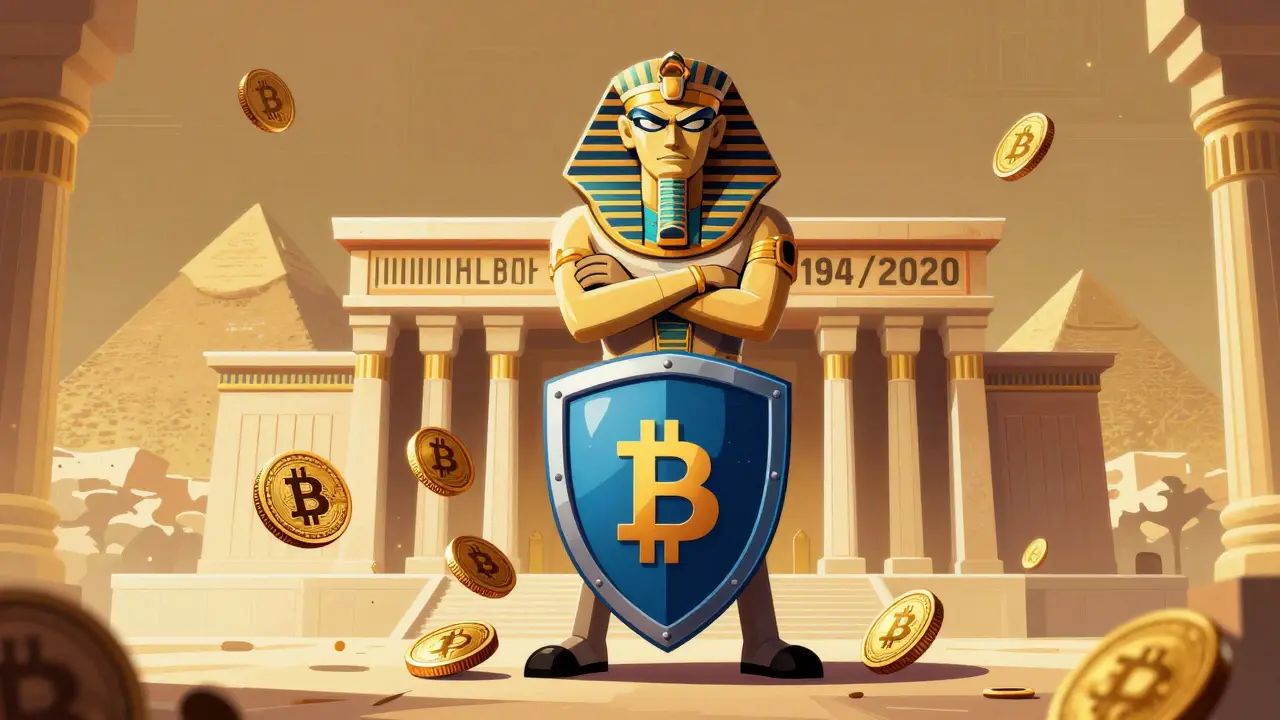
If you are looking to trade Bitcoin or buy Ethereum in Egypt, the short answer is a hard no. The Ronan Hexton has looked into the regulations, and the reality on the ground is strict. The Central Bank of Egypt (CBE) the country's primary monetary authority responsible for regulating financial institutions and maintaining economic stability has enforced one of the most comprehensive cryptocurrency prohibitions in the Middle East. This isn't just a suggestion; it is backed by heavy legal frameworks and reinforced by religious guidance.
You might wonder why Egypt takes such a tough stance while other nations embrace digital assets. It comes down to three main pillars: financial stability, monetary policy control, and consumer protection. But here is the twist-while they hate cryptocurrencies, they actually love the technology behind them. Understanding this distinction is crucial if you are doing business in Egypt or holding Egyptian assets.
The Legal Hammer: Law No. 194/2020
To understand the ban, you have to look at the law itself. In 2020, Egypt passed Law No. 194/2020 The Central Bank and Banking System Law that redefined the regulatory framework for financial activities in Egypt. This legislation didn't just tweak existing rules; it built a wall around the entire banking system.
Under this law, any issuance, trading, exchange, or promotion of cryptocurrencies without prior approval from the CBE is strictly prohibited. Let’s break that down because "promotion" is a key word here. You can’t just avoid buying Bitcoin; you also cannot legally advertise it, run an exchange for it, or even talk it up as a viable investment option within the formal financial sector.
- Issuance: Creating new tokens or coins is banned.
- Trading: Buying or selling crypto through local banks or licensed exchanges is illegal.
- Promotion: Marketing crypto services to Egyptian residents is prohibited.
This creates a blanket ban on virtually all cryptocurrency activities within Egypt's regulated financial system. If you are a foreign company trying to serve Egyptian customers with crypto products, you are stepping on thin ice. The CBE views unregulated virtual currencies as a threat to the nation's monetary sovereignty.
The Religious Factor: A Unique Double Barrier
Most countries regulate crypto based on economics. Egypt adds a second layer: religion. In 2018, Al-Azhar, the highest authority in Sunni Islam, issued a fatwa declaring digital assets haram (forbidden). They argued that cryptocurrencies lack intrinsic value and involve excessive uncertainty (gharar) and gambling-like speculation (maysir).
This combination of legal prohibition and religious guidance creates a powerful deterrent. For many Egyptians, avoiding crypto isn't just about obeying the bank; it's about adhering to religious principles. This dual approach makes Egypt's resistance to cryptocurrency integration much deeper than in secular jurisdictions. It means there is less underground demand compared to countries where only the law prohibits it.
Enforcement Reality: Strict Rules, Fuzzy Execution
Here is where things get complicated. While the law is clear, enforcement is messy. According to the U.S. State Department’s 2025 Egypt Investment Climate Statement, the CBE has prohibited all dealings with cryptocurrencies since 2020, but enforcement remains unclear.
Why? Because monitoring decentralized transactions is incredibly difficult. Cryptocurrencies operate on peer-to-peer networks. Unless you are using a centralized exchange that cooperates with authorities, tracking who bought what is technically challenging. Reports suggest ongoing cryptocurrency activity despite the legal prohibitions, particularly among tech-savvy individuals using peer-to-peer platforms or offshore exchanges.
However, don't mistake this gap for permission. The CBE regularly issues warning statements renewing its stance against dealing with encrypted virtual currencies. Their strategy appears focused on education and deterrence rather than mass prosecution. They want to scare you away from the risks before you lose your money, rather than wait to arrest you after.
| Aspect | Cryptocurrencies (Bitcoin, etc.) | Blockchain Technology |
|---|---|---|
| Legal Status | Prohibited under Law No. 194/2020 | Encouraged for government/commercial use |
| Religious Ruling | Haram (Forbidden) per 2018 Fatwa | Neutral/Permissible if used ethically |
| Banking Access | Banks cannot facilitate transactions | Banks can implement blockchain solutions |
| Primary Risk Viewed | Financial instability, fraud | Minimal if controlled |

The Exception: Embracing Blockchain, Rejecting Coins
This is the part that confuses many outsiders. Egypt bans Bitcoin but uses blockchain. How does that work?
The Egyptian government distinguishes between the speculative asset (the coin) and the underlying technology (the ledger). They see blockchain as a tool for efficiency, transparency, and fraud reduction. They do not see it as a threat to monetary policy if it doesn't involve a rival currency.
A prime example is the Advanced Cargo Information (ACI) system at customs. Egypt implemented blockchain solutions here to enhance transparency and reduce fraud in cross-border transactions. By using distributed ledger technology, they can track goods more securely, ensuring that tariffs are paid correctly and smuggling is minimized.
Government officials and industry leaders are exploring blockchain applications in sectors including:
- Trade and Logistics: Optimizing supply chains and reducing paperwork.
- Identity Management: Creating secure, tamper-proof digital IDs.
- Land Registration: Preventing property fraud with immutable records.
This selective adoption indicates that Egyptian authorities are not Luddites. They are pragmatic. They want the benefits of modernization without the risks of financial destabilization.
What About CBDCs and Future Changes?
Is the ban permanent? Likely yes, for private cryptocurrencies. However, Egypt is watching the global trend toward Central Bank Digital Currencies (CBDCs). Unlike Bitcoin, a CBDC would be issued and controlled by the CBE itself. This allows the state to maintain full oversight of money supply and transaction flows.
Discussions are ongoing regarding blockchain-based startups in sectors like remittances. Remittances are huge for Egypt, sending billions of dollars home from workers abroad every year. If blockchain can make these transfers cheaper and faster without bypassing the central bank, Egypt might allow controlled experimentation. But this would be tightly regulated, not the wild west of current crypto markets.

Risks for Businesses and Individuals
If you are a business operating in Egypt, ignoring the ban is dangerous. Even if enforcement is fuzzy today, the legal liability is real. Banks may freeze accounts if they detect links to crypto exchanges. Partners may hesitate to work with you due to compliance concerns.
For individuals, the risk is primarily financial loss. The CBE warns that cryptocurrency investments pose immense risks to consumers. Without legal recourse, if an exchange hacks your account or disappears, you have no one to call. The Egyptian courts will not help you recover stolen Bitcoin because the activity itself was illegal.
Regional Context: How Egypt Compares
Egypt’s approach places it among several Middle Eastern countries with strict regulations, though mechanisms vary. Some neighbors have moved toward licensing crypto firms, while others have total bans. Egypt’s unique model combines legal prohibition, religious guidance, and selective blockchain adoption. This contrasts with more permissive frameworks in jurisdictions like Dubai or Abu Dhabi, which have created dedicated free zones for crypto businesses.
However, Egypt aligns with broader regional concerns about monetary sovereignty. Many Arab nations fear that widespread crypto adoption could undermine their ability to manage inflation and control capital flight. Egypt’s large population and significant informal economy make this fear particularly acute.
Practical Takeaways for 2026
As we move through 2026, the landscape remains stable. Here is what you need to know:
- No Legal Trading: Do not attempt to register a crypto exchange in Egypt. It will not be approved.
- Blockchain is Safe: If your project uses blockchain for logistics, identity, or record-keeping (without tokens), you may find support from government bodies.
- Watch for CBDC News: Keep an eye on announcements from the CBE regarding digital pounds. This is the only form of digital currency likely to gain official status.
- Respect the Fatwa: Be aware that marketing crypto to Egyptian consumers faces cultural and religious headwinds, not just legal ones.
The Central Bank of Egypt is not going to change its mind overnight. Their priority is protecting the Egyptian Pound and the financial system from volatile, unregulated assets. Until they see a way to integrate digital assets without losing control, the ban stays.
Can I buy Bitcoin in Egypt legally?
No. Under Law No. 194/2020, the issuance, trading, and exchange of cryptocurrencies are strictly prohibited without prior approval from the Central Bank of Egypt, which is currently not granted for private cryptocurrencies.
Why does Egypt ban crypto but use blockchain?
Egypt distinguishes between the speculative nature of cryptocurrencies (which threaten financial stability) and the utility of blockchain technology (which improves efficiency and transparency). They use blockchain for customs (ACI system) and logistics while banning the associated coins.
Is there a religious ruling against crypto in Egypt?
Yes. In 2018, Al-Azhar issued a fatwa declaring digital assets haram (forbidden) due to their lack of intrinsic value and high levels of uncertainty and speculation.
How strictly is the crypto ban enforced?
While the law is strict, enforcement is challenging due to the decentralized nature of crypto. The CBE focuses on warnings and deterrence rather than mass arrests, but banks are prohibited from facilitating crypto transactions, creating a significant barrier.
Will Egypt ever accept cryptocurrencies?
It is unlikely for private cryptocurrencies like Bitcoin. However, Egypt is exploring Central Bank Digital Currencies (CBDCs) and blockchain applications for government services, suggesting a future where state-controlled digital finance exists alongside the ban on private crypto.

Write a comment