
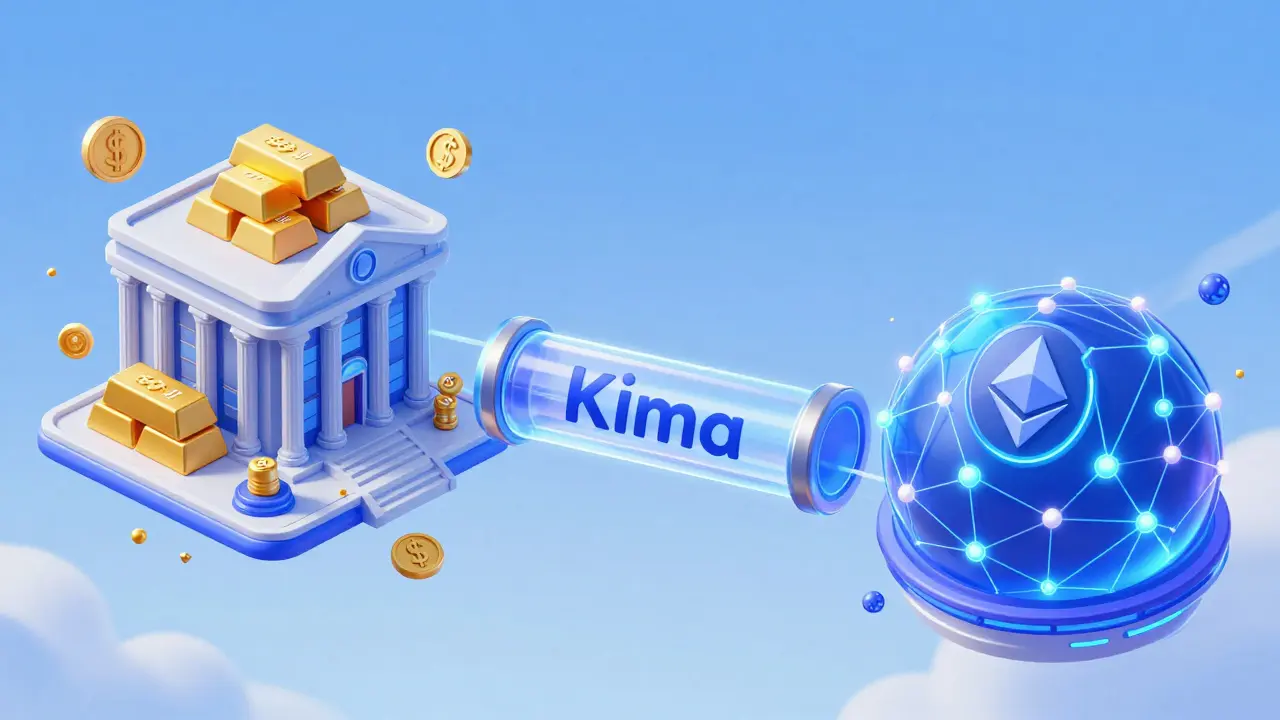
Most people assume that moving money between different blockchains requires wrapping assets or trusting complex bridges. Kima Network is a decentralized protocol designed to settle transactions across blockchain and traditional finance rails without using smart contracts, bridges, or wrapped tokens. Launched with the ticker symbol KIMA, this project positions itself as a universal liquidity layer. It claims to solve the fragmentation problem in digital finance by allowing value to move seamlessly between ecosystems like Ethereum, Solana, and traditional banking systems in a single atomic flow.
If you are looking at KIMA on your portfolio tracker right now, you might be confused by the conflicting data. Some platforms show high circulating supplies while others show low ones. Prices swing wildly, and daily trading volumes can be incredibly thin. This article breaks down exactly what Kima Network is, how its unique technology works, and whether the KIMA token holds any real value for investors or developers in mid-2026.
How Kima Network Works: The No-Bridge Approach
The biggest selling point of Kima is its architecture. In most crypto setups, if you want to send Bitcoin to an Ethereum-based application, you have to lock your Bitcoin in a vault and receive a "wrapped" version (WBTC) on Ethereum. This process relies on smart contracts that manage the locking and unlocking logic. These contracts are frequent targets for hackers. Bridges have been responsible for billions of dollars in losses over the last few years.
Kima takes a different path. It uses a concept called "Smart Transactions." Instead of relying on code-heavy smart contracts to verify every step, Kima operates as a settlement layer. Think of it like a bank clearinghouse but for multiple blockchains. When you initiate a transfer, the protocol coordinates the movement of value directly between the source and destination rails. This means:
- No Wrapped Assets: You don't get a fake version of your token on another chain. The settlement happens natively.
- No Smart Contract Risk: By removing complex user-facing contracts from the critical path, the attack surface shrinks significantly.
- Cross-Ecosystem Compatibility: It connects Web3 (blockchains) with Web2 (traditional finance), allowing fiat-to-crypto flows without leaving the platform.
This design is particularly appealing to institutions. Banks and payment processors hate risk. They cannot afford to trust a random bridge operator. Kima’s promise of atomic settlement-where either both sides of the transaction succeed or neither does-offers the security guarantees these large players need.
Tokenomics and Supply Discrepancies
Understanding the KIMA token requires digging into the numbers, which vary depending on where you look. As of July 2026, the maximum total supply of KIMA is fixed at 210,000,000 tokens. However, the circulating supply-the number of tokens actually available to trade-is reported differently across major data aggregators.
| Platform | Circulating Supply | Market Cap Estimate | Ranking |
|---|---|---|---|
| CoinMarketCap | 194,770,000 KIMA | ~$899,000 USD | #1956 |
| CoinGecko | 68,000,000 KIMA | ~$335,000 USD | #3412 |
| Coinbase | 66,000,000 KIMA | ~$2.45 Million USD | N/A |
Why such a big difference? It likely comes down to how each platform defines "circulating." CoinMarketCap may count all unlocked tokens, including those held by teams or in reserve, while CoinGecko might only count tokens actively traded on exchanges. For an investor, this matters because it affects the fully diluted valuation (FDV). If you buy based on the lower market cap figure, you might think the coin is cheap, but if the true circulating supply is higher, the price pressure could be greater.
The KIMA token serves three main purposes within the network:
- Security & Staking: Users can delegate KIMA to validators. Unlike some systems where you lock up your coins, delegation allows you to keep ownership while assigning voting power. Validators secure the network and earn rewards.
- Transaction Fees: Paying for settlements on the network requires KIMA.
- Liquidity Incentives: Providers who add depth to the shared liquidity pools are compensated in KIMA.
Price History and Liquidity Risks
Let's talk about the elephant in the room: liquidity. If you check the charts for KIMA in early July 2026, you will see extreme volatility. The token hit an all-time high of roughly $1.10 in May 2026. By June, it had crashed nearly 99% to around $0.005. That kind of drawdown is terrifying for retail traders.
More concerning than the price drop is the trading volume. On days when major trackers report activity, the 24-hour volume is sometimes less than $15. What does this mean for you? It means there is very little demand to absorb sell orders. If you try to sell a large amount of KIMA, you could crash the price yourself because there aren't enough buyers waiting in the order book. This is typical for micro-cap projects that haven't yet achieved widespread adoption.
The token trades primarily on decentralized exchanges like Uniswap v4 on Arbitrum. While Coinbase lists the asset, the lack of deep centralized exchange support limits accessibility for average users. Until Kima attracts more institutional partners or major DEX integrations, expect slippage and wide bid-ask spreads.
Use Cases: Who Actually Uses Kima?
A protocol is only as good as its users. So far, Kima has focused on B2B (business-to-business) integrations rather than direct consumer apps. One notable example is its collaboration with Syndika. In August 2023, they used Kima’s DevNet to build a converter app that moves Bitcoin to Wrapped Bitcoin. This proved that the SDK works for real-world applications.
Another key use case is NFT marketplaces. Sellers often struggle when buyers want to pay with stablecoins on different chains. Kima allows marketplaces to accept payments from any ecosystem and settle instantly. The marketplace doesn't need to manage multiple wallets or worry about bridge delays. The settlement happens in the background.
For developers, Kima offers an SDK compatible with both Web2 and Web3 environments. This lowers the barrier to entry. A traditional software engineer doesn't need to become a blockchain expert to integrate cross-chain payments. They just plug into the Kima API. This is a significant advantage over competitors that require deep knowledge of Solidity or Rust.

Is Kima Network Safe?
Security is Kima’s primary marketing pitch. By removing smart contracts from the settlement path, they eliminate the most common vector for hacks. Instead, they rely on native validators and a patent-pending security model. The network uses a proof-of-stake-like mechanism where economic incentives align validators to act honestly.
However, "no smart contracts" doesn't mean "no risk." The protocol itself is still code. Bugs in the core settlement engine or the SDK could still cause issues. Additionally, since the project is relatively new and small, it hasn't undergone the same level of scrutiny as giants like Ethereum or Chainlink. Always do your own due diligence. Check for recent audits and monitor the official communication channels for any security announcements.
Conclusion: High Risk, High Reward Potential
Kima Network represents a bold attempt to fix the broken plumbing of cryptocurrency interoperability. Its vision of connecting TradFi and DeFi without bridges is technically sound and addresses a genuine pain point. If successful, it could become a backbone for institutional payments.
But right now, it remains a niche, high-risk asset. The low liquidity, confusing tokenomics data, and lack of mainstream adoption mean it is not suitable for conservative investors. If you are a developer building cross-chain tools, Kima’s SDK is worth exploring. If you are a trader, be aware that the low volume makes it difficult to enter and exit positions without impacting the price. Watch for signs of increased institutional partnerships or major exchange listings before committing significant capital.
What is the main purpose of Kima Network?
Kima Network is a cross-ecosystem settlement protocol that enables seamless money transfers between blockchains (DeFi) and traditional finance (TradFi) without using bridges, smart contracts, or wrapped assets. It aims to provide atomic, secure, and compliant settlement for various asset types.
How many KIMA tokens exist?
The maximum total supply of KIMA is capped at 210,000,000 tokens. However, the circulating supply varies by data provider, ranging from approximately 66 million to 194 million tokens as of mid-2026, depending on how locked or reserved tokens are counted.
Does Kima use smart contracts?
No, Kima explicitly avoids using smart contracts for its core settlement layer. It uses a proprietary "Smart Transaction" primitive and a dedicated protocol layer to handle settlements, aiming to reduce the security risks associated with complex smart contract code.
Where can I buy KIMA token?
KIMA is primarily traded on decentralized exchanges (DEXs) like Uniswap v4 on Arbitrum. It is also listed on several centralized platforms including Coinbase, Crypto.com, and Gate.io, though liquidity varies significantly between them.
What is the APY for staking KIMA?
Users can delegate KIMA to validators to earn rewards. The target annual percentage yield (APY) is approximately 28%, though actual returns depend on validator performance and commission fees. Delegation allows users to retain ownership of their tokens while supporting network security.
Is Kima Network safe to use?
Kima prioritizes security by removing smart contracts and bridges from the settlement path, reducing common hack vectors. However, as a newer protocol with limited audit history compared to established networks, users should exercise caution and be aware of the inherent risks in early-stage crypto projects.
What is the current market cap of KIMA?
As of July 2026, KIMA's market capitalization is estimated between $335,000 and $900,000 USD, depending on the data source. It ranks outside the top 1,000 cryptocurrencies on major trackers, indicating it is a micro-cap asset with high volatility.
Can developers integrate Kima into their apps?
Yes, Kima provides an SDK compatible with both Web2 and Web3 applications. This allows developers to embed cross-chain settlement and payment flows into their platforms without needing extensive blockchain expertise, facilitating integrations for NFT marketplaces, payment gateways, and more.

Write a comment