
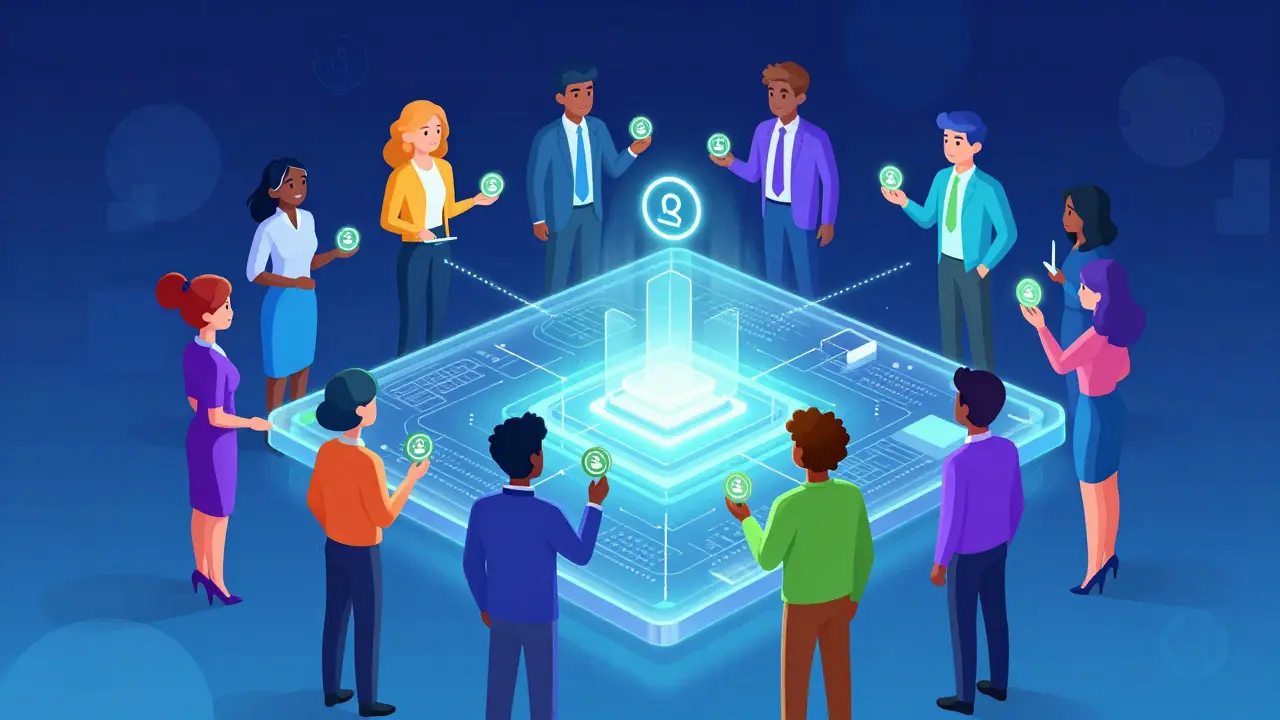
Imagine a company with no CEO, no HR department, and no physical office. Instead, thousands of strangers from around the world vote on decisions using tokens, and code automatically executes those choices. This is the promise of Decentralized Autonomous Organizations, also known as DAOs. They are blockchain-based entities governed by smart contracts and collective decision-making rather than centralized leadership.
The hype around DAOs has been massive since their inception. But if you have tried to join one recently, you might have noticed something different. The dream of perfect digital democracy often collides with slow voting processes, confusing interfaces, and questions about who is actually in charge. As we move through 2026, the reality of DAOs is far more nuanced than the early marketing suggested. They offer incredible transparency and global access, but they also struggle with speed, legal ambiguity, and voter apathy.
What Is a DAO and How Does It Work?
To understand the benefits and limitations, you first need to know what you are looking at. A DAO is not just a group chat or a Discord server. It is an organization where the rules are written into code called smart contracts. These contracts live on a blockchain, such as Ethereum or its faster, cheaper alternatives like Arbitrum.
Here is the basic workflow:
- Treasury Creation: Members contribute funds to a shared wallet (often managed by tools like Gnosis Safe).
- Proposal Submission: Any member can submit a proposal, such as "Let's fund this developer" or "Let's change the protocol fee."
- Voting: Token holders vote. One token usually equals one vote, though some systems use quadratic voting to reduce whale power.
- Execution: If the proposal passes, the smart contract automatically executes the action. No human needs to approve the transfer.
This structure removes intermediaries. In a traditional corporation, a board of directors approves budgets. In a DAO, the code enforces the budget. This creates a level of trust that is hard to replicate in traditional business models.
The Core Benefits: Why People Join DAOs
Despite the challenges, DAOs have grown significantly. By mid-2025, over 13,000 active DAOs were managing approximately $40 billion in treasuries. Why do people participate? Here are the tangible advantages.
1. Radical Transparency
In a traditional company, financial records are private unless audited. In a DAO, every transaction is public. You can see exactly how much money is in the treasury, where it came from, and where it went. For example, Arbitrum DAO manages a $4.2 billion treasury, and anyone can track these funds in real-time. This eliminates hidden fees and embezzlement risks that plague traditional organizations.
2. Global Access and Permissionless Participation
You don't need a visa, a resume, or an interview to join most DAOs. If you hold the token or meet the contribution criteria, you can participate. This opens up talent pools globally. A 19-year-old developer in Nigeria can earn significant income contributing to a project without needing a local employer. According to workforce analyses, DAO participants span 187 countries, compared to the average multinational corporation's 40-60 countries.
3. Automated Rule Enforcement
Human error and bias are reduced because code executes decisions. If a grant is approved, the funds are released automatically. There is no middleman delaying payment or taking a cut. This efficiency is particularly valuable in DeFi (Decentralized Finance) protocols where speed and accuracy are critical.
The Hard Limitations: Where DAOs Struggle
If DAOs were perfect, everyone would run them. They aren't. The limitations are structural and often overlooked by newcomers.
1. Slow Decision-Making
Democracy is slow. In a traditional startup, a founder can pivot strategy in hours. In a DAO, proposals take time. On-chain voting requires gas fees and block confirmations. Even off-chain voting platforms like Snapshot require deliberation periods. Top-performing DAOs like MakerDAO can implement decisions in 72 hours, but the average DAO takes 14-21 days. In a crisis, this delay can be fatal.
2. Voter Apathy and Low Participation
Most DAOs suffer from low engagement. While a DAO might have 10,000 token holders, only a small fraction votes. CoinLaw’s 2025 statistics show that most DAOs report participation rates below 18%. This means a tiny group of dedicated users makes decisions for the majority. It creates a disconnect between the community’s will and the actual governance outcomes.
3. Whale Dominance and Plutocracy
Because voting power is tied to token ownership, large holders (whales) dominate decisions. In many major DAOs, the top 15-20% of holders control 78% of the votes. This contradicts the ideal of decentralization. Dr. Primavera De Filippi noted that "the myth of perfect decentralization has been thoroughly debunked by empirical data showing whale dominance in 89% of major DAOs." Without mechanisms like quadratic voting or reputation systems, DAOs risk becoming plutocracies.
4. Legal Ambiguity
This is the biggest risk for participants. Most DAOs operate in a legal gray area. Who is liable if the DAO gets sued? Is the DAO a partnership, a corporation, or something else? As of 2025, only a few jurisdictions, like Wyoming in the US and the UAE’s RAK DAO Association, have specific laws recognizing DAOs. In many other regions, participants could face personal liability for organizational debts or actions. The SEC has warned that DAO participants may face unexpected regulatory scrutiny.

Comparing DAOs to Traditional Organizations
| Feature | Traditional Corporation | DAO |
|---|---|---|
| Transparency | Low (Private finances) | High (Public ledger) |
| Decision Speed | Fast (Centralized authority) | Slow (Consensus required) |
| Global Access | Limited (Visa/Legal barriers) | Unlimited (Permissionless) |
| Legal Liability | Clear (Limited liability) | Ambiguous (Varies by region) |
| Governance Cost | High (Executives, lawyers) | Lower (Code enforcement) |
Security Risks and Smart Contract Vulnerabilities
Because DAOs rely on code, they are vulnerable to bugs. A single line of bad code can drain millions. In 2025 alone, there were $90 million in losses from DAO-related smart contract exploits. The original The DAO hack in 2016 was a wake-up call, losing $60 million due to re-entrancy vulnerabilities. Today, audits by firms like OpenZeppelin are standard, but they are not foolproof. Formal verification is adopted by only 42% of DAOs. Participants must assume that any code can fail.
Who Should Use a DAO?
DAOs are not for everyone. They work best in specific contexts:
- Protocol Development: Projects like Chainlink or Uniswap benefit from community input on technical parameters.
- Fund Allocation: Grant-making organizations like Gitcoin use DAOs to distribute funds fairly based on community votes.
- Community Coordination: NFT communities and social clubs use DAOs to manage shared assets and events.
They fail in time-sensitive operations. If you need to respond to a security threat in minutes, a DAO is too slow. The 2023 Nouns DAO incident, where $1.2 million was stolen before the community could react, highlights this flaw.
How to Get Started Safely
If you want to join or build a DAO, follow these steps to mitigate risks:
- Understand the Tech: Learn how wallets (like MetaMask) and gas fees work. Familiarize yourself with governance platforms like Snapshot.
- Check Legal Status: Determine if the DAO has a legal wrapper, such as a Wyoming LLC or a Swiss foundation. This protects you from personal liability.
- Start Small: Don’t invest your life savings. Contribute time first to understand the culture and governance process.
- Verify Audits: Ensure the smart contracts have been audited by reputable firms. Look for bug bounty programs.
- Engage Actively: Read proposals. Don’t just vote yes/no. Understand the implications of each decision.
Setup costs for a new DAO average $50,000, including smart contract development, legal structuring, and community tools. It is not a cheap experiment.
The Future: Hybrid Models and AI Integration
The industry is evolving. Pure on-chain voting is giving way to hybrid models. Vitalik Buterin has advocated for reputation-based systems to reduce whale influence. AI tools are now used by 47% of DAOs to summarize proposals and predict voting outcomes, helping combat voter fatigue. Legal frameworks are maturing, with the EU’s MiCA regulations and Wyoming’s DAO LLC providing clearer paths for legitimacy.
However, the core challenge remains: balancing decentralization with efficiency. As McKinsey predicts, DAOs will govern 15% of Web3 projects by 2030 but fewer than 5% of traditional enterprises. They are a powerful tool for specific tasks, not a replacement for all organizational structures.
Is it safe to join a DAO?
Safety depends on the DAO's legal structure and code quality. Technically, smart contracts can have bugs leading to loss of funds. Legally, if the DAO lacks a proper legal wrapper, you might face personal liability. Always check for audits and legal status before participating.
How do I make money in a DAO?
You can earn money by providing services (development, design, writing) funded by DAO grants, holding governance tokens that appreciate in value, or earning yield from the DAO's treasury investments. However, returns are not guaranteed and carry high risk.
What is the difference between a DAO and a traditional company?
A traditional company has centralized leadership and private finances. A DAO is governed by code and token holders, with public finances and decentralized decision-making. DAOs are slower but more transparent and accessible globally.
Are DAOs legal in my country?
It varies. Countries like the US (Wyoming), Switzerland, and the UAE have specific frameworks. Others treat DAOs as unincorporated associations, which can create liability risks. China and India maintain strict prohibitions. Consult a local lawyer specializing in crypto law.
Why do most DAO votes have low participation?
Voter apathy is common due to the complexity of proposals, lack of incentives for voting, and the belief that individual votes don't matter. This leads to a small group of active members dominating governance, a problem known as the "voter participation crisis."
Can a DAO be hacked?
Yes. Since DAOs run on smart contracts, vulnerabilities in the code can be exploited by hackers. Multi-signature wallets and regular audits reduce this risk, but they do not eliminate it entirely. History shows that significant losses occur regularly.
What is a "whale" in a DAO context?
A whale is a person or entity that holds a large amount of governance tokens. Because voting power is often proportional to token holdings, whales can disproportionately influence decisions, potentially undermining the democratic nature of the DAO.
Do I need coding skills to join a DAO?
No. While technical skills help, many DAOs need writers, designers, marketers, and community managers. You primarily need a crypto wallet and an understanding of how to vote and communicate within the platform.

Write a comment