
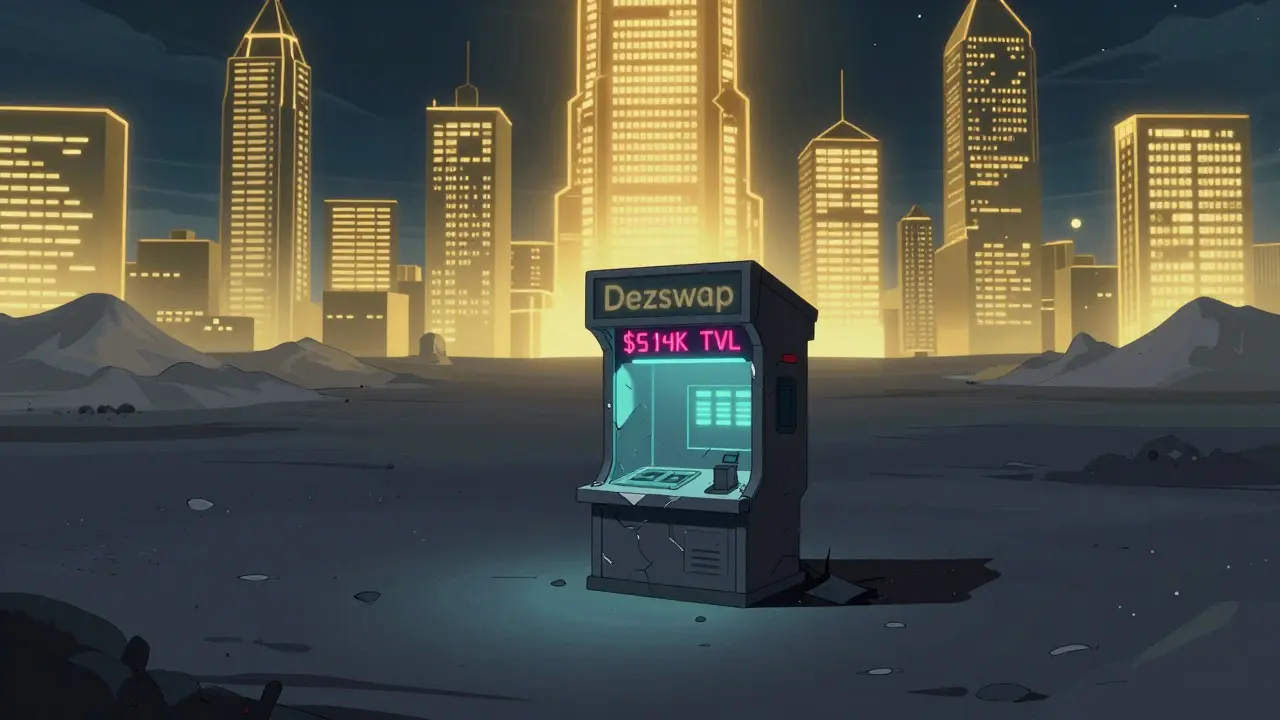
You found Dezswap, a name that popped up in your search results or maybe on a social media feed. You want to know if it’s worth connecting your wallet. The short answer? Proceed with extreme caution. In the world of decentralized finance (DeFi), visibility is usually a proxy for safety and liquidity. Dezswap currently lacks both.
As we move through mid-2026, the decentralized exchange landscape is dominated by giants like Uniswap and PancakeSwap, which handle billions in daily volume. Dezswap sits far outside this mainstream. This review breaks down what little data exists, why that lack of data matters, and whether you should risk your capital on a platform with such a small footprint.
The Hard Numbers: Liquidity and Market Presence
When evaluating any exchange, centralized or decentralized, liquidity is king. It determines how much slippage you get when you trade and whether you can actually exit a position without losing significant value. For Dezswap, the numbers are stark.
According to ChainUnified intelligence tracking, Dezswap secures approximately $514,190 in total value locked (TVL). To put that in perspective, major competitors like Uniswap holds over $4 billion in TVL across multiple chains. Even smaller niche exchanges often boast tens of millions in locked assets. Dezswap’s sub-half-million-dollar TVL places it in the category of micro-exchanges.
| Exchange | Total Value Locked (TVL) | CoinMarketCap Status | Chain Support |
|---|---|---|---|
| Uniswap | $4 Billion+ | Tracked / Top Tier | Multi-chain (ETH, Polygon, Arbitrum, etc.) |
| PancakeSwap | $2 Billion+ | Tracked / Top Tier | BNB Chain, Ethereum, others |
| Curve Finance | $4 Billion+ | Tracked / Top Tier | Multi-chain |
| Dezswap | $514,190 | Untracked Listing | Single Blockchain |
This table highlights the massive gap between established protocols and Dezswap. With less than 0.01% of the liquidity of its top competitors, Dezswap cannot offer competitive pricing for most trades. If you try to swap a large amount, the thin order books will likely result in high slippage, meaning you receive significantly fewer tokens than expected.
Why "Untracked" Status Is a Red Flag
Data transparency is crucial in crypto. Platforms like CoinMarketCap and CoinGecko act as gatekeepers of credibility. They verify volume, audit listings, and ensure that price feeds are not manipulated.
CoinMarketCap categorizes Dezswap as an "Untracked Listing." This isn’t just a minor oversight; it indicates that the exchange fails to meet basic standards for data quality or trading volume. When an exchange is untracked, it means:
- Trading volume may be inflated or fake (wash trading).
- Price data cannot be reliably verified against other sources.
- The platform has not provided adequate information for proper market monitoring.
CoinGecko maintains a page for Dezswap, which suggests some level of recognition, but the absence from major rankings and the lack of detailed performance metrics on these trackers is telling. In 2026, reputable DEXs fight for visibility. Obscurity is rarely accidental.
Single-Chain Limitations
One of the biggest advantages of modern DeFi is interoperability. Users expect to trade across Ethereum, BNB Chain, Solana, Arbitrum, and Optimism seamlessly. Major DEXs have expanded to multiple networks to capture liquidity and reduce gas fees.
Dezswap operates on a single blockchain network. While the specific chain isn't always highlighted in broad summaries, this limitation severely restricts accessibility. If the native token of that chain suffers from congestion or high fees, users have no alternative within the Dezswap ecosystem. Furthermore, cross-chain trading capabilities-essential for diversifying portfolios-are non-existent here. You are locked into one environment, increasing your exposure to that specific chain's risks.
Missing Information: Security and Governance
In a healthy DeFi project, you can easily find details about security audits, the development team, and governance structures. For Dezswap, this information is notably absent from comprehensive reviews and major crypto publications.
Ask yourself these questions before connecting your wallet:
- Has the smart contract been audited by a firm like CertiK, OpenZeppelin, or Trail of Bits?
- Who is behind the project? Are the founders doxxed (publicly identified)?
- Is there a governance token that allows community voting on upgrades?
- What is the fee structure? Are fees transparent?
Without answers to these, you are operating in the dark. Established platforms like Uniswap and Curve publish their code, undergo regular audits, and have active communities discussing every update on Reddit and Twitter. Dezswap generates minimal community engagement. There are no widespread user reviews, no expert analyses, and no forum discussions detailing success stories or bug reports. This silence is often more alarming than negative feedback.

Better Alternatives for Traders in 2026
If you are looking for a decentralized exchange, you have better options depending on your needs. Here is how to choose based on your goals:
- For Ethereum Trading: Use Uniswap. It offers the deepest liquidity, concentrated liquidity features for providers, and robust security.
- For Low Fees & Speed: Try PancakeSwap on BNB Chain or Orca on Solana. These platforms offer fast swaps with minimal cost.
- For Stablecoins: Curve Finance remains the gold standard for swapping stable assets with minimal slippage.
- For Derivatives: Platforms like dYdX provide advanced trading tools without the complexity of managing collateral manually.
These platforms have proven track records, substantial TVL, and active development teams. They mitigate the risks associated with smart contract vulnerabilities and liquidity crunches.
Conclusion: Stay Away Unless You Have a Specific Reason
There is no compelling reason to use Dezswap in 2026. The low TVL, untracked status, single-chain operation, and lack of transparency create a high-risk environment with no apparent reward. Unless you are specifically trying to farm a new token listed exclusively on Dezswap (and even then, the risks likely outweigh the rewards), stick to established protocols.
In DeFi, trust is earned through transparency and volume. Dezswap has neither. Protect your capital by choosing platforms that have stood the test of time and market scrutiny.
Is Dezswap safe to use in 2026?
Safety is questionable due to low liquidity ($514K TVL), untracked status on CoinMarketCap, and lack of public security audit information. High slippage and potential smart contract risks make it unsafe for most traders compared to established alternatives.
Why is Dezswap not listed on major crypto rankings?
Dezswap fails to meet the volume and data quality thresholds required by trackers like CoinMarketCap and CoinGecko for full tracking. Its low trading activity and limited market presence exclude it from top DEX lists.
What is the total value locked (TVL) on Dezswap?
As of mid-2026, Dezswap has approximately $514,190 in TVL. This is significantly lower than major competitors like Uniswap or PancakeSwap, which hold billions in locked value.
Does Dezswap support multiple blockchains?
No, current data indicates Dezswap operates on a single blockchain network. This limits cross-chain trading capabilities and exposes users to the specific risks of that one chain.
Are there better alternatives to Dezswap?
Yes. For general trading, Uniswap and PancakeSwap offer superior liquidity and security. For stablecoins, use Curve Finance. For low fees, consider Orca on Solana. These platforms have higher TVL, better tracking, and stronger community support.

Comments
DJ Maleko
Look, I’ve been in this game since the ICO days and let me tell you something that might hurt your feelings but save your wallet 📉. This review is basically screaming 'RUN' with neon lights flashing everywhere. The TVL numbers are pathetic, like, insultingly low for a platform claiming to be a DEX in 2026. If you’re thinking about putting even $100 in there because you saw some shill on Twitter, you’re not just an idiot, you’re a walking ATM for the devs. Wash trading is rampant on these untracked listings, it’s literally how they fake volume to look legit before the rug pull. Don’t be that guy who loses his life savings on a micro-exchange with zero audits. Stick to Uniswap or PancakeSwap where the liquidity actually exists and the contracts have been stared at by hundreds of security researchers. Your future self will thank you when you don’t have to explain to your spouse why the crypto portfolio is now worth zero 😬.
Tawny Holmes
Untracked status means garbage data. Simple as that.
Linda Hilliard
Oh, please. Let us all pretend that CoinMarketCap’s tracking metrics are the holy grail of DeFi security analysis. How quaint. While the masses scramble toward the bloated, centralized-adjacent monstrosities like Uniswap-sucking up fees and offering mediocre UX-the true connoisseur understands that early-stage protocols often operate in the shadows by design. Dezswap’s ‘low’ TVL is merely a reflection of its exclusivity and the sophisticated nature of its user base, who understand that deep liquidity pools attract retail degenerates and regulatory scrutiny alike. The fact that it operates on a single chain isn’t a limitation; it’s a focused architectural choice that minimizes cross-chain attack vectors. You wouldn’t judge a Michelin-starred restaurant by its foot traffic compared to McDonald’s, would you? No. You’d recognize the nuance. Most of you are too busy chasing yield farms on established platforms to notice the alpha hiding in plain sight. Keep your billions, I’ll take my high-risk, high-reward asymmetry. ;)
Russ Fincham
The argument for obscurity as a feature is laughable if you actually understand smart contract risk. A single-chain deployment with no public audit trail from reputable firms like CertiK is not 'nuanced architecture,' it is negligence. In 2026, we have tools to verify code integrity across multiple chains effortlessly. Choosing to remain isolated and unverified doesn't protect users; it exposes them to unchecked developer privileges. If the team wanted to hide from regulators, they wouldn't need to build a functional exchange; they'd just use a mixer. The lack of governance tokens and doxxed founders suggests a centralized control point that contradicts the very ethos of DeFi. It's not elitism, it's basic due diligence. If you can't trust the code because it hasn't been scrutinized by the community, you aren't investing, you're gambling on the benevolence of anonymous strangers. That's not alpha, that's a trap.
Linda Hilliard
Typical mass-market mentality. You equate 'audited' with 'safe' because that's what the influencers told you. But how many 'audited' protocols have been drained post-audit? The real security lies in the economic incentives and the obscurity that prevents automated exploit bots from targeting you. Dezswap’s model relies on a curated ecosystem, not open-access chaos. You’re confusing visibility with viability. ;)
Shay Thomson
I really wish we could find more common ground here instead of attacking each other so harshly! It seems like everyone has such strong opinions about what constitutes 'safe' trading, and honestly, it’s quite overwhelming. On one hand, I completely agree that transparency is vital and that seeing those low TVL numbers is genuinely concerning for anyone looking to trade seriously. However, I also feel like dismissing smaller projects entirely might overlook potential innovation or niche communities that simply haven’t scaled yet. Maybe there’s a middle path where we can encourage these newer platforms to improve their security practices without immediately labeling them as scams? We should foster a supportive environment where education leads to better choices rather than fear driving decisions. After all, DeFi is supposed to be about decentralization and opportunity for all, right? Let’s try to keep the conversation constructive and helpful for newcomers who might be confused by all this technical jargon.
Winston Lacewing
Oh wow, another peacekeeper trying to hug a shark into submission 🦈💔. Shay, sweetie, you can’t 'support' a rug pull into existence. The morality here isn't complex: taking people's money without proper safeguards is theft, plain and simple. Dezswap isn't 'innovating'; it's exploiting the gap between FOMO and ignorance. When you say 'maybe there's a middle path,' you're essentially saying 'let's give scammers a second chance.' That’s not being open-minded; that’s being naive. The developers didn’t choose obscurity out of artistic integrity; they chose it because they don’t want their faces shown when the bridge gets burned. Stop romanticizing the underdog when the underdog is literally holding a knife to your throat. Wake up! 😡🚩
Shay Thomson
I hear your passion, Winston, and I respect that you care deeply about protecting people! But perhaps shouting won't change minds as much as explaining the risks calmly would. I’m not saying it’s safe, just that we shouldn’t demonize every small project without context. There might be legitimate reasons for their current state that we’re missing. Let’s aim for understanding rather than outrage, okay? ❤️
Kristine Lawson
It is profoundly disturbing to witness such a casual dismissal of fundamental financial prudence. To suggest that 'obscurity' holds any merit in the context of decentralized finance is not merely incorrect; it is dangerously misleading. The absence of CoinMarketCap tracking is not a badge of honor; it is a glaring indicator of non-compliance with industry standards for data verification. Furthermore, the notion that one should 'encourage' platforms lacking security audits is ethically bankrupt. We owe it to the community to uphold rigorous standards of transparency and accountability. Any deviation from these principles invites chaos and exploitation. One must ask oneself: why would a legitimate entity refuse to undergo standard verification processes? The answer is rarely benign. We must reject the narrative that complexity excuses negligence. Clarity, precision, and verified data are not optional luxuries; they are absolute necessities.
Erika Pozzetto
I would like to add my perspective to this discussion regarding the importance of comprehensive data analysis in evaluating decentralized exchanges. It is imperative that we consider not only the total value locked but also the historical performance and community engagement metrics which provide a more holistic view of the platform's stability. While the current TVL of Dezswap is indeed significantly lower than that of established competitors such as Uniswap and PancakeSwap it is important to note that emerging markets often experience periods of volatility before reaching maturity. However the lack of transparency regarding security audits and governance structures remains a critical concern that cannot be overlooked. Users should exercise extreme caution and conduct thorough due diligence before engaging with any platform that does not meet the established standards of the industry. Collaboration between users and developers to enhance transparency could potentially lead to improved trust and adoption over time.
Ella Collinson
The slippage tolerance on a pool with half a million dollars in TVL is mathematically unsustainable for any trade above nominal value. Impermanent loss calculations become irrelevant when you can’t exit the position without losing 20% to price impact alone. The MEV bots will front-run your transactions instantly because the mempool visibility is trivial on a single-chain low-volume DEX. You’re not getting 'alpha'; you’re providing liquidity to arbitrageurs who know exactly how thin the order book is. The smart contract risk is secondary to the economic inefficiency. It’s a dead end.
Andrew Schneider
Hold up! 🛑 Are we really acting like Dezswap is the next big thing just because it’s *not* Uniswap? That’s like saying a leaky boat is great because it’s not a cruise ship! 🚢💀 I mean, come on! The whole point of crypto is freedom, right? So why are we gatekeeping access to 'new' platforms based on boring old metrics like TVL? Maybe Dezswap is the wild west frontier we’ve been waiting for! 🤠✨ Sure, it might explode, sure, the devs might vanish, but hey, isn’t that part of the thrill? Living on the edge! Besides, who needs multi-chain support when you can have the pure, unadulterated pain of gas fees on one congested network? It’s authentic! It’s raw! It’s... probably a scam, but still! Let’s celebrate the chaos! 🎉🔥
Tuan Nguyen
The contrarian stance is amusing, albeit intellectually lazy. Comparing a micro-cap, unaudited protocol to the 'wild west' ignores the structural realities of market efficiency. Liquidity is not a moral virtue; it is a mathematical necessity for price discovery. Without it, the exchange fails its primary function. The 'thrill' of potential loss is not a feature; it is a bug. Most participants here lack the sophistication to manage the tail risks associated with such illiquid environments. It is not 'gatekeeping' to warn against financial suicide; it is basic literacy. The drama is unnecessary. The math is clear.
Jessie Smith
u see the problem wit most folks here is they thinkin bout crypto like its a stock market. nah man. its a vibe. dezswap got that underground energy u cant buy. the fact its untracked means the suits havent touched it yet. pure organic growth (or decay, whatever). i dont care bout tvl. i care bout the soul of the protocol. and dezswap got soul. maybe its a scam, maybe its genius. but its definitely not boring. unlike uniswap which feels like working at a bank. yawn. let the little guys breathe. the matrix wants u to play it safe. i say burn it down. 🔥
Hazel Fruitman
i mean its pretty obvious its risky but ppl always ignore warnings till they lose everything. its sad really. we shouldnt be supporting shady sites just cause theyre new. its wrong. period. stop enabling bad behavior in the space. its immoral to put ur money somewhere thats clearly not transparent. wake up people.
Autumn Story
I totally get why everyone is worried!! It’s super scary when things aren’t clear, right? 😟 But I really hope Dezswap can turn things around! Maybe they just need more time to grow and show us they’re trustworthy? 🌱✨ I believe in giving new projects a chance because innovation takes courage! 💪 Let’s keep our fingers crossed for better transparency soon! 🙏😊
Mark Tuason
While optimism is valuable, it must be tempered with realistic assessment of risk. The data presented in the article indicates significant deficiencies in liquidity and transparency. It is prudent to prioritize platforms with established track records and verifiable security measures. Engaging with Dezswap at this stage presents unnecessary exposure to potential losses. I recommend adhering to the suggested alternatives for safer trading experiences.
Josephine Finlayson
I appreciate the detailed breakdown provided in the article. It is essential to approach new platforms with caution, especially when key information such as security audits is missing. While I understand the allure of discovering early opportunities, the potential risks outlined here are substantial. I encourage everyone to prioritize their financial safety and stick to well-established exchanges until more concrete evidence of Dezswap’s reliability emerges. Thank you for sharing this insightful review!
Ray Arney
Yeah, I’m just gonna stick to PancakeSwap. Less headache, better rates. Why complicate things?
Melissa Beckwith
I have spent considerable time analyzing the structural implications of single-chain DEXs in the current market environment, and the consensus among seasoned analysts is overwhelmingly negative regarding platforms like Dezswap. The isolation from broader liquidity networks creates a fragile ecosystem that is highly susceptible to external shocks and internal manipulation. Furthermore, the lack of community governance implies a centralized decision-making process that undermines the core tenets of decentralization. Users who engage with such platforms are effectively ceding control to unknown entities without recourse. It is a precarious position that offers little reward relative to the immense risk involved. I strongly advise against participation until significant improvements in transparency and multi-chain integration are achieved.