
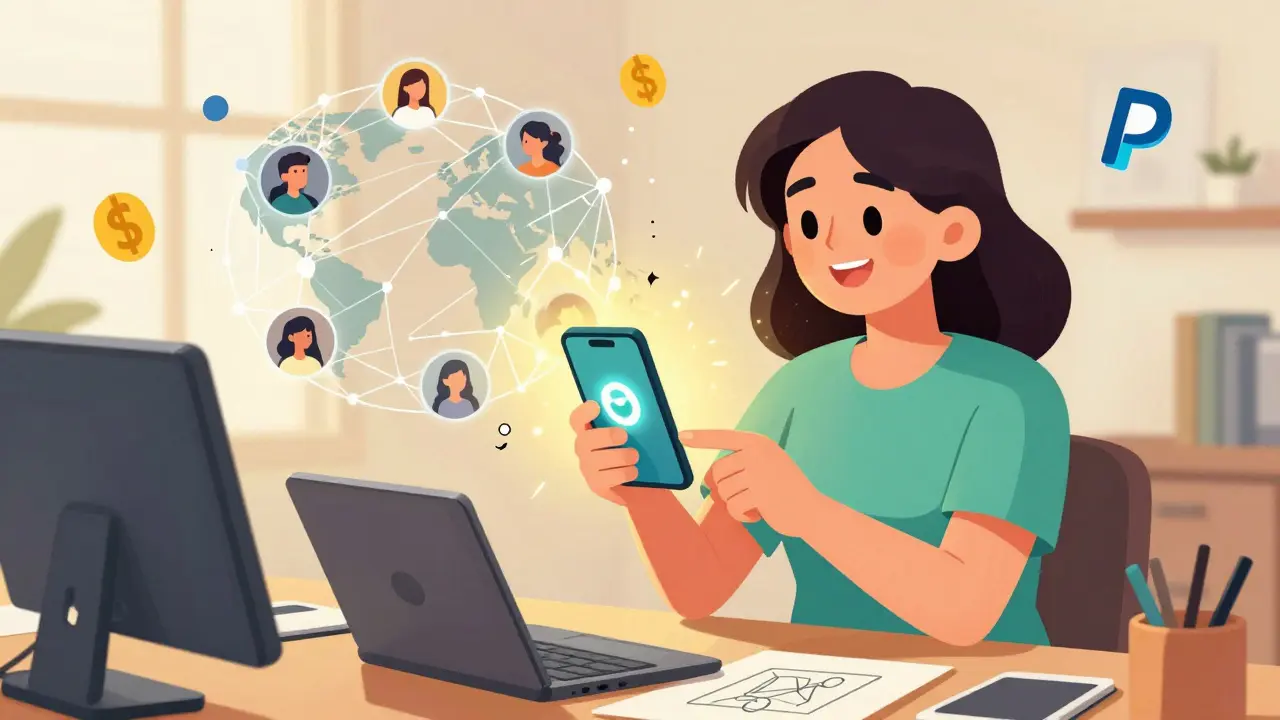
For years, creators have been stuck in a broken system. You make content - videos, music, art, writing - and platforms take 45% or more before you even see a dime. Then there are the delays: PayPal freezes payments from overseas, banks reject transactions from Nigeria or Kenya, and currency conversion eats up another 10%. If you’re not in the U.S., Europe, or Japan, getting paid fairly for your work has always felt like a lottery you didn’t sign up for.
That’s changing.
Today, cryptocurrency is giving creators real power - not just as a way to get paid, but as a way to own their work, their audience, and their income. It’s not about speculation. It’s about control.
Direct Payments, No Middlemen
Traditional platforms like YouTube, Instagram, and Patreon act as gatekeepers. They decide who gets monetized, when, and how much. And they take a cut - often 30% to 50% - just for letting you use their platform. Meanwhile, payment processors like PayPal charge 4.5% plus $0.30 per transaction. For a creator making $1,000 a month, that’s $45 in fees alone.
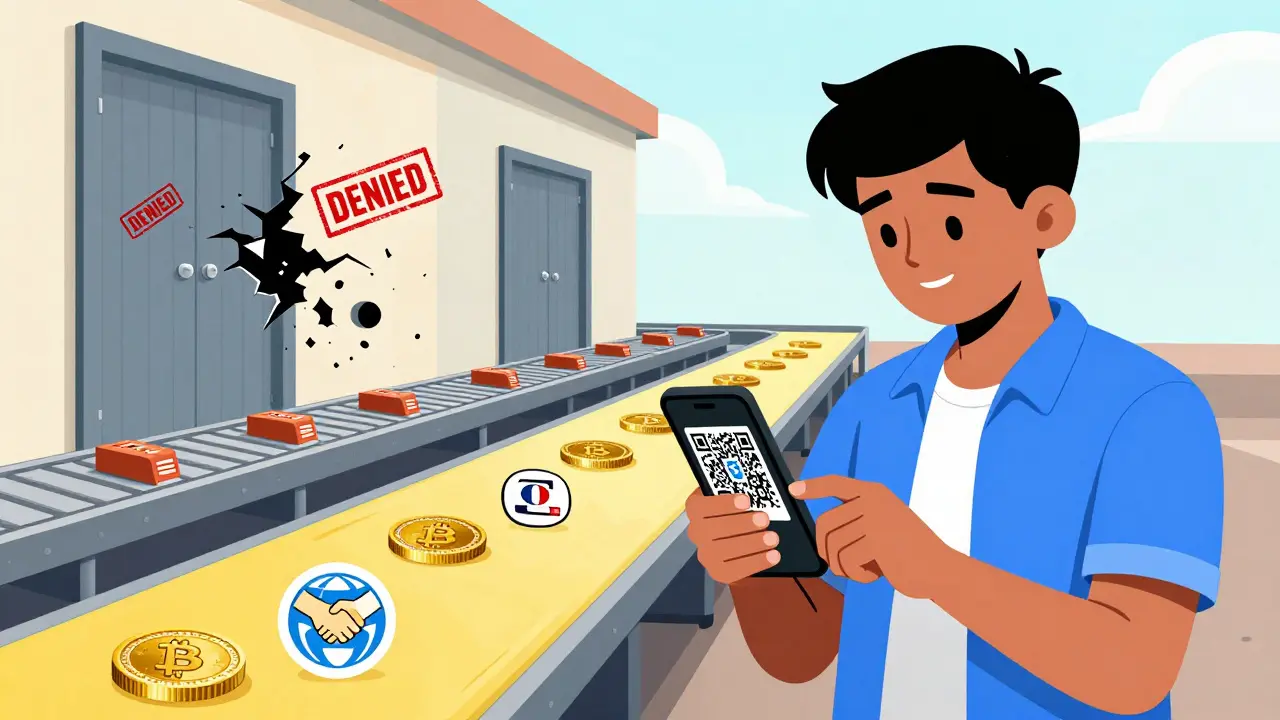
Cryptocurrency cuts that out. With a wallet like MetaMask or Coinbase Wallet, a creator can receive payments directly from fans anywhere in the world. No bank account needed. No waiting 5-7 business days. No risk of account freezes because your payment came from a "high-risk" country.
Take @DigitalDewi, a digital artist in Jakarta. Before crypto, she lost 15.5% of every payment from U.S. buyers - 4.5% to PayPal, 11% to Indonesia’s VAT on foreign transactions. After switching to USDC (a stablecoin pegged to the U.S. dollar), her take-home pay jumped 37%. She didn’t need a new business license. She didn’t need a U.S. bank. She just needed a smartphone and a wallet.
Ownership Through NFTs and Tokens
Cryptocurrency isn’t just about payments. It’s about ownership.
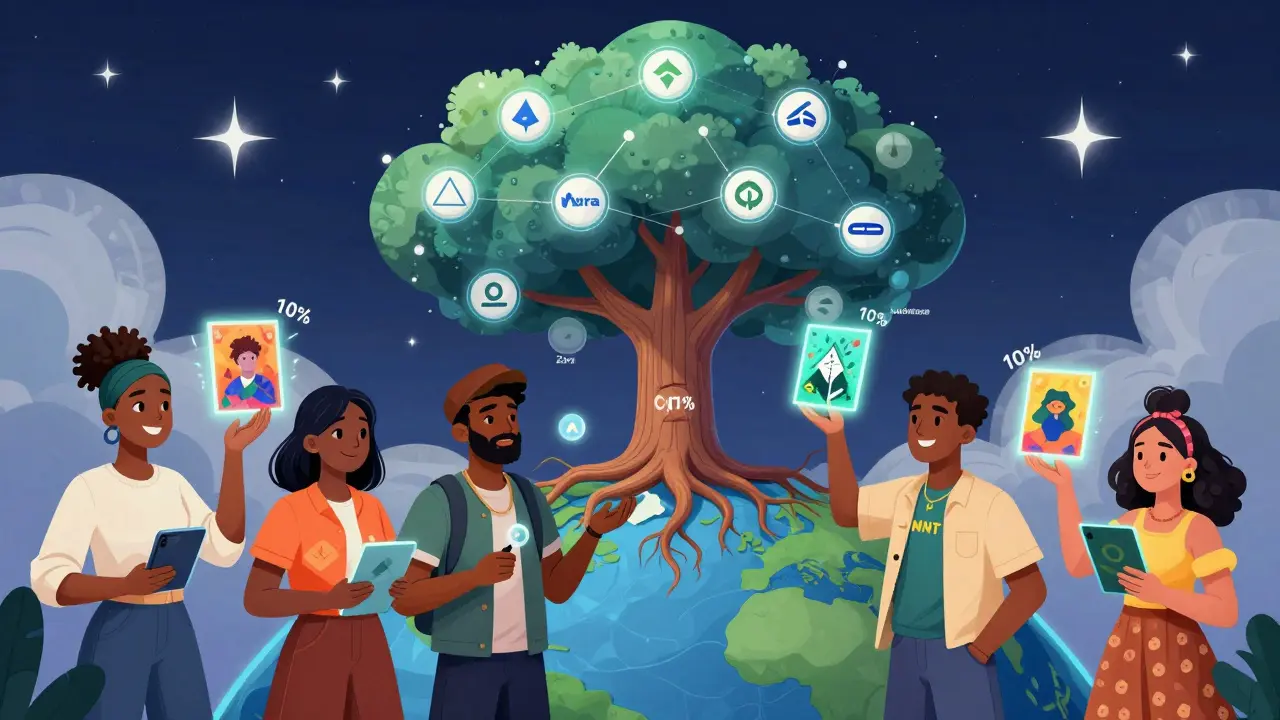
Non-fungible tokens (NFTs) let creators sell unique digital items - a song, a painting, a video - and keep control over who owns what. Unlike a YouTube video that belongs to Google, an NFT is yours. You can sell it once. Or 100 times. And you can program royalties so you earn 10% every time it’s resold. That’s something no platform on Earth does.
Platforms like Zora have processed over 1.5 million creator tokens and $420 million in sales. And here’s the kicker: Zora gives back 50% of trading fees directly to creators. Compare that to Patreon, which takes 5-12% in platform fees, plus payment processing. Or YouTube, which keeps 45% of ad revenue. The math doesn’t even compare.
Some creators are even issuing their own tokens. Fans can buy them to unlock exclusive content, vote on future projects, or get early access. It turns passive followers into active participants. And because it’s built on blockchain, the rules can’t be changed by a corporate policy update. Your community owns the system too.
Global Access, Especially in the Global South
Here’s the most powerful part: cryptocurrency is lifting creators who were never meant to be part of the economy.
In Nigeria, 60% of creators now use crypto to get paid. In Kenya, it’s 58%. In Lagos, Jakarta, São Paulo, and Mumbai, creators are bypassing banks that refuse to serve them. Traditional financial systems lock people out. Crypto doesn’t care where you live.
The creator economy in Africa alone was worth $5 billion in early 2025. By 2032, it’s projected to hit $30 billion - mostly because blockchain removes the barriers that banks and payment processors built. A blogger in Nairobi can get paid instantly by a client in France. No wire transfer. No currency conversion fees. No delays. Just a wallet address.
According to Coinbase Institute, creators in emerging markets are 3.2 times more likely to say crypto payments are critical to their survival than those in North America or Europe. Why? Because for them, it’s not a luxury - it’s the only option.
Stablecoins Make It Practical
Yes, Bitcoin and Ethereum swing wildly. But most creators don’t want to gamble with their income.
That’s where stablecoins come in. USDC and USDT make up 85% of all crypto payments to creators. They’re digital dollars - always worth $1. You get paid in USDC. You cash out to your local currency. Or you hold it. No volatility. No panic.
Platforms like Zora now auto-convert 80% of incoming crypto payments into USDC. That means creators get paid in stable value without lifting a finger. No need to monitor markets. No need to time trades. Just get paid, like a paycheck.
The Learning Curve Is Falling Fast
Two years ago, setting up a crypto payment system meant reading whitepapers, buying ETH, and praying you didn’t lose your private key.
Now? It’s easier than setting up PayPal.
You download MetaMask (used by 63% of creators). You connect it to Coinbase Commerce or a similar service. You add a QR code to your website or Instagram bio. Done. A fan scans it, sends $10 in USDC, and you get it in seconds.
Coinbase’s "Crypto for Creators" course has been completed by over 247,000 people. The average time to get started? 8 to 12 hours. That’s less than a weekend. No coding. No technical degree. Just basic smartphone skills.
And support? Coinbase Commerce offers 24/7 chat with an 8-minute average response time. That’s better than most banks.
What’s Still Hard?
It’s not perfect.
Some creators still lose money by sending to the wrong address. There’s no undo button on blockchain. One Reddit user lost $6,250 that way. No recovery. No help desk.
Regulation is messy. In Europe, some banks freeze accounts that receive crypto. In India, crypto is heavily restricted. In Brazil, it’s clear and legal. In the U.S., it’s a gray zone.
And fans? Only 32% of global internet users understand how crypto wallets work. Explaining it to your audience is still the biggest hurdle for 68% of creators.
Transaction fees? They’re low - $0.15 to $2 per payment - but spike during high traffic. That’s why Ethereum’s Dencun upgrade, coming in late 2025, will cut those costs by 90% for creator-focused networks.
The Future Is Hybrid
Cryptocurrency won’t replace PayPal or Stripe. But it will sit beside them - as a better option for global creators.
Patreon is planning stablecoin payouts by Q1 2026. Shopify now lets creators accept crypto on their stores. Even major brands - 47% of Fortune 500 companies - are starting to pay creators in crypto for campaigns.
By 2027, Gartner predicts 65% of professional creators will accept cryptocurrency. Not because they love Bitcoin. But because it’s the only way to get paid fairly, quickly, and without borders.
The future isn’t crypto-only. It’s crypto-inclusive. For creators everywhere - from a painter in Lagos to a musician in Auckland - it’s finally possible to build a business on your own terms.
Can I really get paid in cryptocurrency without a bank account?
Yes. All you need is a smartphone and a crypto wallet like MetaMask or Coinbase Wallet. These apps let you receive, store, and send cryptocurrency without a bank. Many creators in Africa, Southeast Asia, and Latin America rely on this exact setup. No ID, no proof of income, no approval process. Just a wallet address and a fan who wants to support you.
Are stablecoins safe to use for regular payments?
USDC and USDT are backed by real U.S. dollars held in reserve by regulated financial institutions. They’re designed to stay worth exactly $1.00. Over 85% of all crypto payments to creators use these stablecoins. While no digital asset is 100% risk-free, they’re far more stable than Bitcoin or Ethereum and are the standard for creator payments today.
Do I need to know how to code to use crypto as a creator?
No. You don’t need to write a single line of code. Platforms like Zora, Coinbase Commerce, and MetaMask handle the technical side. You just need to know how to click, scan a QR code, and copy a wallet address. Most creators start with zero technical experience and are up and running in under a week.
What happens if I lose my wallet password?
If you lose your private key or recovery phrase, there’s no way to recover your funds. That’s the trade-off for decentralization. No bank can help you. No support team can reset it. That’s why every creator using crypto must write down their 12- or 24-word recovery phrase and store it somewhere safe - like a locked drawer or a fireproof safe. Never save it on your phone or cloud storage.
Is cryptocurrency legal for creators in my country?
As of 2026, cryptocurrency is legal for personal use in over 140 countries. But regulations vary. Brazil and El Salvador have clear rules for creators. India restricts crypto transactions through banks. The U.S. treats crypto as property for tax purposes. Always check your local government’s stance. But even where it’s restricted, many creators still use crypto - often through peer-to-peer platforms or non-bank exchanges.

Comments
Brenda White
crypto is literally the only reason i can even sell my art anymore. paypal froze my account for "suspicious activity" because i got paid by 3 people in 3 different countries in one week. now i just get usdc and call it a day.
Jessica Beadle
The structural inefficiencies of legacy payment infrastructure are non-trivial. Traditional gatekeepers impose rent-seeking behavior through monopolistic control of distribution channels, effectively commoditizing labor while extracting disproportionate value. Cryptocurrency, by virtue of its decentralized consensus mechanisms and atomic settlement properties, enables disintermediation at the protocol layer, thereby restoring marginal utility to the producer.
iam jacob
i just wish people would stop acting like crypto is magic. it’s not. it’s just another system with different risks. and yeah, i lost $200 once sending to the wrong address. no one helped. no one cares.
Jesse Pals
you guys are underestimating how much this changes lives. i know a guy in Nairobi who started selling digital illustrations and now he’s paying his sister’s medical bills. no bank would touch him. now he’s got a house. not because he’s special. just because he could get paid.
Ann Liu
The assertion that stablecoins are backed by real U.S. dollars requires scrutiny. USDC’s reserve composition includes commercial paper and treasury securities, not 1:1 cash equivalents. While redemption mechanisms exist, systemic risk remains in the event of issuer insolvency or regulatory intervention. Caution is warranted.
Ernestine La Baronne Orange
I mean, this is just another way for rich white guys to get richer while pretending they’re helping the poor. You think a digital artist in Jakarta is going to understand smart contracts? No. She’s just getting scammed faster now. And don’t even get me started on how many people have lost everything because they didn’t write down their recovery phrase. I’ve seen it. Over and over. It’s not empowerment. It’s exploitation dressed up as innovation.
Tobias Wriedt
I’m so tired of people acting like crypto is some kind of moral victory. 😔 You know what’s better than crypto? A government that actually protects workers. A bank that doesn’t discriminate. A world where people don’t need to gamble with their livelihoods just to get paid. This isn’t progress. It’s a Band-Aid on a gunshot wound. 💔
Dionne van Diepenbeek
I’ve been using crypto for 4 years and I still can’t believe how easy it is. I have a QR code on my Instagram. Fans scan it. I get paid. No forms. No waiting. No ‘we’re reviewing your account’. It’s beautiful. I don’t care if it’s not perfect. It’s better than what I had.
Anastasia Danavath
soooo... like... crypto is good? 😍
Manali Sovani
The premise is commendable, yet the execution remains fundamentally flawed. The assumption that blockchain technology inherently democratizes economic participation ignores the digital divide, infrastructural asymmetries, and the cognitive burden placed upon non-technical populations. The narrative of empowerment is, in many contexts, a colonialist fantasy.
Sarah Hammon
I just want to say thank you to everyone who’s been trying to make this easier. I’m a 52-year-old painter from Ohio. I didn’t know what a wallet was 18 months ago. I thought crypto was just for hackers. Now I get paid in USDC, cash out to my local credit union, and my fans send me little notes saying ‘thanks for the art’. It’s not perfect, but it’s real. And that matters.
Diane Overwise
Oh, so now we’re celebrating the fact that people are being forced to use a system that doesn’t have customer service? How very progressive of us. 🙃 I’m sure the 68% of creators who struggle to explain crypto to their audience are just thrilled. And yes, let’s not forget the 32% of fans who still think ‘crypto’ is a type of sushi. Bravo.
Bruce Doucette
You’re all acting like this is the future. It’s not. It’s the same pyramid scheme with new graphics. You think the guy in Lagos is better off? He’s now paying transaction fees to a company that doesn’t even have a physical office. And when his wallet gets hacked? No one helps. No one cares. You’re just making it harder for people who don’t have tech literacy. And you call this empowerment? Pathetic.
anshika garg
I read this and I felt something quiet inside me. Not excitement. Not anger. Just... possibility. I’m from a small town in Uttar Pradesh. I write poetry. No one paid me before. Now, a woman in Canada sends me $5 in USDC every month. She doesn’t know my name. I don’t know hers. But she reads my words. And I’m paid. Not because I’m lucky. Because the system finally let me be seen.
Katrina Smith
lol yeah right. crypto is empowering. next you’ll say nft monkeys are art. and that paypal is the real villain. sure. tell that to the 1000s of creators who got locked out of their accounts after one too many chargebacks. this isn’t freedom. it’s just a new flavor of chaos.