

Imagine buying a piece of Microsoft without opening a traditional brokerage account. You don't have to wait for market hours, and you can move your asset instantly across the globe. This is the promise behind Microsoft tokenized stock, known as xStock or by its ticker symbol MSFTX. It’s a digital token that tracks the price of Microsoft Corporation shares but lives on the blockchain.
If you are new to this space, it might sound like magic. How can a crypto coin represent a real-world tech giant? The short answer is that MSFTX is not a cryptocurrency in the traditional sense like Bitcoin or Ethereum. It is a tracker certificate. It gives you exposure to the value of Microsoft stock while keeping the complexity of traditional finance out of your wallet-mostly. But there are catches, rules, and risks you need to understand before you click "buy."
How MSFTX Actually Works
To understand MSFTX, you first need to separate the idea of ownership from the idea of value. When you buy MSFTX, you are not becoming a shareholder of Microsoft Corporation. You cannot vote in shareholder meetings, and you do not receive direct dividends sent to your email inbox. Instead, you hold a digital claim on the economic value of those shares.
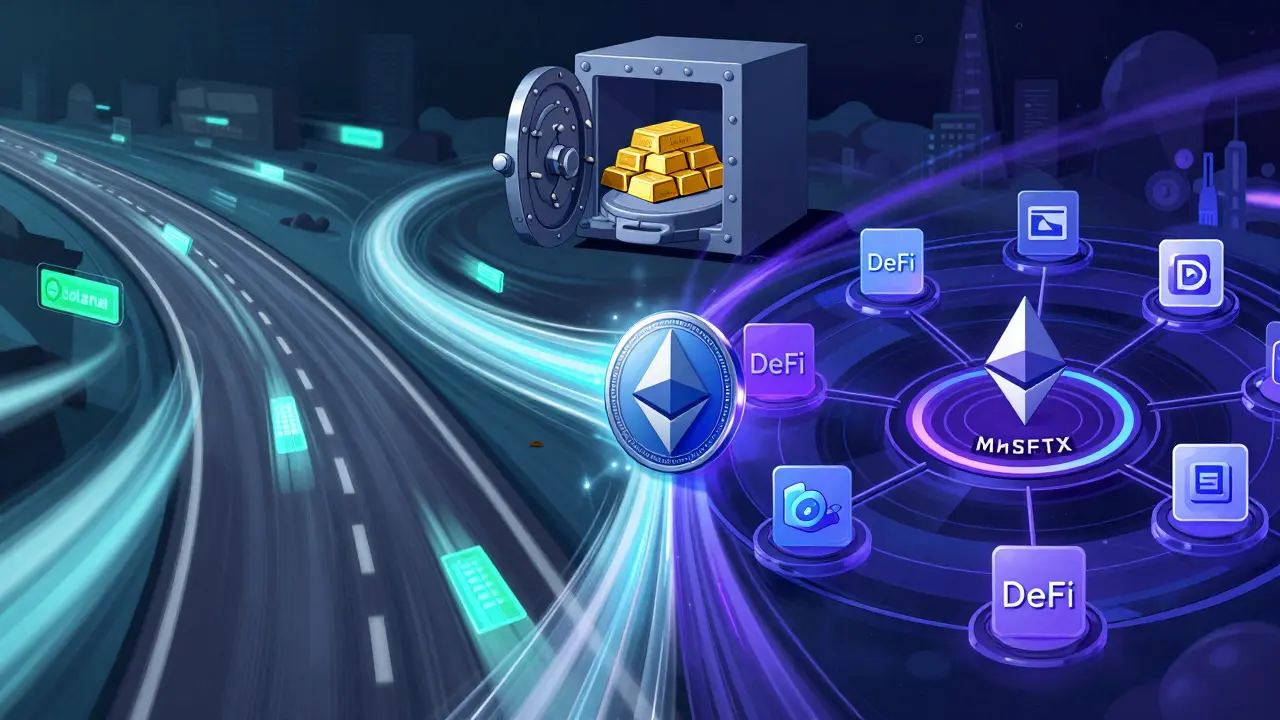
This structure relies on a third-party custodian. Think of this custodian as a secure vault. For every single MSFTX token in circulation, there is one actual share of Microsoft stock held in that vault. This is called a 1:1 backing model. If the price of Microsoft stock goes up, the value of your MSFTX token goes up. If the stock drops, your token loses value. The goal is perfect correlation between the two prices.
The issuer uses a legal framework to ensure that if something goes wrong with the platform, you still have a legal claim to the underlying value. However, because you are dealing with a digital intermediary rather than the NASDAQ exchange directly, you are taking on counterparty risk. You are trusting the custodian and the issuer to keep their promises.
Multi-Chain Technology: Solana and Ethereum
One of the most unique features of MSFTX is where it lives. Unlike many crypto assets that choose one network, MSFTX is issued on two major blockchains simultaneously:
- Solana (SPL Token): On the Solana network, MSFTX exists as an SPL token. Solana is known for high speed and very low transaction fees. This makes it ideal for frequent trading or moving small amounts of value quickly.
- Ethereum (ERC-20 Token): On the Ethereum network, it is an ERC-20 token. Ethereum has a larger ecosystem of decentralized finance (DeFi) applications. Holding MSFTX here allows you to potentially use it in lending protocols or liquidity pools, provided those platforms support it.
This dual-chain approach means you aren't locked into one ecosystem. You can choose the network that best fits your needs for speed or compatibility. However, remember that these are technically different tokens on different ledgers. Moving value between them usually requires a bridge or a specific exchange process, which adds a layer of complexity.
Who Can Buy MSFTX?
Here is the part that trips up many investors: geography matters. MSFTX and the broader xStocks product line are designed to be compliant with European Union regulations. This creates a specific target audience.
Generally, MSFTX is accessible to non-US users. If you are located in the United States, you will likely find that you are restricted from trading these tokens. US securities laws are strict about who can sell tokenized equities, and most issuers avoid the regulatory headache by excluding US persons entirely. For users in Europe, Asia, or other eligible regions, this opens a door to accessing US tech giants without needing a local bank account that supports international wire transfers to Wall Street brokers.
You also need to be an "eligible cryptocurrency market participant." This usually means you must pass Know Your Customer (KYC) checks on the exchange where you trade. You cannot just send money from an anonymous wallet and expect to receive MSFTX. Identity verification is standard practice here to maintain regulatory compliance.
Trading Venues and Liquidity
Finding a place to trade MSFTX can be confusing because availability changes. Major data aggregators like CoinMarketCap, CoinGecko, and Kraken track the price, but that doesn't always mean you can trade it right now on every platform.
Kraken has been a prominent venue for xStocks, offering live pricing and detailed disclaimers about the nature of the asset. Other platforms like Crypto.com, Coinbase, and Investing.com list price data and charts, indicating they monitor the asset closely. However, listings can come and go based on regulatory decisions or business strategies.
Liquidity-the ability to buy or sell large amounts without crashing the price-is another factor. While MSFTX has seen significant trading volumes, it is nowhere near the depth of the actual Microsoft stock market. Microsoft's market capitalization is over $3 trillion. MSFTX, by comparison, has a market cap in the hundreds of millions. This means spreads (the difference between buy and sell prices) can be wider, and slippage can occur during volatile moments.
| Feature | Traditional MSFT Stock | MSFTX Token |
|---|---|---|
| Ownership Rights | Full shareholder rights (voting, dividends) | No voting rights; indirect economic exposure only |
| Trading Hours | Market hours only (approx. 6.5 hours/day) | 24/7 trading on supported exchanges |
| Custody | Brokerage firm holds shares | Third-party custodian holds underlying shares; you hold the token |
| Accessibility | Global, but varies by banking access | Restricted in US; available in EU and other eligible regions |
| DeFi Integration | Not possible | Possible on compatible chains (Solana/Ethereum) |
Risks You Cannot Ignore
No financial instrument is risk-free, and tokenized stocks add new layers of danger on top of market volatility.
Counterparty Risk: Since you rely on a custodian to hold the real shares, what happens if that custodian fails? Or if the issuer gets hacked? While the 1:1 backing is designed to protect you, legal recourse in the crypto world can be slow and difficult. You are trusting a centralized entity within a decentralized-looking product.
Regulatory Risk: Governments are still figuring out how to regulate tokenized securities. A change in law in the EU or elsewhere could suddenly make MSFTX illegal to hold or trade in your region. Exchanges might delist the token overnight to comply with new rules, leaving you holding a token with no easy way to sell it.
Liquidity Risk: As mentioned, the market for MSFTX is smaller than the traditional stock market. In a panic, you might not find a buyer at the price you expect. Price discrepancies between different exchanges can also lead to confusion about the "true" value of your asset.
Technical Risk: Because MSFTX lives on blockchains, you face typical crypto risks. If you store your tokens in a self-custody wallet and lose your private keys, your funds are gone forever. There is no customer service hotline to reset your password. Additionally, smart contract bugs on either Solana or Ethereum could theoretically exploit the token, though this is rare for established standards like SPL and ERC-20.

Why Use MSFTX Instead of Regular Stocks?
So why bother with all this complexity? For some users, the benefits outweigh the risks.
First, accessibility. If you live in a country where opening a US brokerage account is expensive, complicated, or impossible, MSFTX offers a streamlined alternative. You can get exposure to one of the world's largest companies using the same crypto wallet you already own.
Second, flexibility. With MSFTX, you can trade 24 hours a day, seven days a week. Traditional markets close on weekends. If big news breaks about Microsoft on a Sunday, the stock price won't reflect it until Monday morning. MSFTX can react instantly. Furthermore, being on-chain allows for composability. You might be able to use your MSFTX as collateral to borrow stablecoins, a feature not available with traditional stocks unless you use complex margin accounts.
Finally, fractionalization. While many brokerages now offer fractional shares, tokenization takes this further. You can split MSFTX into tiny units, making it easier to diversify small portfolios across multiple tech giants without needing thousands of dollars.
Conclusion: Is MSFTX Right for You?
Microsoft tokenized stock (MSFTX) is a fascinating bridge between traditional finance and the crypto world. It offers a clever solution for global investors who want exposure to blue-chip equities without the barriers of legacy banking systems. However, it is not a replacement for owning actual shares if you value voting rights and direct corporate engagement.
Before you invest, ask yourself: Do I understand the risks of relying on a third-party custodian? Am I in an eligible jurisdiction? Do I have a secure way to store my tokens? If the answer to these questions is yes, MSFTX could be a useful tool in your portfolio. If you are looking for a passive, long-term investment with maximum safety, sticking to a regulated brokerage account might still be the wiser choice.
Is MSFTX the same as owning Microsoft stock?
No. MSFTX is a tracker certificate that mirrors the price of Microsoft stock. You do not have shareholder rights, such as voting in company meetings or receiving direct dividends. You only have a claim on the economic value of the stock held by a custodian.
Can US residents buy MSFTX?
Generally, no. MSFTX and the xStocks platform are designed to comply with EU regulations and are primarily accessible to non-US users. US securities laws restrict the sale of these types of tokenized securities to US persons.
Which blockchain does MSFTX use?
MSFTX is issued on two blockchains: Solana (as an SPL token) and Ethereum (as an ERC-20 token). This allows users to choose between the speed of Solana or the DeFi ecosystem of Ethereum.
Is MSFTX backed by real assets?
Yes. Each MSFTX token is backed 1:1 by actual Microsoft Corporation common stock held by a third-party custodian. This ensures that the token's value is tied directly to the underlying equity.
Where can I trade MSFTX?
Availability varies by region and time. Platforms like Kraken have featured xStocks prominently. Other exchanges may list it temporarily. Always check current listings on major crypto data aggregators like CoinMarketCap or CoinGecko, as availability can change due to regulatory updates.
What happens if the custodian fails?
This is known as counterparty risk. If the custodian holding the real shares fails or goes bankrupt, you may face delays or difficulties in reclaiming the value of your tokens. While legal claims exist, recovering funds in such scenarios can be complex and time-consuming.

Write a comment