
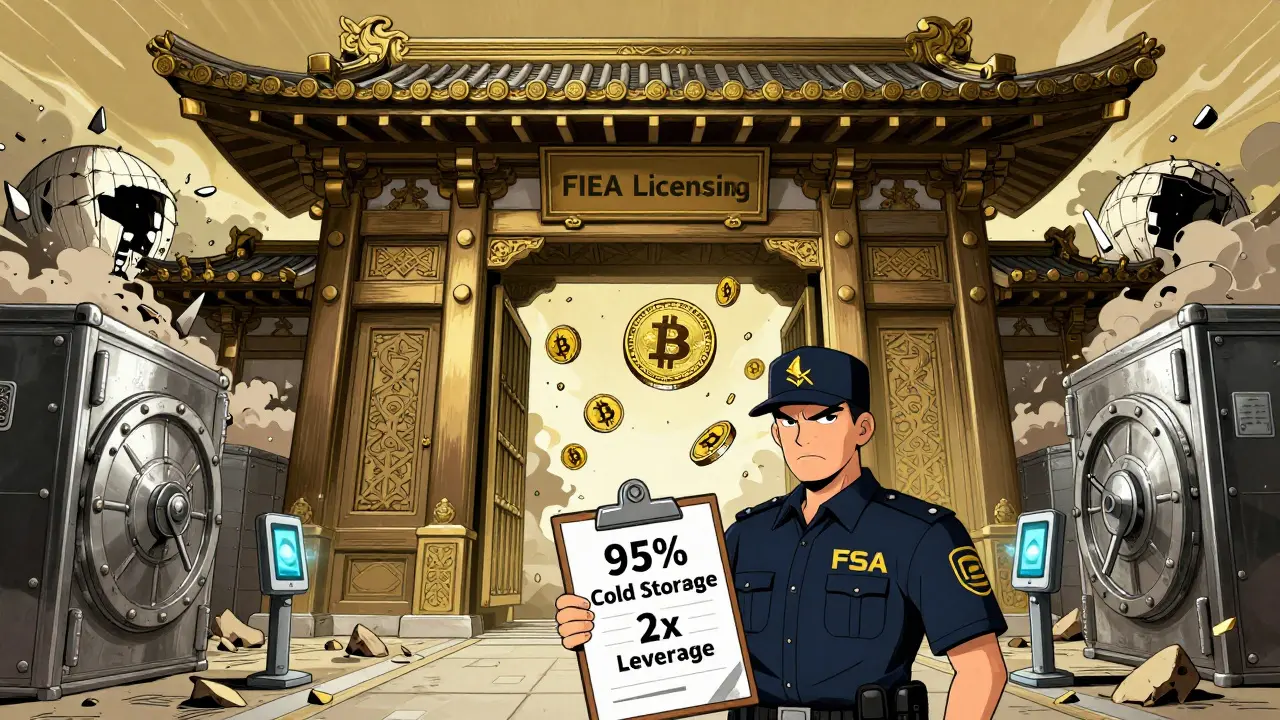
Japan doesn't just allow crypto exchanges to operate - it forces them to jump through some of the toughest hoops in the world. If you're thinking about launching a crypto exchange in Japan, or even just using one as a customer, you need to understand how this system really works. It's not about banning crypto. It's about controlling it. And the rules changed dramatically in September 2025.
From Payment Tool to Financial Asset
For years, Japan treated cryptocurrencies like digital cash. Under the Payment Services Act (PSA), exchanges had to register with the Financial Services Agency (FSA), but the rules were light. Then, on September 2, 2025, everything shifted. The FSA moved crypto oversight from the PSA to the Financial Instruments and Exchange Act (FIEA). This wasn't a tweak - it was a full reclassification. Crypto assets are no longer just payment tools. They're financial instruments. That means the same rules that apply to stocks, bonds, and futures now apply to Bitcoin, Ethereum, and even meme coins.This change didn't come out of nowhere. In 2024, Japan saw a spike in fraudulent token launches and phishing scams targeting retail investors. The FSA realized that treating all crypto the same was dangerous. Now, if a token behaves like a security - promising returns, tied to a project's success - it gets full securities regulation. Payment tokens? Still regulated, but under lighter rules. This split creates clarity that the U.S. still lacks, where the SEC and CFTC argue over who's in charge.
What It Takes to Get Licensed
To operate legally in Japan, a crypto exchange must be a kabushiki-kaisha - a Japanese joint-stock company. No offshore shells. No virtual offices. You need a physical branch in Japan, a resident manager who answers for compliance, and a clean audit history. The minimum capital? 10 million yen (about $68,000 USD), plus positive net assets. That’s not a lot for a bank, but for a startup crypto platform? It’s a wall.Then comes the real test: security. After the 2018 Coincheck hack that stole $534 million in NEM tokens, Japan made cold storage mandatory. Exchanges must keep at least 95% of user funds offline. No exceptions. That means your Bitcoin isn’t sitting in a hot wallet waiting to be hacked. It’s locked in vaults, often buried in geographically dispersed data centers with armed guards and biometric access. This isn’t optional - it’s audited quarterly by third parties approved by the FSA.
On top of that, exchanges need DDoS protection that can handle attacks over 1 terabit per second. They need multi-signature wallets, 24/7 monitoring teams on standby, and response times under 15 minutes for any security alert. The average exchange spends $500,000 to $1 million just to meet these technical requirements. And that’s before hiring compliance staff.
The JVCEA: The Hidden Gatekeeper
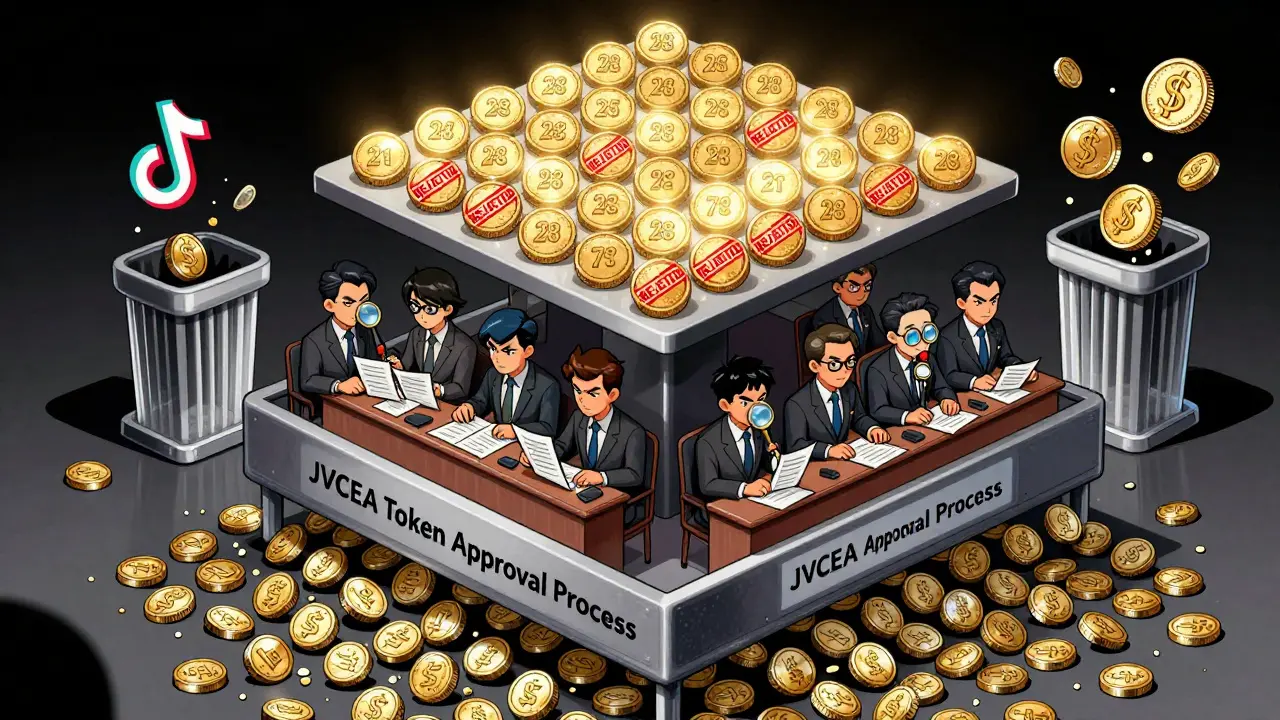
The FSA sets the floor. But the real power lies with the Japan Virtual Currency Exchange Association (JVCEA). Eighteen of the 21 licensed exchanges belong to it. And the JVCEA doesn’t just follow rules - it makes them stricter.Want to list a new token? You can’t. Not unless JVCEA’s 17-member Token Listing Committee approves it. In Q2 2025 alone, they rejected 72% of applications. Why? Whitepapers that sounded like marketing fluff. Smart contracts with known vulnerabilities. No clear use case. One project tried to list a meme coin tied to a viral TikTok trend - denied. Another wanted to launch a token with a 10% annual yield - rejected. The JVCEA doesn’t care if a coin is popular overseas. If it doesn’t meet Japan’s standards, it doesn’t go live.
This is why Japanese users can’t trade trending tokens as fast as users in the U.S. or Singapore. A token might launch on Binance in January, but it takes 3 to 6 months to get approved in Japan. Some users complain. But others say it saved them. In March 2025, a major exchange in Southeast Asia was hacked after listing a poorly audited token. Japanese users on Bitbank and GMO Coin never saw it coming - because it never made it onto their platforms.
Levies, Limits, and Lost Traders
Japan’s rules aren’t just about safety - they’re about control. In 2023, the FSA cut leverage limits from 4x to 2x. That means you can’t borrow more than twice your deposit to trade. Compare that to Dubai’s VARA, which allows 100x leverage. The result? An estimated 15% drop in active day traders on Japanese exchanges, according to CryptoCompare.Professional traders hate it. Retail users? Mixed. Many appreciate the protection. The FSA’s 2025 Consumer Confidence Report found that 87% of Japanese crypto users feel “very” or “somewhat” secure using licensed exchanges. That’s 24 percentage points higher than users in unregulated markets.
But there’s a trade-off. Limited leverage. Limited token selection. Limited product innovation. Some exchanges have responded by focusing on fiat on-ramps and stablecoin trading - areas where regulation is clearer. Others have quietly shut down. Since 2017, 17 exchanges have lost their licenses for failing audits, poor security, or compliance lapses. The FSA doesn’t warn. It cuts.
The Cost of Compliance
Getting licensed isn’t cheap. The process takes 18 to 24 months. You need:- A Japanese legal entity with local management
- A physical office and compliance officer (average salary: ¥12 million/year or $78,000 USD)
- AML systems that process 10,000+ transactions per second
- Third-party security audits from FSA-approved firms like NCC Group
- A 6-month shadow operation where all systems are tested under real conditions
- Banking relationships - and only 8% of Japanese banks will even talk to crypto firms
That’s why most new entrants are either large Japanese corporations (like DMM Bitcoin, owned by a major internet firm) or foreign exchanges with deep pockets (like Bitbank, backed by a Tokyo-based fintech group). Smaller players? They either fold or try to operate illegally - and get shut down fast.
There’s one exception: the FSA’s regulatory sandbox. Since 2018, it’s fast-tracked 27 blockchain projects - including cross-border payment tools from SBI Ripple Asia. If you’re building something that solves a real financial problem, not just trading crypto, Japan will give you a path. But if you’re just trying to list tokens? You’re on your own.
Who’s Winning and Who’s Losing
Japan’s system isn’t perfect. Critics say the cold storage rule creates single points of failure - if a vault gets breached, all funds are at risk. They argue for institutional custody solutions like Coinbase Custody. Others say the 2x leverage rule kills innovation.But here’s what’s undeniable: Japan has the clearest, most predictable framework in Asia. Compared to Singapore’s self-certified model or the U.S.’s regulatory chaos, Japan gives exchanges certainty. You know what’s allowed. You know what’s not. You know what happens if you break the rules.
That’s why 12.1 million Japanese people hold crypto - 9.6% of the population. That’s the third-largest crypto market in the world. And it’s growing. Nomura Research predicts 18.5 million users by 2027. Why? Because people trust the system. They know their money won’t vanish overnight.
The Big Shift Coming in 2026
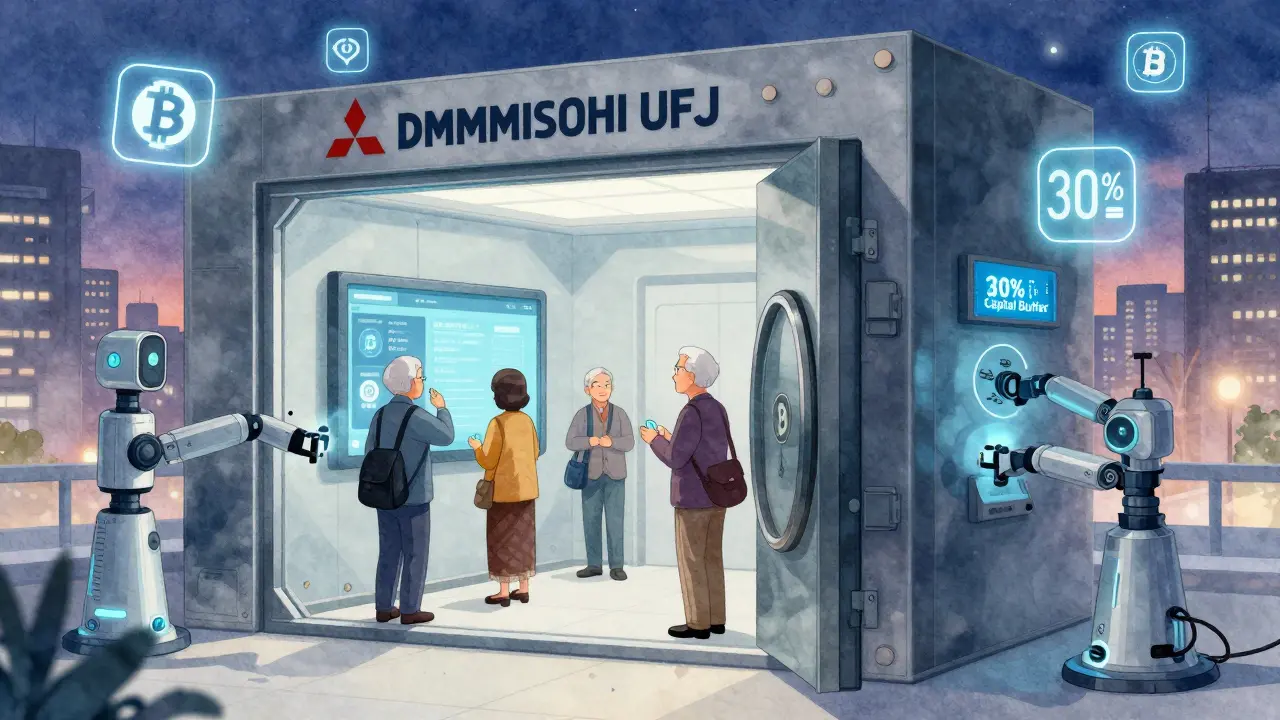
By March 2026, the FSA plans to fully integrate crypto under the FIEA. That means crypto exchanges will be treated like brokerage firms. And in a move that could shake up the market, the FSA is considering letting Japan’s megabanks - Mitsubishi UFJ, Sumitomo Mitsui, and others - register as crypto operators.Right now, banks can’t hold crypto. But new rules might change that. The FSA is testing a framework that would let banks hold Bitcoin as an investment - as long as they set aside 30% capital buffers (vs. 8% for stocks) and pass stress tests for 80% price drops. If this passes, Japan’s banks could become the biggest crypto custodians in the world.
It’s a bold move. But it makes sense. Japan’s aging population needs better investment options. Crypto isn’t going away. So why not bring it into the mainstream - safely?
How many crypto exchanges are licensed in Japan as of 2026?
As of June 2025, 21 crypto exchanges held active licenses from Japan’s Financial Services Agency (FSA). No new licenses were issued after September 2025 due to the transition to the Financial Instruments and Exchange Act (FIEA). The FSA froze new applications until the new framework is fully implemented in March 2026. All existing licensed exchanges remain operational under the new rules.
Why does Japan require 95% of crypto assets to be stored offline?
This rule was introduced after the 2018 Coincheck hack, where $534 million in NEM tokens were stolen because the exchange kept most funds in online wallets. The FSA decided that exchanges must protect users like banks protect cash - by keeping the vast majority offline. Cold storage reduces exposure to hacking, network attacks, and internal fraud. Exchanges are audited quarterly to prove compliance, and failure means license revocation.
Can I trade leveraged crypto on Japanese exchanges?
Yes, but only up to 2x leverage. In 2023, Japan cut leverage from 4x to 2x to protect retail investors from extreme losses. This is stricter than most global markets. Exchanges that offer higher leverage risk losing their license. Traders who want higher leverage often use offshore platforms - but those aren’t protected by Japan’s investor compensation scheme.
Why are new tokens delayed on Japanese exchanges?
The Japan Virtual Currency Exchange Association (JVCEA) requires all new tokens to go through a strict pre-approval process. This includes reviewing the whitepaper, auditing smart contracts with FSA-approved firms, and proving there’s no risk of market manipulation. In Q2 2025, 72% of applications were rejected. The average approval time is 3 to 6 months. This slows down innovation but prevents scams from reaching Japanese users.
Can Japanese banks hold cryptocurrency now?
Not yet, but they soon might. As of September 2025, the FSA proposed allowing banks to hold Bitcoin and other crypto as investment assets - not for trading. They’d need to hold 30% capital buffers against potential losses and pass stress tests for 80% price drops. The rule change is under review and expected to pass in early 2026. If approved, Japan’s megabanks could become the largest crypto custodians in Asia.

Comments
Peggi shabaaz
I really appreciate how Japan handles this. Not flashy, not hype-driven. Just solid, boring rules that actually keep people safe. I wish more countries had this kind of discipline. 🙏
krista muzer
idk i feel like the 95% cold storage thing is kinda overkill? like yeah its safe but also like... what if theres a fire or a flood or some crazy natural disaster? are we just supposed to trust that the vaults are magically invincible? i mean i get the intent but it feels a little like building a fortress and forgetting the moat is dry
Donna Patters
This is what happens when you let technocrats design policy without understanding human behavior. Japan’s system is a monument to control, not innovation. It’s not protecting users-it’s infantilizing them.
Tammy Chew
The JVCEA rejection rate is wild 72%? That’s not regulation that’s gatekeeping. If you’re not on the list you’re not real. And the fact that they’re still letting meme coins get reviewed? That’s just performative. They know they’re not going to approve anything edgy.
Andrea Atzori
I find it fascinating that Japan is moving toward allowing megabanks to hold crypto. This isn’t just regulation-it’s institutionalization. They’re not trying to stop crypto. They’re trying to absorb it. That’s a fundamentally different approach than the US’s ‘wait and see’ chaos.
Beth Trittschuh
I just think about how many people lost everything in 2022... and now Japan says "nope, not here". Not perfect, but at least it’s not a free-for-all. Sometimes safety isn’t sexy. But it’s sacred. 💔🔒
Brittany Meadows
So let me get this straight… the same government that banned Pokémon cards in 1999 because they "corrupted children" is now the world’s most rigorous crypto regulator? 🤔 The irony is thicker than a Bitcoin block. #JapanIsWeird
Keturah Hudson
I lived in Tokyo for three years. The level of social responsibility here is insane. People don’t just follow rules-they internalize them. That’s why this works. It’s not about fear. It’s about collective trust. You can’t copy this in the US. We don’t even agree on what "trust" means anymore.
Ace Crystal
This isn’t about limiting innovation-it’s about making sure innovation doesn’t kill people. Think about it: if your grandma’s retirement fund is in crypto, do you want her exposed to 100x leverage? Or do you want her to sleep at night? I choose sleep. 💪
Benjamin Andrew
The 2x leverage cap is an economic distortion. It creates an arbitrage opportunity for offshore platforms. Japan is not protecting retail investors-it is creating a black market for leverage. The FSA is not a regulator. It is a cartel enforcer.
Joe Osowski
Japan thinks it’s so superior? Let’s see how long it lasts when China’s CBDC starts eating its lunch. You can’t regulate your way to relevance. The world moves fast. Japan’s in a museum.
Kaz Selbie
I’ve traded on Japanese exchanges. The UI is clunky. The support takes 3 days. The token list is a ghost town. This "safety" is just a tax on user experience. You want security? Pay in convenience. Japan’s paying with silence.
Lindsey Elliott
The fact that 87% of users feel "secure" is proof they’re not paying attention. Security isn’t a feeling. It’s a metric. And no one’s auditing the auditors. The FSA’s report is PR. Not proof.
blake blackner
i mean... i get it. i really do. but like... if you cant trade shitcoins on a japanese exchange... whats even the point? i just want to buy doge and laugh. why does it have to be this complicated? i just wanna be rich and chill
Michelle Cochran
You think this is about safety? Look deeper. This is about control. The FSA doesn’t want you to trade crypto. They want you to trust the system. And once you trust the system, you stop questioning it. That’s the real goal. Not security. Compliance. Submission.
Robbi Hess
Japan spent 18 months and $1M to make crypto boring. Mission accomplished.