
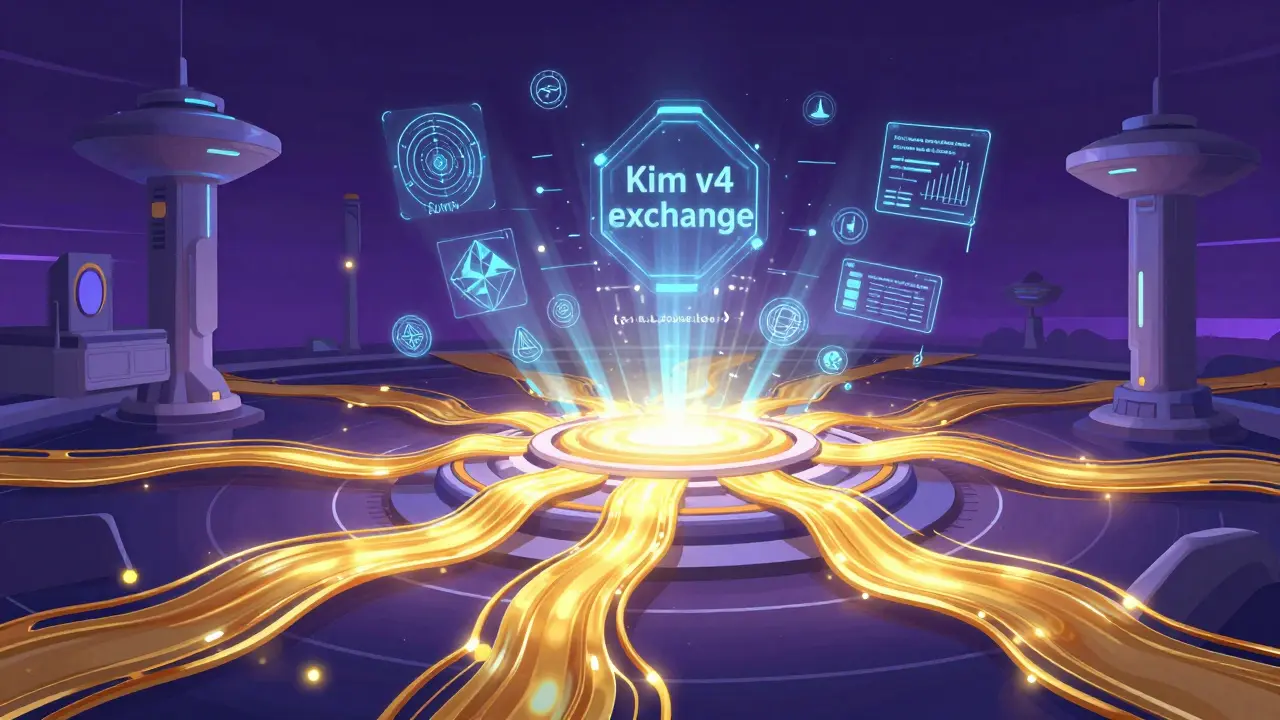
Most people are tired of the same three decentralized exchanges that feel like they were designed in 2018. If you've been hunting for a way to squeeze more yield out of your liquidity without the constant fear of massive slippage, you've probably stumbled across Kim v4 crypto exchange is a decentralized exchange (DEX) operating as a primary liquidity hub on the Mode platform within the Optimism Superchain. It doesn't use a traditional order book, which is a fancy way of saying it doesn't wait for a buyer and seller to agree on a price-it uses math to do it instantly.
How Kim v4 Actually Works
Unlike your average exchange where you place a limit order and hope it fills, Kim v4 relies on an Automated Market Maker (or AMM) model. Specifically, it focuses on concentrated liquidity. For those who aren't math wizards, this just means that liquidity providers can choose exactly which price range they want to provide assets for, rather than spreading their capital thin across a price range from zero to infinity. This is a game-changer for reducing slippage, meaning you get a price much closer to the actual market value when trading.
The technical backbone here is built on the Mode platform, which is part of the Optimism Superchain. By living in this ecosystem, Kim v4 avoids the nightmare gas fees associated with the Ethereum mainnet while maintaining high security. It also uses Multi-Party Computation (or MPC), a cryptographic method that ensures no single party has total control over the computing process, adding a serious layer of protection to your transaction data.
The Token Economy: $KIM and $xKIM
The exchange isn't just a place to swap coins; it's a full-blown ecosystem powered by two distinct tokens. Understanding the difference between them is where most new users get confused.
$KIM is the utility token. Think of this as the fuel. You use it for providing liquidity and staking. If you hold $KIM and stake it, you earn the second token, $xKIM.
$xKIM is a non-transferable governance token. You can't sell it on the open market for a quick profit. Instead, its value lies in power and rewards. You use $xKIM to vote on how the exchange is run and to allocate resources to specific "xKim plugins"-modular hooks that can change how liquidity is managed or how trading strategies are executed.
| Attribute | $KIM Token | $xKIM Token |
|---|---|---|
| Primary Function | Utility & Liquidity | Governance & Rewards |
| Transferability | Tradable on markets | Non-transferable |
| How to Acquire | Purchase / Earn | Staking $KIM |
| Main Benefit | Asset growth | Voting power & Yield boost |

Boosting Yield with kpNFTs
If you're into yield farming, the kpNFTs are the main attraction. Most NFTs are just JPEGs of monkeys, but these are functional tools. By staking your $xKIM, you can acquire these yield-generating NFTs. The platform claims that using kpNFTs can potentially boost your yields by up to 4x compared to standard liquidity positions.
This creates a compounding effect: you provide liquidity with assets, stake $KIM to get $xKIM, and use that $xKIM to get a kpNFT that multiplies your original earnings. It's a sophisticated loop designed to attract long-term liquidity providers rather than "mercenary capital" that leaves the moment rewards dip.
The Risks and Red Flags
No review is honest if it only talks about the upside. Because Kim v4 is a decentralized project on a specific layer-2 stack, there are inherent risks. First, the modular architecture (the xKim plugins) is a double-edged sword. While customization is great, every new plugin is a potential point of failure or a new bug that could be exploited.
We also have to talk about transparency. Unlike giants like Uniswap, Kim v4 doesn't always provide instant, transparent data on total value locked (TVL) or daily trading volumes in a way that's easy for a casual user to find. Without these numbers, it's hard to judge the actual depth of the liquidity. If the liquidity is too low, even with concentrated liquidity models, you might experience unexpected price swings on larger trades.
Furthermore, because it's a DEX, there is no "Forgot Password" button. If you lose your keys or send funds to the wrong contract, that money is gone. There is no customer support team to call to reverse a transaction.
Is Kim v4 Right for You?
Deciding whether to use this exchange depends on your risk appetite and what you're trying to achieve. If you're a casual trader who just wants to swap $100 of one coin for another, a more established DEX might be simpler. However, if you're a DeFi power user looking for higher yields through Liquidity Provision and governance influence, Kim v4 offers tools that most exchanges simply don't have.
The combination of the Mode platform's speed and the MPC security model makes it a technically sound choice for those who trust the Optimism ecosystem. Just remember to diversify; don't put your entire portfolio into a single liquidity pool, regardless of the promised 4x yield.
What is the difference between $KIM and $xKIM?
$KIM is a tradable utility token used for liquidity and staking. $xKIM is a non-transferable governance token earned by staking $KIM, which allows users to vote on exchange plugins and boost their rewards.
How do kpNFTs increase my earnings?
kpNFTs are yield-generating assets obtained through $xKIM staking. They act as multipliers for your liquidity positions, with the platform claiming potential yield increases of up to 4x.
Is Kim v4 secure?
Kim v4 uses Multi-Party Computation (MPC) to secure transaction data and operates on the Mode platform. However, as with all DEXs, users are responsible for their own private keys, and modular plugins can introduce new smart contract risks.
What is concentrated liquidity?
Concentrated liquidity allows providers to allocate their capital to a specific price range rather than the entire price curve. This increases capital efficiency and reduces slippage for traders.
Can I trade Kim v4 on a mobile app?
Kim v4 is primarily accessed via web-based decentralized interfaces and connected wallets (like MetaMask). Always verify the official URL to avoid phishing sites.

Comments
Deepak Prusty
Concentrated liquidity is basically just a more efficient version of the Uniswap v3 model. The MPC security is a nice touch but honestly most people don't even understand how the underlying Optimism Superchain handles state transitions before they start worrying about the cryptographic primitives of the hub.
sekhar reddy
Omg a 4x yield boost!! That is absolutely insane!! I cant even imajine how much my portfolio would grow if i just jumped into those kpNFTs right now!
Arlen Medina
Finally some tech that actually works without those bloated legacy systems. Real American innovation is all about cutting through the noise and maximizing the bag. If you're not using concentrated liquidity you're basically just donating your money to the pool.
Adriana Gurau
Imagine actually thinking a 4x yield is sustainable 🙄. It's clearly just a honeypot for people who don't understand basic tokenomics. So quaint.
Earnest Mudzengi
Wake up people!! MPC is just a smokescreen for some deep-state backdoors. They want your keys in a "distributed" system so they can freeze your assets the moment you stop complying with the globalist agenda. This whole Mode platform is probably just a node for the New World Order to track your every move via the Superchain. Total surveillance capitalism wrapped in a DEX skin. Don't let the fancy jargon about "modular hooks" distract you from the fact that your financial sovereignty is being eroded by a centralized shadow cabal operating under the guise of decentralization. It's a trap to get us into a digital ledger they control entirely while we think we're being edgy with our crypto. The slippage isn't the only thing being manipulated here. Your very identity is on the line. I've seen the patterns and this fits perfectly into the Great Reset playbook. They give you a little bit of yield and then snap the trap shut. Absolute madness if you actually believe the whitepaper.
Emily 2231
The lack of transparent TVL is a critical failure. It is an affront to the principles of a free market and reeks of deception. This is exactly how foreign interests manipulate our domestic financial stability by hiding the true volume of their exchanges. I shall not trust a platform that obscures its own data while claiming to be secure.
Sharhonda Walker
I've used a few of these moduler plugins and they're laely pretty stable, though the risk of a bug is always there. Just make sure you don't put too much in one pool since there is no support to get your funds back if a contract glitchs.
Trish Swanson
Interesting concept!!! Love the idea of choosing a price range!!!
gladys christine
Go for it everyone!! Just be safe with those keys!!
Suzanne Robitaille
There is something profoundly poetic about the non-transferability of $xKIM. It turns a financial instrument into a badge of commitment, a digital testament to one's belief in the ecosystem's longevity. It is truly a beautiful way to align incentives.
June Coleman
Oh sure, a 4x yield. Because that always ends well for everyone in crypto, right? I'm sure it's totally not a Ponzi scheme.
Robert Coskrey
I agree that the diversification advice provided is most prudent!!! It is always wise to mitigate risk across multiple assets!!!
JERRY ORTEGA
just keep your seed phrase offline and you'll be fine mostly. the MPC stuff is just extra fluff but it doesn't hurt
shubhu patel
I think it's quite a thoughtful approach to liquidity provision and I really appreciate how the author explained the difference between the two tokens because it can be quite confusing for those of us who are just starting to explore these kinds of platforms and I feel like this gives us a very balanced view of the pros and cons.
Krystal Moore
The fact that they don't show TVL clearly is just plain wrong. How can anyone in good conscience promote a platform that hides its core metrics? It's ethically bankrupt!
Brooke Herold
It's a neat little corner of the web.