

The Mechanics of the Yield Chase
To understand why mercenary capital behaves the way it does, we have to look at Liquidity Mining. This is a process where protocols distribute their native governance tokens to users who provide assets to their pools. It's essentially a bribe to get people to deposit money so the platform has enough liquidity to function. Mercenary investors use tools like DeFiLlama or Zapper to scan for the highest Annual Percentage Yields (APY). In the early days of "DeFi Summer," some pools offered rewards exceeding 1,000%. A typical mercenary strategy involves depositing a pair of tokens-say, ETH and USDC-into an Automated Market Maker (AMM) like Uniswap or Curve Finance, earning the reward tokens, and then immediately selling those rewards on a secondary market to lock in profit.| Metric | Definition | Key Difference |
|---|---|---|
| APR (Annual Percentage Rate) | The nominal annualized reward rate. | Does not account for compounding. |
| APY (Annual Percentage Yield) | The real rate of return including compounding. | Includes the effect of reinvesting rewards. |
The Danger Zone: Impermanent Loss and Volatility
Chasing high yields isn't a free lunch. One of the biggest technical traps for the mercenary investor is Impermanent Loss. This happens when the price of the tokens you deposited changes relative to each other. If one asset moons while the other stays flat, the AMM rebalances your position, and you end up with fewer of the appreciating asset than if you had just held it in your wallet. In highly volatile markets, these losses can exceed 50%. For example, a user might earn $12,000 in rewards but suffer $28,000 in impermanent loss during a crash, leaving them deeper in the hole than when they started. This creates a perverse incentive: the mercenary must exit the pool as quickly as possible-not just to chase a better yield, but to avoid the risk of the underlying assets diverging too far in price.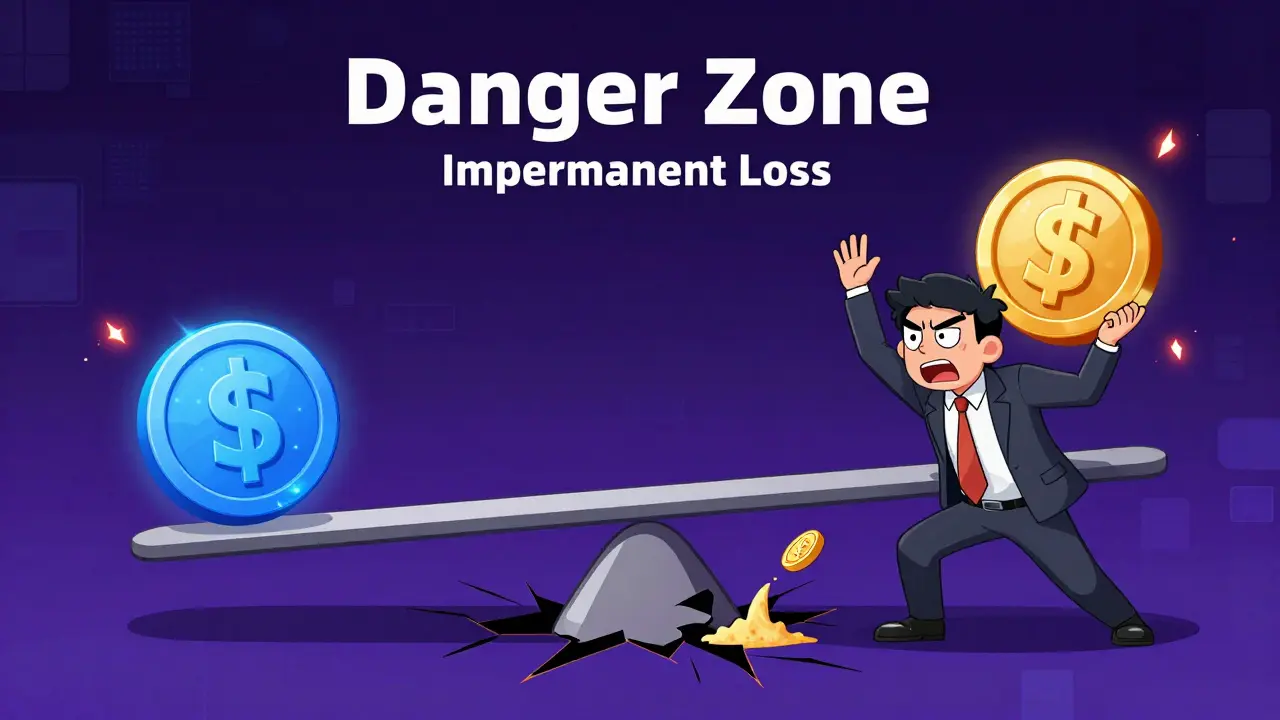
The Ghost Town Effect: Case Studies in Collapse
When a protocol relies solely on high emissions to attract capital, it creates a "death spiral" of incentives. The Big Data Protocol incident in 2021 is a textbook example. Over a single weekend, the protocol attracted roughly $1.2 billion in Total Value Locked (TVL), accounting for about 10% of the entire DeFi ecosystem. But because that capital was purely mercenary, it vanished almost as quickly as it arrived, leaving the project with near-zero activity within days. Similarly, SushiSwap saw its TVL plummet from $1.8 billion to $300 million within six months after its initial launch phase. The pattern is always the same: huge rewards attract huge capital, the token price pumps, the mercenaries sell the tokens and withdraw their liquidity, and the token price crashes because there is no actual utility for the asset beyond farming it.The Shift to DeFi 2.0: Solving for Loyalty
Developers have realized that bribing users with tokens is a losing game. This led to the rise of "DeFi 2.0," which focuses on sustainable tokenomics. The goal is to move from "mercenary capital" to "loyal capital." One of the most influential shifts is Protocol-Owned Liquidity (POL), popularized by Olympus DAO. Instead of renting liquidity from users through rewards, the protocol essentially "buys" the liquidity. They do this by offering discounted bonds, allowing the protocol to own its own liquidity providers. This means the protocol isn't at the mercy of a user who decides to leave for a 1% higher yield elsewhere. Other projects have implemented "lock-up" mechanisms to force a long-term perspective:- Vote-Escrowed Models: Curve Finance introduced veCRV, which requires users to lock their tokens for up to four years to maximize rewards. This effectively removes a huge portion of the supply from the market and forces users to care about the protocol's long-term health.
- Safety Modules: Aave requires users to lock AAVE tokens for 182 days to earn staking rewards, which also serves as insurance for the protocol.
- Withdrawal Penalties: Bancor implemented a system where users pay a fee for withdrawing assets too early, which significantly reduces the "hop-and-skip" behavior of mercenaries.

Is Mercenary Capital Always Bad?
It depends on who you ask. While critics argue it dilutes token value and creates instability, some venture capitalists argue it's a necessary evil for bootstrapping. In the early days of DeFi, liquidity mining was the only way to get the "critical mass" of users needed to make a platform viable. Without those initial mercenary incentives, platforms like Uniswap might never have grown from $100 million to $7 billion in TVL during their early growth spurt. The problem isn't the presence of mercenary capital, but the failure to transition away from it. A protocol that stays in the "incentive phase" forever is essentially a Ponzi scheme where new rewards pay for old liquidity. The winning protocols are those that use mercenary capital to kickstart the engine, then quickly pivot to utility-based value and locked-in governance.Practical Tips for the Modern Liquidity Provider
If you're participating in these pools, you need to move beyond just looking at the APY. High yields are usually a signal of high risk-either extreme token volatility or a high probability of a "rug pull." To protect yourself, keep these rules of thumb in mind:- Check the Lock-up: If a protocol has no lock-up period, expect the TVL to vanish the moment rewards drop.
- Calculate Real Yield: Subtract the expected impermanent loss from the projected APY. If the math doesn't work, the "yield" is an illusion.
- Monitor Fundamentals: Use Token Terminal to see if the protocol is actually making money from fees, or if it's just printing tokens to pay you.
- Diversify Strategies: Instead of putting all your capital in one high-yield pool, split it across liquid staking derivatives (LSDs) like Lido’s stETH for more stability.
What exactly is mercenary capital?
Mercenary capital refers to investors who provide liquidity to a DeFi protocol only as long as the rewards (usually in the form of native tokens) are high. They have no long-term interest in the protocol's success and will withdraw their funds immediately if a better opportunity appears elsewhere.
How does liquidity mining contribute to token price crashes?
Because mercenary investors are motivated by short-term gains, they tend to sell their reward tokens as soon as they receive them. This creates constant selling pressure on the open market. When the protocol reduces its rewards, these investors withdraw their liquidity and dump any remaining tokens, leading to a rapid price collapse.
What is the difference between a sustainable model and a mercenary model?
A mercenary model relies on high, unlocked token emissions to attract TVL. A sustainable model uses mechanisms like protocol-owned liquidity (POL), long-term token locking (e.g., ve-tokenomics), or withdrawal penalties to ensure that capital stays in the system regardless of short-term price fluctuations.
Can I avoid impermanent loss while liquidity mining?
You can minimize it by providing liquidity for stablecoin pairs (where prices don't diverge) or using "single-sided" liquidity pools offered by some newer protocols. However, in most volatile pairs, impermanent loss is a mathematical certainty if the prices of the two assets move apart.
Is DeFi 2.0 the solution to mercenary capital?
DeFi 2.0 introduced a variety of tools-like the Olympus DAO model-designed to replace rented liquidity with owned liquidity. While not every DeFi 2.0 project has succeeded, the shift toward lock-up requirements and sustainable emission schedules has made the ecosystem more resilient than it was in 2020.

Comments
John and Lauren Busch
Classic DeFi. Just a bunch of people pretending to build a city while waiting for the exit door to open.
Michelle Stanish
I actually think the mercenaries are the only honest ones here.
Adedamola Oyebo
Check the smart contract audits first!!! Always check the audit reports before chasing APY!!!
Ian Chait
Absolute joke. These 'sustainable' models are just another way for the cabal to lock your liquidity so they can dump their bags on you. The so-called POL is just a fancy word for a honey pot. Everything is rigged by the central banks to make us think we're decentralized while they control the slippage. Wake up and stop trustin the code that's basically written by the same people who want to track your every move via CBDCs. It's all a game of musical chairs and the music is about to stop.
Sandeep Bhoir
Oh sure, because locking your money for four years in a protocol that might not exist in six months is a great strategy.
siddharth narula
One must reflect upon the moral vacuum of the mercenary investor. To seek profit without contributing to the collective growth of the ecosystem is a spiritual failure. We must strive for a harmony where the individual's gain is aligned with the common good. 🙏
Saurav Bhattarai
Imagine thinking a 'safety module' is actually safe. How quaint. I'm sure the developers are very concerned about your three pennies while they fly their private jets to the next conference.
Alex Long
this is all boring. it's just a ponzi with more words.
Trudy Morse
It's basic game theory, really. Incentive alignment is everything.
Shantal Sanjur
Right, because the 'DeFi 2.0' crowd actually solved something other than finding new ways to trap users in a locked vault while the price hits zero. I love how we're pretending the Olympus model wasn't a total disaster for anyone who didn't get in on day one. Pure comedy.
Shannon Kelly Smith
Let's keep the energy positive! 🚀 Learning about IL is the first step to winning the game! Just keep experimenting and stay curious! 💎🙌
Andrew Southgate
I've spent a lot of time analyzing these cycles and the key takeaway is that most people simply ignore the risk of impermanent loss because the APY looks so seductive on a screen. If you actually sit down with a spreadsheet and model the price divergence, you realize that you're often just gambling on the assets staying pegged rather than actually earning a yield. It's a mental trap where the rewards act as a distraction from the eroding principal, and by the time the average user notices the loss, the reward token has already crashed in value, leaving them with a double loss. I always suggest starting with stable pairs if you're new to this, as it allows you to understand the mechanics without the heart-stopping volatility of altcoin pairs, and then slowly moving into more complex strategies once you've built a buffer of capital that you're actually okay with losing.
Evan Iacoboni
Does the Protocol-Owned Liquidity actually work in a bear market or does it just slow down the crash?
Mark Pfeifer
I agree that the transition from rewards to utility is the only way out. However, the definition of utility in DeFi is still way too vague for most projects.
Robert Preston
For those struggling with the math, remember that real yield is the only metric that matters. If the protocol is paying you with tokens it prints out of thin air, you're essentially being paid in Monopoly money that loses value as more is printed.
Gaurav Undirwade
It is utterly lamentable that the masses continue to chase these ephemeral rewards without any regard for the structural integrity of the financial instruments they employ. One must adhere to a strict discipline of fundamental analysis or suffer the inevitable consequences of their own greed.
Jeff Barlett
Actually, the mercenaries are the ones providing the most liquidity! Without them, these ghost towns wouldn't even have a chance to be built. They're the real heroes of the volatility!
Chintu Parikh
I believe we can find a middle ground where short-term liquidity is rewarded without compromising the long-term vision of the developers. Let us collaborate to find a more balanced approach to emission schedules!
Gillian Kent
I tried one of these pools once and totaly forgot about the lockup period... it was a mess lol
Adam Mann
It is so wonderful to see these detailed explanations because the world of DeFi can be so intimidating for people who just want to grow their savings safely. I always tell my friends that the most important thing is to never invest more than you can afford to lose, because while the upside is amazing, the learning curve can be very expensive if you jump in without a plan. Just imagine the possibilities if we all helped each other learn these concepts instead of just chasing the next big pump, creating a community where knowledge is the real currency and everyone has a chance to succeed regardless of their background or how much they start with, which is really what the dream of decentralization was all about in the first place!
Nishant Goyal
Good breakdown. Simple and clear.
Sandeep Bhoir
Exactly. The 'loyal' capital is just people who got stuck in the lock-up and can't leave.