

The crypto world is full of wild ideas, but few are as strange as GHOAD. It’s not a serious blockchain project with whitepapers full of equations. It’s not a decentralized finance tool that solves real-world problems. GHOAD is a meme coin - yes, the kind that thrives on TikTok trends and Discord hype - but it’s also trying to be something more: an AI-powered token built on the Kaspa network. And that mix? It’s why people are paying attention.
GHOAD runs as a KRC20 token on the Kaspa blockchain. That means it’s not on Ethereum, Solana, or Bitcoin. It lives on Kaspa, which uses something called BlockDAG - a fancy way of saying it processes transactions faster than regular blockchains. Kaspa’s tech lets it handle more transactions per second without slowing down. GHOAD rides on that. It doesn’t rewrite the rules, but it does use the speed and scalability Kaspa offers.
What makes GHOAD different from other meme coins?
Most meme coins - think Dogecoin or Shiba Inu - are jokes with no real function. They exist because someone posted a funny picture and the internet went crazy. GHOAD tries to do more. It calls itself a "hybrid meme and AI token." That sounds like marketing fluff, but here’s the catch: it doesn’t actually use AI to do anything yet. No smart contracts that analyze market trends. No chatbots for community support. No AI-generated art or content. The "AI" part is mostly aspirational. It’s a branding move. A way to ride the AI hype wave while still keeping the meme energy alive.
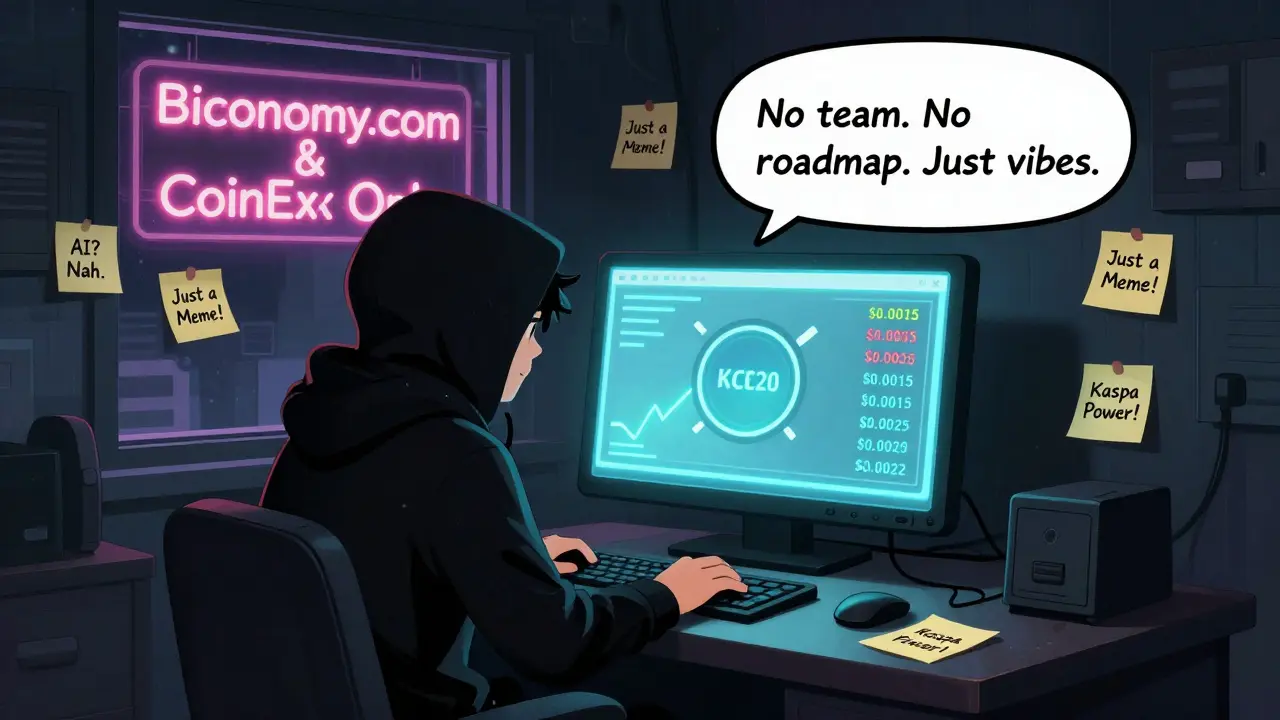
The real engine behind GHOAD is its community. There’s no big team behind it. No corporate office. No CEO giving interviews. Instead, it’s built by traders, meme lovers, and Kaspa enthusiasts who believe in the idea of a coin that’s fun, chaotic, and community-owned. The project’s whole pitch is "fun, community engagement, and cutting-edge BlockDAG technology." That’s it. No whitepaper. No roadmap. Just a token with a name that sounds like a typo and a mission to be the most entertaining coin on Kaspa.
Price, supply, and market data
As of early 2026, GHOAD has a circulating supply of 4 billion tokens. That’s a lot. But because each token is worth less than a penny, the total market cap hovers around $600,000 to $900,000 - tiny compared to major coins. Its price swings wildly. One day, it’s at $0.000165. The next, it jumps to $0.00022. On CoinCodex, it was projected to hit $0.003356 by February 2025. That would’ve been a 229% gain. But projections like that are like lottery tickets. They look good on paper, but the odds are stacked against you.
Here’s what the numbers look like across platforms:
| Platform | Price (USD) | 24H Change | Trading Volume |
|---|---|---|---|
| Biconomy.com | $0.000216 | - | $29,904 |
| CoinEx | $0.000226 | - | $3,989 |
| Dropstab | $0.000217 | -7.52% | $69,737 |
| Coincarp | $0.000165 | -0.99% | $9,031 |
| TradingView | $0.000152 | +1.86% | - |
Notice how the price changes so much between platforms? That’s normal for small tokens. It means liquidity is thin. You can’t trade large amounts without moving the price. If you buy $10,000 worth, you might be the only buyer that day.
Volatility is high. Over the last 30 days, GHOAD moved up or down by 26.92% on average. That’s wild. For comparison, Bitcoin’s 30-day volatility is usually under 5%. GHOAD has 11 green days out of 30 - so less than 40% of the time it goes up. The rest? Down. Or sideways.
Where can you trade GHOAD?
You won’t find GHOAD on Coinbase, Binance, or Kraken. It’s only listed on two smaller exchanges: Biconomy.com and CoinEx. Both are centralized, so you’ll need to create an account, verify your identity, and deposit USDT or another stablecoin to trade it. No wallet-to-wallet swaps. No DEXs. If you want GHOAD, you’re going through a centralized exchange.
Trading pairs are simple: GHOAD/USDT. That’s it. No BTC pairs. No ETH pairs. Just USDT. That tells you something important - this isn’t a long-term hold. It’s a short-term trade. People buy it when the hype is hot, sell when it spikes, and move on.
Should you invest in GHOAD?
Let’s be blunt: GHOAD is not an investment. It’s a gamble. Coincarp says it outright: "GHOAD is a cryptocurrency that is highly volatile and therefore may not be suitable for all investors." And they’re right.
If you’re looking for steady growth, long-term value, or a coin that solves real problems - skip it. But if you enjoy the thrill of meme coins, like following crypto trends, and are okay with losing your money - then maybe give it a small shot. Never put in more than you can afford to lose. And never use leverage. Perpetual futures and margin trading on GHOAD? That’s a fast way to wipe out your account.
The "AI" part? Don’t expect anything. There’s no AI algorithm running. No smart contracts analyzing social sentiment. No AI-generated memes. It’s all in the name. The project’s future depends entirely on whether the community keeps pushing it. If memes die, the price dies. If someone builds something real on top of it - maybe an AI chatbot for the community - then it could evolve. But right now? It’s pure speculation.
The bigger picture: Why does GHOAD even exist?
GHOAD isn’t trying to replace Bitcoin. It’s not aiming for mass adoption. It’s a digital experiment in chaos. It’s testing whether a meme coin can survive on a serious blockchain like Kaspa. Can a token with no utility, no team, and no roadmap still hold value? GHOAD says yes - for now.
It’s also a mirror to the crypto market. People aren’t buying GHOAD because they believe in its tech. They’re buying because they saw a meme, got FOMO, or heard someone made money on it last week. That’s the reality of most small-cap tokens. The tech is just the backdrop. The real driver is emotion.
And that’s why GHOAD matters. Not because it’s revolutionary. But because it’s honest. It doesn’t pretend to be something it’s not. It’s a meme coin with a fancy blockchain. And in a world full of overhyped projects, that’s kind of refreshing.
Is GHOAD a good investment?
GHOAD is not a good investment for most people. It’s a highly volatile meme coin with no real utility or team behind it. While some traders have made short-term profits, the risk of losing your entire investment is very high. Only consider it if you’re comfortable treating it like gambling, not investing.
Can GHOAD reach $1?
It’s extremely unlikely. With a 4 billion token supply, GHOAD would need a market cap of $4 billion to hit $1 per token. That’s 5,000 times its current value. No meme coin has ever reached that level without massive adoption, real utility, or a major exchange listing - none of which GHOAD has. Even Dogecoin, with over 130 billion tokens, trades at less than $0.10.
Where can I buy GHOAD?
GHOAD is only available on two exchanges: Biconomy.com and CoinEx. You’ll need to create an account, complete KYC, and deposit USDT to trade it. It’s not listed on any major platforms like Binance or Coinbase.
Does GHOAD have AI functionality?
No. Despite being called an "AI token," GHOAD has no actual artificial intelligence features. The name is purely marketing. There are no smart contracts using AI, no automated trading bots, and no AI-driven community tools. It’s a meme coin with a buzzword attached.
Why does GHOAD have so many different prices?
GHOAD trades on only two small exchanges with low volume. Prices vary because each platform updates at different times and has different buyers and sellers. There’s no single source of truth. That’s common for small-cap tokens and makes it risky to rely on price data from one site.
Is GHOAD built on Kaspa? What does that mean?
Yes. GHOAD is a KRC20 token on the Kaspa blockchain. Kaspa uses BlockDAG technology, which allows faster and more scalable transactions than traditional blockchains. This gives GHOAD better speed and lower fees than coins on older networks. But GHOAD itself doesn’t add any new features - it just uses Kaspa’s infrastructure.

Comments
monique mannino
lol at the "AI" part. it's just a meme with a buzzword slapped on. no smart contracts, no bots, just vibes and a weird name. 🤡
Will Lum
this is why crypto is beautiful. no whitepaper, no team, just a community that thinks "ghoad" sounds funny and now it's a thing. i love it. 🤘
Elizabeth Choe
you know what? i don't care if it's "real" ai or not. the fact that people are building something fun on kaspa? that's the win. meme coins are the heartbeat of crypto sometimes. keep it weird. 💖
Santosh kumar
i came for the meme, stayed for the kaspa tech. blockdag is underrated. ghoad might be silly but the chain beneath it? solid. 🙌
Andrea Atzori
the volatility alone is a work of art. 26.92% average movement? that's not a coin, that's a rollercoaster made of pure chaos. i'm here for it. 🎢
Brittany Meadows
obviously the feds are behind this. why else would a coin called "ghoad" be on kaspa? it's a psyop. they're testing if we'll buy a nonsense word because it sounds like "goat". we're all sheep. 🐑
blake blackner
ghoad? more like go away lol. why are we even talking about this? someone make a real coin already. this is just noise.
Beth Trittschuh
i think ghoad is a mirror. it doesn't pretend to be anything deep. it's just a reflection of how we all chase hype, memes, and dopamine hits. maybe that's the real utility. we're all just looking for a reason to feel alive again.
Ekaterina Sergeevna
let's be honest - calling it "ai" is the most sophisticated marketing tactic since "web3". you're not building infrastructure, you're selling a fantasy wrapped in a blockchain. and honestly? i'm impressed. it's a masterpiece of semantic sleight-of-hand.
Lindsey Elliott
price on coinex is $0.000226 but coincarp says $0.000165? classic. this is why you never trust price feeds on small caps. it's like trying to read the weather from three different barometers in a hurricane.
Christopher Wardle
it's not about whether ghoad has value. it's about whether a community can sustain meaning without authority. no team. no roadmap. just a name and a chain. that's the real revolution.
krista muzer
i think people miss the point. ghoad isn't meant to be a currency. it's a social experiment. like a digital campfire where people gather to laugh, gamble, and pretend they're part of something. maybe that's the future of finance - not utility, but belonging.
Claire Sannen
i'm not here to judge. but if you're thinking of investing, please remember: this isn't a stock. it's a lottery ticket with extra steps. only risk what you're okay losing. and maybe take a nap after.
Grace Mugambi
the fact that it's only on biconomy and coinex? that's kind of beautiful. it's not trying to be big. it's just existing. quietly. chaotically. and honestly? that's more honest than half the projects with 50-page whitepapers and 12 vc investors.
Crystal McCoun
i'm so glad someone finally made a meme coin that admits it's a meme. no fake utility. no "ecosystem." just pure, unapologetic chaos. and honestly? that's more valuable than 90% of the "decentralized finance" stuff out there.
Donna Patters
this is why crypto is a joke. a token named after a typo, with no ai, on a chain most people can't pronounce, trading at fractions of a cent. we've officially lost our minds.
Michelle Cochran
you're telling me people are buying this because it's "on kaspa"? so the blockchain is the hero, and the coin is just… a decoration? i'm not mad. i'm just… impressed by the audacity.
Ace Crystal
i bought 10k ghoad last week. lost it all. but i laughed so hard i cried. that’s the real return on investment. you can’t buy joy, but you can buy a meme coin and accidentally find it.
Joe Osowski
this is why america is failing. we're turning memes into currency. what's next? trading tiktok sounds as nfts? we are a nation of idiots.
Benjamin Andrew
the market cap is $900k? that's less than my rent. if this is the future of finance, then i'm moving to a cabin in the woods and growing my own potatoes. no more screens. no more ghoad.
Sakshi Arora
ghoad on kaspa is like putting a sparkler on a rocket ship. the sparkler is dumb but the rocket? wow. the tech is real. the coin? just the fireworks
bala murali
blockdag is underappreciated. kaspa can handle more tx/sec than solana. ghoad is just the first thing people slapped on it. but the infrastructure? clean. efficient. silent. powerful.
SAKTHIVEL A
this is the ultimate crypto tragedy. a coin with no utility, no team, no future - but somehow, it's still alive. we are witnessing the death of rationality. and i am here for the spectacle.
Elijah Young
i don't invest. but i follow. because ghoad reminds me that sometimes, the most honest thing in crypto is the thing that doesn't try to be anything more than what it is.
Tammy Chew
ai token? more like ai-trolled. the marketing team must've had a field day. "we're not doing anything" is now a selling point. the future is here, and it's hilarious.