
Cryptocurrency Reporting: Real Insights on Scams, Regulations, and Token Truths
When it comes to cryptocurrency reporting, the process of investigating, verifying, and communicating facts about digital assets, exchanges, and market trends. Also known as crypto journalism, it’s not about hype or price predictions—it’s about exposing what’s broken, hidden, or fake in a space full of noise. Most people think crypto reporting means tracking Bitcoin’s price or announcing another airdrop. But real cryptocurrency reporting digs deeper: Who’s behind that new token? Is that exchange really regulated? Why does this ‘project’ have zero code commits and $0 trading volume?
It’s not just about coins—it’s about the systems around them. crypto scams, fraudulent operations that trick users into sending funds, often through fake airdrops, phishing sites, or romance scams. Also known as crypto fraud, these are often run from places like Myanmar’s Shwe Kokko zone, where armed groups protect the operators and victims alike. Reports like the $10 billion stolen from Americans in 2024 aren’t guesses—they’re based on OFAC sanctions, blockchain forensics, and victim testimonies. Then there’s crypto regulations, government rules that control how exchanges operate, who can trade, and how taxes are collected. Also known as VASP laws, these vary wildly: Brazil demands Central Bank licensing, Pakistan now requires PVARA approval, and India enforces 30% taxes with 1% TDS on every trade. Reporting on these isn’t boring legal jargon—it’s survival info. If you’re trading in India or Brazil, ignoring regulation means risking your funds.
And then there’s the tokens. tokenomics, the economic design behind a crypto asset—how it’s distributed, what it’s used for, and whether it has real demand. Also known as token utility, this separates real projects from dead ones. Look at OneRing (RING) or Fry (FRY): no team, no use case, no volume. Or LAMBO—five different tokens with the same ticker, each pretending to be the real thing. Real cryptocurrency reporting calls these out. It doesn’t just say "avoid this token." It shows you why: no liquidity, abandoned GitHub, fake social media followers, or a contract that can’t be audited.
This collection isn’t about chasing the next 100x. It’s about protecting yourself in a world where 80% of trading volume comes from derivatives, where anonymous exchanges offer 400x leverage, and where wrapped tokens like WBTC rely on a single company holding your Bitcoin. You’ll find deep dives on exchanges like BXTEN and WeDEX, where unverified volume and no KYC make them dangerous. You’ll see how airdrops like WKIM Mjolnir and HaloDAO (RNBW) are total fabrications. And you’ll learn how to spot the difference between a platform token with real utility—like Blockasset for sports betting—and a meme coin with zero backing.
What you’re holding here isn’t a list of headlines. It’s a field guide to the hidden mechanics of crypto. Every article here was written to answer one question: Is this real? And if not, why does it still exist? The answers aren’t always pretty. But they’re the only ones that matter when your money’s on the line.
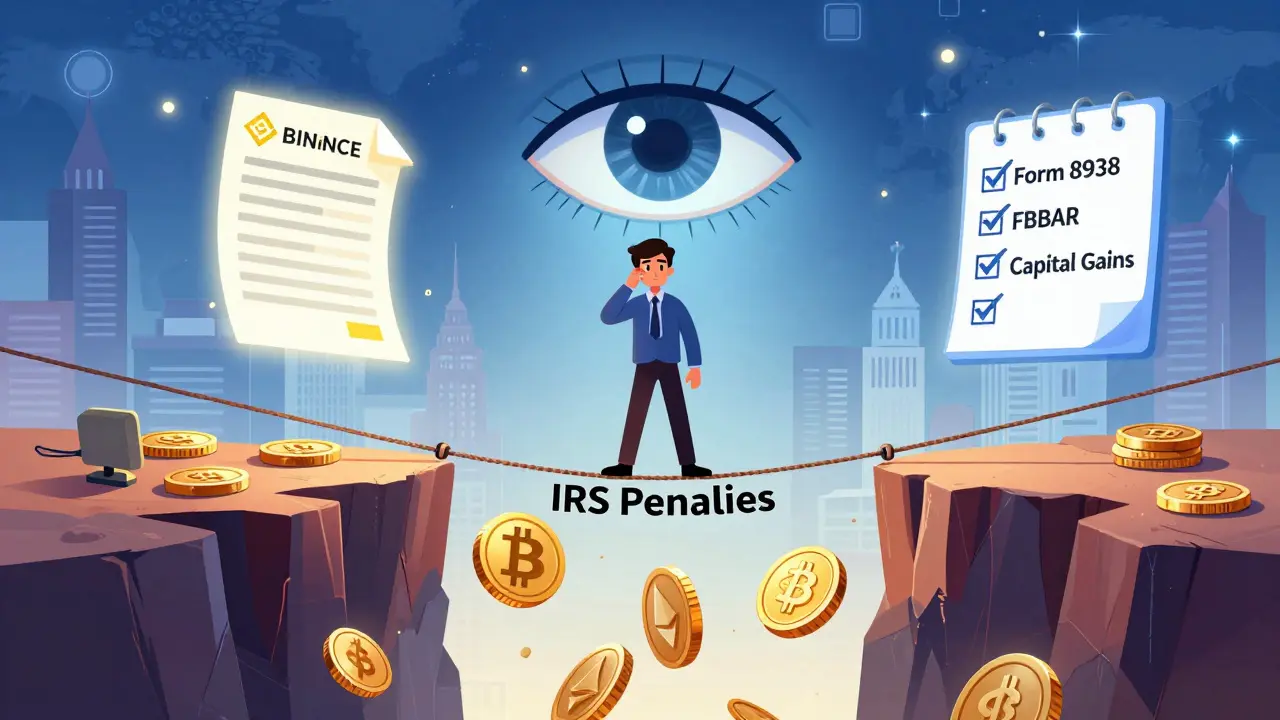
FATCA and Cryptocurrency Reporting for US Citizens: What You Must Know in 2025
U.S. citizens with foreign cryptocurrency must report holdings under FATCA if they exceed $50,000. FBAR rules are changing in 2025 - crypto may soon be included. Know your thresholds, how to value assets, and how to avoid penalties.
read more