
Imagine finding a new crypto exchange that promises lightning-fast trades and fees so low they’re practically free. It sounds like the holy grail of DeFi, right? That’s exactly the pitch ThunderSwap is a decentralized exchange (DEX) operating on the Binance Smart Chain (BSC) that was developed as a fork of Uniswap. But here is the cold, hard truth for anyone looking to trade in 2026: ThunderSwap is not just a risky bet; it is likely a ghost town.
If you are reading this because you found the TNDR token or heard whispers about this platform, stop. Before you connect your wallet, you need to understand why major data providers have flagged this project as "non-tracked." This isn’t a hidden gem waiting to be discovered. It is a case study in what happens when a protocol lacks transparency, liquidity, and community trust.
The Red Flag: What Does 'Non-Tracked' Mean?
In the world of cryptocurrency, visibility is everything. When a legitimate exchange launches, platforms like CoinMarketCap and CoinGecko immediately start tracking its volume, market cap, and liquidity. For ThunderSwap, the story is different. As of late 2024 and continuing into 2026, CoinMarketCap lists ThunderSwap with a specific disclaimer: "Los datos de volumen no tienen seguimiento" (Volume data is not tracked).
This isn’t a technical glitch. It is a warning sign. When an exchange cannot provide verifiable trading volume, it usually means one of two things: either no one is trading there, or the numbers being reported are fake. In the context of DeFi, where liquidity is king, a lack of tracked volume suggests the pool is dry. If you try to swap tokens on a platform with no real liquidity, you won’t get a fair price. You will get slippage so high it might cost you more than the trade itself, or worse, you might not be able to exit your position at all.
Compare this to PancakeSwap is the leading decentralized exchange on Binance Smart Chain with billions in Total Value Locked. PancakeSwap reports over $2 billion in TVL and hundreds of millions in daily volume. These numbers are public, auditable, and trusted by millions of users. ThunderSwap has none of this. Its absence from authoritative rankings like Koinly’s "10 Best Decentralized Exchanges" or Alchemy’s directory of major DEXs tells you everything you need to know about its market standing.
Technical Reality: A Fork Without Features
Technically, ThunderSwap is a fork of Uniswap is the pioneering Automated Market Maker (AMM) protocol that launched in May 2018. This means it uses the same basic code structure: the constant product formula ($x \times y = k$) to manage liquidity pools. On paper, this should work fine on the Binance Smart Chain is a blockchain network known for low transaction costs and fast block times compared to Ethereum.
However, being a fork doesn’t make a project safe. In fact, many scams start as simple forks of popular protocols because the code is easy to copy. The problem with ThunderSwap is that it hasn’t evolved beyond this basic copy-paste job. While Uniswap has upgraded to V3 with concentrated liquidity and complex fee tiers, and Curve Finance has optimized algorithms for stablecoins, ThunderSwap offers nothing new. It provides standard AMM functionality without the advanced features that justify using a niche platform.
More importantly, there is no documentation regarding smart contract audits. In DeFi, an audit is your first line of defense against bugs and exploits. Major exchanges publish their audit reports from firms like CertiK or Trail of Bits prominently on their websites. ThunderSwap has no such records available through official channels. Trading on an unaudited contract is like walking into a casino where you haven’t checked if the cards are stacked. The house always wins, but in this case, the house might just vanish with your funds.
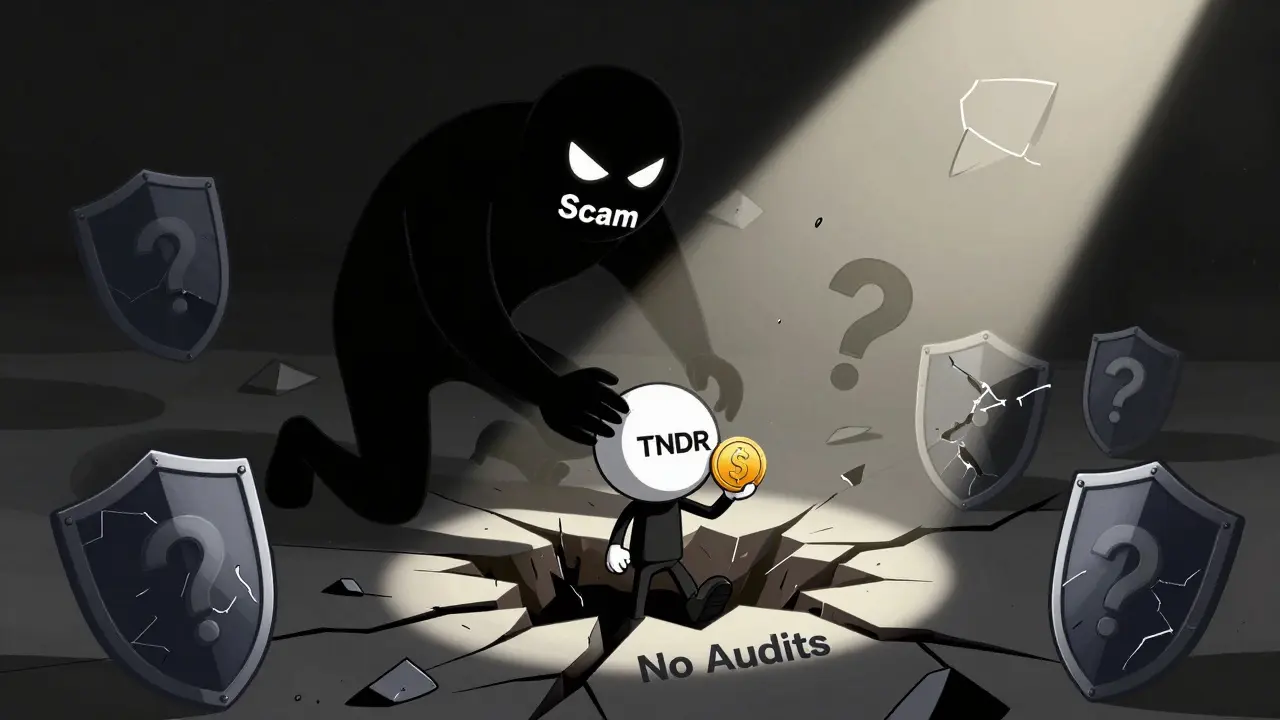
The TNDR Token: A Liquidity Trap?
Every DEX has a native token, and for ThunderSwap, it is TNDR is the native utility token of the ThunderSwap ecosystem. You might see TNDR listed on some smaller exchanges like WEEX, providing real-time USD conversion rates. This can create a false sense of legitimacy. Just because a token has a price doesn’t mean it has value or utility.
In healthy ecosystems, native tokens are used for governance, fee discounts, or staking rewards that are backed by real revenue. With ThunderSwap’s volume untracked and its operational status questionable, the TNDR token lacks fundamental support. There is no verifiable buyback mechanism, no clear governance power, and no substantial staking yields derived from actual trading fees. Instead, holders are often left hoping for a speculative pump that rarely materializes in dead projects.
If you hold TNDR, you face a classic liquidity trap. You can see the price, but you may not find enough buyers to sell your holdings without crashing the price further. This is a common pattern in "rug pull" scenarios, where developers abandon the project after draining liquidity. According to Cryptolegal.uk, crypto rug pulls accounted for 37% of reported DeFi scams in early 2025, often involving small DEX projects that fork established protocols before disappearing. ThunderSwap fits this profile perfectly.
Silence Speaks Volumes: The Lack of Community
Crypto is driven by community. Whether it’s Twitter spaces, Discord chats, or Reddit threads, active projects buzz with discussion. Try searching for ThunderSwap on r/CryptoCurrency or r/defi. You will find virtually nothing. No user reviews, no troubleshooting help, no celebration of updates. Compare this to Uniswap, which boasts thousands of Trustpilot reviews and active development roadmaps.
The silence around ThunderSwap is deafening. Legitimate teams engage with their users, announce upgrades, and respond to concerns. ThunderSwap shows no evidence of recent protocol updates, team activity, or development progress since its initial listing phase. Delphi Digital’s 2025 DeFi Sustainability Report notes that projects lacking transparent metrics and community engagement typically disappear within 18 months of launch. ThunderSwap has already passed that threshold, yet remains in limbo-a digital zombie.
Furthermore, regulatory pressures are tightening. Under MiCA (Markets in Crypto-Assets) regulations effective mid-2024, trading platforms must implement robust transaction monitoring and compliance measures. Non-tracked exchanges like ThunderSwap likely fail these requirements, making them inaccessible to regulated entities and increasingly isolated from the broader financial ecosystem. This isolation accelerates their decline, leaving retail investors holding the bag.

Safe Alternatives: Where to Trade on BSC Instead
You don’t need ThunderSwap to trade on Binance Smart Chain. In fact, avoiding it is the smarter move. Here are three proven alternatives that offer the low fees and high speed you want, but with the security and liquidity you need:
| Feature | PancakeSwap | Biswap | BakerySwap | ThunderSwap |
|---|---|---|---|---|
| Total Value Locked (TVL) | $2 Billion+ | $50 Million+ | $10 Million+ | Untracked / Unknown |
| Audits | Yes (Multiple Firms) | Yes | Yes | No Public Records |
| Community Size | 1.5M+ Twitter Followers | Active Discord/Twitter | Active Community | Virtually None |
| Tracking Status | Fully Tracked | Fully Tracked | Fully Tracked | Non-Tracked (Warning) |
| Risk Level | Low | Medium-Low | Medium | Very High |
PancakeSwap is the undisputed leader on BSC. It offers deep liquidity, meaning you can trade large amounts with minimal slippage. It also has a robust yield farming ecosystem and regular updates. If you want safety and scale, this is your go-to.
Biswap is a strong second choice, particularly for those looking for lower fees on certain pairs. It has a solid reputation, verified audits, and a growing community. It’s a great option if you want to diversify away from PancakeSwap without sacrificing security.
BakerySwap was one of the early movers on BSC. While its market share has shrunk compared to PancakeSwap, it remains a legitimate, audited platform with a loyal user base. It’s suitable for trading older or niche tokens that might still have liquidity there.
How to Protect Yourself From Dead DEXs
Learning about ThunderSwap isn’t just about avoiding one bad apple; it’s about building better habits for navigating DeFi. Here is how you can spot red flags before you lose money:
- Check Tracking Status: Always verify if the exchange is tracked on CoinMarketCap or CoinGecko. Look for the "Non-Tracked" label or missing volume data. If the numbers aren’t there, assume they are zero.
- Verify Audits: Never trade on a platform that doesn’t link to its smart contract audit reports. Check who performed the audit and read the summary. Unaudited code is a major risk.
- Assess Community Activity: Join the project’s Telegram or Discord. Are real people asking questions? Is the team responding? Or is it just bots posting hype? Silence is a bad sign.
- Look for Liquidity Depth: Use tools like DexScreener or Dextools to check the liquidity pool size. Small pools (<$100k) are prone to manipulation and high slippage.
- Start Small: If you must experiment with a new or lesser-known DEX, never invest more than you can afford to lose. Treat it as tuition for learning, not an investment.
DeFi is powerful, but it is also permissionless. That means anyone can deploy a contract, even if they intend to scam users. By sticking to established platforms with transparent data, you keep your capital safe while still enjoying the benefits of decentralized trading.
Is ThunderSwap a scam?
While we cannot definitively label it a scam without legal proof, ThunderSwap exhibits all the characteristics of a high-risk or defunct project. Its "non-tracked" status on CoinMarketCap, lack of audited smart contracts, and absence of community activity suggest it is unsafe for trading. Many similar projects have been identified as rug pulls, where developers drain liquidity and disappear.
What does it mean if a crypto exchange is "non-tracked"?
When a platform like CoinMarketCap marks an exchange as "non-tracked," it means they cannot verify the trading volume or market data provided by the project. This often indicates that the exchange has insufficient liquidity, fails to meet verification standards, or may be reporting fake numbers. It is a major red flag for investors.
Is it safe to use TNDR tokens?
Holding TNDR tokens carries significant risk. Since ThunderSwap lacks verifiable liquidity and operational transparency, the token has little fundamental value. You may find it difficult to sell your tokens without suffering massive losses due to low liquidity. It is generally advised to avoid accumulating tokens from non-tracked or unaudited projects.
What is the best alternative to ThunderSwap on Binance Smart Chain?
PancakeSwap is the best and safest alternative. It dominates the BSC DEX market with over $2 billion in TVL, multiple security audits, and a massive active community. Other reliable options include Biswap and BakerySwap, which also offer verified security and transparent trading data.
Why did ThunderSwap fail to gain popularity?
ThunderSwap failed because it offered no unique advantages over existing competitors like PancakeSwap. It was a simple fork of Uniswap without innovative features, strong marketing, or community building. In the crowded DeFi space, projects that do not differentiate themselves or build trust quickly become obsolete and are abandoned by users.

Comments
Fede Faith
Look, I've been in DeFi since the early days of Uniswap V1, and this post hits the nail on the head. The 'non-tracked' label is basically a death sentence for any DEX trying to claim legitimacy in 2026. If CoinGecko isn't tracking your volume, you don't have volume. It's that simple. People need to stop falling for the 'hidden gem' narrative because usually, it's just a hidden rug pull waiting to happen.
Josh Dodson
totally agree with this. i lost like 50 bucks on a similar fork last year called something like MoonSwap or whatever. the slippage was insane. just stick to pancake if u want safety. dont be greedy lol
Suman Patil
Absolutely right about the liquidity trap aspect. In India, we see so many new projects popping up claiming to be the next big thing on BSC, but they lack the fundamental infrastructure. The constant product formula $x imes y = k$ is standard, but without deep liquidity pools, the impermanent loss kills you before you even start trading. It's crucial to check DexScreener for real-time pool depth rather than trusting their website stats which are often manipulated by wash trading bots.
Kumaran sowkarpet
Very true bro :D. I always tell my friends here in Chennai to check for audits first. No audit means no trust. ThunderSwap looks like a classic copy-paste job with zero innovation. Why risk your hard-earned money when PancakeSwap is right there? Stay safe everyone! :)
ravi mahla
Oh wow, another article telling us what we already know. Like, seriously, who is still using these dead forks? It's 2026, not 2017. The silence from the community is deafening because there IS no community. Just devs collecting fees and hoping nobody notices the liquidity draining away. Typical.
Mark Brunschwiler
You think you are smart but you are just following the herd. Maybe ThunderSwap is the future and you are too blind to see it. The elites want you to stay on PancakeSwap where they can watch you. I feel a disturbance in the force when people talk about audits. Audits are just papers written by people who get paid to say yes. Trust your gut not the data.
Sonya O'Brien
I have to say that while the points raised in this article are certainly valid regarding the lack of transparency and the potential risks associated with unaudited smart contracts, it is also important to consider the broader context of decentralized finance innovation, which sometimes requires taking calculated risks on newer platforms that may not yet have established themselves within the traditional metrics of success as defined by major aggregators like CoinMarketCap or CoinGecko, although one must admit that the absence of tracked volume is indeed a significant red flag that cannot be easily ignored by prudent investors who value capital preservation above all else in the current volatile market environment.
Filbert Reeves
Its all part of the plan they want you to believe only the big exchanges are safe because they are regulated by the same people who want to control your money. ThunderSwap might be untracked because its too successful for them to track. I read somewhere that CoinGecko has deals with certain DEXs to hide competitors. Its obvious really if you look at the patterns. Every time a small exchange gains traction it gets flagged or delisted. Its not about safety its about control. You cant trust the mainstream narrative.
Nick Rice
Listen up folks. If you are trading on BSC and you are not using PancakeSwap or Biswap, you are doing it wrong. Simple as that. The TVL numbers don't lie. Billions vs unknown. Do the math. Don't let FOMO make you stupid. Check the contract address. Verify the liquidity lock. If it's not locked, run. This is basic DeFi hygiene.
Amit Thakur
The technical analysis here is spot on. The lack of concentrated liquidity features like those in Uniswap V3 makes ThunderSwap obsolete immediately. Why would anyone use an AMM that doesn't optimize capital efficiency? It's inefficient and costly. Plus, the jargon-heavy reality is that without MEV protection and proper oracle feeds, you're just sitting duck for front-running bots. Get educated or get rekt.
Eric Scheinberg
The assertion that ThunderSwap lacks verifiable metrics is empirically sound. One must observe that the absence of third-party verification constitutes a material breach of trust in financial instruments. Furthermore, the comparison with established protocols such as PancakeSwap highlights the disparity in operational maturity. Prudence dictates avoidance of such entities.
pankaj chawla
I completely agree with the assessment. We need more awareness about these shady platforms. Many people in our local crypto groups fall for these 'low fee' traps. Sharing this info is very helpful. Let's keep spreading the word about checking audits and tracking status.
Jessica Lane
This is a very well-researched piece. I appreciate the detailed breakdown of why 'non-tracked' status is a critical warning sign. It is alarming how many retail investors overlook these fundamental checks. Could you elaborate more on the specific regulatory implications under MiCA for users who inadvertently trade on such platforms?
Charles Pawlikowski
typical american bias against anything not listed on coinmarketcap. maybe thunderswap is just private and exclusive. i dont care what these tech bros say. i like gambling on shitcoins. if it goes to zero so be it. freedom of choice man. :)
Andrea Burd
Boring. Another generic warning post. Real alpha comes from finding gems before they get tracked. But sure, keep playing it safe with your pancakes while the rest of us make actual profits. Whatever. Im out.
Akeem Whittaker
Let's be clear about the risks here. There is no middle ground with unaudited code. You either trust the math or you trust the dev. With ThunderSwap, you have neither. The community silence is not a feature; it is a bug. Avoid at all costs.
Danna Charris
Precisely. The mediocrity of ThunderSwap is evident. Only amateurs would consider such a platform. Stick to the top tier exchanges if you value your capital. Concise advice: avoid.
Mauricio Contreras Loredo
Haha, nice try selling fear. But seriously, yeah, it looks dead. I checked their discord, it's full of bots. Classic scam setup. Thanks for the heads up though, saved me from looking foolish.
sreeja boora
The regulatory framework in India is becoming stricter. Projects like ThunderSwap that operate in grey areas pose significant legal risks to Indian citizens. It is imperative to adhere to compliant platforms. The lack of transparency is unacceptable.
Grace Newman
I suspect that the 'non-tracked' status is a deliberate move to evade surveillance by global financial institutions. They are operating in the shadows for a reason. It is highly probable that this platform is connected to larger illicit networks. One must remain vigilant against such covert operations.
Annemarie Fitzgerald
It is quite tragic really how people chase after these digital ghosts. The existential dread of holding a token with no utility is palpable. I feel for those who fell into this trap. The silence is not just empty; it is heavy with regret. Perhaps we should meditate on the impermanence of blockchain ventures.