
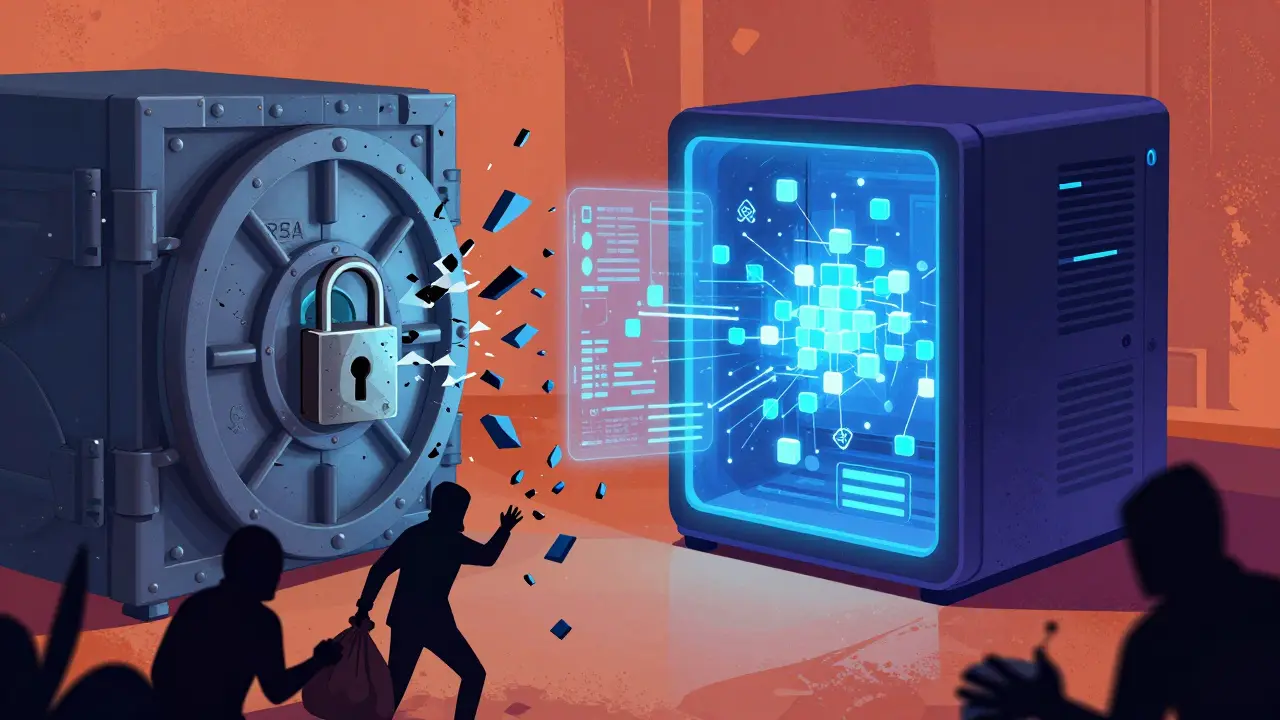
The clock is ticking on the encryption methods that protect your bank accounts, private messages, and digital assets. For decades, we have relied on mathematical problems that classical computers find nearly impossible to solve. But quantum computers are changing the rules of the game entirely. If you are still using standard RSA or ECC encryption in 2026, you are likely exposing sensitive data to a future threat that could be exploited today.
This isn't science fiction anymore. The transition to quantum-resistant algorithms is no longer optional; it is a critical survival step for any organization handling long-term data. Whether you manage a blockchain network, a healthcare database, or a financial ledger, understanding how to migrate to Post-Quantum Cryptography (PQC) is essential. Let’s break down what this means, which standards you need to follow, and how to execute the shift without breaking your systems.
Why Your Current Encryption Is Vulnerable
To understand why we need new algorithms, we first need to look at why the old ones are failing. Most public-key cryptography relies on two specific mathematical challenges: integer factorization (used by RSA) and discrete logarithms (used by Elliptic Curve Cryptography or ECC). Classical computers struggle with these tasks because they require checking possibilities one by one. As the numbers get larger, the time required grows exponentially.
Quantum computers operate differently. They leverage quantum mechanics principles, specifically superposition and entanglement, to process vast amounts of information simultaneously. Shor’s algorithm, a quantum computing method, can solve these specific mathematical problems exponentially faster than any classical supercomputer. This means a sufficiently powerful quantum computer could crack an RSA-2048 key in hours rather than millennia.
The risk isn’t just about future decryption. It’s about the "harvester now, decrypt later" attack scenario. Malicious actors are already intercepting and storing encrypted data today. They don’t need to break it now; they just need to wait until quantum hardware matures enough to unlock it. According to Dr. Michele Mosca, a cryptography expert from the University of Waterloo, there is a one-in-seven chance that fundamental public-key tools will be broken by 2026, rising to a 50% chance by 2031. That window is closing fast.
NIST Standards: The New Gold Standard
In July 2022, the National Institute of Standards and Technology (NIST) announced its first set of standardized quantum-resistant algorithms. This was a pivotal moment for the industry, providing a clear roadmap for developers and security teams. These algorithms are not magic; they are classical algorithms designed to withstand attacks from both conventional and quantum computers. Importantly, they do not require quantum hardware to run. You can implement them on existing servers and devices.
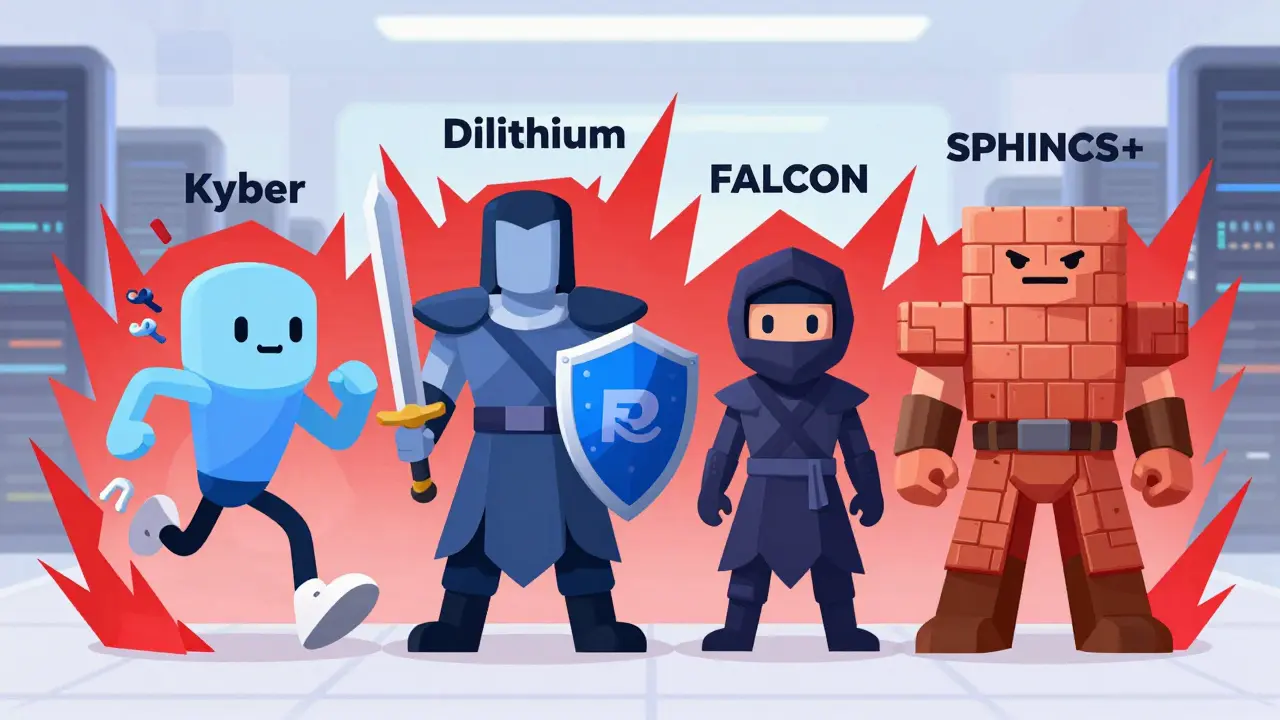
NIST selected four primary algorithms, split into two categories based on their function:
- CRYSTALS-Kyber (General Encryption/KEM): Used for securing data transmission, such as HTTPS connections. It is favored for its small key sizes and high speed, making it efficient for widespread deployment.
- CRYSTALS-Dilithium (Digital Signatures): The primary choice for identity verification and digital signatures. It offers a balanced trade-off between performance and signature size.
- FALCON (Compact Digital Signatures): Recommended for applications where storage space is tight, such as mobile devices or constrained IoT environments, due to its significantly smaller signature size compared to Dilithium.
- SPHINCS+ (Stateless Hash-Based Signatures): A backup option based on a completely different mathematical approach (hash functions). While slower and producing larger signatures, it provides diversity in case lattice-based algorithms like Kyber and Dilithium face unforeseen vulnerabilities.
| Algorithm | Primary Use Case | Key Advantage | Trade-off |
|---|---|---|---|
| CRYSTALS-Kyber | Data Encryption (KEM) | Small keys, high speed | Larger ciphertext than RSA |
| CRYSTALS-Dilithium | Digital Signatures | High efficiency, good balance | Moderate signature size |
| FALCON | Digital Signatures | Smallest signatures | Slightly more complex implementation |
| SPHINCS+ | Digital Signatures (Backup) | Mathematically distinct (Hash-based) | Slower, larger signatures |
PQC vs. Quantum Cryptography: Clearing the Confusion
A common mistake organizations make is confusing Post-Quantum Cryptography (PQC) with Quantum Cryptography. They are fundamentally different approaches. PQC consists of classical algorithms running on classical hardware. It solves the problem through mathematical complexity that quantum computers cannot easily unravel.
Quantum Cryptography, on the other hand, often refers to Quantum Key Distribution (QKD). QKD uses the physical laws of quantum mechanics-such as the observer effect-to detect eavesdropping. While secure, QKD requires specialized infrastructure, including fiber optic lines and quantum repeaters. It is expensive and difficult to scale globally. PQC, by contrast, can be integrated into existing TLS protocols, APIs, and blockchain networks without replacing your entire hardware stack. For most businesses, PQC is the practical, immediate solution.
Implementing Crypto-Agility
Transitioning to quantum-resistant algorithms is not a simple software update. It requires a strategy known as crypto-agility-the ability to quickly swap out cryptographic primitives without disrupting operations. IBM recommends a three-step framework for this transition: inventory, assess, and migrate.
- Inventory: Map every instance of cryptography in your system. Where are you using RSA or ECC? This includes SSL/TLS certificates, database encryption, email signing, and smart contracts.
- Assess: Determine the sensitivity and longevity of the data. Data that needs protection for 10+ years (like medical records or state secrets) must be prioritized. Short-lived session tokens may be lower priority but still require updates.
- Migrate: Implement hybrid modes initially. Combine classical algorithms (like RSA) with quantum-resistant ones (like Kyber). This ensures that if a flaw is found in the new PQC algorithm, your classical layer still provides security. Once confidence in PQC grows, you can phase out the legacy components.
For blockchain networks, this transition is particularly complex. Many blockchains use ECDSA for transaction signatures. Upgrading to Schnorr signatures combined with PQC variants, or migrating to a new consensus mechanism that supports Dilithium or FALCON, requires hard forks or layer-2 solutions. Developers must test these changes extensively to avoid network splits or denial-of-service attacks caused by larger signature sizes.

Challenges and Pitfalls to Avoid
The shift to PQC introduces new operational challenges. One major issue is bandwidth and storage. PQC keys and signatures are generally larger than their classical counterparts. For example, a Kyber public key is significantly larger than an RSA-2048 key. In constrained environments like IoT devices or mobile apps with limited battery life, this increase can impact performance and energy consumption.
Another pitfall is underestimating the integration effort. Legacy systems, embedded devices, and older databases may not support the new algorithm libraries. You might need to upgrade operating systems or replace hardware modules that lack the processing power to handle lattice-based mathematics efficiently. Additionally, interoperability remains a concern. If your partners or customers haven’t migrated yet, you may need to maintain dual-stack capabilities for several years.
Security analysis is also ongoing. While NIST has standardized these algorithms, academic research continues to probe their limits. Relying solely on one algorithm family (like lattice-based) carries risk. This is why NIST included SPHINCS+, a hash-based alternative, as a backup. Diversifying your cryptographic toolkit reduces the risk of a single point of failure.
Next Steps for Organizations
If you are ready to start your migration journey, begin with a free PQC ideation workshop or internal audit. Identify your most critical data assets and map their current encryption status. Engage with vendors who offer quantum-safe solutions, ensuring they comply with NIST standards. Remember, the goal is not just to survive the quantum era but to thrive in it by building trust through robust, future-proof security. The technology is here, the standards are set, and the time to act is now.
What is the difference between Post-Quantum Cryptography and Quantum Cryptography?
Post-Quantum Cryptography (PQC) uses classical algorithms designed to resist quantum computer attacks, running on standard hardware. Quantum Cryptography, such as Quantum Key Distribution (QKD), uses quantum physics principles and requires specialized quantum infrastructure like fiber optics and quantum repeaters.
Which NIST algorithm should I use for my website?
For general encryption (like HTTPS), use CRYSTALS-Kyber. For digital signatures (like verifying user identities), use CRYSTALS-Dilithium as the primary choice. If you need smaller signatures for mobile apps, consider FALCON.
Is my data safe today if I don't switch to PQC?
Your data is currently safe from immediate decryption by classical computers. However, it is vulnerable to "harvest now, decrypt later" attacks. Adversaries may store your encrypted data today and decrypt it once powerful quantum computers become available in the coming years.
Do I need to buy new hardware to use quantum-resistant algorithms?
No, PQC algorithms are designed to run on existing classical computing devices. However, you may need to upgrade software libraries and ensure your processors have enough power to handle the increased computational load of larger keys and signatures.
What is crypto-agility?
Crypto-agility is the ability of a system to quickly switch between different cryptographic algorithms without significant downtime or redesign. It is crucial for transitioning to PQC because it allows you to adapt to new standards or discovered vulnerabilities rapidly.

Comments
Melissa L
so basically if i dont update my password manager right now some hacker from the future is gonna steal my bank info? thats kinda scary lol. i thought quantum computers were still like 10 years away.
Rob Morton
The concept of 'harvest now, decrypt later' really shifts the paradigm of security from immediate threat mitigation to long-term data stewardship. It forces us to consider the lifecycle of information in a way that classical cryptography never truly demanded. We are essentially building digital vaults for secrets that may not be opened for decades, yet we must ensure the locks remain impenetrable against tools that do not yet exist in their final form. This requires a philosophical shift in how we view trust and time in digital systems.
Ryan Peters
Another day, another NIST mandate trying to slow down American innovation with bureaucratic red tape. These algorithms are bloated and inefficient, designed by academics who have no idea what real-world performance means. We should be focusing on domestic hardware solutions rather than relying on these theoretical math puzzles that will just bloat our bandwidth costs. The government knows best, apparently, while ignoring the actual needs of enterprise infrastructure.
ross harris
You see the rot setting in, don't you? The lattice structures of Kyber are merely a band-aid on a gaping wound in the fabric of digital trust. It's a colorful dance of numbers, a desperate attempt to keep the ghosts at bay while the house burns down. SPHINCS+ is the old man screaming into the void, hash-based and stubborn, but ultimately doomed by its own sluggishness. We are all dancing on the edge of a cliff, pretending the ground isn't crumbling beneath our feet.
Carl Belgrave
Listen up folks, this is about national security and protecting our sovereign data assets from foreign adversaries who are already harvesting our encrypted traffic. If you're not implementing hybrid modes immediately, you're negligent. We need to stop relying on outdated RSA keys that are basically open doors for Chinese or Russian state actors. Crypto-agility isn't a suggestion, it's a requirement for any organization that wants to survive in this hostile geopolitical landscape.
Trent Erman1
I've been working on migrating our internal APIs to CRYSTALS-Kyber and the performance hit is minimal if you optimize your key generation properly. The key takeaway here is definitely the hybrid approach; don't rip out RSA overnight. Keep both running side-by-side until you're confident in the PQC implementation. It’s exciting to be part of this transition because it means we’re proactively securing the future rather than reacting to breaches. Let’s get those inventories started!
Fiona Ellis
It is fascinating how quickly the industry has pivoted towards lattice-based cryptography. I recently audited a client's blockchain infrastructure and found they were still using ECDSA without any migration plan. The implications for long-term asset integrity are staggering. One must consider that quantum key distribution remains impractical for most use cases due to the sheer cost of fiber optic infrastructure. Therefore, PQC is indeed the only viable path forward for widespread adoption. 🌐🔒
Sajjad Ghorbani Moghaddam
If anyone is struggling with the inventory phase, start by looking at your TLS certificates and database encryption layers first. Those are usually the biggest surface areas. Don't forget about email signing too; S/MIME and PGP users need to update their key pairs. It’s a big job, but breaking it down into small steps makes it manageable. Reach out if you need help mapping your crypto assets.
Rebecca Shoniker
Let me be absolutely clear: if you are not prioritizing data with a longevity of ten years or more, you are failing in your duty of care. Medical records, legal documents, and financial ledgers require immediate attention. The 'harvest now, decrypt later' attack vector is not hypothetical; it is an active threat model employed by sophisticated nation-state actors. Your negligence today could result in catastrophic data exposure tomorrow. Act now, or face the consequences.
Jay Sharma
They want you to think you need new software, but really they just want to track everything even more closely. Quantum resistant doesn't mean secure from the people writing the code. I bet NIST backdoors these algorithms before they even publish them. Wake up sheeple. They are harvesting your data right now and laughing at you for buying into the hype.
Abby Martin
Oh please, everyone acts like this is rocket science. It's just math. If you can't figure out how to swap an algorithm, maybe you shouldn't be handling sensitive data. It's not that hard to read the NIST guidelines. Stop whining about bandwidth and just do your job properly. The standards are there, the tools are available, so excuse me if I'm tired of hearing excuses from lazy IT departments.
Mélanie Boulay
While the technical aspects of transitioning to post-quantum cryptography are undoubtedly complex, one must also consider the broader organizational implications, including the necessary training for staff, the potential disruption to legacy systems, and the ongoing maintenance required to ensure that the new cryptographic primitives are implemented correctly across all platforms, which often involves significant coordination between development, operations, and security teams to avoid any unintended vulnerabilities during the migration process.
Maurice Flynn
I guess we just have to roll with it. The tech is coming whether we like it or not. Hybrid mode seems like the safest bet for now. Just don't break anything when you switch.
nancy jarecki
The entire premise of this article is pedestrian. Anyone with a basic understanding of cryptanalysis knows that lattice-based schemes are riddled with side-channel vulnerabilities that haven't been fully addressed. Relying on NIST standards is a fool's errand. Real security comes from obscurity and custom implementations, not these bloated, standardized algorithms that every script kiddie will eventually reverse engineer. Typical mass-market thinking.
Carl Hanzel
Everyone is panicking for nothing. Quantum computers won't be powerful enough for decades. You're wasting millions of dollars on a problem that doesn't exist. And even if it did, Shor's algorithm is theoretical nonsense in practice. Save your money and buy better air conditioning instead. This whole PQC craze is just fear-mongering by consultants trying to bill hours.
Daniel J. Cox
In Japan, we are seeing similar trends with FIPs standards aligning with NIST. The cultural approach to security is very meticulous there. They take the 'inventory' step very seriously. It's interesting to see how different regions are adopting these standards. Emoticon usage aside, the technical challenge is universal. :)
John Curry
We stand at the precipice of a new era, where the very foundations of digital trust are being rewritten. The transition to PQC is not merely a technical upgrade; it is a testament to human ingenuity in the face of existential threats. We must embrace this change with open minds and cautious optimism, recognizing that our current methods are fleeting shadows of what is to come. The drama of this transition is palpable, echoing through the halls of cybersecurity.
Robert Hundley
Hey guys! Let's get moving on this! It's actually pretty cool once you get the hang of it. Just remember to test your stuff thoroughly. No point in rushing and breaking production. Stay positive and keep learning! :)