
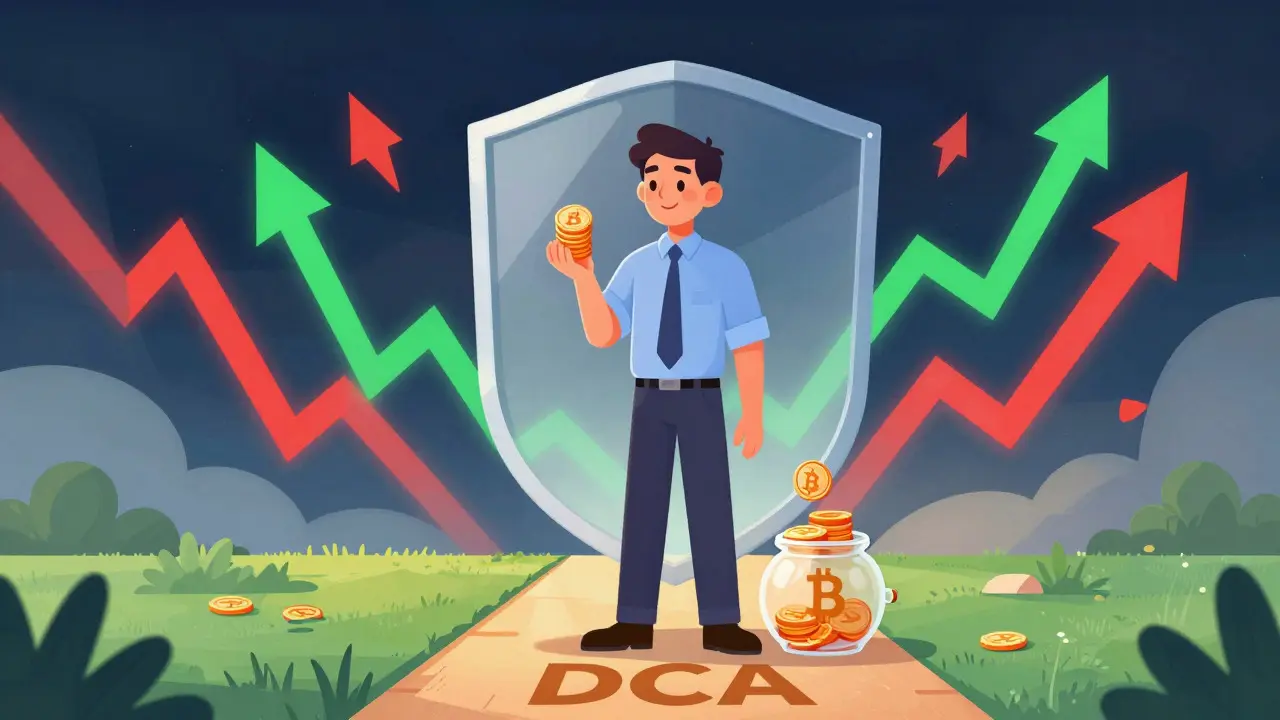
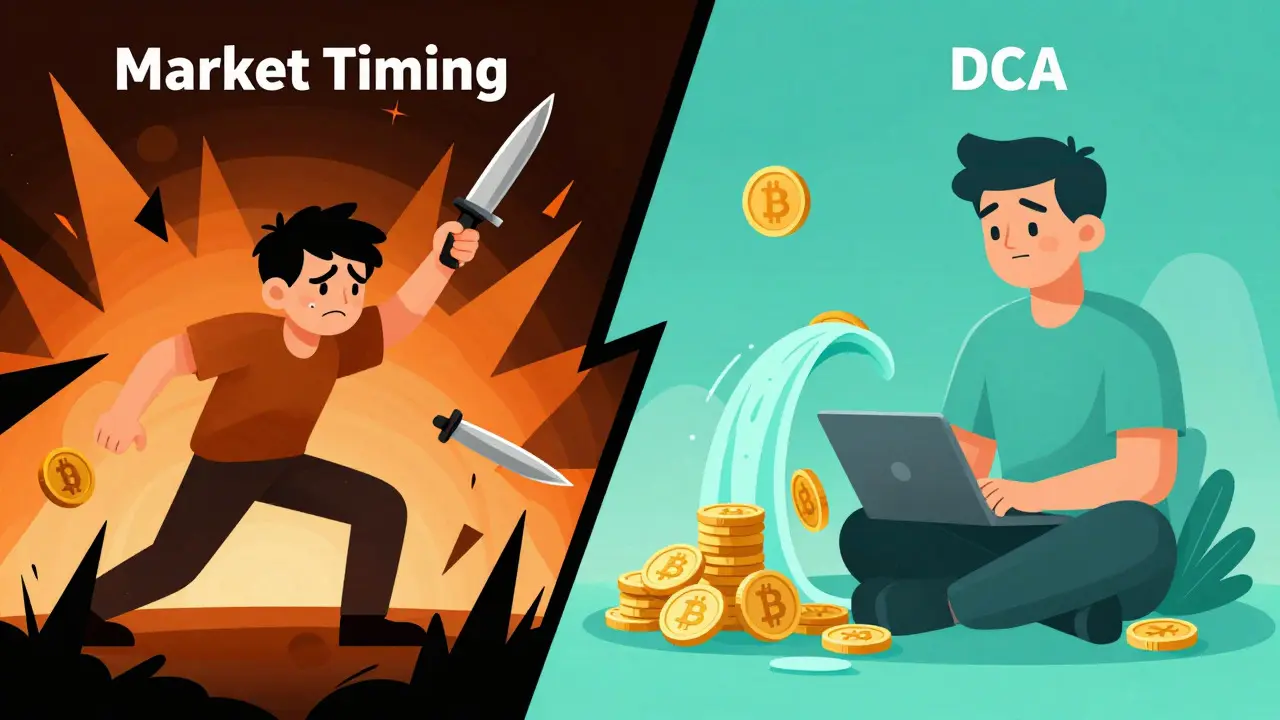
Trying to time the Bitcoin market is like trying to catch a falling knife. You might get lucky once or twice, but eventually, you’re going to get cut. Most investors who try to buy at the absolute bottom and sell at the top end up stressed, over-leveraged, or completely out of the market when prices actually recover. That’s why Dollar Cost Averaging is a systematic investment strategy where an investor divides their total investment amount into smaller, equal portions and invests them at regular intervals, regardless of the asset's price. It removes the guesswork, kills the emotion, and builds wealth quietly in the background.
If you’ve been watching Bitcoin’s wild swings and wondering how to participate without losing sleep, this guide breaks down exactly how to set up a DCA strategy that works for your budget and lifestyle. We’ll cover the math, the platforms, the fees, and the psychological traps you need to avoid.
What Is Dollar Cost Averaging (DCA) for Bitcoin?
At its core, DCA is simple. Instead of dumping $10,000 into Bitcoin all at once, you split it up. Maybe you invest $500 every month for twenty months. Or $100 every week for two years. The key rule is consistency: you buy the same amount of money worth of Bitcoin at the same time interval, no matter what the price is doing.
Why does this work? Because Bitcoin is volatile. Some days it goes up 5%, other days it drops 10%. When the price is high, your fixed dollar amount buys fewer satoshis (the smallest unit of Bitcoin). When the price crashes, that same dollar amount buys more. Over time, this averages out your entry price. You aren’t trying to be right about the market; you’re just showing up consistently.
| Month | Bitcoin Price | Investment Amount | Bitcoin Bought |
|---|---|---|---|
| January | $90,000 | $1,000 | 0.0111 BTC |
| February | $70,000 | $1,000 | 0.0143 BTC |
| March | $110,000 | $1,000 | 0.0091 BTC |
| Average | $90,000 (Arithmetic) | $3,000 Total | 0.0345 BTC (Avg Cost ~$87k) |
In the example above, the arithmetic average price was $90,000, but your actual average cost basis dropped to roughly $87,000 because you bought more Bitcoin when it was cheaper. That’s the power of DCA.
Step 1: Determine Your Budget and Frequency
The biggest mistake beginners make is investing money they can’t afford to lose. Before you open an account, look at your monthly expenses. Pay your rent, buy your groceries, save for emergencies. Whatever is left over is your "play money." Financial advisors often suggest allocating only a small percentage of your disposable income to high-volatility assets like Bitcoin.
Let’s say you have $600 a month to spare. You could invest all $600 on the first of every month. Or you could break it down further. Common frequencies include:
- Monthly: Easiest to manage, aligns with paychecks, lowest transaction fee impact if using per-trade fees.
- Weekly: Better at smoothing out volatility, but may incur higher fees depending on the platform.
- Daily: Rarely recommended for retail investors due to fee accumulation and diminishing returns on volatility smoothing.
For most people, weekly or bi-weekly strikes the best balance. It feels frequent enough to stay engaged but isn’t so frequent that fees eat into your gains. If you’re investing $500 a month, splitting it into four $125 weekly purchases is a solid approach.
Step 2: Choose the Right Platform
You need a place to buy Bitcoin that supports automated recurring purchases. Manual buying is error-prone-you’ll forget, or you’ll panic-sell during a dip. Automation is non-negotiable for long-term success.
There are three main types of platforms to consider:
- Centralized Exchanges (CEX): Platforms like Coinbase, Kraken, and Binance offer built-in "Recurring Buy" features. They are easy to use, regulated, and support fiat currency deposits (USD, NZD, EUR, etc.). However, they charge fees, which can range from 0.25% to 1.5% per transaction.
- Bitcoin-Specific Apps: Services like River Financial are designed specifically for Bitcoin holders. They often offer zero-fee recurring purchases and direct-to-wallet transfers, reducing counterparty risk.
- Decentralized Options: Advanced users might use Lightning Network integrations or self-hosted bots. This requires technical knowledge and offers true custody control but has a steeper learning curve.
For beginners, a reputable centralized exchange or a dedicated Bitcoin app is the best starting point. Look for platforms with low spreads (the difference between the buy and sell price) and transparent fee structures.
Step 3: Set Up Automation and Forget It
This is the hardest part for many investors: stepping back. Once you’ve configured your recurring buy-say, $100 every Monday morning-you need to stop checking the price daily. DCA is a "set it and forget it" strategy.
Here’s how to execute it properly:
- Fund your account: Ensure your linked bank account or payment method has sufficient funds before each purchase date.
- Enable auto-buy: Turn on the recurring feature in your exchange settings.
- Secure your holdings: For large amounts, consider moving your Bitcoin to a self-custody wallet after accumulating a certain threshold. For smaller DCA amounts, keeping them on a secure, insured exchange is acceptable for convenience.
The goal is to remove human emotion from the equation. If you check the price every day, you’ll be tempted to pause your buys during a crash or increase them during a rally. Both actions break the DCA discipline.
DCA vs. Lump Sum: Which Is Better?
You’ve probably heard conflicting advice. Some experts say lump-sum investing wins in rising markets. Others swear by DCA. Here’s the reality:
Lump-sum investing puts all your capital to work immediately. If Bitcoin goes up 50% next year, you win big. But if it drops 50%, you’re underwater and likely will panic-sell. DCA sacrifices potential upside in a straight-line bull market for significant downside protection. In a volatile or bearish market, DCA dramatically reduces your average entry price compared to someone who bought everything at the peak.
Given Bitcoin’s history of 30-50% corrections even in bull markets, DCA is statistically safer for most retail investors. It prevents the catastrophic loss of timing a single bad entry point.

Common Pitfalls to Avoid
Even with a simple strategy, people mess it up. Here are the most common errors:
- Ignoring Fees: If you’re buying $20 a week on a platform with a $2 flat fee, you’re paying 10% in fees. That destroys your returns. Use platforms with percentage-based fees or zero-fee tiers for small amounts.
- Changing the Plan: Don’t increase your buy amount just because the price went up. Don’t stop buying because the price went down. Stick to the schedule.
- Tax Negligence: In many jurisdictions, including New Zealand, selling Bitcoin triggers a tax event. Keep records of every DCA purchase. Using software that tracks your cost basis can save hours during tax season.
- Chasing Altcoins: DCA works best with established assets like Bitcoin. Applying DCA to highly speculative altcoins adds unnecessary risk. Stick to Bitcoin for your core DCA strategy.
Long-Term Mindset: Why Consistency Wins
Bitcoin’s market cap exceeds $1.2 trillion as of late 2024, making it a mature asset class. Institutional adoption continues to grow, but retail investors still benefit most from patience. River Financial describes DCA as "an automated investment strategy for long-term value investing, not short-term gains."
The psychological benefit is huge. When the market crashes, your DCA plan kicks in automatically, buying more Bitcoin at discounted prices. Instead of feeling fear, you feel relief-you’re getting a deal. When the market moons, you’re happy you’re already invested. This emotional stability is worth more than any extra percentage points in return.
Start small. Stay consistent. Let time do the heavy lifting.
How much should I start with for Bitcoin DCA?
Start with an amount you won’t miss if it disappears. Many investors begin with $50-$100 per month. The exact number matters less than the consistency. Focus on building the habit first, then scale up as your income grows.
Is weekly or monthly DCA better for Bitcoin?
Weekly DCA smooths out price volatility more effectively than monthly. However, if your exchange charges per-transaction fees, monthly might be cheaper. Calculate the fee impact: if fees are low or zero, choose weekly. If fees are high, stick to monthly.
Can I change my DCA amount mid-year?
Yes, but try not to base changes on market price. Increase your DCA amount only if your disposable income rises. Changing based on price action introduces emotional bias and defeats the purpose of averaging costs.
What happens if I miss a DCA payment?
Don’t panic. Just resume your normal schedule. Don’t double up to "make up" for the missed payment unless you have extra cash flow. Consistency over perfection is the goal.
Should I move my Bitcoin off the exchange after DCAing?
For small balances, leaving it on a reputable, insured exchange is fine for convenience. As your holdings grow (e.g., over $1,000-$2,000), consider transferring to a hardware wallet or self-custody solution to reduce counterparty risk.

Write a comment