
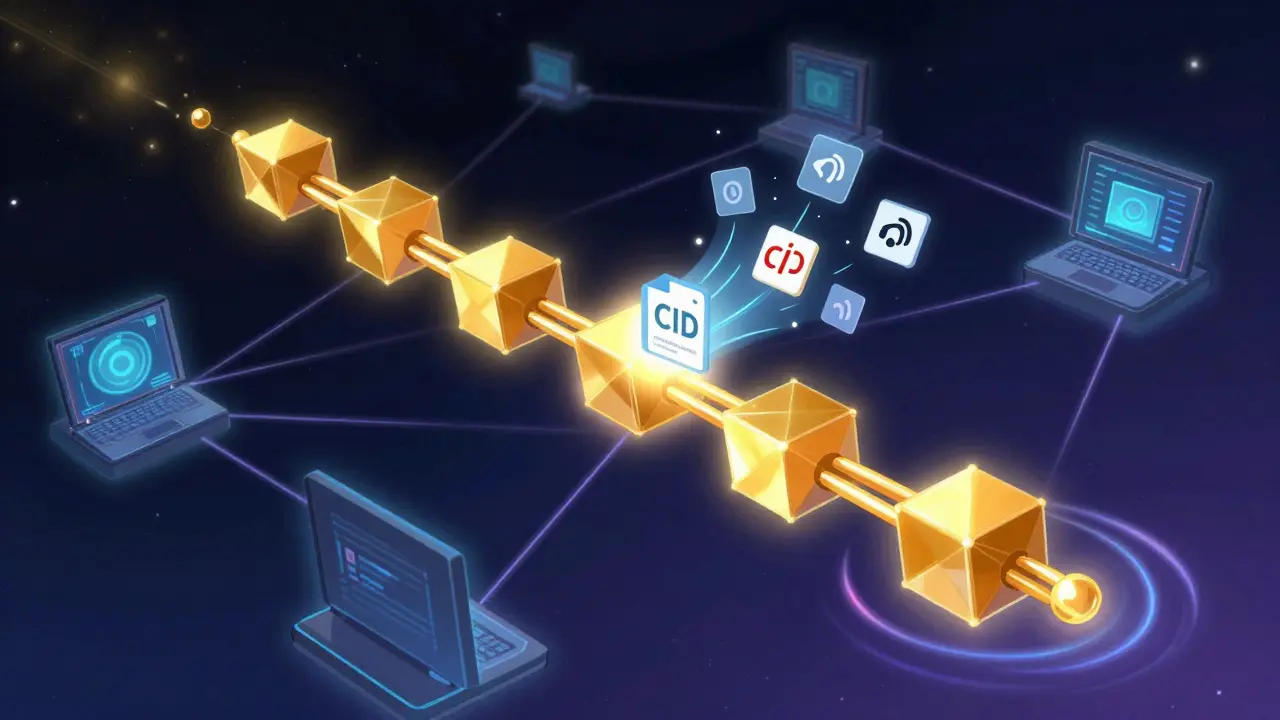
Most NFTs you see online aren’t actually stored on the blockchain. That’s not a bug-it’s the design. If every NFT image, video, or audio file were stored directly on Ethereum, the cost would be astronomical. A single 5MB image could cost over $250 to store. That’s why nearly every major NFT project, from Bored Ape Yacht Club to CryptoPunks, uses IPFS for storage. But what exactly is IPFS, and why does it matter so much for your NFTs?
What Is IPFS and How Does It Differ from Regular Web Storage?
IPFS stands for InterPlanetary File System. It’s not a website or a cloud service like Google Drive. It’s a protocol-a set of rules-that lets files be stored and shared across a decentralized network of computers. Instead of finding a file by its location (like https://example.com/image.jpg), IPFS finds it by its content. Every file gets a unique fingerprint called a Content Identifier, or CID. That CID looks like ipfs://QmXoypizjW3WknFiJnKLwHCnL72vedxjQkDDP1mXWo6uco. If even one pixel changes in your image, the CID changes completely.
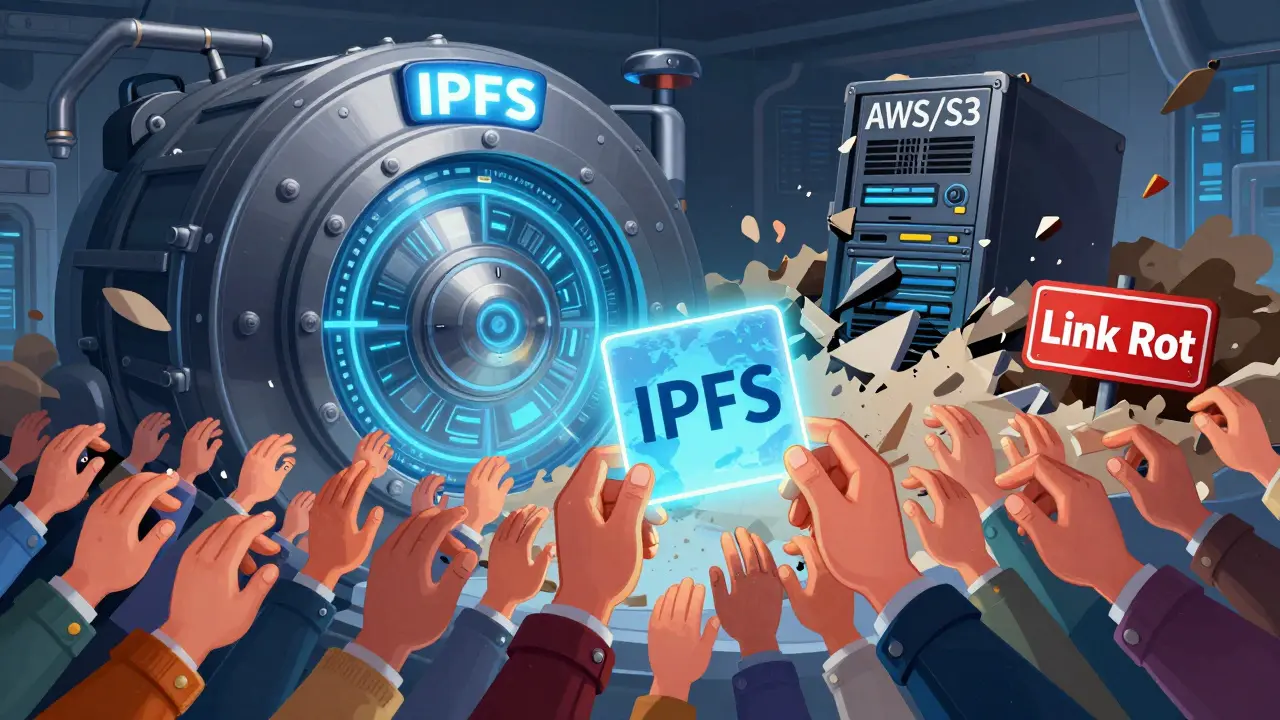
This is the key difference from traditional web storage. On regular websites, if the server goes down or the file gets moved, the link breaks. That’s link rot. A 2022 Stanford study found that over 32% of NFTs minted in 2021 already had broken images because they relied on centralized servers. With IPFS, the file doesn’t need to live in one place. It’s copied across any node that wants it. As long as someone is storing it, the file stays available.
Why IPFS Is the Default for NFTs
By 2023, around 78% of NFT collections used IPFS for storing metadata and media. Why? Because it’s the only system that balances cost, permanence, and trust. Blockchains like Ethereum are great at proving ownership-they’re slow, expensive, and not built for storing large files. IPFS solves that by storing the actual art off-chain while keeping a secure, unchangeable pointer on-chain.
When you mint an NFT, your smart contract doesn’t store the image. It stores the CID. When someone opens your NFT on OpenSea or MetaMask, their wallet or marketplace pulls the file from IPFS using that CID. The blockchain proves you own it. IPFS proves the image hasn’t been swapped out.
Compare that to using AWS S3 or Google Cloud. If you shut down your server, your NFT becomes a blank image. With IPFS, your NFT can still be viewed even if your company disappears-because the file is stored by thousands of random computers around the world.
The Pinning Problem: Why Your NFT Might Vanish
Here’s the catch: IPFS doesn’t automatically keep your files forever. Nodes only store content they’re interested in-or that they’ve been paid to store. If no one is actively keeping your file, it gets deleted. This is called pinning. Think of it like bookmarking a file on a shared drive. If you don’t pin it, it disappears.
That’s why so many NFT creators have lost value. One Reddit user lost $15,000 worth of NFTs after stopping manual pinning. Their images started returning 404 errors. The files weren’t gone-they were just no longer pinned.
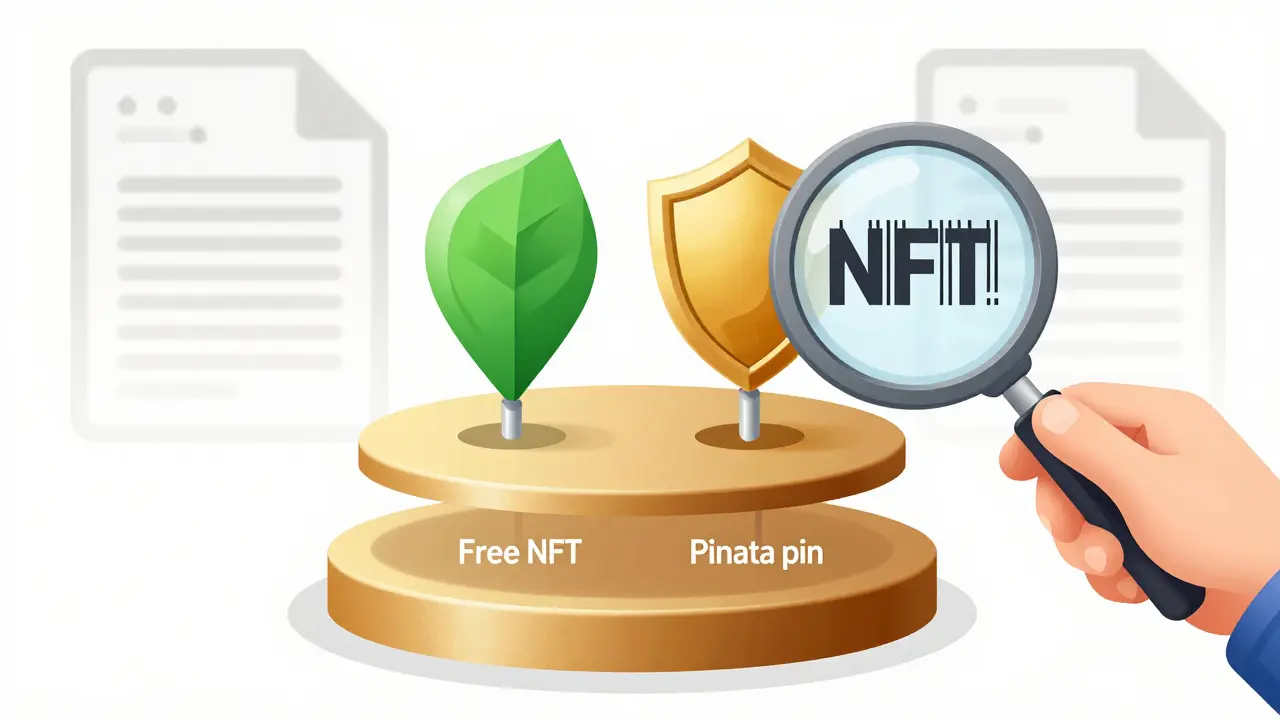
That’s where pinning services come in. Services like Pinata and NFT.Storage run dedicated nodes that keep your files alive. Pinata charges $19/month for 1TB. NFT.Storage? Free for up to 5GB. Both are used by over 100,000 projects. NFT.Storage even uses Filecoin to prove your files are stored, giving you cryptographic proof that your data hasn’t been lost.
For serious creators, the rule is simple: never rely on one pinning service. Use at least two. If one goes down, the other keeps your NFT alive.
How IPFS Compares to Other Storage Options
IPFS isn’t the only option. But it’s the most widely adopted. Here’s how it stacks up:
| Option | Cost Model | Permanence | Privacy | Best For |
|---|---|---|---|---|
| IPFS | Free (with pinning services) | Requires active pinning | Public by default | Most NFTs, especially mid-to-high volume |
| Arweave | One-time payment (approx. $10-$50 per NFT) | Guaranteed forever | Public | High-value art, collectibles, long-term archives |
| Filecoin | Pay per storage per month (FIL tokens) | High, if paid | Public | Projects needing verifiable storage proofs |
| AWS S3 / Cloudinary | Monthly fees | Only as long as you pay | Can be private | Beginners testing ideas-avoid for real collections |
Arweave is the only option that guarantees your NFT will look the same in 50 years. But it’s expensive upfront. IPFS is cheaper and flexible. Most NFTs don’t need a 50-year guarantee-they just need to survive the next 2-3 years of active trading. That’s where IPFS wins.
Real-World Examples: Who Uses IPFS and Why
OpenSea, Rarible, and Foundation-all use IPFS. Bored Ape Yacht Club stores its 10,000 ape images on IPFS with multiple pinning layers. Even major artists like Grimes and Beeple use it. Why? Because they need their work to stay accessible no matter what happens to their companies.
One creator, known as CryptoPunkArtist, uploaded 10,000 NFTs using NFT.Storage for free. Fourteen months later, every single image still loads. No downtime. No lost files. That’s the power of proper pinning.
On the flip side, NFTNovice99 reported on GitHub that their images would sometimes 404 during traffic spikes on public gateways like cloudflare-ipfs.com. That’s not IPFS failing-it’s relying on a single gateway. The solution? Use multiple gateways. Or better yet, run your own IPFS node.
How to Use IPFS for Your NFTs
You don’t need to be a developer to use IPFS. Most minting platforms handle it automatically. But if you’re building your own NFT collection, here’s the basic process:
- Prepare your metadata: Create a JSON file with fields like
name,description, andimagepointing to your file’s CID. - Upload your image and metadata to an IPFS pinning service (Pinata, NFT.Storage, etc.).
- Copy the CID you get back. It will look like
Qm.... - Use that CID in your smart contract’s token URI.
- Set up redundant pinning: Use at least two services.
For developers, IPFS has APIs for Node.js, Python, and Go. You can automate uploads, check CID health, and even trigger re-pinning if a file disappears. Tools like IPNS (InterPlanetary Naming System) let you create mutable links-so you can update a file without changing its CID, though this is rarely used for NFTs because immutability is the point.
What Could Go Wrong-and How to Avoid It
There are three big risks:
- Unpinned content: Your NFT’s image disappears. Solution: Use multiple pinning services. Set up monthly checks.
- Gateway dependency: If you rely only on cloudflare-ipfs.com and it goes down, your NFT looks broken. Solution: Use several gateways (ipfs.io, dweb.link, pinata.cloud) in your code.
- CID version confusion: Some tools use CIDv0, others CIDv1. They’re compatible, but mismatched tools can cause errors. Solution: Always use CIDv1-it’s the modern standard.
Check your NFTs regularly. Tools like NFT.Storage’s upcoming NFT Storage Checker (coming late 2023) will let you scan your collection and flag broken links. Until then, manually test 10 random NFTs every few months.
What’s Next for IPFS and NFTs
IPFS isn’t perfect, but it’s improving fast. In 2023, Protocol Labs released IPFS Cluster v0.16.0, which reduced content loss by 37%. NFT.Storage added cryptographic storage proofs using Filecoin. Optimism is testing a system that uses transaction fees to automatically re-pin NFTs.
Experts agree: IPFS will remain the standard for at least the next five years. As Vitalik Buterin wrote in 2022, it’s the most practical solution we have. The real challenge isn’t the tech-it’s the behavior. Most creators don’t understand pinning. They upload once and forget. That’s why so many NFTs are already broken.
If you’re building or collecting NFTs, treat IPFS like a vault-not a link. Store your CIDs safely. Use multiple pinners. Check your files. The blockchain will always prove you own it. But only you can make sure it still looks the way it should.
Is IPFS free to use for NFT storage?
Yes, the IPFS protocol itself is free. But to keep your files accessible, you need to pin them. Services like NFT.Storage offer free pinning for up to 5GB. For larger collections or guaranteed uptime, paid services like Pinata charge $19/month. You pay for reliability, not the protocol.
Can I store NFT art directly on the blockchain?
Technically yes, but it’s not practical. Storing a single 5MB image on Ethereum costs over $250. Most NFTs are much larger-videos can be hundreds of MBs. That would make minting prohibitively expensive. IPFS solves this by storing the data off-chain while keeping a secure, tiny pointer on-chain.
What happens if IPFS shuts down?
IPFS isn’t a company-it’s a protocol. Even if Protocol Labs disappeared, the network would keep running because it’s made up of thousands of independent nodes. The software is open source. Anyone can run a node. That’s what makes it resilient. It’s like email-no single company owns it, but it still works.
Are IPFS files private?
No. Anything uploaded to IPFS is public by default. If someone has the CID, they can access the file. If you need privacy, you must encrypt your files before uploading. Some projects do this for sensitive metadata, but most NFT art is meant to be public. Don’t store personal data or private keys on IPFS.
How do I check if my NFT’s image is still working?
Copy the CID from your NFT’s metadata and paste it into a public gateway like https://ipfs.io/ipfs/[CID]. If the image loads, it’s fine. If you see a 404, the file isn’t pinned anymore. Use tools like NFT.Storage’s checker (coming late 2023) or manually test a sample of your collection every few months.
Do I need to run my own IPFS node?
Not unless you’re a developer or running a large collection. For most creators, using a pinning service like Pinata or NFT.Storage is easier and more reliable. Running a node requires technical setup, constant uptime, and storage space. It’s powerful, but overkill unless you’re storing thousands of NFTs and need full control.

Comments
Jordan Fowles
IPFS is the quiet hero of the NFT world. No one talks about it, but without it, half the art we admire would’ve vanished by now. It’s not flashy, but it’s resilient. Think of it like a library where every copy of a book is owned by someone different - if one burns, ten others still exist. That’s the magic.
Alexandra Wright
Ugh. So many creators think ‘upload and forget’ is a strategy. You’re not storing art - you’re storing digital dust if you don’t pin. I’ve seen NFTs with $50k floor prices turn into blank squares because someone used ONE pinning service and got lazy. Wake up. This isn’t Instagram.
Brooklyn Servin
Yessss!! 🙌 I used NFT.Storage for my collection and set up Pinata as backup - no regrets. Last week I checked all 200 NFTs and every single one loaded. I even got a notification when one gateway went down and switched to another automatically. IPFS isn’t perfect, but when you treat it right? It’s magic. 🌐✨
Andrew Prince
While the article is technically accurate, it ignores the fundamental epistemological flaw in assuming decentralization equates to permanence. IPFS nodes are voluntary, and human incentive structures are inherently unstable. The notion that ‘thousands of random computers’ will preserve your JPEG of a monkey for decades is a romantic delusion. Without economic mechanisms enforcing persistence - like Arweave’s endowment model - you are merely borrowing storage, not owning it. This is not storage; it is a social contract that will collapse under neglect.
dayna prest
IPFS? More like I-Probably-Forgot-Storage. I’ve got a Bored Ape that loads as a broken image 3 out of 10 times. It’s like owning a painting that’s hidden behind a curtain that sometimes gets pulled down. And don’t get me started on gateways - cloudflare-ipfs.com is basically a public bathroom with a broken lock. Everyone uses it, but no one trusts it.
Shawn Roberts
So basically if you want your NFT to survive you gotta pay someone to babysit it? 😅 I thought blockchain was supposed to be ‘trustless’… turns out it’s just ‘trust someone else’s server’
Andrea Stewart
For beginners: if you're using OpenSea or Rarible, you're already on IPFS - no action needed. But if you're minting your own, DO NOT skip the two-pinner rule. I lost a project last year because I trusted only Pinata. They had a 3-hour outage. My entire collection went dark. Now I use NFT.Storage + Pinata + a friend's home node. It's not glamorous, but it works.
Mike Reynolds
Just wanted to say thanks for explaining pinning. I thought once you uploaded it, it was forever. I’m embarrassed to admit I had 12 NFTs vanish because I didn’t know. Now I’ve got two services set up and I check every month. Feels good to be responsible.
Amy Garrett
OMG I JUST FOUND OUT MY NFTS ARE BROKEN?? 😱 I thought they were fine because OpenSea showed them! I’m checking right now… yep, 3 of them are 404s. I’m signing up for Pinata NOW. Thank you for this post!!
Jackson Storm
One thing no one mentions: CIDv1 vs CIDv0. I spent 3 days debugging why my NFT wouldn’t load on some wallets. Turns out my metadata used CIDv0 and the wallet only accepted CIDv1. It’s not a bug - it’s a gotcha. Always generate with CIDv1. Use the IPFS CLI or NFT.Storage’s uploader - they default to v1. Save yourself the headache.
Emily L
Why do people act like IPFS is some revolutionary tech? It’s just a glorified torrent. And now we’re supposed to trust random strangers on the internet to host our $20k ape? That’s not decentralization - that’s dumpster diving for digital art.
surendra meena
IPFS IS A SCAM!!! THE GOVERNMENT IS CONTROLLING THE NODES!!! THEY’RE DELETING NFTS TO CONTROL THE MARKET!!! I SAW A VIDEO ON TIKTOK!!!
Jake West
Wow. So you’re telling me I need to pay $19/month just to keep my cartoon monkey visible? I didn’t buy an NFT - I bought a subscription service. Thanks for the transparency, I guess. I’m just gonna hold onto my Ethereum and forget the whole thing.
Steve Williams
This is a well-structured and deeply informative piece. The distinction between on-chain ownership and off-chain storage is critical for the future of digital art. I appreciate the emphasis on redundancy - it reflects the wisdom of distributed systems. Thank you for highlighting NFT.Storage’s cryptographic proofs; this is the kind of transparency the ecosystem needs to mature.
Jack and Christine Smith
okay so i just uploaded my nft and used nft.storage but i think i messed up the cid?? it looks like qmabc123 but i swear i copied it wrong? is that bad? also can i use dropbox as backup?? 😅
Haritha Kusal
This is so helpful! I’m from India and didn’t know where to start with IPFS. I used NFT.Storage for free and now my art is live. Thank you for making it simple. I’ll definitely set up a second pinner soon. You’re all helping make Web3 real for people like me 💛
Josh Seeto
Arweave is the only real solution. IPFS is just a band-aid. If you’re minting something meant to last, spend the $30 now. Otherwise, you’re just gambling that someone else will keep your JPEG alive. Spoiler: they won’t.
dina amanda
They say IPFS is decentralized but I bet the NSA has a backdoor. Why else would they let this tech exist? You think they want you to own your art? No. They want you to think you do. Wake up. The NFTs are a distraction. The real asset is the data they collect from your wallet. You’re not storing art - you’re feeding the machine.