
Quick Summary
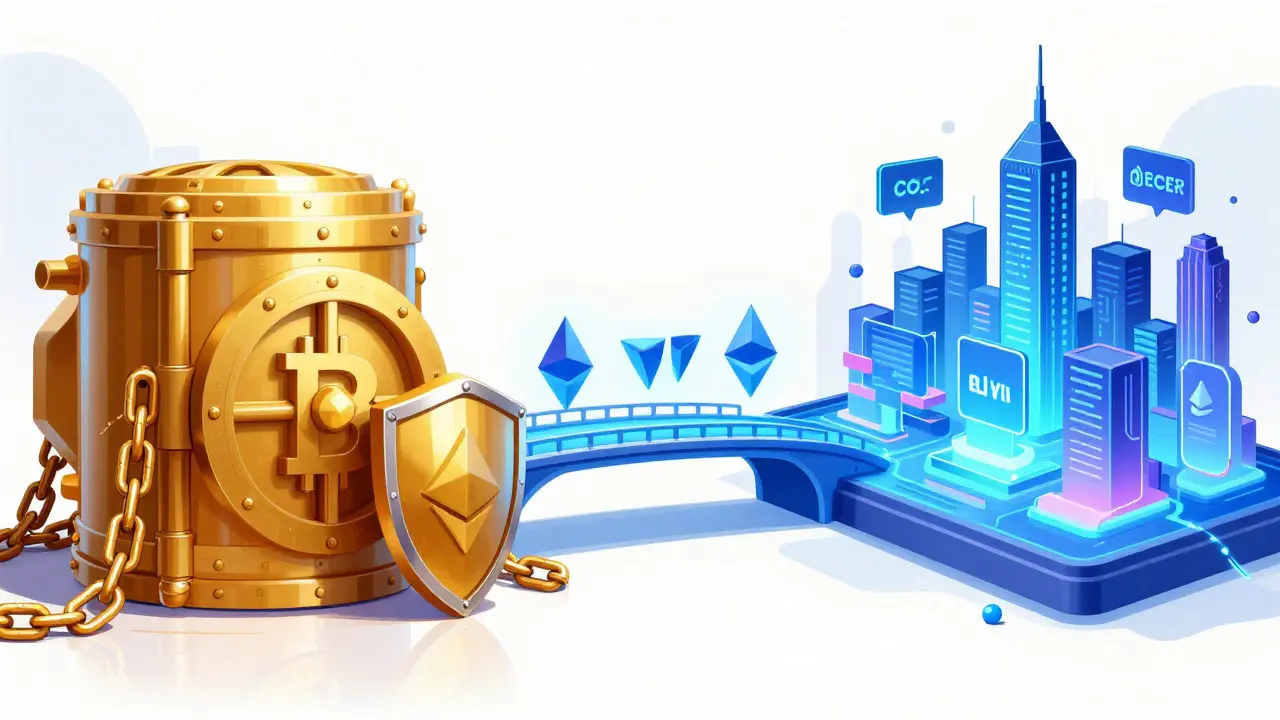
- Core (CORE) is a Layer 1 blockchain that merges Bitcoin’s security with Ethereum’s smart contract functionality.
- It uses a unique Satoshi Plus consensus mechanism involving Bitcoin staking, mining power delegation, and CORE token staking.
- The native CORE token has a hard cap of 2.1 billion, mimicking Bitcoin’s scarcity model to resist inflation.
- Developers can deploy Ethereum-compatible apps on Core with minimal code changes, making it ideal for Bitcoin-backed DeFi.
- While innovative, Core faces challenges in adoption, liquidity, and dependence on Bitcoin miner participation compared to giants like Polygon or Solana.
You’ve probably heard the saying: "Bitcoin is digital gold." It’s secure, scarce, and decentralized. But it’s also rigid. You can’t easily build complex financial apps on it. Then you have Ethereum, which lets you build anything but struggles with high fees and slower speeds during busy times. What if you could have both?
That’s exactly what Core (CORE) is trying to do. Launched in January 2023, Core is a blockchain that acts as a bridge between these two worlds. It’s not just another copycat chain; it’s designed specifically to unlock the potential of Bitcoin by giving it smart contract capabilities without sacrificing its legendary security. If you’re holding Bitcoin and wondering why your assets are sitting idle, or if you’re a developer tired of Ethereum gas fees, Core might be the answer you’ve been looking for.
In this guide, we’ll break down how Core works, why its technology matters, and whether it’s worth your attention in the current crypto landscape.
How Core Solves the Blockchain Trilemma
Every blockchain faces a tough choice known as the "trilemma": you can usually pick two out of three-security, decentralization, and scalability. Most chains sacrifice one to get the other two. Core aims to keep all three intact.
At its heart, Core is an Ethereum Virtual Machine (EVM) compatible blockchain. This means if you know how to write Solidity code for Ethereum, you can deploy that same code on Core almost instantly. No major rewrites needed. But here’s the twist: while it runs Ethereum-style apps, its security backbone comes from Bitcoin.
This combination allows Core to process transactions quickly and cheaply (scalability) while relying on the robust, battle-tested security model of Bitcoin (security) and maintaining a decentralized governance structure through its DAO (decentralization). According to analysis from TastyCrypto in early 2024, this approach positions Core uniquely in the market, offering a "best of both worlds" scenario that neither pure Bitcoin forks nor standalone Ethereum competitors can easily replicate.
The Satoshi Plus Consensus Mechanism
Most blockchains use Proof of Work (like Bitcoin) or Proof of Stake (like Ethereum). Core does something different. It uses a hybrid system called Satoshi Plus. This isn’t just a marketing term; it’s a structural innovation that ties three distinct groups together to secure the network.
- Self-Custodial Bitcoin Staking: Bitcoin holders can timelock their BTC to vote for validators. This brings real Bitcoin value into securing the Core network.
- Delegated Proof of Work: Bitcoin miners can delegate their hash power to vote for validators. This incentivizes miners to support Core alongside Bitcoin.
- Delegated Proof of Stake: Holders of the native CORE token lock their coins to participate in governance and validation.
Why does this matter? Because it creates a multi-layered security model. If one group withdraws support, the others still hold the line. For example, even if CORE token holders sell off, the network remains secured by Bitcoin miners and stakers. This design directly addresses concerns about centralization often seen in newer proof-of-stake chains.
| Feature | Bitcoin (PoW) | Ethereum (PoS) | Core (Satoshi Plus) |
|---|---|---|---|
| Security Source | Hash Power | Staked ETH | BTC Staking + Mining Power + CORE Staking |
| Energy Efficiency | Low | High | Medium-High |
| Smart Contracts | Limited | Full Support | Full Support (EVM Compatible) |
| Transaction Speed | ~7 TPS | ~15-30 TPS (L1) | ~1,000 TPS |
The CORE Token: Economics and Utility
Every blockchain needs a native token, and Core’s is no exception. The CORE token serves several critical functions within the ecosystem. First, it’s used for paying transaction fees. Second, it’s essential for governance. Holders vote on proposals that shape the future of the network, from fee structures to new features.
One thing that stands out about CORE is its supply model. It has a hard cap of 2.1 billion tokens, mirroring Bitcoin’s 21 million limit. This scarcity principle is intentional. By capping the supply, Core resists inflationary pressure that plagues many other altcoins. Furthermore, annual block rewards decrease by 3.6% each year, and a portion of transaction fees are burned. This deflationary mechanism ensures that the token supply approaches but never exceeds the hard cap.
For investors, this structure offers long-term value accrual potential. However, remember that price volatility remains a risk. As noted by users on Reddit and CoinMarketCap, CORE has experienced significant swings, dropping over 40% in short periods despite strong fundamentals. Always do your own research before investing.
Building on Core: A Developer’s Perspective
If you’re a developer, Core offers a familiar environment. Since it’s fully EVM-compatible, you can use tools like MetaMask, Hardhat, and Remix without modification. This lowers the barrier to entry significantly. According to Core Academy’s 2024 survey, experienced Solidity developers typically become proficient on Core within 2-3 weeks.
However, there are challenges. Integrating Bitcoin staking features can be complex, with 63% of surveyed developers citing it as a hurdle. Additionally, RPC endpoint reliability has been inconsistent, affecting 57% of developers. Despite these issues, the community is active. With over 12,000 members on Discord and nearly 9,000 on Telegram, help is usually available. The official documentation scores well for completeness (4.1/5) but less so for beginner-friendliness (3.3/5).
Currently, there are 127 active projects built on Core, including DeFi protocols, NFT marketplaces, and gaming applications. One notable success story is a Bitcoin-backed lending protocol that achieved a 2.5% APY, demonstrating the practical utility of the platform.

Core vs. The Competition
Core doesn’t exist in a vacuum. It competes with established players like Polygon, Solana, and Binance Smart Chain. So, where does it fit?
Polygon relies on Ethereum’s security, while Solana builds its own standalone model. Core borrows security from Bitcoin while maintaining Ethereum compatibility. This makes it particularly attractive for Bitcoin holders who want yield without moving their assets off the Bitcoin blockchain-a feature that distinguishes it from solutions like Liquid Network or RSK.
However, Core lags in adoption. As of Q1 2024, Polygon processed around 7 million daily transactions, while Core handled approximately 120,000. Solana boasts 2,000-4,000 transactions per second (TPS), whereas Core currently supports around 1,000 TPS. These numbers highlight Core’s growth potential but also its current limitations in handling mass-scale throughput.
User feedback reflects this mixed reality. While many praise the easy migration path from Ethereum and the unique Bitcoin integration, complaints about low liquidity on decentralized exchanges and slow customer support (averaging 72 hours response time) are common. Trustpilot ratings for Core-related services average 2.8/5 stars, indicating room for improvement in user experience.
Future Roadmap and Market Outlook
Core is actively evolving. The upcoming "Satoshi Plus 2.0" upgrade, scheduled for Q3 2024, promises dynamic fee adjustments and enhanced Bitcoin integration. Beyond that, the roadmap includes Bitcoin Lightning Network integration by Q4 2024 and cross-chain messaging protocols by mid-2025.
Market predictions vary wildly. Some analysts forecast CORE reaching $2.10 by 2025 and potentially $13.22 by 2030. Others, like UC Berkeley professor David Yermack, call these projections "unrealistic," noting that only a handful of top cryptocurrencies have sustained such growth over five years. Galaxy Digital predicts 5-7x growth by 2026, while Bernstein analysts see limited upside due to competitive pressures.
The key variable is Bitcoin miner participation. Fidelity Investments estimates a 35% probability of failure if Bitcoin block rewards drop below $100,000 per block before 2028, as miners may lose incentive to support Core. Conversely, Pantera Capital sees significant upside if Core becomes the primary yield layer for Bitcoin.
Frequently Asked Questions
Is Core (CORE) safe to invest in?
Like any cryptocurrency, Core carries risks. Its innovative consensus model provides strong security, but the project is relatively new and faces competition from larger chains. Volatility is high, with prices swinging significantly based on market sentiment and Bitcoin's performance. Always diversify your portfolio and only invest what you can afford to lose.
How do I buy CORE tokens?
You can purchase CORE tokens on major centralized exchanges like Binance, KuCoin, and Gate.io, as well as decentralized exchanges supported by the Core ecosystem. Ensure you use a wallet that supports EVM-compatible tokens, such as MetaMask, configured for the Core network.
What is the maximum supply of CORE?
The maximum supply of CORE is capped at 2.1 billion tokens. This fixed supply is designed to mimic Bitcoin’s scarcity model, helping to resist inflation and maintain long-term value for holders.
Can I stake my Bitcoin on Core?
Yes, Core allows self-custodial Bitcoin staking. By timelocking your BTC, you can participate in the network’s security and governance, earning rewards without selling your Bitcoin. This is a key feature that differentiates Core from other platforms.
Is Core better than Polygon or Solana?
It depends on your needs. Core excels in integrating Bitcoin security with Ethereum compatibility, making it ideal for Bitcoin-centric DeFi. Polygon and Solana offer higher transaction throughput and broader adoption but lack direct Bitcoin security integration. Choose Core if you prioritize Bitcoin synergy; choose others for speed and scale.

Write a comment