
Key Takeaways for Financial Access
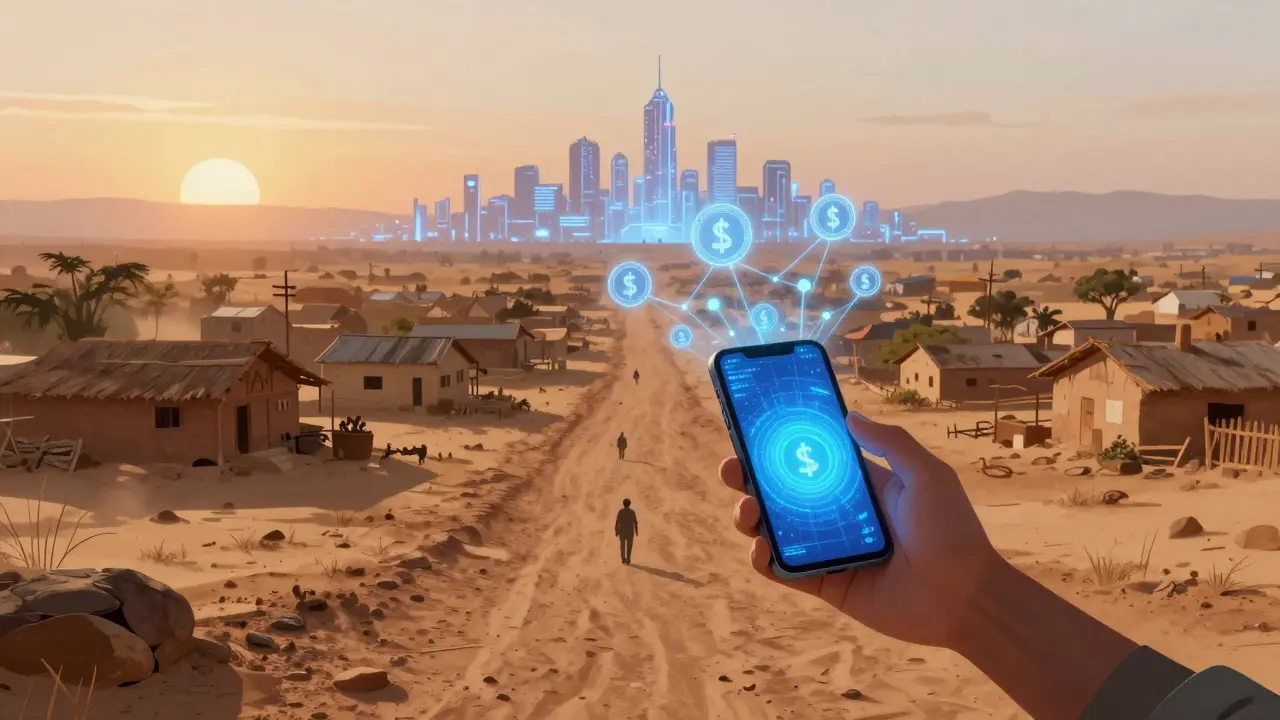
- Instant Onboarding: No credit checks or physical IDs required to start a digital wallet.
- Cheaper Remittances: Reducing transfer fees from 15% down to less than 1%.
- Wealth Protection: Using digital assets to hedge against crashing local currencies.
- Business Growth: Tokenization allows small businesses to attract global capital.
Solving the Remittance Nightmare
For many families in developing countries, money sent home by relatives working abroad is a primary source of survival. However, the traditional system is broken. Services like Western Union or bank wires often charge exorbitant fees, sometimes between 6% and 15% of the total amount. When you're sending a few hundred dollars, losing 20 bucks to a fee is a huge blow. Plus, the money can take days or even weeks to clear. Bitcoin, the first decentralized cryptocurrency launched in 2009, changed this math. By using a peer-to-peer network, a worker in Dubai can send value to their parents in rural Kenya almost instantly. The cost is typically under 1% of the transaction value. This isn't just about convenience; it's about ensuring more money actually reaches the people who need it for food, healthcare, and education.A Shield Against Hyperinflation
In countries where the local currency loses value by the hour, a savings account is effectively a leaking bucket. When inflation hits double or triple digits, the money you earned yesterday buys half as much today. This creates a desperate need for a "stable" store of value. Many people in emerging markets use Stablecoins-digital assets pegged to a steady currency like the US Dollar-or Bitcoin to preserve their purchasing power. Unlike local fiat currencies, Bitcoin has a fixed supply, which makes it an attractive inflation hedge. Instead of watching their life savings evaporate due to government mismanagement, users can hold their wealth in a global asset that isn't tied to any single failing economy.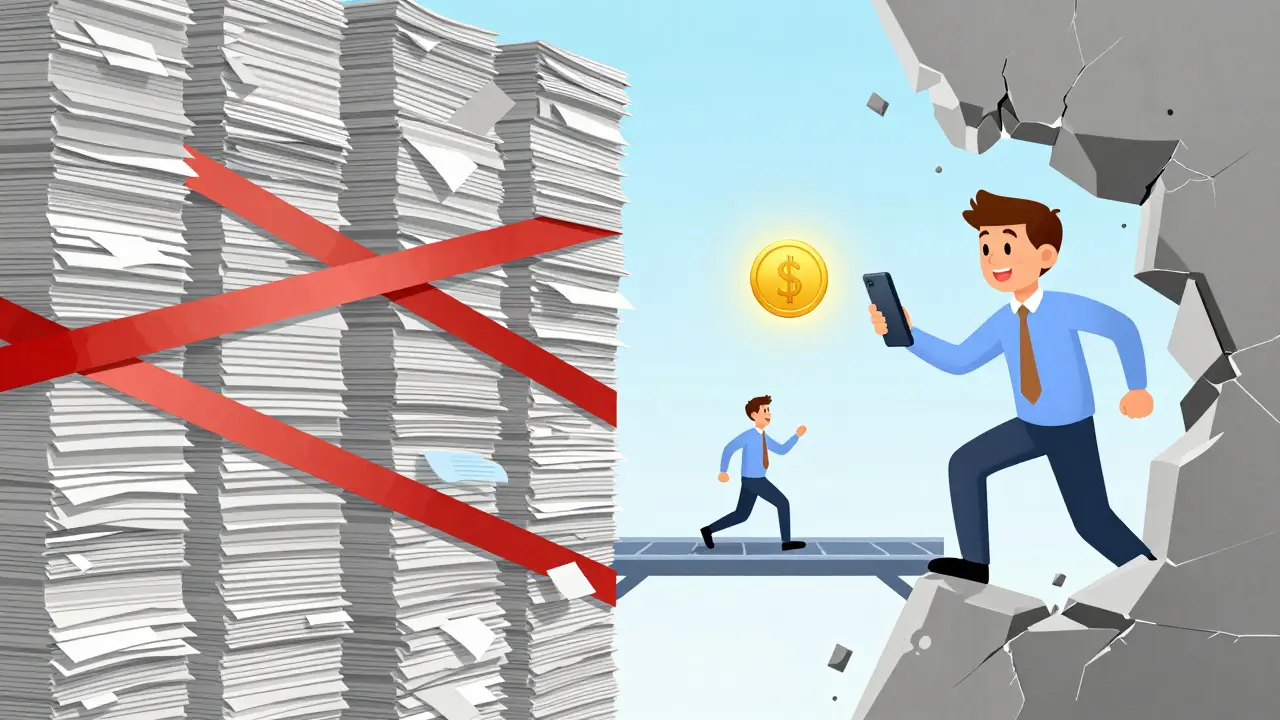
Bypassing the "Paperwork Wall"
Traditional banks have a high barrier to entry. They want proof of address, government IDs, and a minimum deposit. For a subsistence farmer or a street vendor in Sub-Saharan Africa, these requirements are often impossible to meet. This is the "Paperwork Wall" that keeps billions of people in a cash-only existence. Crypto wallets require none of that. All you need is a smartphone and a basic internet connection. This accessibility is a game-changer in regions like Nigeria and South Africa, where adoption has skyrocketed. You don't need to be "approved" by a bank manager to participate in the economy; you simply download an app and you're in. This shift moves financial power from centralized institutions to the individual.| Feature | Traditional Banking | Cryptocurrency |
|---|---|---|
| Requirements | ID, Address Proof, Min. Balance | Smartphone & Internet |
| Setup Time | Days to Weeks | Seconds |
| Remittance Cost | 6% - 15% | Typically < 1% |
| Access | Physical Branch Needed | Global / Remote |
Beyond Payments: Tokenization and Small Business
It's not just about sending money; it's about building wealth. Most small businesses in developing nations can't get a loan because they have no formal credit history. They are effectively invisible to the financial system. Asset Tokenization is the process of converting real-world assets-like land, livestock, or future harvests-into digital tokens on a Blockchain. This allows a small business owner to sell fractional ownership of their business or use a tokenized asset as collateral for a loan from a global pool of investors. This opens up a flood of private capital to enterprises that were previously ignored by local banks, driving job creation and local economic growth.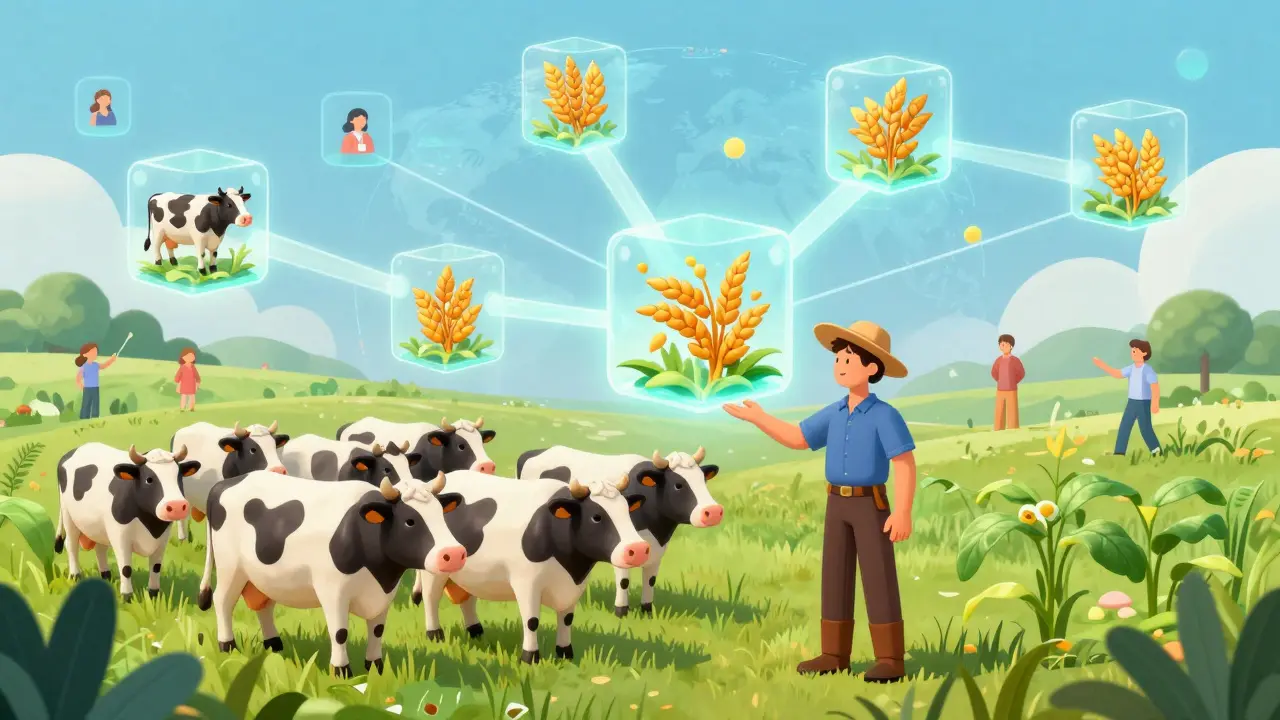
The Roadblocks: Why Isn't Everyone Using It?
If crypto is so great, why hasn't it completely replaced banks? Because the transition isn't seamless. There are four major hurdles that need to be cleared:- Regulatory Chaos: Many governments are terrified of losing control over their currency. Some ban crypto entirely, while others have no laws at all. This uncertainty makes people nervous about putting their hard-earned money into digital assets.
- The Tech Gap: While smartphones are common, reliable 4G or 5G internet is still spotty in rural areas. If you can't get a signal, your money is effectively locked in a digital vault.
- The Learning Curve: Managing "private keys" and seed phrases is intimidating. If you lose your password in the traditional world, you call the bank. In the crypto world, if you lose your keys, your money is gone forever. This risk is too high for someone living on the edge of poverty.
- Volatility: Bitcoin's price can swing wildly. For a wealthy investor, a 10% drop is a bad day. For a family living on $2 a day, a 10% drop in their savings is a catastrophe.
The Future: Hybrid Systems and CBDCs
We aren't looking at a total replacement of banks, but rather a hybrid evolution. Expert analysis from Georgetown University suggests that crypto works best as a complement to existing systems. For example, a rural farmer might use crypto for international trade and inflation hedging, but still use a local credit union for small, short-term loans. We're also seeing the rise of CBDCs (Central Bank Digital Currencies). Countries like Ghana and Nigeria are testing their own digital currencies. These aim to combine the efficiency of blockchain (fast, cheap transfers) with the stability and legal backing of a government-issued currency. This could be the "middle ground" that provides the benefits of crypto without the extreme volatility.Is cryptocurrency safe for people with very low incomes?
It depends on the asset. Volatile coins like Bitcoin carry high risk. However, stablecoins pegged to the US Dollar offer a safer way to preserve value compared to a local currency experiencing hyperinflation. The biggest risk is usually not the market, but the loss of private keys or falling for scams due to low digital literacy.
Do you need a computer to use crypto for financial inclusion?
No, a basic smartphone with internet access is sufficient. Most modern crypto wallets are designed as mobile apps, making it possible for users in developing regions to manage their funds without ever owning a PC.
How does crypto help people who have no government ID?
Non-custodial wallets allow users to create an account without any "Know Your Customer" (KYC) process. Unlike banks, which require passports or utility bills to open an account, a blockchain address is generated mathematically, allowing anyone to receive and send value regardless of their legal documentation status.
What is the difference between CBDCs and Bitcoin?
Bitcoin is decentralized, meaning no one person or government controls it. CBDCs are digital versions of a country's official currency, issued and controlled by the central bank. While CBDCs are more stable, they also give the government more surveillance over how money is spent.
Can crypto really help a small business get a loan?
Yes, through tokenization. A business can turn a future crop or a piece of equipment into digital tokens and sell them to investors globally. This bypasses the need for a local bank's approval and allows the business to raise capital from a much wider pool of people.

Comments
Findlay Duncan Lyon
Absolute game changer for global trade.
Tara Aman
This is so inspiring! We really need to push for more digital literacy so everyone can get on board with this 🚀
Yvette P
Oh sure, because just handing a seed phrase to someone who can barely read is a foolproof plan. Let's talk about the actual L1 scalability issues and the gas fees on Ethereum that would literally eat a peasant's entire weekly budget before the transaction even hits the mempool, not to mention the systemic risk of algorithmic stablecoins collapsing and wiping out the very 'wealth protection' we're pretending to provide for the sake of a little blockchain utopianism that ignores the basic laws of economics and liquidity pools. It's just precious that we think a fancy ledger solves deep-seated geopolitical instability and centuries of systemic poverty while the whales just pump and dump their bags on the most vulnerable populations who don't even know what a cold wallet is. Truly a masterpiece of naive optimism!
Eric Raines
Everyone knows the 'paperwork wall' is just a cover for the banks to keep the poor down, but honestly, most of these people wouldn't even know how to set up a wallet without someone holding their hand through the whole thing.
Jennifer L
It is truly heartbreeking that people are left out of the economy.. I just hope the technolgy is actually acessible to them without too much trouble!
Ali Tate
pure gold for the patriots who want to dump these useless banks and take back the power from the suits in dc
Jason M
This is a monumental shift! Imagine the empowerment of a farmer owning their own financial destiny for the first time in history! It is absolutely thrilling to see these barriers crumble!
Greg Reynolds
The claim that Bitcoin is a reliable inflation hedge for someone living on two dollars a day is logically flawed, as the volatility is far more dangerous than the gradual depreciation of a fiat currency.
Sarah Fisher
It makes me think about how we define 'value' when it's no longer tied to a physical location or a government's promise.
Benjamin Forg
cbdcs are just trackin devices for the elites to watch every penny you spend while the banks still steal your soul
Sara Ellis
money is just energy anyway so why not use a phone
Liz Ariza
Such a wonderful way to bring people together! 🌟 Let's all support these amazing innovations to make the world a fairer place! ✨
Charlie Queen
Totally agree! The world is so much more connected now 🌍💖
Keith Garcia
The sheer audacity to suggest a smartphone is a 'financial hub' is laughable. 🙄 A modest attempt at analysis, I suppose.
Miranda Jamieson
If you still think banks are the answer, you're just blind to the obvious corruption of the old system.
Paige Raulerson
The table is a bit simplistic, but I guess for the average reader it suffices.
praveen subbiah
India is already leading the way in digital payments! This is the future and we are proud to be part of it!! 🇮🇳
Guy Bianco
I believe we should guide these users with care to avoid the pitfalls of volatility. (-_-)
Larry Yang
Tknization is basically just a buzzword for 'I want to sell you a piece of a cow' lol. kinda mid.
jill huyo-a
I'd love to see more about how the actual on-boarding works for people who have never used a digital wallet before.
Robert Mosolygo
The mention of CBDCs is a giant red flag. It's the perfect tool for a social credit system where they can freeze your funds if you think for yourself.