

Imagine sending money to a friend, but the entire world can see who you paid and how much. That is the default state of most public blockchains like Bitcoin. It creates a tension: we want the security of a shared ledger, but we also want our financial details to stay between us and the recipient. Confidential Transactions are the cryptographic solution to this problem. They allow a network to verify that your inputs equal your outputs without ever revealing the actual amounts.
This technology isn't just a theoretical concept; it is live in networks like Monero and the Liquid Network. If you have ever wondered how a coin can be both verifiable and private, this is the mechanism making it happen. We will break down how it works, why it matters for your privacy, and what the trade-offs are when adopting this tech.
The Core Problem: Transparency vs. Privacy
Public ledgers are transparent by design. Every transaction is broadcast to every node, meaning anyone with a laptop and an internet connection can analyze your spending habits. This transparency builds trust in the system's integrity, but it leaks sensitive data. For businesses, this means competitors can track supply chains. For individuals, it means potential surveillance or social pressure based on donation sizes.
Greg Maxwell, a Bitcoin Core developer, first proposed Confidential Transactions in 2013 to solve this exact conflict. The goal was simple: keep the math checkable while hiding the numbers. Today, according to a 2023 Chainalysis report, 97% of privacy-focused cryptocurrency transactions use some form of this technology. It has moved from a niche experiment to a standard tool for those who value financial discretion.
How Pedersen Commitments Hide the Amount
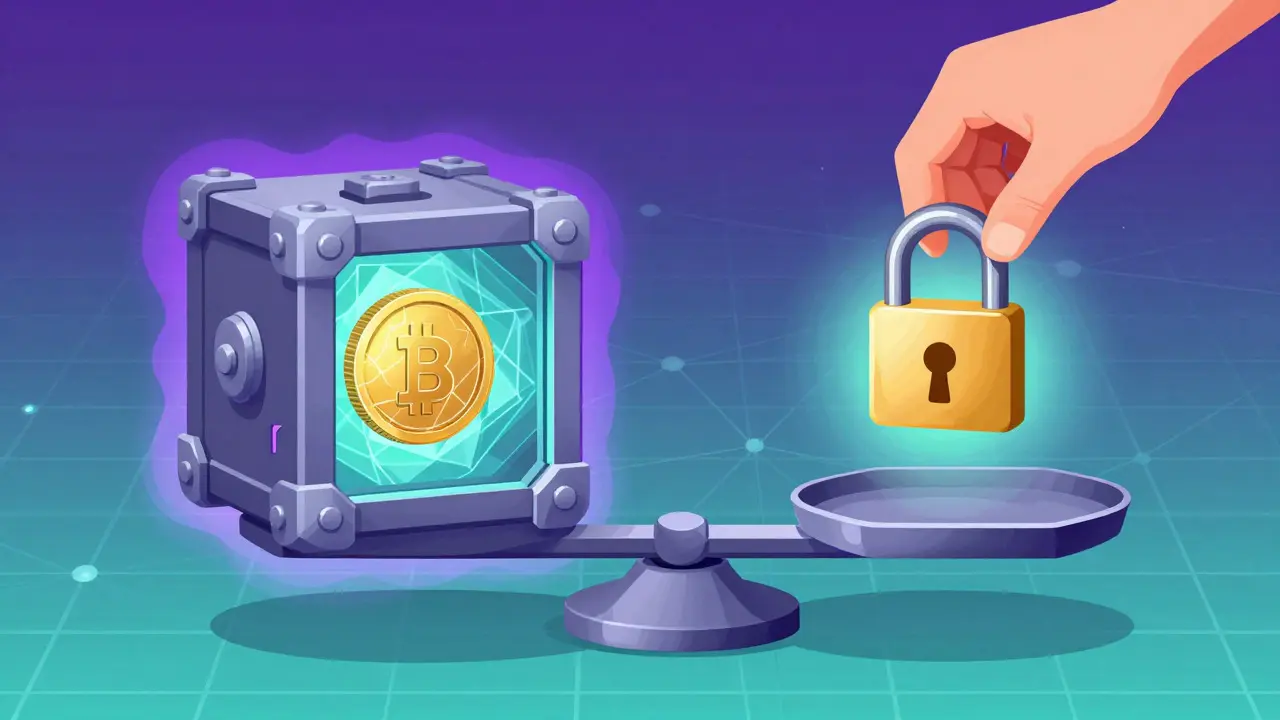
To understand Confidential Transactions, you need to understand the "box" that holds the secret. This box is called a Pedersen Commitment. Think of it as a one-way function. You put a number inside, and the commitment generates a unique hash-like string. Anyone can verify that the same number was used in two different places, but they cannot reverse-engineer the original number from the string alone.
In a standard Bitcoin transaction, you say, "I am moving 5 BTC from Address A to Address B." In a Confidential Transaction, you instead move two Pedersen Commitments. One represents the input amount, and the other represents the output amount. The network checks if Input Commitment equals Output Commitment plus Fee Commitment. Because Pedersen Commitments are homomorphic (meaning you can add them together mathematically), the nodes can do this arithmetic without opening the boxes.
This ensures that no new money is created out of thin air. If the math doesn't balance, the transaction is rejected. But throughout this process, the actual value remains hidden behind the cryptographic curtain.
Range Proofs: Preventing Negative Money
If amounts are hidden, how do we stop someone from creating negative coins? Or infinite coins? This is where Range Proofs come in.
A range proof is a cryptographic statement that says, "My number is between 0 and X," without revealing what the number actually is. Early implementations used large proofs that bloated the blockchain. However, a breakthrough in 2017 introduced Bulletproofs, developed by Benedikt Bünz and others. Bulletproofs reduced the size of these proofs from about 10KB to roughly 670 bytes.
This efficiency was critical. Without small proofs, Confidential Transactions would have made blockchains too heavy to store. With Bulletproofs, the overhead became manageable, allowing privacy features to scale across entire networks rather than just isolated side-chains.
Real-World Implementations: Monero and Liquid
You don't have to wait for Bitcoin to adopt this fully to experience it. Two major networks already run on Confidential Transactions.
- Monero (XMR): Launched in 2014, Monero uses a variant called RingCT (Ring Confidential Transactions). Introduced in January 2017, RingCT combines hidden amounts with ring signatures to hide the sender. As of the 'Akita' upgrade in May 2023, Monero hides transactions within a set of 16 decoys, making tracing extremely difficult.
- Liquid Network: Built by Blockstream, this is a side-chain of Bitcoin that launched confidential assets in October 2018. It is designed for institutions. While it hides amounts, it requires permissioned access, making it ideal for banks and exchanges that need speed and privacy without the full anonymity of a public chain.
The difference is stark. Monero offers strong privacy for retail users, while Liquid serves institutional needs. Both rely on the same core mathematical principles but apply them differently based on their target audience.
Performance and Trade-offs
Privacy comes at a cost. Here is what you should expect if you use Confidential Transactions:
| Metric | Standard Bitcoin | Confidential (Liquid/Monero) |
|---|---|---|
| Avg. Transaction Size | ~250 bytes | ~290-400+ bytes |
| Verification Time | < 0.1 seconds | ~0.8 seconds |
| Sender Anonymity | None (Pseudonymous) | High (Ring Signatures/Stealth Addresses) |
| Amount Privacy | None | Full (Hidden via Commitments) |
Notice the increase in size. On the Liquid Network, transactions are about 15-20% larger than standard Bitcoin transfers. This bloat increases storage requirements for full nodes. The MIT Digital Currency Initiative estimated that full CT implementation on Bitcoin could increase node storage needs by 25%. For casual users running lightweight wallets, this isn't an issue. For miners and full-node operators, it adds computational load.
There is also a metadata risk. Dr. Sarah Meiklejohn from UC San Diego warned that even if amounts are hidden, timing analysis can still leak information. If you send a payment exactly when you know your supplier ships goods, the correlation might reveal the transaction link despite the hidden amount.

Regulatory Landscape and Future Outlook
Privacy is not illegal, but it is scrutinized. The U.S. Treasury’s 2022 guidance stated that privacy technologies must maintain sufficient transparency for Anti-Money Laundering (AML) compliance. This led to some exchanges delisting Monero in certain regions. However, the trend is shifting toward "selective disclosure."
In 2023, the Liquid Network collaborated with the Monetary Authority of Singapore to develop protocols that allow regulators to view specific transactions upon request, while keeping the rest private. This hybrid approach aims to satisfy both privacy advocates and compliance officers. Gartner predicts that by 2027, 65% of institutional blockchain deployments will include some form of Confidential Transactions.
For the average user, the future looks brighter. As hardware gets faster and proof sizes shrink, the performance gap between transparent and confidential transactions will close. You may soon be able to enjoy bank-level privacy without sacrificing speed or ease of use.
Frequently Asked Questions
Are Confidential Transactions legal?
Yes, in most jurisdictions. However, regulations vary. Some countries restrict the trading of privacy coins like Monero due to AML concerns, but the underlying technology is widely accepted in institutional settings like the Liquid Network.
Do I need a special wallet to use them?
If you are using Monero or Liquid, yes. You need a wallet specifically designed to handle Pedersen Commitments and Range Proofs. Standard Bitcoin wallets do not support Confidential Transactions natively yet.
Can hackers see my transaction amounts?
No. The amounts are encrypted using Pedersen Commitments. Unless you share your private key, neither hackers nor network validators can see the specific value being transferred. They can only verify that the math balances.
Is Monero better than Zcash for privacy?
It depends on your needs. Monero uses Confidential Transactions by default for all users, ensuring uniform privacy. Zcash uses zk-SNARKs, which offer stronger anonymity but require users to actively choose to shield funds. Monero is generally considered more user-friendly for consistent privacy.
Will Bitcoin adopt Confidential Transactions?
It is possible but not guaranteed. Proposals like Taproot Assets aim to integrate similar concepts. However, Bitcoin developers are cautious about increasing block size. Many believe optional privacy plugins or side-chains are more likely paths for Bitcoin adoption.

Write a comment