
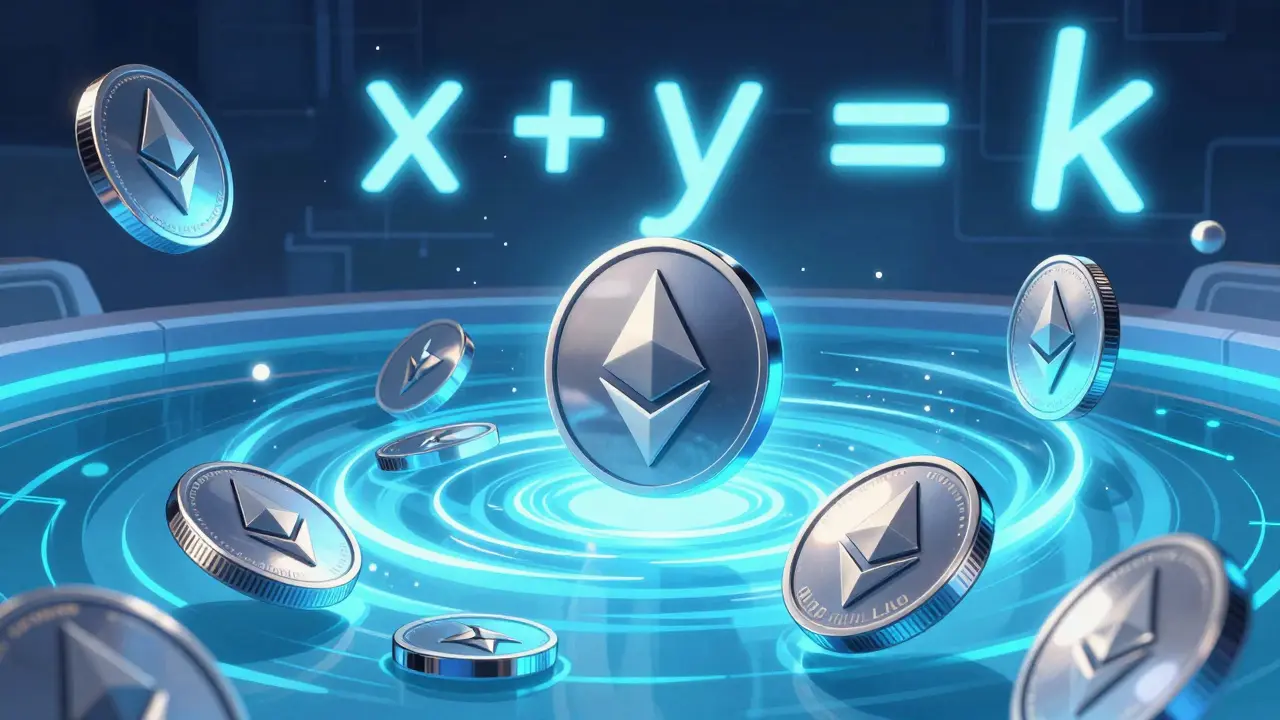
Imagine you want to trade some Ethereum for USDC, but there is no single person on the other side of the trade waiting to swap with you. How does the trade happen instantly? This is where the Constant Product Formula is a mathematical relationship used by Automated Market Makers (AMMs) to determine the price of assets in a liquidity pool. Represented by the simple equation x * y = k, it ensures that a pool always has liquidity, even if there is no traditional order book.
At its core, this formula creates an inverse relationship between two assets. If the amount of one asset in the pool goes up, the other must go down to keep the total product (k) the same. This mechanism allows platforms like Uniswap to function without a centralized intermediary, effectively replacing a human market maker with a piece of code.
The Math Behind the Magic
To understand how this works, you only need basic algebra. In the equation x * y = k, x and y represent the reserves of two different tokens in a pool, and k is the constant product that must remain unchanged during a trade.
For example, let's say a pool has 10 ETH (x) and 10,000 USDC (y). The constant k would be 10 * 10,000 = 100,000. If a trader wants to buy ETH, they must add USDC to the pool. As the amount of USDC (y) increases, the amount of ETH (x) must decrease to keep the product at 100,000. This is why the price of the asset increases as its supply in the pool drops-the formula automatically pushes the price up to discourage further draining of the asset.
The visual representation of this relationship is a rectangular hyperbola. As you move along the curve, the ratio between the two assets changes, which is exactly how the "market price" is discovered in a decentralized environment.
| Feature | Constant Product (AMM) | Traditional Order Book |
|---|---|---|
| Price Discovery | Algorithmic (x * y = k) | Bid/Ask Spread |
| Liquidity Source | Liquidity Providers (LPs) | Market Makers / Traders |
| Trade Execution | Instant (against the pool) | Depends on matching orders |
| Slippage | Higher for large trades relative to pool size | Depends on order book depth |
Who Provides the Liquidity?
For this formula to work, the pool needs assets. This is where Liquidity Providers are users who deposit pairs of tokens into a smart contract to facilitate trades in exchange for a share of the trading fees come in. When you provide liquidity, you typically must deposit an equal value of both tokens. If you put in $1,000 of ETH, you must also put in $1,000 of USDC.
These providers act as the "backbone" of the DEX. In return for taking on the risk, they earn a percentage of every trade that occurs in that pool. However, it is not free money. Liquidity providers face a specific risk called impermanent loss.
The Trap of Impermanent Loss
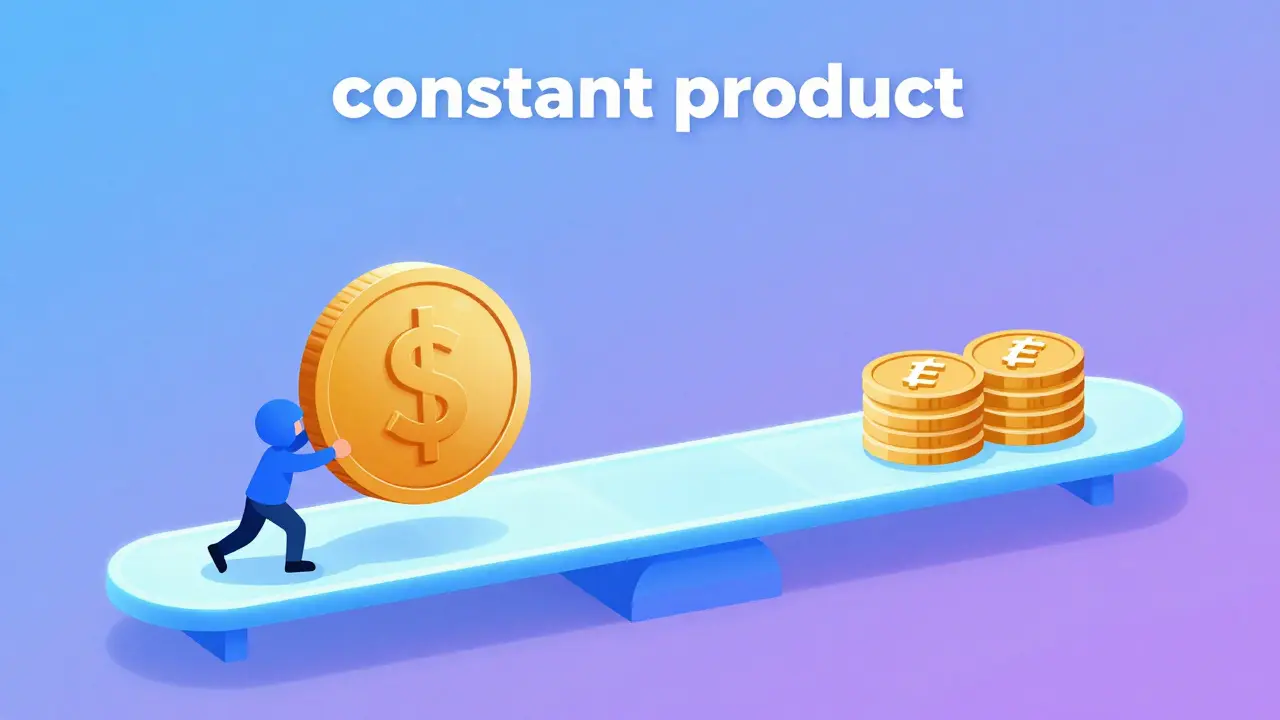
Impermanent loss happens because the Constant Product Formula doesn't know what the "real" price of an asset is on external exchanges like Binance or Coinbase. It only knows the ratio of assets inside its own pool.
If the price of ETH jumps 50% on an external exchange, arbitrageurs will quickly buy the "cheap" ETH from the AMM pool until the pool's price matches the external market. While the pool remains balanced (k is still the same), the liquidity provider now has more of the losing asset and less of the winning asset than if they had just held the tokens in a wallet. This loss is "impermanent" because if the price returns to the original ratio, the loss disappears. But if you withdraw your funds while the price is diverged, that loss becomes permanent.
Real-World Impact and the Uniswap Effect
The most famous implementation of this logic is Uniswap is a leading decentralized exchange (DEX) that popularized the use of the Constant Product Formula for permissionless token swapping . By removing the need for a centralized order book, Uniswap allowed any token-no matter how obscure-to have a liquid market as long as someone was willing to seed a pool for it.
According to data from Dune Analytics, Uniswap has processed hundreds of billions of dollars in volume using this exact math. It proved that a simple algebraic rule could replace the complex infrastructure of traditional finance. However, this simplicity comes with a trade-off: slippage. In a small pool, a large trade will move the price significantly because the formula forces the product to remain constant, leading to a worse execution price for the trader.

Beyond the Simple Formula
While x * y = k changed the game, it isn't perfect. Modern DeFi has evolved to fix its flaws. For instance,
Concentrated Liquidity is
a mechanism that allows liquidity providers to allocate their funds to specific price ranges rather than the entire curve
. This reduces slippage for traders and increases earning potential for providers by making the capital more efficient.
Other protocols use "weighted" formulas, where different assets have different weights (e.g., 60/40 instead of 50/50), allowing for pools with more than two assets. Despite these upgrades, the original constant product model remains the gold standard for understanding how decentralized liquidity functions.
What happens if the constant 'k' changes?
In a standard trade, k does not change. However, k increases when liquidity providers add more assets to the pool. When LPs withdraw their funds, k decreases. The constant k only stays constant during the actual swapping of tokens by traders.
Why is it called an "Automated Market Maker"?
It is called "automated" because the price is set by a mathematical formula rather than by humans negotiating bids and asks. The "market making" part refers to the act of providing the liquidity necessary for others to trade.
Is the Constant Product Formula safe?
The formula itself is a mathematical certainty, but the implementation in smart contracts can have bugs. Additionally, users face financial risks like impermanent loss and slippage, which are inherent to the way the formula manages liquidity.
How does slippage relate to this formula?
Slippage occurs because every trade changes the ratio of assets in the pool. Because the formula follows a curve, a very large buy order will push the price up significantly as it consumes the available supply, meaning the average price you pay is higher than the price you saw when you clicked "swap."
Can I use this formula for any two assets?
Yes, as long as there is a liquidity pool containing those two assets. The formula doesn't care if the tokens are stablecoins, governance tokens, or wrapped assets; it only cares about the quantity of each in the pool.
Next Steps for Learners
If you want to put this into practice, try using a Slippage Calculator online to see how pool size affects your trade price. For those looking to earn, start by exploring low-volatility pairs (like two different stablecoins) to minimize the risk of impermanent loss. If you're a developer, exploring the Solidity code of early Uniswap versions is the best way to see how x * y = k is actually written into a smart contract.

Comments
Heather Warren
This is a really great breakdown of the basics. For anyone just starting, remember that stablecoin pairs are a fantastic way to get a feel for providing liquidity without the stress of huge price swings.
Kieran Smith
wow thnx for the explantion!! i always wondered why the price jumped so much on some swaps, guess its just the math doin its thing
Surender Kumar
really cool stuff man.. keeps it simple and easy to digest
daniella davis
omg finally someone explains it but honestly everyone knows the constant product formula is so basic its almost embarrassing that we need a whole guide for it lol
Lela Singh
Absolute gold mine of info! This simplifies the chaos of DeFi into a tiny nut shell!
7stargee Emmanuel Obani
lol imagin believing LPs actually make money after impermanent loss 🤡
Hope Johnson
It is fascinating to consider how the mathematical rigidity of the x * y = k formula creates a new kind of trustless equilibrium in the digital age, shifting the burden of reliability from a corporate entity to a deterministic equation, which essentially redefines our understanding of market liquidity in a way that invites us all to participate in the structural foundation of finance regardless of our social standing or institutional access.
aletheia wittman
like literally who even uses v1 anymore anyway it's so old school
Jason Davis
Great write up. Just a heads up for the new guys, always check the pool depth before a big trade or you'll get reked by slippge.
Swati Sharma
The mention of concentrated liquidity is key here because the capital efficiency in v3 drastically mitigates the opportunity cost of providing liquidity, allowing for tighter spreads and a more robust delta-neutral strategy for sophisticated LPs.
Jonathan Chamma
It is wonderful to see such a welcoming introduction to the world of decentralized finance. Let's all remember to be patient with ourselves as we learn these complex tools together.
EDOZIEM MICHAEL
math is just a mirror of nature in a way
jennelle williams
simple and clean
Chidinma Sandra okafor
Oh sure, because nothing says "financial freedom" like losing your principal to an arbitrage bot because the formula is too simple for the real world
Lauren Abrams
Interesting perspective on the hyperbola visualization.
Samson Selleck
The naive assumption that a basic constant product model is sufficient for institutional-grade liquidity is laughable, as it ignores the systemic inefficiencies and the inevitable slippage that renders such a model obsolete in the face of high-frequency algorithmic arbitrage.