
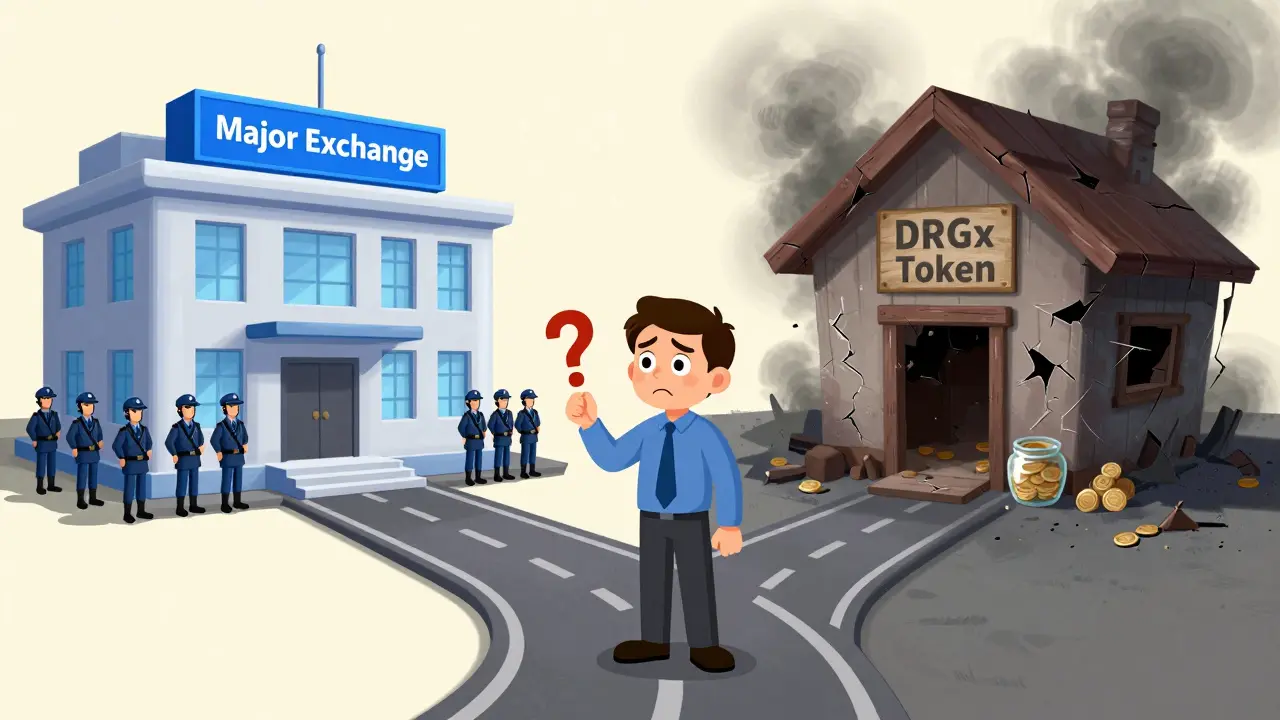
Have you heard about DRGx, the supposed new cryptocurrency exchange? If you are looking for a platform to trade Bitcoin, Ethereum, or even stablecoins like USDT, you might be in for a confusing ride. The short answer is that DRGx isn't really an exchange in the way you think. There is a major mix-up happening here between a digital asset called DRGX token and the idea of it being a trading venue itself.
As of mid-2026, there is no significant evidence that DRGx operates as a standalone, reputable centralized exchange (CEX) comparable to giants like Coinbase or Kraken. Instead, what you are likely seeing online is information about the DRGX token, which is traded on other platforms. This distinction is critical because treating a low-volume token project as a full-service exchange can lead to serious financial losses due to lack of liquidity and potential security gaps.
The Core Confusion: Token vs. Platform
To understand why you won't find a standard "sign up" page with robust features for DRGx, we need to separate two concepts. First, there is the DRGX token. This is a specific cryptocurrency asset. Second, there is the concept of an cryptocurrency exchange, which is a marketplace where you buy and sell these assets.
In many cases, small projects launch a token and create a website that looks like an exchange, but they don't have the infrastructure to handle large volumes of trades securely. The available data suggests DRGX is primarily recognized as a tradeable asset rather than an exchange infrastructure provider. You cannot "use" DRGx to trade other coins; instead, you trade the DRGX coin itself on other platforms. This is a common trap for beginners who see a familiar name and assume it offers a wide range of services.
Where Is DRGX Actually Traded?
If you want to buy or sell DRGX, you have to go to third-party exchanges. The most prominent platform currently listing the DRGX/USDT trading pair is Nonkyc.io. This name gives you a huge clue about the nature of the platform. "No KYC" stands for "Know Your Customer," meaning these platforms often skip identity verification.
While skipping ID checks sounds appealing for privacy, it comes with massive risks. These platforms are less regulated, meaning if something goes wrong, you have little to no recourse. Furthermore, Nonkyc.io is not a tier-one exchange. It lacks the deep liquidity and security audits found on major venues. For context, the 24-hour trading volume for DRGX on this platform was reported at a mere $72.64 USD in recent data, though some aggregators like CoinPaprika show slightly higher figures around $1,296 USD. Either way, these numbers are microscopic compared to established exchanges.
Liquidity Crisis: Why You Can't Trade Big
One of the biggest red flags in any crypto review is liquidity. Liquidity refers to how easily you can buy or sell an asset without causing its price to change drastically. For DRGX, the situation is precarious. Data indicates that the order book depth is incredibly thin. We are talking about only $3 available at +2% price impact and $3 at -2%.
What does this mean for you? If you try to buy $50 worth of DRGX, you might push the price up by 5% or more just because there aren't enough sellers at the current price. This is called slippage. In a healthy market, buying $50 wouldn't move the needle. Here, it would. This makes DRGX unsuitable for anyone trying to invest meaningful amounts of money. It is effectively a niche asset for micro-traders who are willing to accept high costs and volatility.
| Feature | DRGX (on Nonkyc.io) | Major Exchange (e.g., Binance/Kraken) |
|---|---|---|
| 24-Hour Volume | $72 - $1,300 USD | $Billions USD |
| Order Book Depth | Extremely Thin ($3 at ±2%) | Deep (Millions at ±0.1%) |
| KYC Requirements | Often None (High Risk) | Mandatory (Regulated) |
| Slippage Risk | Very High | Negligible |
| Security Audits | Unverified/Limited | Regular Third-Party Audits |
Price Performance and Market Sentiment
Let's look at the numbers. As of the latest data, DRGX is trading at approximately $0.049617 USD per unit. The fully diluted valuation (FDV) is listed as BTC1.2148, with a maximum supply of 21 million tokens. While the supply cap mimics Bitcoin's structure, the performance tells a different story.
Over a recent 7-day period, DRGX declined by 3.20%, while the broader cryptocurrency market advanced by 4.40%. This underperformance is a warning sign. When the general market is rising, strong assets usually rise with it. Assets that fall during bull runs often indicate weak demand or active selling pressure from early investors. The spread on the DRGX/USDT pair is 0.87%, which is quite wide. A tight spread is usually below 0.1% on major pairs. A wider spread means you lose more value immediately upon entering a trade.
Security Concerns and Lack of Transparency
When reviewing any crypto entity, transparency is king. Who is behind DRGx? What is their track record? Unfortunately, historical information about the DRGX token launch date, development team, or project fundamentals is scarce. There are no comprehensive expert reviews or technical analyses available in mainstream industry resources.
This opacity is dangerous. In the crypto world, anonymity used to be cool; now, it's a liability. Without knowing who controls the smart contracts or the exchange backend, you are trusting strangers with your funds. Established exchanges publish proof-of-reserves and undergo regular security audits. There is no indication that DRGx or its primary trading venue, Nonkyc.io, provides such guarantees. If the platform shuts down or gets hacked, your funds could vanish instantly.
Better Alternatives for Crypto Trading
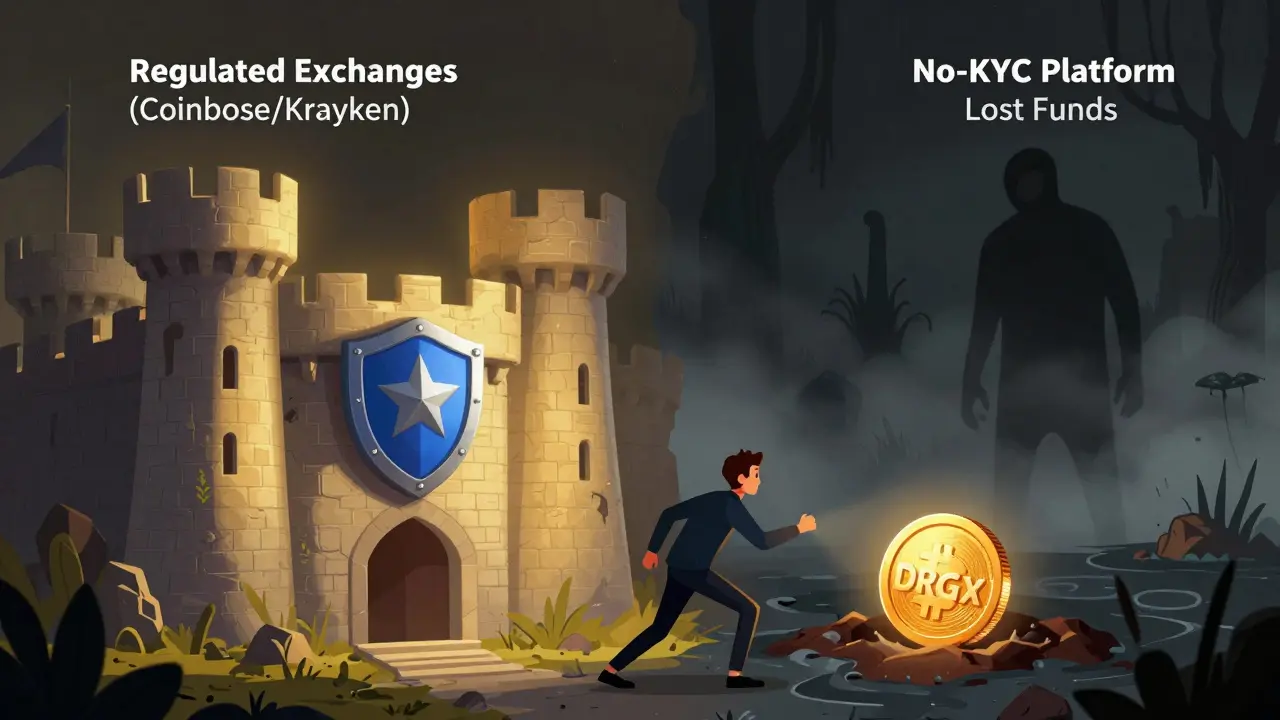
If your goal is to trade cryptocurrencies safely and efficiently, sticking to unknown, low-liquidity tokens on unregulated platforms is risky. Consider these alternatives based on your needs:
- For Beginners: Use Coinbase or Kraken. They are regulated, user-friendly, and offer strong customer support. You will have to complete KYC, but your money is safer.
- For Advanced Traders: Platforms like Binance or MEXC offer deep liquidity and a wide variety of altcoins. MEXC, in particular, lists many smaller tokens, so if you absolutely must trade obscure assets, you'll find better conditions there than on Nonkyc.io.
- For Privacy Seekers: Even if you dislike KYC, using decentralized exchanges (DEXs) like Uniswap is often safer than shady centralized "no-KYC" sites. DEXs run on blockchain protocols, meaning you retain control of your keys until the moment of swap.
Conclusion: Proceed With Extreme Caution
Is DRGx a scam? Not necessarily in the traditional sense of stealing money directly, but it operates in a gray area that favors insiders over retail users. The combination of tiny trading volume, wide spreads, and lack of regulatory oversight makes it a poor choice for investment. The confusion between the token and an exchange platform further complicates things, leading users into traps where they cannot exit positions easily.
If you are curious about DRGX, treat it as a high-risk speculative experiment with money you can afford to lose entirely. Do not use it as a primary wallet or trading hub. Stick to verified, liquid markets for the bulk of your portfolio. In crypto, liquidity is life. Without it, your paper gains are just numbers on a screen you can't cash out.
Is DRGx a legitimate cryptocurrency exchange?
No, DRGx is not widely recognized as a legitimate, full-service cryptocurrency exchange. It is primarily known as a token (DRGX) that is traded on other platforms, such as Nonkyc.io. There is no evidence of it operating as a major exchange infrastructure provider with standard security and regulatory compliance.
Where can I buy DRGX token?
The DRGX token is primarily traded on Nonkyc.io against USDT. However, be aware that this platform has very low liquidity and may not require identity verification, which increases risk. Always check current listings on aggregator sites like CoinPaprika before attempting to trade.
Why is the trading volume for DRGX so low?
Low trading volume, reported between $72 and $1,300 daily, indicates limited interest and participation from traders. This can result from the token's niche appeal, lack of marketing, or poor performance compared to broader market trends. Low volume leads to high slippage and difficulty executing larger orders.
What are the risks of trading on No-KYC exchanges?
Trading on No-KYC exchanges carries significant risks, including lack of regulatory protection, higher chances of fraud or hacking, and limited recourse if funds are lost. These platforms often have weaker security measures and may disappear overnight, leaving users with no way to recover their assets.
How does DRGX compare to Bitcoin in terms of stability?
DRGX is far less stable than Bitcoin. While Bitcoin has deep liquidity and widespread adoption, DRGX suffers from thin order books and high volatility. Recent data shows DRGX declining while the broader market rose, highlighting its instability and susceptibility to sharp price swings.

Comments
Alicia Hull
I have been looking into this DRGx thing for a while and the confusion is absolutely maddening. It is not just a simple mix-up between a token and an exchange platform, it feels like a deliberate obfuscation tactic designed to trap inexperienced retail investors. The article correctly points out that there is no robust infrastructure here, but I think we need to dig deeper into why these projects persist in this gray area. Are they relying on the sheer volume of confused users to maintain some semblance of liquidity? The lack of KYC on Nonkyc.io is not just a privacy feature, it is a massive red flag that screams regulatory evasion. I demand more transparency from these entities because the current state of affairs is unacceptable for anyone trying to build a legitimate portfolio. We cannot continue to treat these low-volume tokens as viable investment vehicles without serious consequences.
Johan Otto
Oh please. You people are so scared of a little risk. 😂
Anuj Kashyap
The irony is palpable when one considers that the very concept of 'liquidity' is often misunderstood by those who chase high returns with low effort 🤔. DRGX is not merely a token; it is a mirror reflecting the collective anxiety of the market. To say it is unsafe is to ignore the philosophical underpinning of decentralized trust. However, I must concede that trading $50 worth of DRGX and moving the price by 5% is less of a financial strategy and more of a performance art piece 🎭. The thin order book is not a bug, it is a feature of a niche ecosystem that rejects the mainstream narrative. Yet, for the average user, this is simply a recipe for disaster. One must ask: what is the value of an asset that cannot be exited without significant slippage? It is a question that haunts the soul of every trader who has ever bought the top 📉.
Tracy Marshall
its all part of the grand scheme to keep us poor and distracted while the elites move their money offshore ( ͡° ͜ʖ ͡°) they want you to think its about safety but its really about control. nonkyc is just a front for money laundering operations that go unchecked by the feds. i see the truth behind the curtain and its ugly. dont let them fool you with their fancy charts and volume numbers. its a trap set by the globalist agenda to harvest your data and your funds. stay woke and stay away from these digital snake oils.
Guy Davis
Typical crypto scam vibes. No real team, no audits, just hype. Stay away.
KEITH WONG
Listen up folks 👂 most of you are total noobs if you are even considering this trash. DRGx is a joke and anyone who trades it is donating to the insiders. The volume is literally zero which means you cant sell unless you want to lose half your stack. Stick to BTC or ETH if you have any brains. This stuff is for degenerates who want to gamble their rent money. Do better 🚫📉
Curtis Johnson
I understand the frustration everyone is feeling here but lets try to approach this with a bit of perspective. Its true that DRGx has serious issues with liquidity and transparency but maybe we can learn from this experience instead of just panicking. The key takeaway is to always do your own research and verify the sources before putting any money down. We should support each other in making smarter choices rather than attacking those who might have made a mistake. Lets focus on building a community that values education and caution over fear and anger. Together we can navigate this complex landscape safely 🙏✨
Hamza k
The sheer audacity of calling this a 'platform' is breathtakingly absurd! It’s like calling a puddle an ocean. 🌊 The liquidity crisis isn’t just a problem; it’s a catastrophe waiting to happen for anyone who doesn’t read the fine print. These guys are playing Russian Roulette with your savings and laughing all the way to the bank. Don’t be the fool who thinks you’ve found the next big thing when it’s clearly the last place you should put your money. Run, don’t walk, away from this digital dumpster fire! 🔥💸
John Harman
Let me break it down for you since apparently basic economics is too hard. Liquidity matters. If you can't sell your asset without crashing the price, it's worthless. DRGx has $3 depth at 2% impact. That's not a market, that's a parking lot. Anyone buying this is either stupid or being paid to shill. Stop falling for these rug pull setups.
Antony Lopez
This is exactly why foreign regulations are needed. American exchanges follow strict rules to protect citizens. These offshore no-KYC sites are havens for criminals and scammers who prey on our naive population. We need to shut down access to platforms like Nonkyc.io immediately. It’s a national security risk allowing these unregulated entities to operate within our borders. Patriotism means protecting our financial system from these threats. 🇺🇸
Kat Barr
Hey everyone!! I know this post is super scary but remember that mistakes happen to the best of us!!! 💖 Just take a deep breath and focus on learning from this experience. There are so many amazing safe options out there like Coinbase and Kraken that will keep your money secure!!! Let’s spread some positivity and help each other avoid these traps in the future!!! You got this!!! ✨🌈🙌
Logan Edmison
the nature of reality is fluid much like the price of drgx. perhaps the lack of liquidity is a metaphor for the emptiness of material wealth. we seek solidity in a world of chaos but find only slippage. interesting how the mind grasps for control in markets that defy logic. maybe we are all just tokens waiting to be traded. deep thoughts huh?
Michelle Walker
Pathetic. Another day another scam alert ignored by the masses. Wake up sheeple. Your ignorance is killing your portfolio.
Shay Thomson
Wow, the tension in this thread is almost palpable! It’s clear that emotions are running high regarding the DRGx situation. But let’s step back and breathe. We are all here to learn and grow together. Instead of pointing fingers, let’s share resources on how to identify safe exchanges. Imagine a community where we uplift each other rather than tear each other down. That is the power of unity! 🌟🤝
DJ Maleko
Look, I get that you’re worried about your money, but honestly, if you’re trading on Nonkyc.io, you probably deserve whatever happens. 🤷♂️ It’s not rocket science to check if an exchange is legit. Why are people so eager to hand over their cash to anonymous operators? It’s almost like you’re begging to be scammed. Maybe spend less time complaining here and more time reading whitepapers. Or don’t, and watch your funds vanish. Your choice. 😒📉
Erika Pozzetto
In light of the aforementioned discrepancies regarding the operational status of the entity referred to as DRGx it becomes increasingly evident that the distinction between a tradable asset and a functional exchange platform is of paramount importance to the integrity of the financial ecosystem in which we currently reside and participate on a daily basis thereby necessitating a thorough examination of the underlying mechanisms that govern such transactions and the potential risks associated therewith which include but are not limited to liquidity constraints regulatory ambiguities and security vulnerabilities that may compromise the assets of unsuspecting participants who engage in said activities without adequate due diligence or understanding of the complex interplay between market dynamics and technological infrastructure thus underscoring the critical need for enhanced educational initiatives and transparent reporting standards across the industry at large.
Russ Fincham
The data presented here is quite compelling and highlights the severe deficiencies in the DRGx project. From a formal analytical standpoint, the lack of verifiable proof-of-reserves and the absence of third-party security audits constitute fundamental breaches of standard operational protocols expected in reputable financial institutions. Furthermore, the extreme slippage rates observed in the order book indicate a market structure that is inherently unstable and unsuitable for institutional or even serious retail participation. It is imperative that investors recognize these red flags and adjust their strategies accordingly to mitigate exposure to such high-risk assets.
Linda Hilliard
One must possess a certain level of sophistication to appreciate the nuances of market microstructure, which clearly eludes the majority of commenters here. The DRGX token exemplifies the quintessential 'zombie asset'-a hollow shell devoid of fundamental value, sustained only by the delusions of its holders. The notion that one could derive any meaningful utility from such an instrument is laughable to those versed in quantitative analysis. It is a testament to the degradation of financial literacy when individuals conflate speculative gambling with strategic investing. Avoid this dross at all costs. 🙄📉
Winston Lacewing
Can we talk about how messed up this whole situation is?! 😡 It’s not just about losing money, it’s about the betrayal of trust! These developers knew exactly what they were doing, creating a fake sense of legitimacy to suck in vulnerable people. And now they’re sitting on their hands while regular folks get crushed. It makes my blood boil! We need to hold them accountable, not just shrug it off as 'market risk.' This is predatory behavior plain and simple! 😤💔🔥