

Imagine finding a new coin that promises to change how you trade. You dig into the specs, see it runs on Binance Smart Chain, a popular network for fast transactions, and think, "This could be it." But when you check the trading volume, there's nothing. No user reviews. No recent code updates. That is exactly where SoupSwap stands today.
If you are looking at SoupSwap as a place to park your savings or execute daily trades, you need to know what is actually happening under the hood. This platform launched in 2021 and claims to be a multi-ecosystem decentralized finance hub. However, by mid-2026, its activity levels have dropped to near zero. Before you connect your wallet, let's look at the hard data so you can decide if this project is worth your time or just another digital ghost town.
The Core Promise: Multi-Bonded Proof of Stake
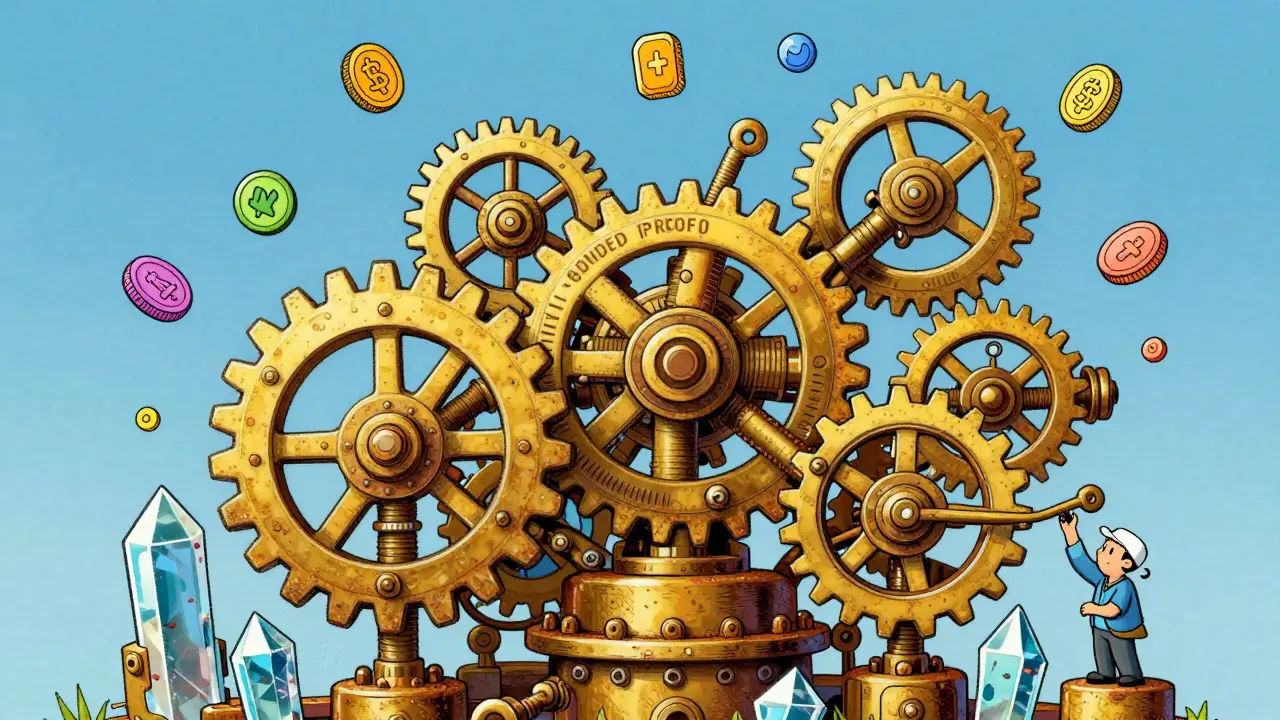
SoupSwap differentiates itself with a consensus mechanism called Multi-Bonded Proof of Stake (MBPoS). In simple terms, standard Proof of Stake locks your assets in one specific type to secure the network. MBPoS claims to remove these restrictions, allowing staked assets to retain value across different digital asset types without being locked into a single utility.
The theory sounds appealing for diversification. You stake your tokens, but they aren't "dead" money restricted to one function. The platform argues this saves time and costs while boosting security. However, innovation means little if no one is using it. As of late 2025, SoupSwap held an "Untracked Listing" status on CoinMarketCap. This label isn't just a technicality; it means the platform didn't generate enough consistent trading volume for major trackers to monitor it reliably. For context, top-tier protocols like Uniswap process hundreds of billions of dollars quarterly. SoupSwap sits far below that threshold, suggesting its unique tech hasn't attracted significant liquidity yet.
Liquidity and Market Presence
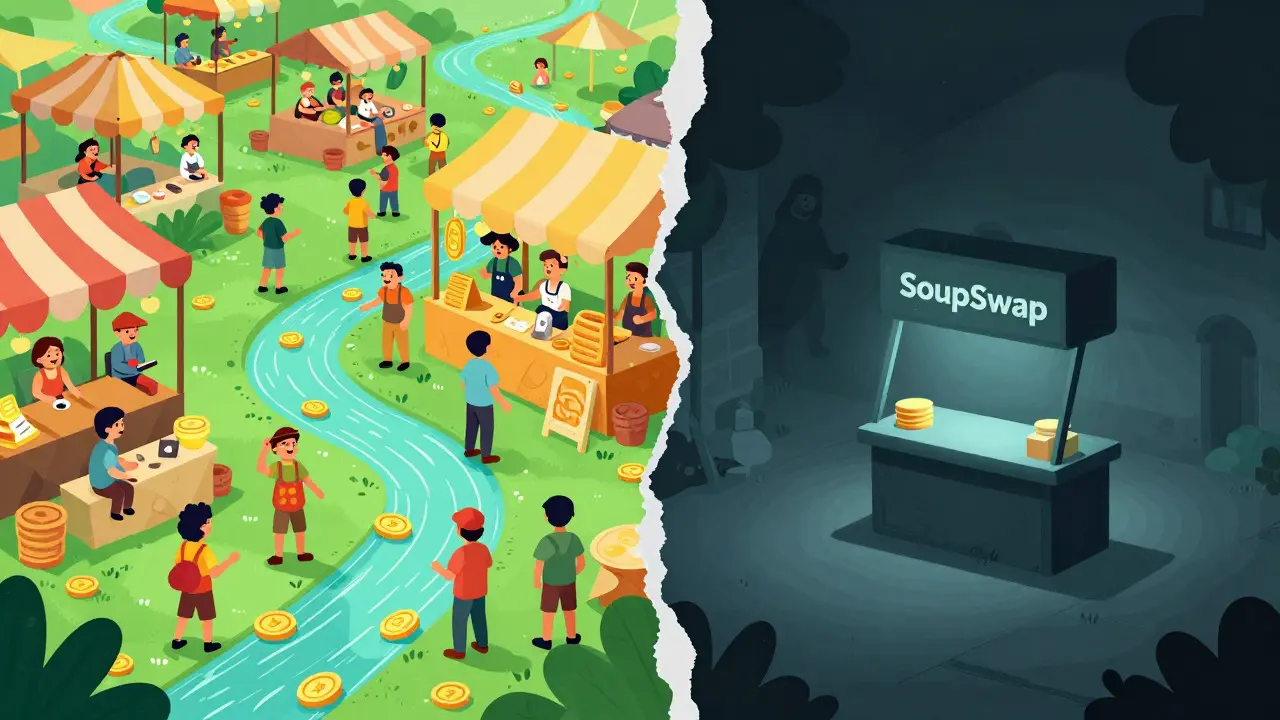
In decentralized exchanges, liquidity is king. If you can't swap your tokens quickly without massive price slippage, the exchange is practically useless. SoupSwap operates exclusively on BSC, which offers low fees and high speed. But speed doesn't matter if there are no buyers or sellers in the pool.
Current data shows SoupSwap has negligible market share, estimated at less than 0.01% of the DeFi sector. Compare this to giants:
| Protocol | Quarterly Volume | Market Status | Audit Status |
|---|---|---|---|
| Uniswap | $324.7 Billion | Top Tier / Tracked | Multiple Audits |
| PancakeSwap | $189.3 Billion | Top Tier / Tracked | CertiK Verified |
| SoupSwap | Untracked / Negligible | Marginal / Untracked | No Public Reports |
The absence of verifiable liquidity pools is a red flag. When you try to swap a large amount of tokens on a thin pool, the price impact can be severe. On established platforms, you might lose 0.1% to slippage. On a dormant platform like SoupSwap, that number could skyrocket, eating into your profits or turning a profitable trade into a loss.
Security and Audit Concerns
Security is the biggest worry for any DeFi user. In 2025, Immunefi, a leading bug bounty platform, reported that 78% of exploited DeFi protocols lacked proper audit coverage. SoupSwap fits this risk profile perfectly. There are no public records of audits from major firms like CertiK or Hacken.
Why does this matter? An audit checks smart contracts for bugs that hackers can exploit. Without one, you are trusting the code blindly. Given that SoupSwap shows no recent commits on GitHub and no active developer presence, the risk of unpatched vulnerabilities grows over time. If a bug exists in their MBPoS logic, it could remain hidden until someone exploits it, potentially draining the entire liquidity pool.
User Experience and Community Support
Let's talk about the human side. How is the interface? Does support answer emails? For SoupSwap, the answers are mostly silence. As of November 2025, there were zero active discussion threads on major forums like Bitcointalk or Reddit. No user reviews appeared on Trustpilot or CryptoSlate. The official Twitter/X account showed no verifiable activity, and GitHub repositories demonstrated no recent code changes.
This lack of community engagement contrasts sharply with competitors. Uniswap has over 427,000 Twitter followers and thousands of GitHub stars. Even smaller, niche projects maintain active Discord channels and Telegram groups. SoupSwap appears to have no dedicated community hub. If you run into a technical issue-say, a failed transaction or a stuck token-you likely won't find help from a support team or a helpful community member. You would be on your own.
Regulatory and Viability Risks
The regulatory landscape for BSC-based platforms tightened in 2025. The SEC's "Project Nagano" targeted 17 DeFi protocols for unregistered securities offerings. While SoupSwap hasn't been specifically named in those filings, operating in a gray area without clear legal structure adds another layer of risk. Institutional investors avoid such platforms entirely. Gauntlet Network’s dashboard shows zero institutional usage for SoupSwap, compared to 1,247 institutional users for Aave.
Viability is also a concern. A Messari report from late 2025 indicated that 83% of DeFi protocols with no trading volume for 180+ days become fully inactive. SoupSwap has been in this low-volume state for months. Industry standards suggest a protocol needs at least $500,000 in daily trading volume to sustain operations. SoupSwap demonstrably fails to meet this threshold. Without fresh capital inflow, development teams often disband, leaving users stranded.
Alternatives to Consider
If you want to swap tokens on BSC or explore DeFi staking, there are safer, more liquid options. Here is why you might want to look elsewhere:
- PancakeSwap: Native to BSC, highly liquid, audited, and supports a vast range of tokens. It is the go-to for most BSC traders.
- Uniswap: The leader in Ethereum-based DeFi, with massive liquidity and a proven track record. While fees can be higher, the security is robust.
- SimpleSwap: If you prefer fiat on-ramps and simplicity, SimpleSwap supports over 1,500 cryptocurrencies with a user-friendly interface.
- GhostSwap: Offers cross-chain swaps without KYC requirements, providing flexibility for privacy-focused users.
These platforms offer what SoupSwap lacks: verified liquidity, active communities, and third-party security checks. They provide a smoother experience whether you are a beginner or a pro.
Frequently Asked Questions
Is SoupSwap safe to use in 2026?
Safety is questionable due to the lack of third-party audits and minimal trading volume. While it operates on the secure Binance Smart Chain infrastructure, the specific smart contracts for SoupSwap have not been widely verified by major security firms like CertiK. Users should exercise extreme caution and only invest amounts they can afford to lose.
What is the Multi-Bonded Proof of Stake (MBPoS) mechanism?
MBPoS is SoupSwap's proprietary consensus method. It claims to allow staked assets to maintain value across different digital asset types without strict locking restrictions. Unlike standard Proof of Stake, which ties assets to specific network functions, MBPoS aims for greater flexibility, though its real-world efficiency is unproven due to low adoption.
Why is SoupSwap listed as 'Untracked' on CoinMarketCap?
The 'Untracked' status indicates that the platform's trading volume is too low or inconsistent for CoinMarketCap to include in its standard ranking metrics. This usually signals marginal market presence and suggests that very few users are actively swapping tokens on the platform.
Does SoupSwap require KYC (Know Your Customer)?
As a decentralized exchange (DEX), SoupSwap typically does not require traditional KYC for basic swaps. However, because documentation is scarce, users should verify current requirements directly on the platform. Most DEXs rely on wallet connections rather than identity verification, preserving user anonymity.
Are there better alternatives for BSC swaps?
Yes. PancakeSwap is the primary alternative for Binance Smart Chain users, offering significantly higher liquidity, lower slippage, and regular security audits. For Ethereum-based swaps, Uniswap remains the industry standard. These platforms have active communities and transparent governance structures.

Write a comment