

Imagine trying to verify a library's contents without reading every single book. That is exactly the problem Data Availability Layers are designed to solve. In the early days of blockchain, networks like Bitcoin and Ethereum handled everything themselves-execution, consensus, and storage. This monolithic approach worked fine when transaction volumes were low. But as demand skyrocketed, these networks hit a wall. They became slow, expensive, and prone to congestion. The solution wasn't just making the existing blocks bigger; it was separating concerns. Enter the modular blockchain architecture, where different tasks are handed off to specialized layers. Among these, the Data Availability Layer (DAL) has emerged as the critical backbone for scaling.
A data availability layer is a dedicated subsystem responsible for storing transaction data and ensuring that this data is publicly accessible for verification. Unlike traditional blockchains where full nodes must download and process every transaction to ensure security, a DAL allows light clients to verify that data exists without downloading the entire dataset. This separation enables execution layers, such as rollups, to process transactions at high speeds while relying on the DAL for secure, verifiable data storage. The concept gained traction around 2021, with Celestia launching its testnet as the first dedicated DAL, followed by Ethereum’s shift toward a rollup-centric roadmap.
The Core Problem: Why We Need Dedicated Data Layers
To understand why DALs matter, you have to look at the "data availability problem." In a trustless system, anyone should be able to join the network and verify its state. Historically, this meant running a full node, which required downloading every block ever created. As block sizes grew, this became impractical for most users. If data is not available, malicious actors could hide fraudulent transactions or censor activity, undermining the network's integrity.
In monolithic blockchains, increasing block size to handle more transactions forces nodes to store more data. This creates a bottleneck. You can either scale throughput and sacrifice decentralization (by requiring powerful hardware) or keep decentralization and accept low throughput. DALs break this trade-off. By offloading data storage to a specialized layer, execution environments can scale independently. For example, Ethereum's current approach limits throughput to roughly 15-45 transactions per second due to gas constraints and storage requirements. A dedicated DAL removes this constraint, allowing for theoretical throughputs of over 100,000 transactions per second.
How Data Availability Layers Work: The Technical Mechanics
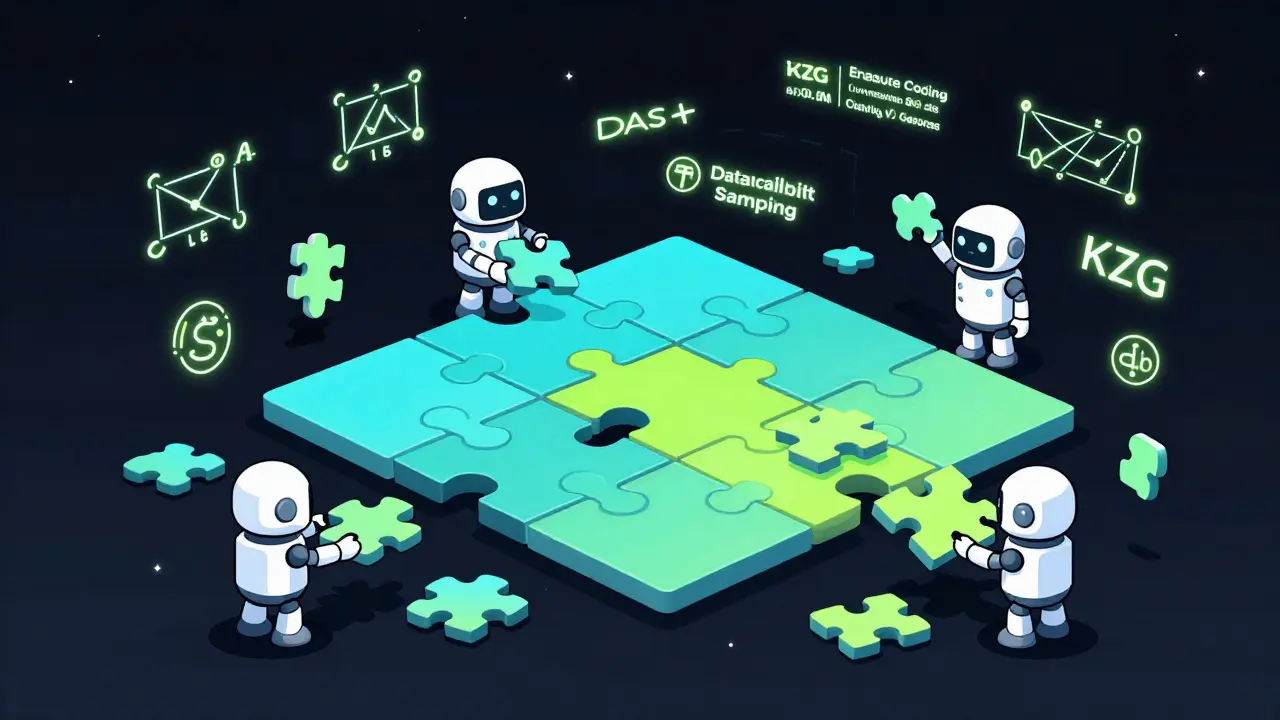
DALs rely on three core cryptographic mechanisms to function efficiently: erasure coding, KZG polynomial commitments, and data availability sampling. These technologies work together to ensure data is stored securely and can be verified quickly.
- Erasure Coding: This technique expands the original data to allow recovery from partial information. For instance, Celestia uses Reed-Solomon coding to double the size of the data. If you lose half of the encoded fragments, you can still reconstruct the original data. This ensures that even if some nodes go offline or act maliciously, the data remains intact.
- KZG Polynomial Commitments: Developed by researchers including Vitalik Buterin and Dankrad Feist, these commitments provide succinct proofs about data properties. Instead of verifying the entire dataset, a user can check a small mathematical proof that confirms the data matches what was published. This drastically reduces computational overhead.
- Data Availability Sampling (DAS): Formalized by Mustafa Al-Bassam, DAS allows light clients to verify data availability by randomly sampling a small subset of data fragments. With just 30-40 samples, a client can achieve 99.9% confidence that the data is available without downloading the whole block. This is the key innovation that makes large-scale decentralized verification possible.
These mechanisms transform how we think about node participation. You no longer need terabytes of storage to participate meaningfully in network security. Light nodes can operate on standard hardware, broadening the base of validators and enhancing decentralization.
On-Chain vs. Off-Chain DAL Approaches
Not all data availability solutions are built the same. The market is currently divided between on-chain approaches, where data is stored on the main blockchain, and off-chain dedicated layers. Each has distinct trade-offs regarding cost, throughput, and security assumptions.
| Feature | On-Chain (e.g., Ethereum Pre-Danksharding) | Off-Chain Dedicated (e.g., Celestia, EigenDA) |
|---|---|---|
| Throughput | Low (15-45 TPS) | High (100,000+ TPS potential) |
| Cost per Transaction | High ($1.23 avg. in late 2023) | Low ($0.0001 estimated) |
| Node Storage Requirement | High (>1 TB) | Low (1-2 GB for light nodes) |
| Security Model | Economic Security (Slashing) | Cryptographic Security + Economic Incentives |
| Ecosystem Maturity | Very High | Growing (Celestia ~15 active rollups in 2023) |
Ethereum’s transition with proto-danksharding (EIP-4844) represents a hybrid step. It introduces "blobs" of data that are cheaper to post than calldata, reducing rollup costs by approximately 90%. However, it still relies on Ethereum’s base layer for availability. Dedicated off-chain solutions like EigenDA leverage restaking via EigenLayer to provide higher throughput at lower costs, though they introduce new trust assumptions regarding the committee operators.
Key Players in the DAL Ecosystem
Several projects are leading the charge in building robust data availability infrastructure. Understanding their differences helps developers choose the right stack for their applications.
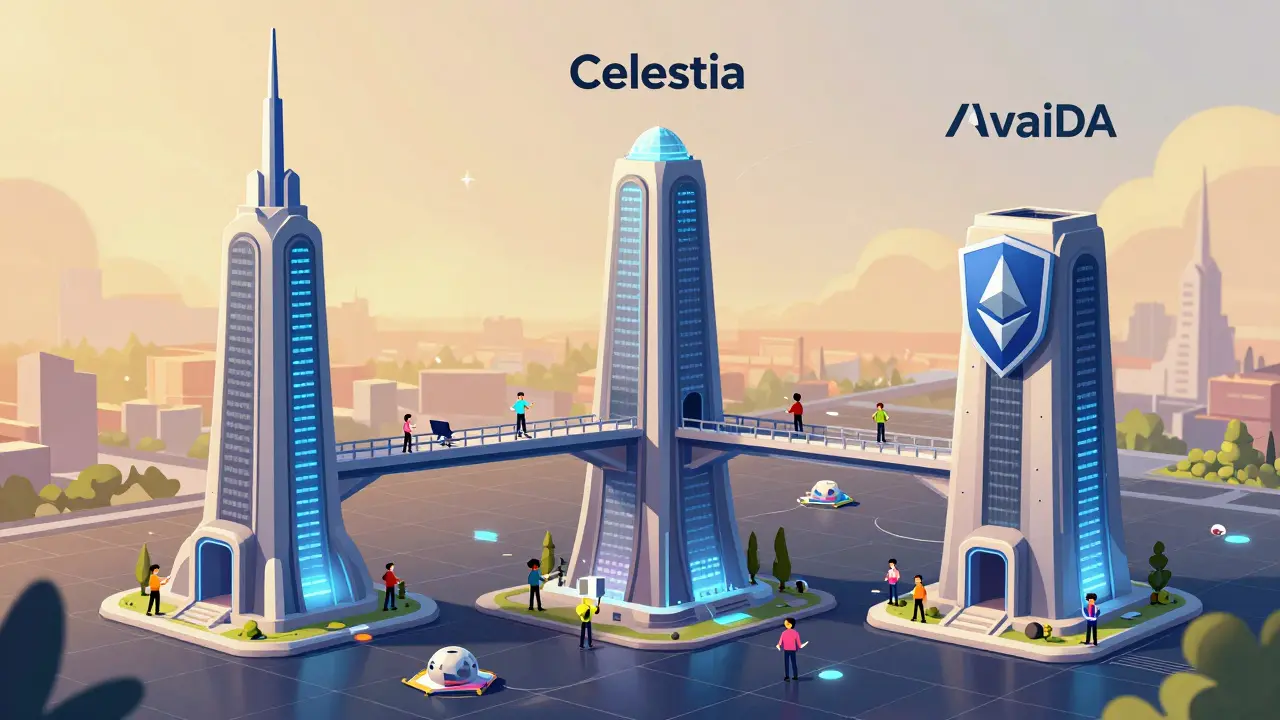
Celestia is often cited as the pioneer of dedicated DALs. Its architecture focuses purely on data availability, avoiding execution logic entirely. This specialization allows it to achieve high throughput with minimal resource usage. As of Q3 2023, Celestia processed approximately 1.25 MB per block with finality times of 10-15 seconds. Its Cosmos SDK-based design offers flexibility but requires developers to adapt to non-EVM environments.
Avail takes a multi-layered approach, combining data availability with cross-chain interoperability (Nexus layer) and multi-token security (Fusion layer). This makes it attractive for enterprises looking for broader connectivity options. Polygon’s announcement of an Avail-based solution for enterprise clients highlights its growing appeal in institutional settings.
EigenDA stands out for its integration with Ethereum’s staking ecosystem. By using restaked ETH as collateral, it aims to provide economic security comparable to Ethereum itself. Testnet benchmarks showed impressive performance, handling 100,000 transactions per second. However, its reliance on committees means users must trust that enough honest operators are online to prevent data withholding attacks.
Implementation Challenges for Developers
Building on a modular architecture introduces new complexities. While the benefits of scalability are clear, the learning curve is steep. Developers typically spend 3-4 weeks mastering data availability concepts before feeling comfortable integrating them into production systems.
One major hurdle is tooling maturity. According to a Blockworks survey of 150 developers, 52% cited lack of mature tooling as a significant barrier. Celestia’s GitHub repository shows numerous open issues related to DAS implementation complexity. Similarly, Ethereum’s danksharding efforts face challenges with KZG commitment integration. For teams used to Solidity and EVM tools, moving to Cosmos SDK or custom RPC endpoints requires significant retraining.
Another challenge is interoperability. Moving data between different DALs or from a DAL to an execution layer isn't seamless. The Interchain Foundation’s $5 million research initiative aims to address these gaps, but standardized protocols are still evolving. Developers must carefully consider dispute resolution mechanisms, especially when using Data Availability Committees (DACs), as seen in StarkEx implementations where increased complexity arises during fraud proofs.
Market Trends and Future Outlook
The momentum behind modular blockchains is undeniable. Messari’s September 2023 report projects the DAL market will grow from $1.2 billion in 2023 to $8.7 billion by 2027, a compound annual growth rate of 49%. Investment flows reflect this optimism, with Coinbase investing $50 million in Celestia and Binance Labs launching a $100 million fund for modular infrastructure.
Regulatory frameworks are also catching up. The European Union’s MiCA regulation, effective December 2024, mandates verifiable data availability for transaction records. This requirement likely accelerates adoption among compliant entities seeking transparent audit trails. Gartner predicts that by 2026, 70% of new blockchain applications will utilize modular architectures with dedicated DALs, up from just 15% in 2023.
As the ecosystem matures, we expect greater specialization. Projects like Celestia plan upgrades such as "Arbital" to add validity proofs, further blurring the lines between availability and execution. Meanwhile, Ethereum’s continued refinement of sharding promises to make its native DAL more competitive. The future belongs to those who can balance scalability, security, and usability effectively.
What is a Data Availability Layer?
A Data Availability Layer (DAL) is a specialized subsystem in modular blockchain architecture that stores transaction data and provides cryptographic guarantees that this data is publicly accessible. It separates data storage from execution, allowing networks to scale without forcing every node to process all transactions.
Why do we need Data Availability Layers?
We need DALs to solve the scalability trilemma. Monolithic blockchains struggle to increase throughput because larger blocks require more storage and bandwidth for full nodes. DALs enable trustless scaling by allowing light clients to verify data availability through sampling, thus supporting high-throughput execution layers like rollups.
How does Data Availability Sampling work?
Data Availability Sampling (DAS) allows a verifier to confirm that data is available by randomly checking a small number of data fragments. Using erasure coding, the original data is expanded so that any subset of fragments can reconstruct the whole. With 30-40 samples, a client can achieve 99.9% confidence that the data is present without downloading the entire block.
What is the difference between Celestia and Ethereum's DAL?
Celestia is a dedicated, off-chain DAL focused solely on data availability, offering high throughput and low costs with lightweight nodes. Ethereum's approach is integrated; currently, it uses its main chain for data availability, limiting throughput. However, with proto-danksharding (EIP-4844), Ethereum introduces cheaper data blobs, moving toward a more modular model while maintaining economic security.
Are Data Availability Committees safe?
Data Availability Committees (DACs) offer high performance but introduce centralization risks. They rely on a smaller set of operators to store data. While economically secured through slashing conditions (as seen in EigenDA or StarkEx), they require trust that enough honest operators remain online. Dedicated decentralized DALs like Celestia offer stronger censorship resistance but may have higher latency.
Which DAL should I choose for my project?
Your choice depends on your needs. If you prioritize EVM compatibility and ecosystem maturity, Ethereum (especially post-EIP-4844) is ideal. For maximum throughput and lower costs with a willingness to learn new stacks, Celestia is a strong candidate. For enterprise-grade interoperability, consider Avail. Always evaluate tooling support and community resources before committing.

Comments
Tracy McBurney
Let's cut through the marketing fluff. This "modular" narrative is just a way to hide the fact that we are fragmenting security for the sake of cheap fees. The post mentions EigenDA and its reliance on committees. That is not decentralization, that is a trust assumption wrapped in crypto-bro jargon. You are trading censorship resistance for throughput. It's a bad trade. The data availability problem isn't solved by offloading it to a layer that relies on restaked ETH from a small set of operators. If those operators collude or go offline, your rollup is dead. Period. Don't let them sell you this as an upgrade.
Aaron Zeiler
look i get the skepticism but you gotta see the technical reality here. erasure coding is legit. if you lose half the data you can still reconstruct it. that is math not marketing. celestia uses reed-solomon which is standard stuff in storage systems for decades. the issue with monolithic chains is that full nodes need terabytes of storage. nobody wants to run a node on their laptop anymore. das allows light clients to check availability with like 30 samples. that is huge for decentralization because it lowers the barrier to entry for verification
Andrew Todd
typical american tech bro optimism. you think this will work because you read a whitepaper. meanwhile europe has mica coming in and they know better. these modular blockchains are a scam to keep us paying high fees while pretending to scale. ethereum is the only real chain everything else is garbage. stay away from celestia it is a trap.
Brendan Thraxton
hey andrew chill out man. look i know ethereum feels safe but the scalability trilemma is real. you cant have security decentralization and scalability all at once without making tradeoffs. danksharding is a step but dedicated dal layers offer more flexibility. if you want to build an app that handles 100k tps you cant do it on mainnet eth right now. its not about replacing eth its about giving developers options. maybe try looking at the benchmarks for eigen da again they show impressive numbers even if the trust model is different
Andrew Todd
benchmarks mean nothing if the underlying security is weak. you are trusting a committee. that is centralization. i prefer slow and secure over fast and broken. america loves speed but forgets safety. typical.
Gabrielle Danis
The distinction between on-chain and off-chain DALs is crucial for developers choosing a stack. Ethereum’s proto-danksharding reduces costs by approximately 90%, which is significant for rollups currently facing high gas fees. However, dedicated solutions like Celestia offer lower costs per transaction, estimated at $0.0001, compared to Ethereum’s average of $1.23 in late 2023. For enterprise applications requiring high throughput, the cost differential alone might justify the complexity of integrating with a non-EVM environment. The tooling maturity remains a hurdle, but the economic incentives are clear.
Sri Astuti
:( oh my god another article pretending to be smart about blockchain. you people talk about erasure coding like it is magic. it is just math. and then you say celestia is great but ignore that it has no execution logic so you have to build everything from scratch. why would anyone do that when polygon exists? and don't get me started on eigen da. restaking is just gambling with other people's money. the whole modular thing is a buzzword fest. i am tired of reading this nonsense every day. :(
Elle Kharitou
Hi everyone! 🌏 I find the concept of Data Availability Layers fascinating from a cultural perspective too. It reminds me of how libraries evolved. We used to need to own every book to verify knowledge existed. Now we have indexes and catalogs. Blockchain is doing the same. Celestia and Avail are trying to create a global catalog that anyone can access without downloading the entire library. It promotes inclusivity in tech because light nodes can run on simple devices. Let's embrace this evolution together! ✨📚 #ModularBlockchain #Inclusion
Noel Mandotah
Boring. Everyone knows what a DAL is. Stop writing guides for beginners who should just buy ETH.
Carli Bates
so basically we are outsourcing trust to mathematicians who probably drink too much coffee and wear hoodies. kzg commitments sound like something you'd find in a fantasy novel. polynomial proofs. sure jan. i guess we just hope the random sampling doesn't miss the part where the data is missing. 99.9% confidence sounds like a gamble to me. but hey free money right?
Barbara Jones
i think this is really helpful info thank you for sharing. i was confused about why we need separate layers for data. now i understand it helps with scaling. celestia seems interesting but i am worried about the learning curve. does anyone know if there are good tutorials for beginners? i want to learn more but im afraid of getting stuck. thanks!
Nitin Gupta
I appreciate the detailed breakdown of the technical mechanics. Erasure coding is indeed a powerful tool. In my experience working with distributed systems, Reed-Solomon codes provide robust fault tolerance. The challenge lies in the implementation complexity for developers unfamiliar with Cosmos SDK. I suggest starting with small test projects to familiarize yourself with the RPC endpoints before committing to production. Collaboration within the community can help bridge the tooling gap mentioned in the post.
edie rosa
This entire industry is built on sand. You talk about security models but ignore the human element. People lie. Operators collude. Restaking is just a pyramid scheme with extra steps. I refuse to engage with this toxic positivity. Your project will fail because you rely on trustless systems in a world that is inherently untrustworthy. Go touch grass.
Ipsita Seal
ugh another long article. nobody reads this. just tell me if i should buy celestia or not. i am tired of reading all these technical details about erasure coding and kzg. it gives me a headache. why can't things be simple? i just want to make money not learn cryptography. this post is useless to me.
Janis Naglis
!!! WOW !!! The potential for interoperability here is HUGE!!! Avail’s multi-layered approach is a game-changer for enterprises!!! We need to leverage Nexus layer for cross-chain connectivity!!! The Fusion layer provides multi-token security which is ESSENTIAL for institutional adoption!!! Polygon’s involvement signals MASSIVE growth!!! Let’s collaborate and build the future of modular blockchains TOGETHER!!! 🚀🚀🚀
Ryan Nakielny
lol look at janis going crazy with the exclamation marks. calm down. the post is fine but yeah the tooling is still rough. i tried building a rollup on celestia last month and spent more time debugging rpc errors than writing actual logic. its not ready for prime time yet. but the theory is sound. das is cool.
Janis Naglis
@ryan nakielny YES IT IS!!! The challenges are temporary!!! The innovation is PERMANENT!!! We must support early adopters!!! The community is GROWING!!! Let’s fix the tooling together!!! 💪💪💪
Wayne Gillis
Hey guys 👋 Just wanted to drop by and say nice post. I've been following Celestia since the testnet days. The team is solid. Also shoutout to EigenDA for pushing boundaries. Love seeing new players enter the space. Keep up the good work everyone! 🙌🔥
Livvy Cooper
this is all rubbish. modular blockchains are a solution looking for a problem. ethereum works fine. why complicate things? you are just adding more points of failure. i hate this trend. it makes everything worse. stop promoting this garbage.
Rain Richardsson
I hear your frustration Livvy. But consider the user experience. High fees on Ethereum exclude many users. Modular architectures aim to lower barriers. It is not about replacing Ethereum but expanding accessibility. Perhaps we can find common ground in supporting scalable solutions that benefit everyone.
Livvy Cooper
accessibility means nothing if the system is insecure. i stick to my guns. ethereum is the only way. everything else is noise.
Iestyn Lloyd
A balanced perspective is always valuable. The UK regulatory landscape is also evolving, with MiCA setting precedents for data verifiability. This aligns well with the goals of DALs. As developers, we must adapt to these standards. The shift towards modular architectures is inevitable due to both technological necessity and regulatory pressure. It is wise to prepare accordingly.
Jimmy vasquez
Hey folks! Great overview. I've been working with EIP-4844 implementations and the blob space savings are real. Rollup costs dropped significantly after the upgrade. It's a stepping stone, but definitely not the end state. Dedicated DALs like Celestia offer more headroom for now. Good luck to everyone experimenting with these stacks!
Kathleen Warren
Thank you for this clear explanation. I was struggling to understand the difference between execution and data availability. Now it makes sense. It is like separating the kitchen from the dining room. The kitchen cooks the food (execution) and the dining room serves it (data). This separation helps everything run smoother. I feel much more confident about exploring these technologies now. Thanks for helping me learn.
Michael Repak
This is an excellent summary!!! The comparison table is particularly useful!!! I agree that tooling maturity is a key challenge!!! Developers need better documentation!!! Let’s support each other in this journey!!! The future is modular!!! 🌟🌟🌟