

Since December 30, 2024, the EU’s Markets in Crypto-Assets (MiCA) regulation has completely changed how cryptocurrency businesses operate in Cyprus. No more patchwork rules. No more loopholes. If you’re running a crypto exchange, custody service, or token issuer in Cyprus, you now answer to one clear, strict, EU-wide standard - and it’s not optional. The old system is gone. The new one is here, and it’s forcing companies to either adapt or disappear.
What MiCA Actually Means for Cyprus Crypto Firms
MiCA isn’t just another rulebook. It’s a full overhaul. Before MiCA, Cyprus had its own rules for crypto firms - relaxed, flexible, and easy to navigate. But now, every crypto asset service provider (CASP) must get formal authorization from CySEC, the Cyprus Securities and Exchange Commission. And that authorization isn’t handed out lightly.To qualify, a company must be legally based in Cyprus, with a real office, real staff, and real decision-makers living on the island. At least half of the board must be independent directors - no rubber-stamping by offshore consultants. The firm must prove it has solid risk controls, clear governance, and real operational plans. And it must submit everything in writing: a full business plan, proof of capital, cybersecurity protocols, and even how it handles customer complaints.
Companies that were already operating under Cyprus’s old rules got a grace period. They have until July 1, 2026, to apply for full MiCA authorization. After that, any unlicensed operation is illegal. There’s no gray area. No extensions. No exceptions.
The Travel Rule Just Got Real
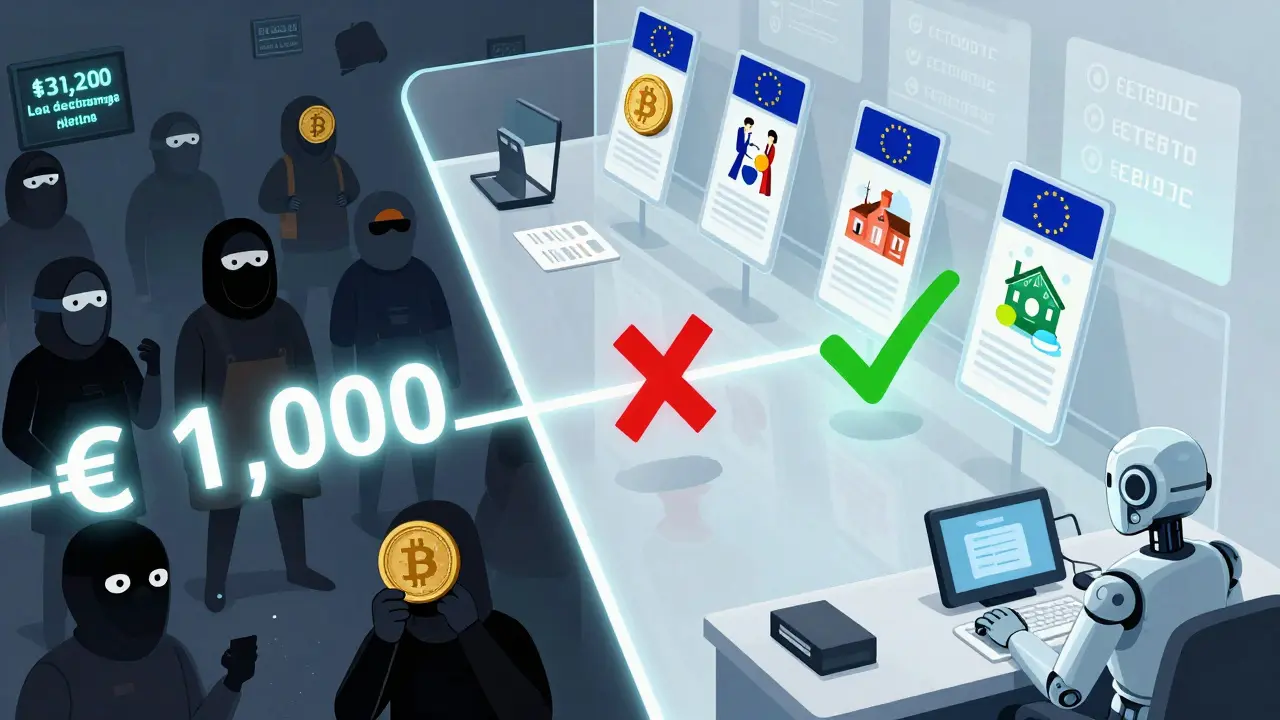
One of the most disruptive parts of MiCA is how it enforces the Transfer of Funds Regulation (TFR) - commonly called the "Travel Rule." This means every crypto transfer over €1,000 must carry identifying info about the sender and receiver. Not just wallet addresses. Real names, addresses, IDs. Even if the transaction goes to a self-hosted wallet, the CASP has to collect and verify that data.This isn’t theoretical. Cyprus-based firms had to upgrade their entire tech stack. Systems that once just tracked balances now need to capture, encrypt, and transmit personal data securely. Many small exchanges couldn’t afford the development costs. Some shut down. Others merged. Those that stayed are now running lean, compliant operations with automated AML software and trained compliance officers.
And it’s not just about transfers. MiCA classifies CASPs as "obliged entities" under EU anti-money laundering laws. That means they must do full customer due diligence - not just once, but continuously. If a client comes from a high-risk country, they get extra scrutiny. If a transaction looks odd, it gets flagged. And if they fail? Fines. Suspension. Revocation.
CySEC’s Innovation Hub: The Secret Weapon
Here’s where Cyprus stands out. While other EU countries are scared of crypto, Cyprus has built a bridge between regulation and innovation. CySEC’s Innovation Hub, running since 2018, is a live testing ground. Startups can apply to run their crypto product inside a controlled sandbox - real markets, real users, real regulators watching.It’s not a free pass. You still follow MiCA rules. But you get feedback, guidance, and time to fix flaws before going live. This has attracted serious players. One DeFi protocol testing in the sandbox reduced its smart contract risk by 70% before launch. Another tokenized fund used the sandbox to prove its valuation model worked under MiCA’s strict reporting rules.
The Central Bank of Cyprus even opened its own innovation unit. That’s huge. For years, the CBC stayed quiet on crypto. Now, it’s actively helping firms navigate MiCA. This isn’t just compliance - it’s collaboration.
Consolidation: The Big Players Win
MiCA’s costs are brutal for small operators. Licensing fees. Compliance staff. Tech upgrades. Cybersecurity audits. All add up. The average cost to get MiCA-compliant in Cyprus? Between €300,000 and €700,000. That’s not a startup budget. That’s corporate funding.The result? The market is shrinking - but getting stronger. In 2023, Cyprus had 87 registered crypto firms. By early 2025, that number dropped to 42. But the remaining firms? They’re bigger. Better funded. And 100% authorized.
Some of the biggest names in European crypto moved their EU headquarters to Cyprus because of this. They don’t want to deal with five different national regulators. They want one clear path. Cyprus gives them that. And with CySEC’s reputation for being thorough but fair, they trust it.
Tokenization Is the Next Big Thing
While others focus on trading, Cyprus is quietly building the future: tokenization. MiCA gives legal clarity to digital tokens representing real-world assets - shares, real estate, commodities, even art.One Cypriot fund administrator just launched a €50 million real estate fund where each unit is a token on a blockchain. Investors can buy fractions. Trade them on licensed platforms. Get dividends automatically. And because it’s MiCA-compliant, it’s legal across the entire EU.
This isn’t speculation. It’s happening. And Cyprus is leading the way. Asset managers, custodians, and even law firms are retooling to support tokenized products. The demand is real. The infrastructure is being built. And MiCA made it possible.

What’s Next? AEU-Wide Watchdog
By 2026, the EU’s Anti-Money Laundering Authority (AMLA) will start operating. It won’t replace CySEC. But it will oversee the highest-risk CASPs - the ones handling over €1 billion in assets annually. Cyprus’s top firms are already preparing. They know: if you’re big enough to catch AMLA’s eye, you’re big enough to be scrutinized.Meanwhile, the DLT Pilot Regime - a separate EU program for blockchain-based trading infrastructures - has barely taken off in Cyprus. Too complex. Too slow. Too expensive. But MiCA? It’s working. It’s being used. It’s changing the game.
Final Reality Check
MiCA didn’t make Cyprus crypto safer because it was nice. It did it because it had to. The EU needed a unified system. Cyprus, with its existing financial infrastructure and willingness to adapt, became the perfect testing ground.If you’re a crypto business in Cyprus today, you’re not just surviving MiCA - you’re being reshaped by it. The firms that made it through are leaner, more professional, and more credible. The ones that didn’t? They’re gone.
And for investors? That’s good news. No more fly-by-night exchanges. No more anonymous wallets. No more regulatory chaos. Just clear rules. Clear oversight. And real accountability.
Is MiCA mandatory for all crypto firms in Cyprus?
Yes. Since December 30, 2024, all crypto asset service providers (CASPs) operating in Cyprus must be authorized under MiCA. The old national registration system was shut down in October 2024. Firms that were previously registered under Cyprus’s old rules have until July 1, 2026, to apply for full authorization. After that date, any unlicensed operation is illegal.
What’s the difference between CySEC and the Central Bank of Cyprus under MiCA?
CySEC is the main regulator for Crypto-Asset Service Providers (CASPs), handling licensing, supervision, and enforcement for exchanges, custodians, and token issuers. The Central Bank of Cyprus (CBC) oversees Electronic Money Tokens (EMTs), which are a specific type of stablecoin pegged to fiat currency. While CySEC handles most crypto activities, the CBC steps in only when EMTs are involved - like those used for payments or remittances.
Do I need to be physically in Cyprus to get MiCA authorization?
Yes. To qualify for CASP authorization, your company must be legally incorporated in Cyprus. More than that: the majority of your board members must be based in Cyprus and actively involved in decision-making. Remote directors or shell offices won’t cut it. Regulators want real presence - real people, real meetings, real accountability on the island.
How does MiCA affect crypto transfers to self-hosted wallets?
MiCA requires all CASPs to collect and transmit sender and receiver information for any transfer over €1,000 - even if the destination is a self-hosted wallet. This means if you’re a user sending crypto from a licensed exchange to your personal wallet, the exchange must verify your identity and the recipient’s wallet address. If they can’t verify the recipient, they must block the transaction. This rule applies to every transfer above the threshold, no exceptions.
Can startups still launch crypto projects in Cyprus under MiCA?
Absolutely - but not the way they used to. The CySEC Innovation Hub offers a Regulatory Sandbox where startups can test their products under real regulatory supervision. You still need to follow MiCA rules, but you get expert feedback, time to fix issues, and a clear path to full authorization. Many successful tokenized funds and DeFi protocols in Cyprus today started in this sandbox.

Comments
AJITH AERO
lol so now crypto in cyprus is just a corporate spa day for rich guys with lawyers. €700k to start? more like €700k to stop being a startup. 🤡
Jennifer Riddalls
i mean if you're actually building something real this makes sense but it's wild how fast the vibe shifted from 'crypto frontier' to 'compliance zoo'
Chris Thomas
MiCA isn't regulation-it's institutionalized gatekeeping. The EU didn't want to tame crypto, they wanted to domesticate it. And Cyprus? They're the velvet rope at the club. You get in if you've got the pedigree, the balance sheet, and the compliance officer on speed dial. Everyone else? Go build in Georgia.
kieron reid
so now the only crypto firms left are the ones that could afford to hire ex-cysec auditors. congrats, you turned innovation into a bureaucracy cosplay.
Nicole Stewart
tokenized real estate is just securitized delusion with blockchain glitter
andy donnachie
the innovation hub is actually pretty smart. it's like giving startups a training wheels version of hell. you still have to pass the test, but at least you get feedback before you crash. not all bad.
Alan Enfield
travel rule is the real killer. i get the intent but forcing exchanges to verify self-hosted wallet owners? that's not compliance, that's surveillance by another name. no wonder small players are bailing.
Nikki Howard
This is precisely the kind of regulatory clarity that institutional capital requires. The previous regime was a regulatory arbitrage playground. MiCA, while stringent, establishes a credible, enforceable framework that enhances market integrity. It is not a barrier-it is a foundation. 📊
Dominica Anderson
usa should just leave the eu to this. we got better things to do than babysit europe's compliance theater
Ruby Ababio-Fernandez
they didn't kill crypto. they just killed the grifters. finally.
Andrew Edmark
i just want to say thank you to the devs and compliance teams who are pulling 80hr weeks to make this work. it's ugly, it's expensive, but if it stops another rugpull, it's worth it. 🙏
Kyle Tully
you know what's funny? they're calling this 'innovation' but it's just a way for the big boys to buy the whole damn table. the sandbox? more like a velvet prison. you're not learning-you're being groomed. and don't get me started on how 'independent directors' are just ex-bankers on retainer. 🤢
Geet Kulkarni
tokenization is the future. real estate, art, even music royalties. if you're not building on this, you're not in the game. mica just made sure the game has rules. and rules mean safety. 🌟
Sasha Wynnters
they didn't regulate crypto. they baptized it. turned wild west into a cathedral. and honestly? i didn't think i'd say this, but i'm kinda proud. the system is ugly, yes. but it's not broken anymore. it's becoming something… sacred. like a temple built on code and compliance. 🕊️
JJ White
let me guess-the next thing they'll do is require every crypto transaction to come with a signed affidavit from a notary, a blood sample, and a handwritten haiku about financial responsibility. this isn't regulation. it's performance art. and we're all just extras in the background. 🎭
Ian Plunkett
the fact that cyprus has a functioning innovation hub while the rest of the eu is still arguing over whether crypto is a commodity or a security? that’s the real win. they didn’t just comply-they reimagined.
Paul David Rillorta
miica? more like miica: mind i'm controlling america. they're using the eu to lock us out. this isn't about safety. it's about control. next they'll require your crypto wallet to have a gps tracker. mark my words. 🛰️
James Breithaupt
cyprus is quietly becoming the switzerland of crypto. not because it's perfect, but because it's consistent. no chaos, no flip-flopping. just rules. and in crypto? that's gold. 🏔️