
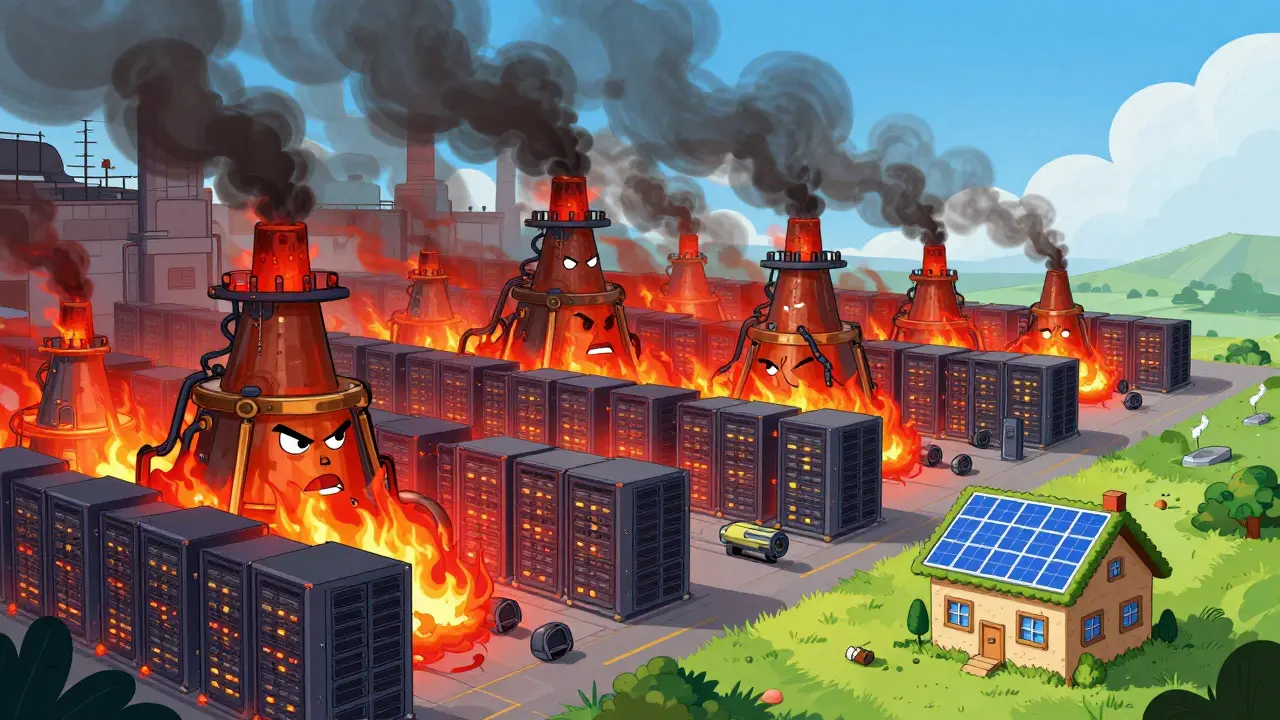
Imagine a world where securing the internet’s financial backbone doesn’t require massive warehouses humming with servers and guzzling enough electricity to power small towns. That world is here. For over a decade, Proof of Work (PoW) was the dominant consensus mechanism used by blockchains like Bitcoin to validate transactions through energy-intensive computational puzzles. It worked, but it came with a heavy environmental and economic cost. Now, a new standard is taking over: Proof of Stake (PoS), which uses an economic security model where validators lock up cryptocurrency as collateral to secure the network instead of using computational power.
This isn’t just a technical tweak; it’s a fundamental rewrite of how digital trust is established. If you’ve been watching the crypto space since 2025, you’ve likely noticed that almost every major new blockchain launches with PoS, and even giants have switched. Understanding how staking replaces mining is no longer optional for anyone serious about blockchain technology. It changes who can participate, how much energy is wasted, and how networks stay secure.
The Old Way: How Mining Actually Works
To understand why the industry moved away from mining, we first need to look at what mining actually does. In a Proof of Work system, miners compete against each other to solve complex cryptographic puzzles. Think of it like a global lottery where buying more tickets means spending more electricity on specialized hardware called ASICs or GPUs. The first miner to solve the puzzle gets to add the next block of transactions to the blockchain and receives a reward in newly minted coins plus transaction fees.
This process serves two main purposes. First, it prevents double-spending by making it computationally expensive to alter past records. Second, it issues new currency into circulation. However, this competition drives an arms race. As more people join, the difficulty of the puzzles increases, requiring more powerful machines and more energy. By 2024, Bitcoin mining alone consumed more electricity than some mid-sized countries. This inefficiency became unsustainable for many developers and environmentally conscious investors, creating the perfect opening for a different approach.
The New Standard: Mechanics of Staking
Staking replaces the physical labor of computing with financial commitment. Instead of burning electricity to prove you’re honest, you lock up your own money to prove you have skin in the game. In a Proof of Stake network, participants known as validators are nodes selected to propose and attest to new blocks based on the amount of cryptocurrency they have locked in a smart contract.
Here is how the selection works. When a new block needs to be added, the protocol randomly selects a validator to propose it. But it’s not purely random. Your chances of being picked are proportional to the size of your stake. If you hold 1% of all staked tokens, you have roughly a 1% chance of being chosen. Once selected, the validator checks the transactions in the block, signs them, and broadcasts them to the network. Other validators then vote on whether the block is valid. If the majority agrees, the block is finalized.
This shift eliminates the need for specialized mining rigs. You don’t need a warehouse full of graphics cards. You just need a computer connected to the internet and a significant amount of the native cryptocurrency. The "work" is no longer computational; it is economic. The security comes from the fact that if a validator tries to cheat, they lose their locked-up funds.
| Feature | Proof of Work (Mining) | Proof of Stake (Staking) |
|---|---|---|
| Resource Used | Computational Power (Hashrate) | Cryptocurrency Holdings (Stake) |
| Hardware Required | ASICs, High-end GPUs | Standard Server or Laptop |
| Energy Consumption | Very High (Megawatts) | Very Low (Kilowatts) |
| Entry Barrier | High Capital + Technical Expertise | Token Ownership + Basic Tech Skills |
| Punishment for Malice | Wasted Electricity/Hardware Cost | Slashing (Loss of Staked Tokens) |
Why Security Still Holds Up Without Mining
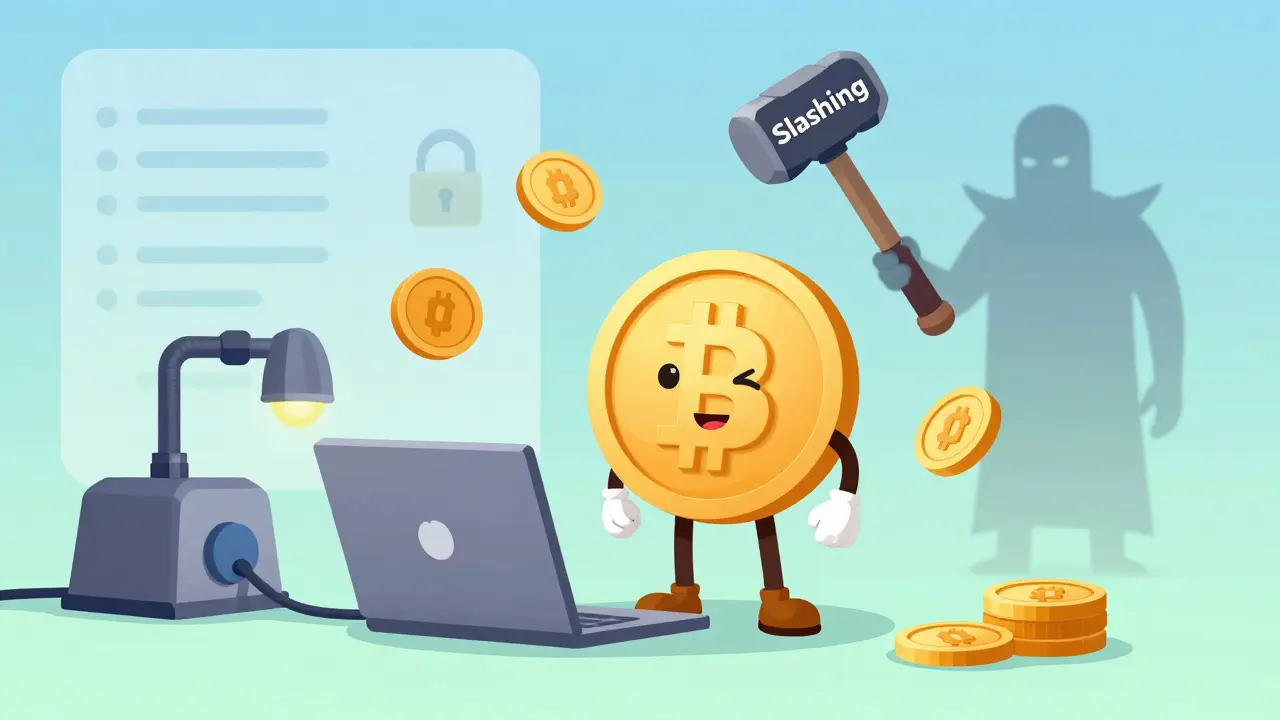
Skeptics often ask: "If there’s no energy cost, can’t someone just attack the network easily?" This is the most common misconception about PoS. In reality, PoS introduces a stronger economic deterrent called slashing, which is a penalty mechanism that destroys a portion of a validator's staked funds if they act maliciously or go offline unexpectedly.
In Proof of Work, if a miner tries to rewrite history, they waste electricity and hardware costs. They might still profit if the attack succeeds. In Proof of Stake, if a validator signs two conflicting blocks or goes offline for too long, the protocol automatically detects this behavior and burns part of their stake. This is immediate financial loss. To attack a PoS network, an attacker would need to acquire 51% of the total supply of the token. Buying that much cryptocurrency would likely crash the price, destroying the value of their investment before they could even launch an attack. This makes large-scale attacks economically irrational.
Furthermore, PoS systems often use finality gadgets like Casper FFG (used in Ethereum) to make blocks irreversible after a short period. This adds another layer of security that mining-based chains struggle to implement efficiently. The security model shifts from "it’s too expensive to compute" to "it’s too expensive to buy and lose."
The Environmental Impact: A Massive Reduction
The environmental argument is the most visible driver behind the shift from mining to staking. Let’s look at the numbers. Before its transition, Ethereum’s energy consumption was estimated at around 7-10 TWh per year, comparable to the annual electricity usage of countries like Argentina or Norway. After switching to Proof of Stake in 2022, that consumption dropped by approximately 99.95%. Today, validating Ethereum transactions uses less energy than a typical household appliance.
This efficiency isn’t unique to Ethereum. Networks like Cardano, Solana, and Polkadot have operated on PoS from day one, maintaining high throughput with minimal carbon footprints. For institutional investors and governments concerned about ESG (Environmental, Social, and Governance) criteria, this difference is decisive. Staking allows blockchain technology to scale without scaling its environmental impact proportionally.
Decentralization: Who Controls the Network?
A frequent criticism of PoS is that it favors the wealthy. Critics argue that those with the most tokens get the most rewards, leading to centralization among large holders, often called "whales." While this is a valid concern, the reality is nuanced. Mining also centralized power among those who could afford cheap electricity and industrial-scale hardware farms.
Staking offers lower barriers to entry in several ways. First, you don’t need to buy expensive hardware. Second, many networks support delegated staking, which allows users to delegate their tokens to professional validators without running their own nodes, earning a share of the rewards in return. Platforms like Lido or Rocket Pool allow users to stake small amounts by pooling resources. This democratizes participation. Even with $32 worth of ETH (in pooled models), you can contribute to network security and earn rewards.
However, true decentralization requires active effort. Networks must design incentives to prevent large entities from dominating. Some protocols implement caps on maximum stake sizes or adjust rewards to favor smaller validators. As of 2026, the trend shows a healthy mix of solo validators, small pools, and large institutions, preventing any single group from controlling the narrative.

Economic Incentives: Passive Income vs. Operational Costs
For the average participant, the financial model has changed dramatically. Miners face ongoing operational expenses: electricity bills, cooling systems, hardware depreciation, and maintenance. Their profit margin is thin and volatile, depending heavily on the coin’s price and the network’s difficulty adjustment.
Stakers, on the other hand, enjoy a passive income stream with near-zero operational costs. Once you lock your tokens, the network handles the rest. Rewards are typically distributed annually, ranging from 3% to 8% APY depending on the network and market conditions. These rewards come from newly issued tokens and transaction fees. Because there are no electricity bills, the break-even point is much lower. This makes staking attractive not just for speculators, but for long-term holders who want their assets to work while they sleep.
That said, staking carries liquidity risks. Depending on the protocol, your tokens may be locked for a specific period or subject to an exit queue. In Ethereum, for example, withdrawing staked ETH can take days or weeks due to congestion in the withdrawal queue. Participants must plan accordingly, ensuring they don’t need immediate access to their capital.
Real-World Adoption: Beyond Ethereum
While Ethereum’s transition was the most high-profile, it’s not the only player. Cardano uses Ouroboros, a mathematically proven Proof of Stake protocol designed for high security and decentralization. Solana employs Tower BFT, a variant of PoS optimized for high-speed transactions and low fees. Each network tweaks the algorithm to suit its goals. Solana prioritizes speed, allowing thousands of transactions per second. Cardano focuses on academic rigor and gradual upgrades. Tezos incorporates self-amendment, allowing the protocol to update itself without hard forks.
This diversity proves that staking is flexible. It can support slow, secure store-of-value chains or fast, scalable application platforms. The underlying principle remains the same: economic stake replaces computational work. As we move further into 2026, new Layer 1 blockchains are launching exclusively with PoS, signaling that mining is becoming a legacy technology rather than the future standard.
Challenges and Future Developments
Despite its advantages, PoS is not without challenges. One major issue is the "nothing at stake" problem, where validators might theoretically vote on multiple competing chains because they lose nothing by doing so. Modern protocols mitigate this through slashing conditions and checkpoint finality. Another challenge is key management. If a validator loses their private key, their entire stake is lost forever. There are no backups in cryptography.
Future developments aim to address these issues. Research into distributed key custody (Distributed Validator Technology) allows multiple parties to control a single validator key, reducing the risk of single points of failure. Additionally, improvements in sharding will allow PoS networks to handle even higher transaction volumes by splitting the database into smaller pieces, each secured by a subset of validators.
The shift from mining to staking is complete for the majority of the industry. It represents a maturation of blockchain technology, moving from experimental energy-heavy experiments to efficient, sustainable, and economically sound systems. For users, it means easier participation. For developers, it means better scalability. And for the planet, it means a significantly lighter footprint.
Is staking safer than mining?
Security depends on the definition. PoS is financially safer for attackers because attacking requires owning 51% of the supply, which is prohibitively expensive. For participants, staking is technically simpler but carries the risk of slashing if you misconfigure your node. Mining carries higher operational risks (hardware failure, electricity spikes) but no direct penalty for mistakes other than wasted time.
Can I mine Bitcoin using Proof of Stake?
No. Bitcoin will remain a Proof of Work network indefinitely. Its core philosophy relies on energy-backed security. However, you can use Bitcoin in wrapped forms on PoS chains like Ethereum via bridges, but the underlying Bitcoin chain itself still uses mining.
What happens if my validator goes offline?
In most PoS networks, going offline results in missed rewards and potentially small penalties. If you remain offline for an extended period, you may face slashing, where a portion of your staked tokens is burned. Always ensure your node software is updated and your server has reliable internet connectivity.
Do I need a lot of money to start staking?
It depends on the method. Solo staking on Ethereum requires exactly 32 ETH. However, through liquid staking derivatives or staking pools, you can start with as little as 0.01 ETH. Pools aggregate funds from many users to meet the minimum requirement, distributing rewards proportionally.
Will Proof of Stake ever replace Bitcoin?
Unlikely. Bitcoin’s value proposition is tied to its immutable codebase and Proof of Work security model. While PoS is more efficient, Bitcoin’s community and market position are deeply entrenched in PoW. PoS is replacing mining in *new* projects and altcoins, not necessarily displacing Bitcoin’s original architecture.

Write a comment