
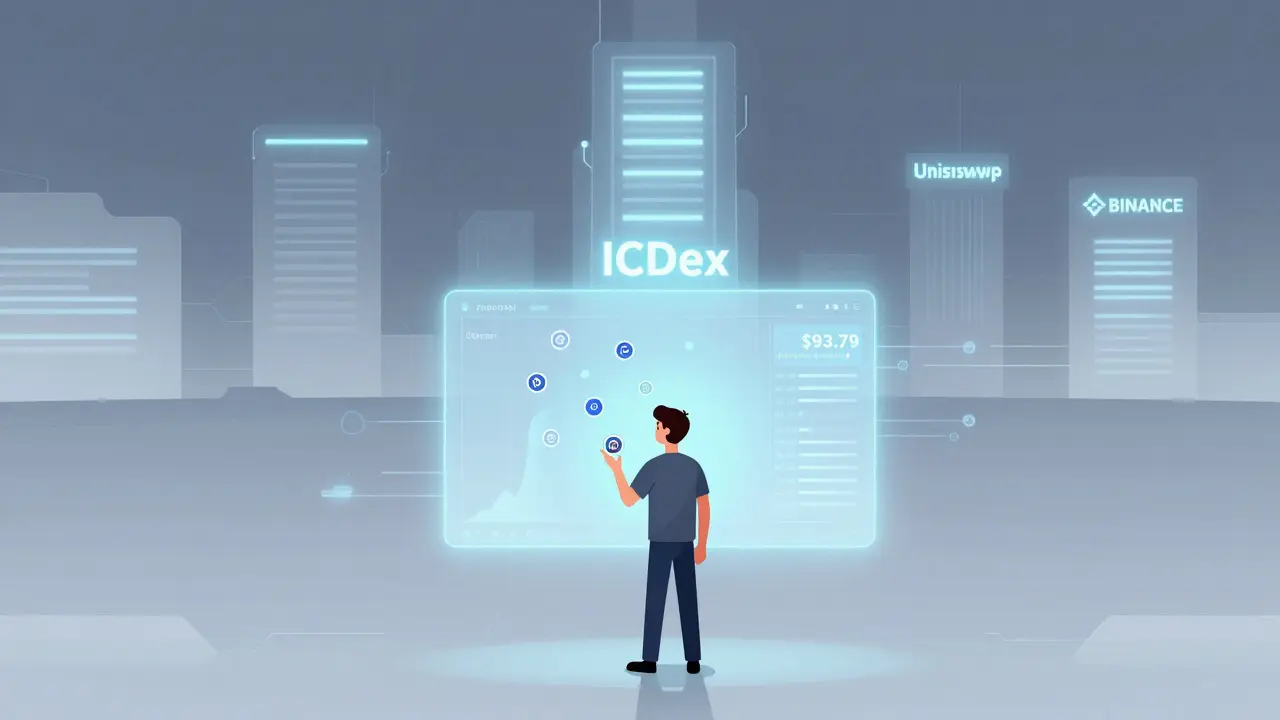
If you're looking for a crypto exchange that lets you trade without giving up control of your coins, ICDex sounds like it should be on your radar. But here's the truth: ICDex isn't a mainstream platform. It doesn't have millions of users, high liquidity, or even a decent number of trading pairs. It's a tiny, technically interesting experiment built for one specific group of people - those who want to trade Internet Computer (ICP) tokens in a fully decentralized way.
What Is ICDex, Really?
ICDex is a decentralized exchange (DEX) built entirely on the Internet Computer a blockchain designed to run web applications and smart contracts at web speed without relying on traditional cloud infrastructure. Unlike Uniswap or PancakeSwap, which use automated market makers (AMMs), ICDex uses a real on-chain order book. That means buy and sell orders are stored directly on the blockchain, just like a traditional stock exchange. You place a limit order, someone else matches it, and the trade settles on-chain - no middleman, no custodial wallet.
This is a big deal technically. Most DEXs sacrifice order book functionality for simplicity. ICDex doesn’t. It gives you limit orders, stop orders, and fill-or-kill options - tools you’d normally find only on centralized exchanges like Binance or Kraken. But here’s the catch: you need to already own ICP or related tokens. There’s no way to deposit fiat. No credit card option. No bank transfer. If you don’t have crypto on the Internet Computer network, you can’t trade on ICDex.
How Does It Work? The Technical Side
ICDex runs on smart contracts audited by third parties (though no public audit report names are available). All trades happen on-chain, so every transaction costs a small fee paid in ICP. The fee structure is simple: makers (people placing limit orders) pay 0% - that’s right, zero. Takers (those who fill existing orders) pay between 0.2% and 0.5%, depending on which board they trade on. Most users end up on the THIRD Board with a 0.5% taker fee.
The platform supports only 8 tokens and 8 trading pairs. The most active pair is ICL/ICP, which accounted for nearly all of the $93.79 in 24-hour volume reported by CoinGecko in late 2023. That’s not a typo. Ninety-three dollars. For comparison, Uniswap processes over $4 billion daily. ICDex’s volume is so low, it’s barely registering. Some days, the 24-hour volume drops below $10.
Because of this, order books are extremely thin. If you try to buy 100 ICP, you’ll likely see the price jump instantly because there aren’t enough sellers. This makes it nearly impossible to execute larger trades without massive slippage. It’s not a bug - it’s the result of almost no users.
Who Is ICDex For?
Let’s be clear: ICDex is not for beginners. It’s not for people looking to trade Bitcoin, Ethereum, or Solana. It’s not even for most DeFi users.
It’s only for one group: developers, early adopters, or investors who already hold ICP or tokens native to the Internet Computer ecosystem and want to trade them without trusting a centralized exchange. If you’re holding ICP because you believe in the Internet Computer’s vision of web-scale blockchains, ICDex is one of the few places where you can trade it without handing over your keys.
For everyone else, it’s a dead end. There are no educational resources on the site. No tutorials. No customer support. No Telegram group. No Reddit community. The website (iclight.io) looks clean, but it’s empty of useful content. If you get stuck, you’re on your own.
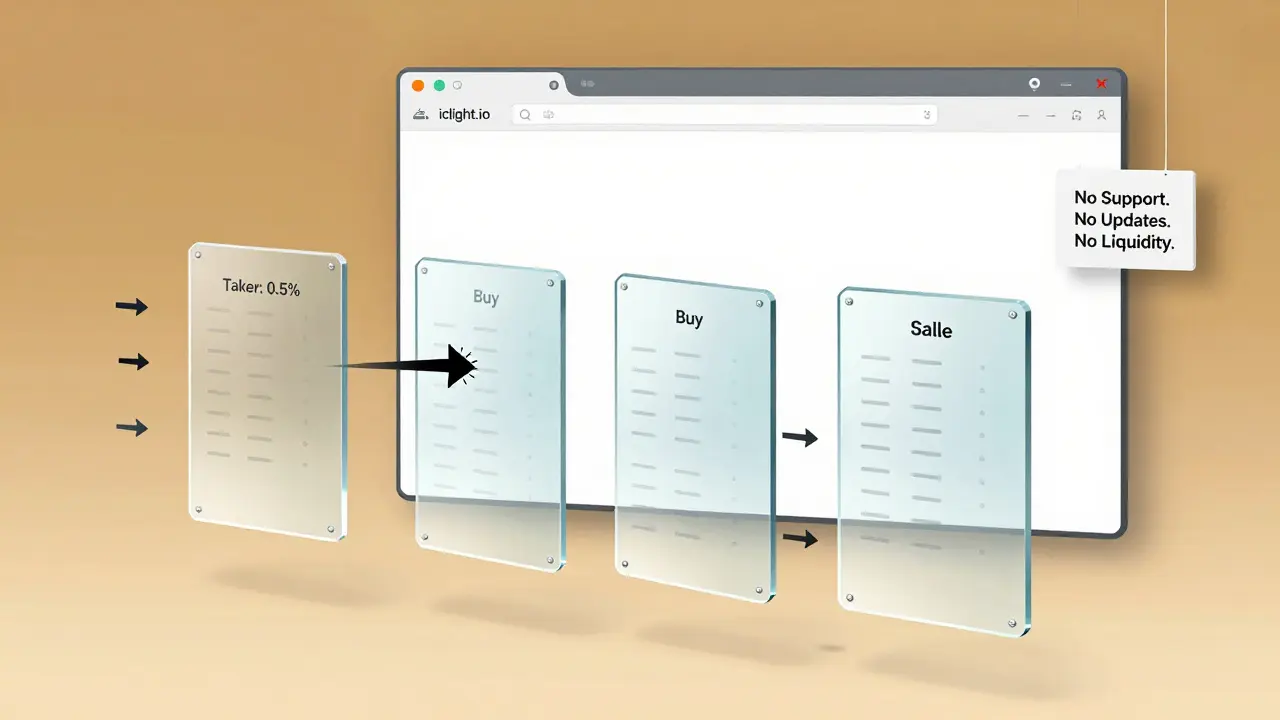
Security and Regulation
Since ICDex is non-custodial, your funds are never held by the platform. That’s a major security win. If the site gets hacked, your wallet isn’t touched - because you never gave them access. The smart contracts have been audited, though details are scarce. That’s better than most DEXs, which often skip audits entirely.
But low activity creates its own risk. With so little liquidity, a single large trade can manipulate prices. There’s no protection against flash loan attacks or whale manipulation. And because ICDex is incorporated in Singapore but operates without any government regulation, you have zero legal recourse if something goes wrong.
There are no KYC requirements, no identity checks, and no compliance team. That’s fine if you value privacy. But if you’re used to regulated platforms like Coinbase or Kraken, this will feel like stepping into the wild west.
Why It’s Not Working
ICDex suffers from the classic DEX dilemma: no liquidity → no traders → no liquidity. The Internet Computer blockchain itself has struggled to gain traction compared to Ethereum or Solana. Fewer developers build on it. Fewer users hold its tokens. Fewer projects launch on it.
As a result, ICDex is stuck in a loop. It offers advanced trading tools - but nobody uses them. It charges low fees - but there’s nothing to trade. It’s technically impressive, but practically useless for anyone outside a tiny circle of ICP enthusiasts.
Compare this to Uniswap, which has over 10,000 trading pairs and billions in daily volume. Or dYdX, which offers derivatives trading with deep liquidity. ICDex doesn’t even make the top 100 DEXs by usage. CoinGecko ranks it in the bottom 21% for volume. Cashbackforex puts it at 490th out of 600 exchanges in organic traffic - meaning only about 264 people visited the site in a month.
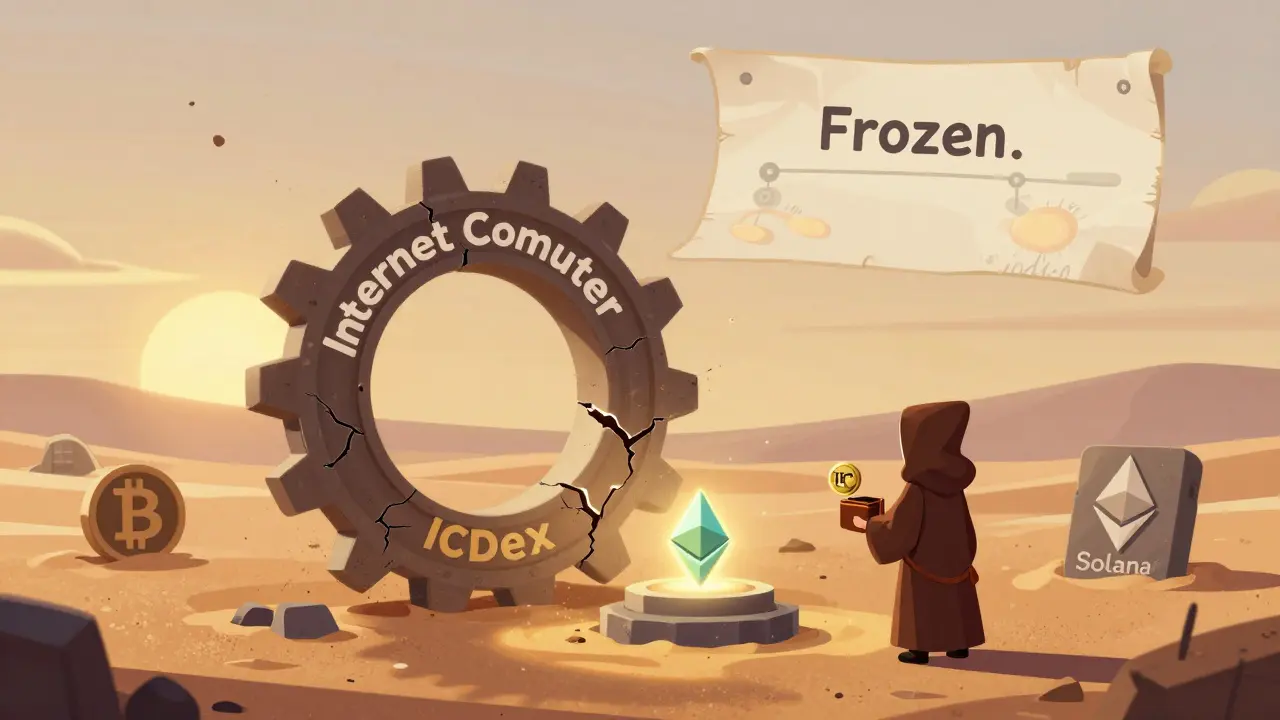
What’s Missing?
There’s no mobile app. No wallet integration beyond basic browser wallets. No API for developers. No liquidity mining programs to incentivize traders. No partnerships with other DeFi protocols. No token listings beyond ICP and a handful of obscure tokens.
There’s no roadmap. No announcements. No updates. The project seems frozen. While other DEXs are adding cross-chain bridges, layer-2 scaling, and staking rewards, ICDex hasn’t changed in over a year. The team behind it - tied to the DFINITY Foundation - appears focused elsewhere.
Should You Use ICDex?
Only if all of these are true:
- You already own ICP or Internet Computer ecosystem tokens
- You want to trade them without giving up custody
- You’re okay with trading tiny amounts and accepting high slippage
- You don’t mind zero support, zero tutorials, and zero community
- You’re not trying to trade anything else - no ETH, no BTC, no SOL
If any of those points don’t apply to you, walk away. There are dozens of better options.
For most people, using a centralized exchange like Kraken or Binance (with proper security practices) is safer, faster, and cheaper. For DeFi users, Uniswap, PancakeSwap, or Curve offer thousands of tokens, deep liquidity, and active communities.
ICDex is a proof of concept - not a practical tool. It shows what’s possible with on-chain order books. But it doesn’t show what’s viable.
Alternatives to Consider
If you’re interested in decentralized trading, here are better options:
- Uniswap (Ethereum) - Best for trading ETH and ERC-20 tokens with deep liquidity
- PancakeSwap (BNB Chain) - Top choice for low-fee trading on BNB Chain
- dYdX - Only DEX offering derivatives, futures, and leveraged trading
- Curve - Best for swapping stablecoins with minimal slippage
All of these have millions in daily volume, active teams, and strong communities. None of them are as technically unique as ICDex - but they actually work.
Is ICDex safe to use?
Yes, but only if you understand the risks. Since ICDex is non-custodial, your funds are never held by the platform. The smart contracts have been audited, though details aren’t public. However, with near-zero trading volume, the market is vulnerable to manipulation. A single large trade can swing prices dramatically. Use only small amounts you can afford to lose.
Can I trade Bitcoin or Ethereum on ICDex?
No. ICDex only supports tokens native to the Internet Computer blockchain. That means ICP and a handful of obscure tokens like ICL, ICPUSD, and a few others. You cannot trade Bitcoin, Ethereum, Solana, or any major cryptocurrency on this platform.
Do I need a special wallet to use ICDex?
Yes. You need a wallet that supports the Internet Computer blockchain. The most commonly used is the Dfinity Wallet (browser extension), but others like ICPSwap Wallet or Internet Identity may work. You cannot use MetaMask, Trust Wallet, or Coinbase Wallet - they don’t support ICP.
Is ICDex regulated?
No. ICDex is incorporated in Singapore but operates without any government oversight. There is no KYC, no AML compliance, and no regulatory license. This means you have no legal protection if something goes wrong - no chargebacks, no refunds, no recourse.
Why is ICDex’s trading volume so low?
Because the Internet Computer ecosystem itself has very little adoption. Few people hold ICP tokens. Few projects build on it. Without users, there’s no liquidity. Without liquidity, traders won’t come. It’s a classic chicken-and-egg problem. Even with zero maker fees and low taker fees, there’s simply nothing to trade.

Comments
Ifeanyi Uche
This is why decentralization is a myth. You think you're free but you're just poor. $93 in volume? That's not innovation, that's a graveyard. If you're holding ICP, you already lost. Stop pretending this is Web3, it's Web1.0 with extra steps and zero users.
Jeff French
The order book on-chain is a brilliant technical achievement. The real bottleneck isn't the tech-it's the ecosystem. No liquidity because no one's building on IC. No builders because no liquidity. Classic loop. The fix isn't more marketing-it's incentivizing dev tooling and grants. This could be the backbone of a new web if someone cared to nurture it.
Elana Vorspan
I love that someone is trying this 😊 Maybe it's small now but think about how Uniswap started. Tiny. Barely used. Now it's massive. ICDex has the bones of something revolutionary. Give it time. The real crypto believers are the ones who show up when no one else is watching.
Kristi Emens
The lack of wallet integration beyond Dfinity Wallet is a massive UX flaw. If you're serious about adoption, you need to support at least one major wallet like Phantom or Brave. Otherwise you're just preaching to the choir of people who already downloaded your niche extension.
Deborah Robinson
I appreciate the honesty in this review. Too many people try to romanticize these projects. ICDex isn't broken-it's just not ready. It's a prototype. Not a product. And that's okay. Progress isn't always loud.
Michelle Mitchell
so like... its not even worth it right? like why even bother? i tried to use it once and my tx failed and no one helped and i was like lol
Kaitlyn Clark
If you're still holding ICP after this, you're either a true believer or you're in denial. This isn't DeFi. It's a digital ghost town. Zero liquidity = zero utility. Stop pretending this is the future. The future has volume, community, and devs who actually ship updates.
christopher luke
I've been holding ICP since 2021. ICDex is the only place I trust to trade it. Yeah the volume is low. Yeah the UI is bare. But I get to keep my keys. That's worth more than 1000 centralized exchanges with $10B volume. This isn't about money. It's about sovereignty. 🙏
Maggie House
I think people forget that real innovation is messy. Look at Ethereum in 2015-no one used it. No one cared. But the builders kept building. ICDex is like that. Not a product yet. A promise. And promises take time. I'm still here. Are you?
Cameron Pearce Macfarlane
The whole 'non-custodial' thing is a marketing gimmick. If you can't even trade more than $100 a day, you're not decentralized-you're irrelevant. Real decentralization doesn't mean you can't trust anyone. It means you can't be exploited by one. This? This is just a lonely sandbox.
Elizabeth Smith
The fact that this exists at all proves the system is broken. Why are we rewarding projects that build on top of a blockchain with no users? We're not building the future-we're just rearranging deck chairs on the Titanic. ICP was a bet on vaporware. And now we're gambling on its graveyard.
Robert Kromberg
I get why people hate this. But I also get why it matters. It's not about volume. It's about proving that on-chain order books can work without centralized matching engines. That's huge. Even if it's slow. Even if it's quiet. It's a proof point. And proof points lead to breakthroughs.
Daisy Boliaan
OMG I tried to use this and my wallet got stuck for 3 hours. No support. No chat. No nothing. I thought I lost my money. I screamed into my pillow. Then I realized... I didn't lose it. I just wasted 3 hours of my life. ICDex is a glitch in the matrix. 🤯
Nicki Casey
Let’s be brutally honest: this isn’t a DEX. It’s a surveillance-free data dump for crypto purists who believe in blockchain purity over practicality. The Singapore incorporation? A red herring. The lack of regulation? A feature for bad actors. This platform doesn’t serve users-it serves ideology. And ideology doesn’t pay bills.
Jessica Carvajal montiel
I'm not saying this is a scam but... who funds this? DFINITY? Why? Are they just burning money to keep the ICP narrative alive? This feels like a PR stunt. $93 in volume? That's less than what I spent on coffee last week. Someone's got a ledger somewhere showing ICP holders are being manipulated. I'm not paranoid. I'm informed.
maya keta
You call this decentralized? Bro it's a one-token graveyard. ICP? ICL? What even are these? You need to be a crypto anthropologist to understand this. Meanwhile, Uniswap V4 is launching AI-powered liquidity pools. ICDex? Still on version 1.2.3 from 2022. This isn't innovation. It's archaeology.
Curtis Dunnett-Jones
The technical architecture of ICDex represents a paradigm shift in decentralized finance. By implementing a true on-chain order book, it eliminates the need for centralized matching engines, thereby reducing systemic counterparty risk. The low liquidity is not a failure of design but rather a function of market adoption lag. One must not confuse technological merit with market velocity.
Sean Logue
I used ICDex once. Just to say I did. I traded 0.001 ICP. Felt like I was part of something. Then I went back to Uniswap. But I still check ICDex every week. Like a haunted house. I know it's empty. But I still knock on the door.
Carl Gaard
I came here looking for answers. Left with more questions. Why does this exist? Who’s behind it? Why no updates? Why no community? I spent 2 hours reading docs. Found 3 sentences. That’s it. I’m not mad. I’m just... sad. This could’ve been beautiful.
bella gonzales
I just... I can't. I spent 4 hours trying to connect my wallet. I had to reinstall my browser. I had to switch networks. I had to read a Medium post from 2021. I cried. I gave up. And now I'm here. This isn't crypto. This is emotional labor.
Paul Reinhart
The tragedy of ICDex isn't its low volume. It's that it proves something we refuse to accept: that technology alone doesn't create adoption. Community does. Culture does. Narrative does. ICDex is a cathedral built in a desert. The architecture is flawless. The congregation? Nonexistent. And yet, someone still lights the candles every day. That’s the quietest kind of rebellion.
Samantha Stultz
If you think ICDex is a DEX, you're missing the point. It's a decentralized liquidity oracle. It doesn't need volume. It needs to prove that order books can exist on-chain. That's the signal. The trades? Just noise. The real value is in the data structure. The fact that it exists proves that Web3 infrastructure can scale without centralized intermediaries. You're not trading tokens-you're validating consensus.
Robert Conmy
This isn't about ICDex. This is about the entire crypto industry. Everyone wants to be the next Uniswap. But no one wants to build the first ICDex. The real pioneers aren't the ones with millions in volume. They're the ones who show up when the lights are off. ICDex is the quiet hero. And it deserves better than being mocked.