
Buying a cryptocurrency with a name like Bitcat sounds easy enough. You see the ticker, you see the price, and maybe you think it’s just another cat-themed digital asset. But before you swap your hard-earned stablecoins for BTCAT, you need to know exactly what you are holding. It is not Bitcoin. It is not a utility token powering a decentralized app. It is a speculative meme coin living on the Solana blockchain.
If you are looking for the next Dogecoin or Shiba Inu, you might be disappointed by the reality of Bitcat. As of mid-2026, this token exists in the shadows of the crypto market-a micro-cap asset with tiny liquidity, no clear roadmap, and a history of massive volatility. This guide breaks down what Bitcat actually is, how it works technically, and why buying it carries significant risk.
Key Takeaways
- Bitcat (BTCAT) is a meme token built on the Solana blockchain, classified as an SPL token.
- The project has no public whitepaper, no doxxed team, and no documented utility beyond speculation.
- Market data shows a micro-cap status (around $21k) with extremely low trading volume, making exits difficult.
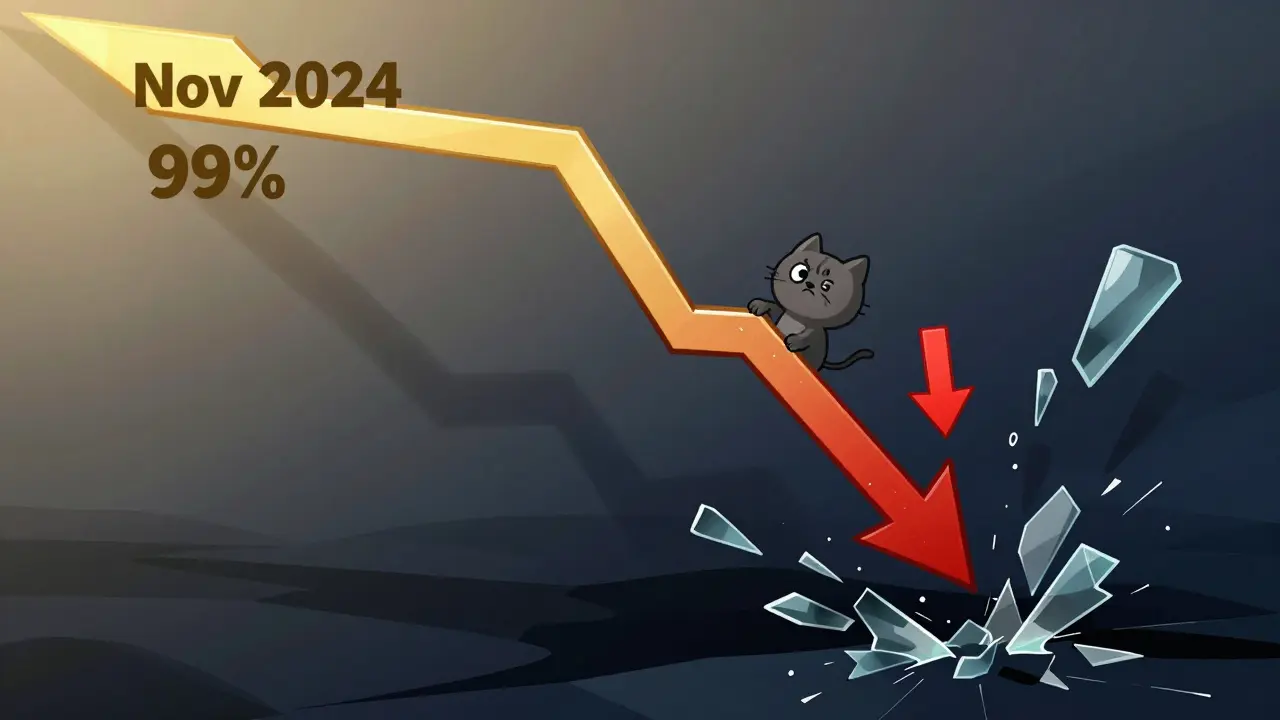
- BTCAT dropped over 99% from its all-time high in November 2024, highlighting extreme downside risk.
- You can only buy it via decentralized exchanges (DEXs) using wallets like Phantom or Binance Web3 Wallet.
What Exactly Is Bitcat (BTCAT)?
At its core, Bitcat (BTCAT) is a community-driven meme cryptocurrency token issued on the Solana network. Unlike major cryptocurrencies that solve specific problems-like Ethereum enabling smart contracts or Bitcoin acting as digital gold-Bitcat serves primarily as a vehicle for speculation.
Major platforms like Binance and CoinSwitch explicitly label BTCAT as a "meme" token. This classification matters because it tells you there is likely no underlying technology, revenue stream, or governance structure backing the price. The value comes entirely from what other people are willing to pay for it right now. If interest fades, the price usually follows.
There is no official website linked by major aggregators, no published whitepaper, and no known founding team. In the world of crypto, anonymity is common for meme coins, but it also means you have zero accountability if things go wrong. You are betting on a brand image-a "bitcat"-rather than a product.
Technical Foundation: Why Solana?
Bitcat runs on Solana, which is a high-performance blockchain known for fast transaction speeds and low fees. Specifically, BTCAT is an SPL token. SPL stands for Solana Program Library, which is the standard format for tokens on this network, similar to how ERC-20 works on Ethereum.
Why does this matter to you? Two reasons:
- Speed and Cost: Sending BTCAT costs fractions of a cent and takes seconds. On older networks like Bitcoin or even Ethereum during busy times, fees could eat up your entire investment.
- Ecosystem Fit: Solana became the home of many viral meme coins (like BONK and dogwifhat) due to its low barrier to entry. Developers and traders flock here because they can create and trade tokens cheaply.
However, being on Solana does not make the token safe. It just makes it easier to move around. The security of your funds depends on the wallet you use and the integrity of the token contract itself.
| Feature | Bitcat (BTCAT) | Dogecoin (DOGE) | Solana (SOL) |
|---|---|---|---|
| Type | Meme Token (SPL) | Currency/Meme | Layer-1 Blockchain |
| Utility | Speculation Only | Payments/Tips | Network Security/Staking |
| Team | Anonymous/Unknown | Open Source Community | Public Foundation |
| Risk Level | Extreme | High | Medium-High |
Tokenomics: Supply and Circulation
Understanding supply is crucial when evaluating any crypto asset. For Bitcat, the numbers are surprisingly tight compared to other memes that often have trillions of tokens.
- Maximum Supply: 955,360,000 BTCAT
- Circulating Supply: Approximately 955,080,000 BTCAT
This means nearly 99.97% of all existing tokens are already in circulation. There is very little room for new inflation unless the creators hold hidden minting authority (which we cannot verify without auditing the contract code). While a fixed supply sounds good for scarcity, remember that the total market cap is tiny. A small number of holders controlling a large percentage of these 955 million tokens could easily manipulate the price.
Data discrepancies exist across platforms. Some aggregators show zero circulating supply, which is a technical error, while others like Bybit provide detailed figures. Always cross-reference multiple sources before trusting a single number.
Price History and Volatility Reality Check
Let’s look at the hard data. Bitcat had a moment of glory back in November 2024, reaching an all-time high (ATH) of roughly $0.00926. That was likely driven by a short-lived hype cycle typical of meme coins.
Fast forward to early 2026, and the price sits between $0.000013 and $0.000022. Doing the math, that represents a drop of approximately 99.75% from its peak. This is not unusual for micro-cap memes, but it is vital context. If you bought at the top, you have lost almost everything. If you buy now, you are hoping for a miracle rebound against steep odds.
Current trading volumes are alarmingly low. Reports show 24-hour volumes sometimes dipping below $40 on some platforms. What does this mean for you? It means liquidity is thin. If you try to sell a significant amount of BTCAT, you might not find enough buyers. Your sale could crash the price further, or worse, you might not be able to exit at all without massive slippage.
How to Buy Bitcat (BTCAT) Safely
You won’t find Bitcat on major centralized exchanges like Coinbase or Kraken. It lives in the decentralized web. Here is how you actually acquire it:
- Get a Solana Wallet: Download a reputable wallet like Phantom, Solflare, or use the Binance Web3 Wallet. Never share your seed phrase with anyone.
- Fund with SOL: Buy Solana (SOL) on a major exchange and send it to your wallet address. You need SOL to pay for transaction fees (gas).
- Connect to a DEX: Use a decentralized exchange like Raydium or Jupiter. Connect your wallet to the platform.
- Swap for BTCAT: Search for the BTCAT token address. Warning: Always verify the contract address on a reliable tracker like CoinGecko to avoid fake scam tokens with the same name.
- Execute Trade: Swap your SOL for BTCAT. Be prepared for high slippage settings due to low liquidity.
Risks You Must Understand
Investing in Bitcat is not investing; it is gambling. Here are the specific dangers:
- Liquidity Risk: With daily volumes under $1,000, getting out is hard. Large sells will wipe out the order book.
- No Audit: There is no record of a smart contract audit by firms like CertiK. This means hidden bugs or malicious functions (like rug pulls) could exist in the code.
- Regulatory Uncertainty: Governments worldwide are cracking down on unregistered securities and high-risk assets. Meme coins are often first on the chopping block.
- Zero Utility: Without a use case, the price relies solely on marketing and FOMO (Fear Of Missing Out). When the hype dies, the price goes to zero.
Is Bitcat a Good Investment?
Honestly? Probably not. If you are looking for wealth preservation or steady growth, Bitcat fails every metric. It lacks fundamentals, transparency, and stability. However, if you are a seasoned trader who understands how to read on-chain data, manage risk, and treat your capital as disposable entertainment money, you might spot a short-term trading opportunity.
For the average person, the safer bet is to stick to established assets with clear utility and deep liquidity. Bitcat belongs in the "high-risk speculation" bucket, where losses are the norm, not the exception.
Is Bitcat (BTCAT) the same as Bitcoin?
No. Despite the "BTC" in its ticker symbol, Bitcat has nothing to do with Bitcoin. It is a meme token built on the Solana blockchain. Bitcoin is a standalone Layer-1 currency, while BTCAT is a simple token with no intrinsic value beyond speculation.
Where can I buy Bitcat?
You cannot buy BTCAT on traditional centralized exchanges like Coinbase. You must use a decentralized exchange (DEX) such as Raydium or Jupiter on the Solana network. You will need a Solana-compatible wallet like Phantom or Solflare to complete the transaction.
Who created Bitcat?
The creators of Bitcat remain anonymous. There is no public whitepaper, no listed team members, and no corporate entity behind the project. This lack of transparency increases the risk for investors.
What is the maximum supply of BTCAT?
The maximum supply of Bitcat is capped at 955,360,000 tokens. Currently, nearly 99.97% of these tokens are in circulation, meaning there is very little new supply left to enter the market.
Why is the price of Bitcat so volatile?
Volatility stems from its micro-cap status and low liquidity. With a market cap around $21,000 and daily trading volumes sometimes under $100, even small buys or sells can cause massive percentage swings in price. Additionally, as a meme coin, its value is driven purely by sentiment rather than fundamentals.
Is Bitcat a scam?
While there is no definitive proof that Bitcat is a scam, it exhibits many red flags associated with fraudulent projects: anonymous team, no audit, no utility, and extreme price drops. Treat it as a high-risk speculative asset and never invest more than you can afford to lose completely.

Write a comment