
Confirmation Requirements Calculator
Select your transaction type and value to see recommended confirmations and security level.
Transaction Details
Recommended Confirmations
Recommended Confirmations
Risk Level
Transaction risk assessment
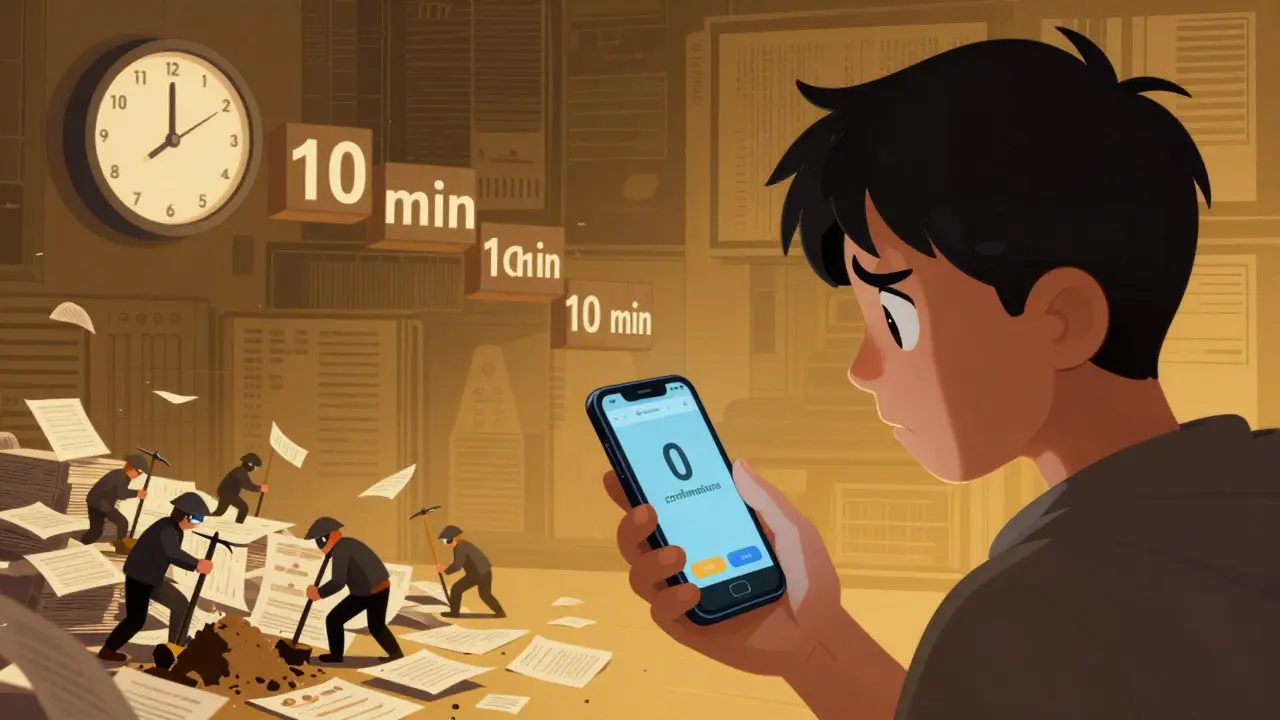
Ever sent Bitcoin and stared at your wallet, wondering why it’s still "pending"? You’re not alone. Cryptocurrency confirmation times aren’t just technical jargon-they directly affect whether your payment goes through in time for a coffee, a rent payment, or a last-minute online purchase. Unlike bank transfers that settle in seconds, crypto transactions rely on a decentralized network of miners and validators. And that process? It’s not always fast. But it’s not random either. Understanding how confirmation times work helps you avoid delays, reduce fees, and know when it’s safe to consider your transaction final.
What Exactly Is a Cryptocurrency Confirmation?
A confirmation happens when your transaction gets written into a block on the blockchain. Think of it like this: you hand someone cash. The moment they take it, it’s done. But with crypto, the network has to verify that you actually owned the money and didn’t try to spend it twice. That’s called preventing double-spending. Once a miner includes your transaction in a block and that block gets added to the chain, you get your first confirmation. Each new block added on top of yours adds another confirmation. Six confirmations? That means six new blocks have been built on top of the one containing your transaction.
Each confirmation makes it harder and harder to reverse your transaction. After just one, it’s still possible-though rare-for a powerful attacker to rewrite history. After six? The chances are astronomically low. That’s why exchanges and merchants wait for multiple confirmations before releasing funds or goods. It’s not about waiting for the transaction to appear-it’s about waiting for it to become permanent.
Why Do Confirmation Times Vary So Much?
Not all blockchains are built the same. Bitcoin adds a new block roughly every 10 minutes. That means one confirmation takes about 10 minutes on average. But Ethereum? It’s faster-around 12 to 15 seconds per block. Solana? Under 0.5 seconds. So if you’re sending ETH instead of BTC, you’re going to see confirmations much quicker.
But even within the same network, times change. Why? Three big reasons:
- Network congestion: When everyone’s sending crypto at once, transactions pile up like cars at a toll booth. Miners can only process so many per block. If your fee is too low, you get stuck in line.
- Transaction fees: Miners prioritize transactions with higher fees. If you’re in a hurry, pay more. Simple as that. A $5 fee on Bitcoin during peak hours might get you confirmed in 5 minutes. A $0.10 fee? Could take hours-or even days.
- Transaction complexity: Sending 1 BTC to one address is simple. Sending 50 inputs from 20 different wallets? That’s a bulky transaction. Bigger size = more data = slower processing.
There’s no universal clock for crypto confirmations. It’s a dynamic system shaped by demand, fees, and network rules.
How Many Confirmations Do You Actually Need?
There’s no single answer. It depends on how much money you’re dealing with and how much risk you’re willing to take.
- Zero confirmations (ZeroConf): Some merchants accept payments instantly. Coffee shops, digital downloads, or small peer-to-peer transfers often do this. It’s risky-you’re trusting the network hasn’t reversed the transaction yet. But with low-value transactions, the risk is minimal. Services like Lightning Network make this safer by handling payments off-chain.
- 1 confirmation: Fine for small purchases under $100. Most users see this as "done" if they’re just sending to a friend.
- 3 confirmations: The sweet spot for most exchanges and medium-sized payments. For Bitcoin, that’s about 30 minutes. It’s fast enough for usability and secure enough for most use cases.
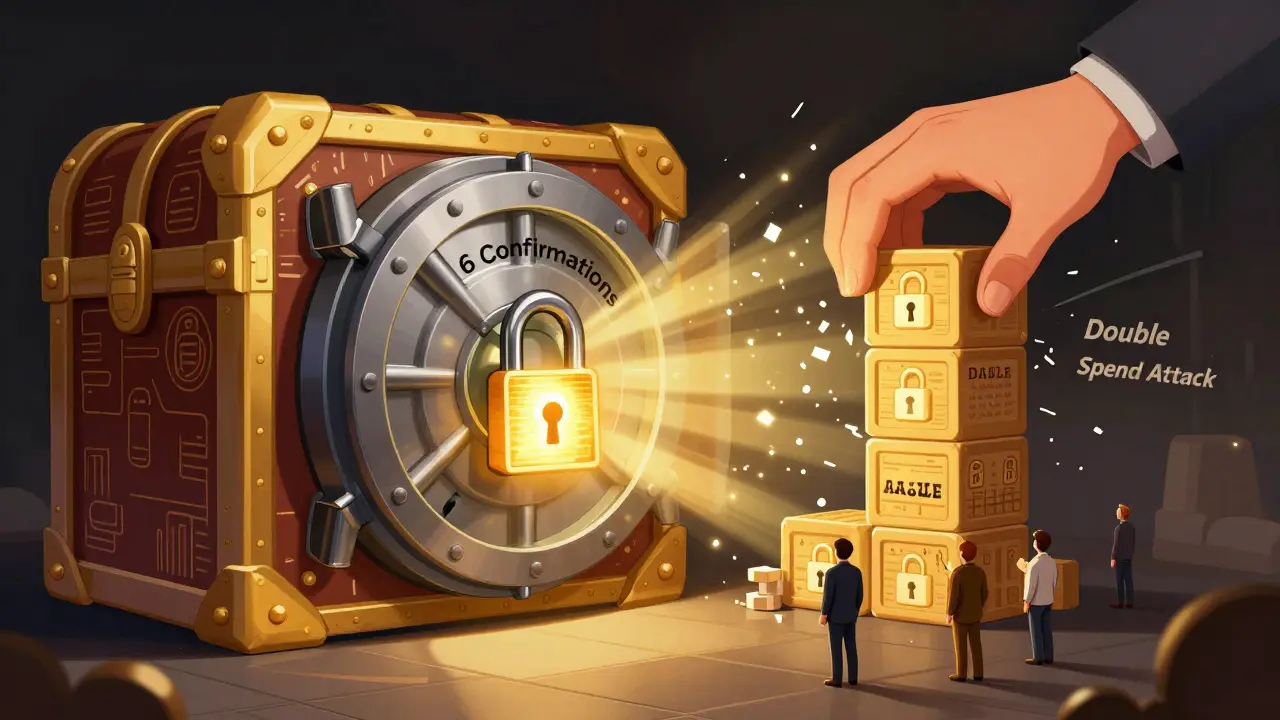
- 6 confirmations: The gold standard for Bitcoin. This is what most exchanges require for deposits. It’s what’s taught in textbooks, written in whitepapers, and baked into security protocols. Six blocks mean over an hour has passed. At this point, reversing the transaction would require controlling more than half the entire Bitcoin network-a near-impossible feat.
- 60+ confirmations: Used for massive transfers, institutional custody, or high-value sales. Think $1 million+ transactions. That’s 10 hours of waiting, but it’s the equivalent of burying your cash in concrete.
Bottom line: Don’t assume everyone uses the same rules. Always check what the recipient requires. An exchange might ask for 30 confirmations for Dogecoin. A marketplace might accept 1 for Litecoin. Never guess.

How to Speed Up a Slow Confirmation
If your transaction is stuck, here’s what you can do:
- Check the fee: Use a blockchain explorer like Blockchain.com or Etherscan to see your transaction’s fee rate (satoshis per byte or gwei). Compare it to current network averages. If it’s way below average, you’re in the slow lane.
- Use Replace-by-Fee (RBF): If your wallet supports RBF (Bitcoin only), you can increase the fee on your pending transaction. This tells miners to replace your old one with a new, higher-fee version.
- Child-Pays-for-Parent (CPFP): If you control the receiving address, you can send another transaction from it with a high fee. Miners may include both transactions together to collect the higher total fee.
- Wait it out: Sometimes, the network clears. If it’s not urgent, patience is cheaper than panic.
Pro tip: Most modern wallets (like Electrum, Exodus, or Trust Wallet) now show real-time fee estimates. Use them. Don’t just click "Send" and hope for the best.
Zero Confirmation: Fast But Risky
ZeroConf is becoming more common. It lets you receive crypto instantly without waiting for a single block. Some businesses use it successfully-especially for low-value, low-risk purchases like streaming subscriptions or digital art.
But here’s the catch: ZeroConf is vulnerable to double-spending attacks. Imagine someone sends you 1 BTC and immediately broadcasts another transaction spending the same coins to a different address. If the network picks the second one instead of yours, you get nothing. The chance is tiny for small amounts, but real.
Services like the Lightning Network reduce this risk by using smart contracts and payment channels. They don’t rely on on-chain confirmations at all. That’s why apps like Strike and BlueWallet can process Bitcoin payments in seconds-even during congestion.
Don’t use ZeroConf for buying a car, paying rent, or sending money to someone you don’t trust. But for a $5 tip on a crypto blog? It’s fine.
What’s Changing in 2025?
Confirmation times are getting smarter. Newer blockchains like Solana, Avalanche, and Polygon have optimized for speed. Even Bitcoin is evolving. Layer-2 solutions like the Lightning Network and sidechains are taking pressure off the main chain. More wallets now offer dynamic fee suggestions based on real-time network data.
Also, more merchants are adopting hybrid models: accept ZeroConf for small amounts, require 3-6 confirmations for larger ones. It’s a balance between speed and security that’s becoming standard.
Meanwhile, regulators are starting to ask questions. If a payment is considered "final" after one confirmation, is that legally binding? Some jurisdictions are beginning to define minimum confirmation thresholds for financial compliance. The rules are still forming-but they’re coming.
Final Thoughts: Don’t Guess, Know
Cryptocurrency confirmation times aren’t broken-they’re designed this way on purpose. The delay isn’t a bug. It’s the security feature. The longer you wait, the more irreversible your transaction becomes.
But you don’t have to sit around waiting forever. Know your network. Know your fee. Know your risk tolerance. Use wallet tools that show real-time estimates. Don’t assume Bitcoin’s 10-minute rule applies to every coin. And never treat a single confirmation as final for anything valuable.
When in doubt, wait for three. It’s fast enough for most things, and secure enough to sleep on.
How long does a Bitcoin transaction take to confirm?
On average, a Bitcoin transaction takes about 10 minutes for the first confirmation, since blocks are mined roughly every 10 minutes. But if the network is busy or your fee is low, it can take longer-sometimes hours. For safety, most exchanges and services wait for six confirmations, which takes about an hour.
Why is my crypto transaction still unconfirmed?
Your transaction is likely stuck because the fee you paid was too low. Miners prioritize transactions with higher fees, especially when the network is congested. You can check your fee rate using a blockchain explorer. If it’s below the current average, your transaction will wait until either the network clears or you use a tool like RBF or CPFP to bump the fee.
Can I cancel a crypto transaction that hasn’t confirmed yet?
You can’t cancel it directly, but you can replace it. If your wallet supports Replace-by-Fee (RBF), you can send a new transaction with a higher fee using the same inputs. This tells miners to ignore the old one. If RBF isn’t available, you can try Child-Pays-for-Parent (CPFP) by spending the output of your stuck transaction with a high fee. Otherwise, you’ll need to wait until it’s either confirmed or dropped from the mempool (usually after 48-72 hours).
Is 1 confirmation enough for crypto payments?
For small amounts under $50, one confirmation is often acceptable, especially with low-risk recipients like digital service providers. But for anything larger-like buying a device, paying rent, or depositing to an exchange-you should wait for at least three confirmations. Six is the industry standard for Bitcoin. One confirmation is not final; the transaction can still be reversed in rare cases.
Do all cryptocurrencies have the same confirmation times?
No. Bitcoin takes about 10 minutes per block. Ethereum is around 12-15 seconds. Solana is under half a second. Litecoin is 2.5 minutes. Even within the same network, confirmation speed depends on transaction fees and network load. Always check the specific blockchain’s average block time before assuming how long a transaction will take.
What’s the difference between block time and confirmation time?
Block time is how often a new block is added to the blockchain-for example, 10 minutes for Bitcoin. Confirmation time is how long it takes for your specific transaction to be included in a block and then have additional blocks built on top of it. Your transaction might be confirmed in one block, but if you wait for six confirmations, you’re waiting for six blocks to be added after yours, which could take an hour or more.
Why do exchanges require so many confirmations?
Exchanges handle millions of dollars daily. A single double-spend attack could cost them millions. Waiting for 30, 40, or even 60 confirmations reduces the risk of fraud to near zero. It’s not about speed-it’s about protecting their users and their own financial stability. For them, security outweighs convenience.
Can I speed up a transaction after it’s already sent?
Yes, but only if your wallet supports Replace-by-Fee (RBF) or you can use Child-Pays-for-Parent (CPFP). RBF lets you replace your original transaction with a new one that has a higher fee. CPFP works if you control the receiving address-you send a new transaction from it with a high fee, incentivizing miners to confirm both. If neither option is available, you can’t speed it up. You’ll need to wait or wait it out.

Comments
Tara Marshall
One confirmation isn't final. Period. I've seen people get burned sending rent money with just one confirm. Wait for three. It's 30 minutes. Your landlord won't care if you're 30 minutes late. The blockchain won't forget you paid.
Simple.
Stop guessing.
Billye Nipper
OMG YES!! I just sent ETH last week and thought I was in trouble because it took 2 minutes... then I realized I was on Ethereum and not Bitcoin 😅 I felt so dumb. But seriously, if you're new to crypto, this is the kind of post that saves you from crying over a missed payment. Thank you for explaining it so clearly!!
Also, Lightning Network is magic. I tip my barista in BTC now and it's instant. No stress. No waiting. Just coffee and blockchain vibes ☕️
Nelson Issangya
You people are overcomplicating this. If you're paying for something worth more than your lunch, wait for six confirmations. If you're sending $5 to your buddy? Chill. Use Lightning. Stop acting like every transaction is a bank heist. The system works fine if you stop being lazy and read the damn wallet tips.
Also, if your fee is under 5 sat/byte on Bitcoin right now, you're basically begging miners to ignore you. Don't be that guy.
Regina Jestrow
Wait, so if Solana confirms in 0.5 seconds, why aren't we all using it? Is it just because Bitcoin has brand recognition? Or is there something deeper here? I feel like this post hints at a bigger truth about trust in decentralized systems...
Like, if speed = security, then why does Bitcoin sacrifice speed for perceived safety? Is safety even the real goal, or is it just nostalgia for the old-school banking model?
Also, I just sent a transaction and it's been 47 minutes. I'm starting to think the universe is punishing me for buying NFTs.
rita linda
Let me be clear: Bitcoin is the only real crypto. Everything else is a meme. Ethereum? A speculative Ponzi. Solana? A centralized mess pretending to be decentralized. You want confirmation times? Wait for Bitcoin's 10 minutes. That's the price of honesty. The rest are toys for gamblers. If you don't respect the 6-confirm standard, you're not serious about money. You're just chasing hype.
michael cuevas
So you're telling me I could've saved $20 in fees if I'd just checked the fee estimator instead of spamming send like a toddler with a credit card?
Wow.
Thanks for the education, I guess.
My wallet's still mad at me.
Barb Pooley
Did you know the government is using confirmation delays to track crypto users? That's why they let Bitcoin be slow-it's a surveillance tool. They want you to panic when your transaction takes 2 hours so you'll call your bank and reveal your identity. And the wallets? They're in on it. They show you "low fee" options because they want you to get stuck. I've seen the documents. They're not joking.
Also, I think the moon landing was faked. Just saying.
Nicole Parker
I think what's really interesting here isn't the technical details-it's the psychology behind waiting. We're conditioned by banks to expect instant gratification, but crypto forces us to sit with uncertainty. That’s uncomfortable. And that discomfort? It's the price of decentralization. We don't have a central authority to call when things go wrong. We have math. We have code. We have patience. And honestly? That’s kind of beautiful. It’s like learning to meditate, but with more blockchain.
Also, I once waited 14 hours for a 0.01 BTC transfer because I didn't pay attention to fees. I cried. Then I laughed. Then I bought a new wallet. It's a journey.
Tom Van bergen
Everyone's talking about fees and confirmations like it's some profound mystery. It's not. It's economics. Miners are profit-driven. You pay more, you move faster. That's capitalism. You want faster? Pay. You want free? Wait. No magic. No conspiracy. Just supply and demand. Stop romanticizing the blockchain. It's just a ledger with a hype factory attached.
Jonathan Sundqvist
Bitcoin is American. Ethereum is for hipsters. Solana is for tech bros who think they're Elon. If you're sending crypto in the US, you better be using Bitcoin. That's the only one that matters. The rest are just noise. And if you're using RBF? You're already part of the problem. Just wait. Like a real American.
Thomas Downey
It is profoundly disappointing to observe the casual disregard for cryptographic integrity exhibited by those who accept one confirmation as sufficient. Such behavior reflects a societal decay in the appreciation for rigorous security protocols. One must ask: if one is willing to compromise on transaction finality, what other foundational principles are one prepared to surrender? The moral implications are staggering.
Annette LeRoux
Just sent a $3 coffee tip with Lightning and got the green check in 0.3 seconds 😍 I'm not even mad anymore. I used to stress about this stuff like it was a job interview. Now? I just smile. Crypto isn't about waiting. It's about choosing the right tool. And sometimes... that tool is a coffee cup and a QR code. ☕️✨
Manish Yadav
I am from India. I send crypto to my sister in USA. She say 6 confirmations is too long. I say, if you want fast, use UPI. Crypto is not for fast. Crypto is for trust. I wait. I trust. I sleep. No problem.
Ben VanDyk
It's ironic that people complain about confirmation times while using wallets that hide fee estimates behind three menus. The problem isn't the blockchain. It's the user interface. If your wallet doesn't show you the current mempool congestion in plain English, you shouldn't be allowed to send a transaction. Period. Fix your app. Not the network.
Scott Sơn
I once sent a Bitcoin transaction during a Bitcoin Pizza Day sale. Thought I was getting a deal. Turned out my fee was so low, it took 17 hours. I missed the pizza. I missed the meme. I missed my chance at crypto immortality.
Now I pay the fee. I pay the extra. I pay the emotional toll.
And I still cry sometimes.
But I’m not a rookie anymore.
miriam gionfriddo
ok so i sent 0.5 btc to my friend and it said 1 confirm in 5 min but its been 4 hrs and i think my wallet is hacked?? i checked blockchain and it says pending but i cant see it in my wallet?? is this a scam?? i think they stole my keys?? i think the feds are in my phone?? i need help someone please??
Roseline Stephen
I used to think confirmation times were just technical noise. Then I sent a payment to a friend's business for a $200 invoice and waited 4 hours because I didn't check the fee. They thought I was ghosting them. I had to explain blockchain to a small business owner who just wanted to get paid.
Now I always check the fee estimator. I always wait for three. I never assume.
It's not about crypto. It's about respect.
Renelle Wilson
What strikes me most about this entire system isn't the speed or the fees-it's how it mirrors human trust. We don't trust institutions anymore, so we trust math. We don't trust banks, so we trust consensus. But we still want instant results. We want the security of a vault with the speed of a text message. That tension? That's the heart of crypto. It's not a payment system. It's a cultural experiment in faith. And honestly? I'm rooting for it. Even when my transaction takes 2 hours. Especially then.
Mariam Almatrook
One must question the very premise of this discourse. The notion that confirmation time is a variable to be optimized implies a fundamental misunderstanding of the ontological purpose of blockchain technology. One does not seek speed in a system designed for immutability; one seeks permanence. To prioritize velocity over veracity is to mistake the vessel for the voyage. The 10-minute block interval is not a flaw-it is a sacred interval, a liturgical rhythm of consensus. To tamper with it through Layer-2 abstractions or fee manipulation is to commit a form of cryptographic heresy. One must bow before the algorithm, not beg it for mercy.
Adam Bosworth
Okay so I just got scammed. I sent 5 BTC to this guy who said he'd send me 10. I waited 6 confirmations. He disappeared. I checked the blockchain. The transaction went through. I'm ruined. Now I know the truth: crypto isn't about technology. It's about people. And people are liars. I'm done. I'm going back to cash. At least cash doesn't lie. And if someone steals your cash, you can scream at them. You can't scream at a blockchain.