
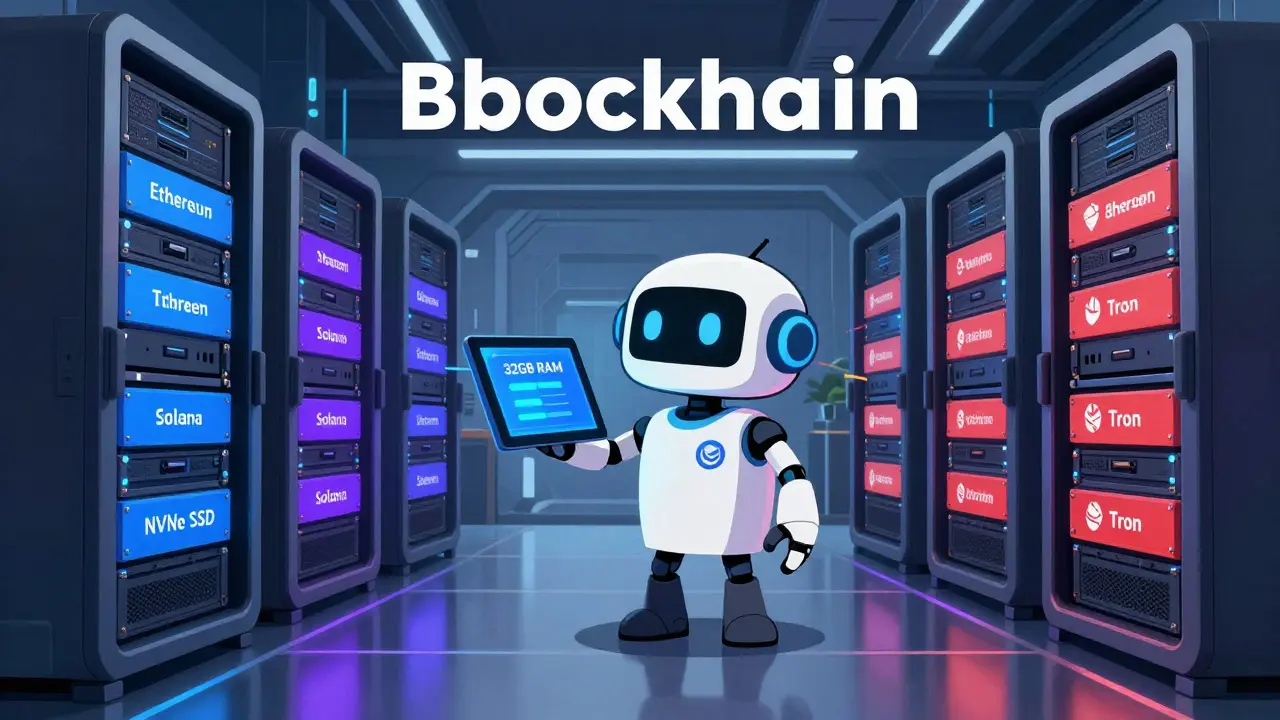
Running a blockchain validator isn't just about buying tokens and waiting for rewards. It is a technical operation that demands serious hardware, significant capital, and constant uptime. If you are looking to join the network as a validator in 2026, the first thing you need to know is that there is no single standard. The barriers to entry vary wildly depending on which chain you choose. Ethereum asks for deep pockets but offers a massive ecosystem. Solana demands top-tier computing power. Tron requires political savvy alongside technical skill.
This guide breaks down exactly what it takes to run a validator on the major networks today. We will look at the hardware you need to buy, the tokens you must lock up, and the hidden costs that eat into your profits. Whether you have $5,000 or $1 million, understanding these requirements helps you decide if running a node is a viable business move or a hobbyist project.
The Core Role of a Blockchain Validator
Before diving into specs, let's clarify what a Blockchain Validator is a specialized network node responsible for ordering, verifying, and securing transactions within a decentralized ledger system. Unlike simple full nodes that just store data, validators actively participate in the consensus mechanism. They propose new blocks, vote on the validity of transactions, and ensure the network agrees on the state of the ledger.
In Proof of Stake (PoS) systems, which dominate modern crypto, validators are selected based on the amount of cryptocurrency they stake. This stake acts as collateral. If a validator behaves honestly, they earn rewards. If they try to cheat or go offline for too long, they face "slashing"-a penalty where part of their staked funds are destroyed. This economic security model replaces the energy-intensive mining of Bitcoin with financial accountability.
Hardware Specifications: What You Need to Run
Your computer setup dictates which chains you can validate. Some networks run smoothly on a high-end gaming PC, while others require server-grade infrastructure. Here is how the top networks compare in terms of raw hardware needs.
| Blockchain | CPU | RAM | Storage (SSD) | Network Speed |
|---|---|---|---|---|
| Ethereum | 4-Core x64/arm64 | 32 GB DDR4 | 4 TB NVMe | 10 Mbps (No Cap) |
| Solana | 12-Core/24-Thread @ 2.8GHz+ | 256 GB ECC RAM | 2.25 TB NVMe (Separate Drives) | 1 Gbps Symmetric |
| Tron (Super Rep) | 32-Core AMD EPYC | 128 GB+ RAM | 3 TB NVMe | High Bandwidth Required |
| Constellation | 8 vCPUs | 16 GB RAM | 320 GB Snapshot | 10 TB Monthly Traffic |
Ethereum remains relatively accessible for hardware. A solid mid-range server with 32GB of RAM and a large NVMe drive can handle the load. However, storage grows over time. As the blockchain history expands, your 4TB drive will eventually fill up, requiring upgrades or archival strategies.
Solana is a different beast entirely. To keep up with its high throughput, you need enterprise-grade equipment. The requirement for 256GB of ECC (Error-Correcting Code) RAM is not a suggestion; without it, memory errors will cause your node to desync from the network. You also need separate physical drives for accounts, ledgers, and snapshots to prevent I/O bottlenecks. Expect to spend between $2,600 and $5,000 on physical hardware alone, excluding electricity and internet.
Tron’s Super Representatives sit at the top of the hardware hierarchy. With 32-core CPUs and massive RAM requirements, running a TRX validator is an institutional-level operation. For most individuals, delegating to existing validators is the only practical option unless you have significant capital to invest in infrastructure.
Financial Barriers: Staking Minimums and Capital
Hardware is just the upfront cost. The real barrier to entry is the financial stake required to activate a validator. This varies dramatically across ecosystems.
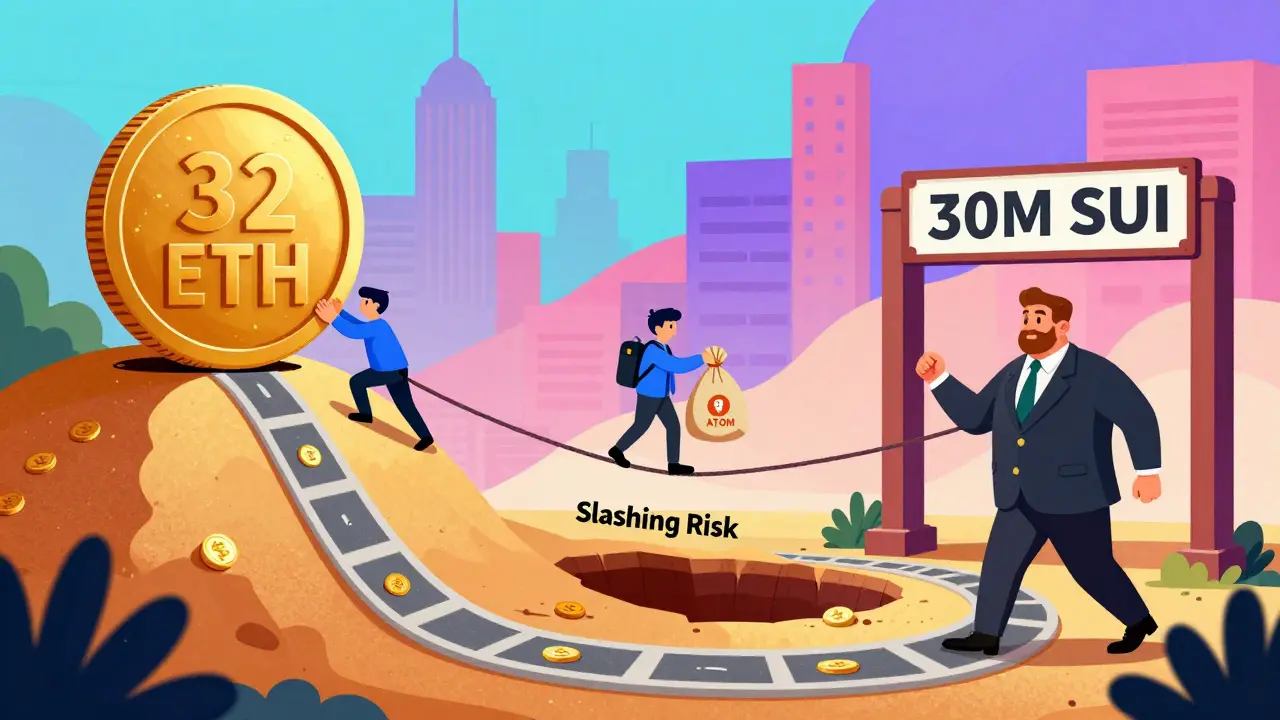
- Ethereum: Requires exactly 32 ETH. At current market rates, this represents a substantial investment (often exceeding $80,000 USD). This fixed amount ensures every validator has equal voting power regardless of total stake size.
- Avalanche: Needs 2,500 AVAX to operate as a validator. Alternatively, you can delegate as little as 25 AVAX to an existing validator, making it easier for smaller holders to participate indirectly.
- Sui Network: Demands an exceptionally high entry fee of 30 million SUI tokens. This creates a highly exclusive validator set, limiting participation to large institutions or wealthy entities.
- Cosmos: Operates on a competitive model. Only the top 180 validators by stake remain active. While there is no hard minimum, community data suggests you need approximately 33,052 ATOM to stay in the top tier. If your stake drops below this threshold, you become inactive and stop earning rewards.
- Solana: Technically allows validation with just 1 SOL. However, this is economically unviable. Due to daily voting fees and operational costs, the break-even point is estimated around 5,700 SOL (roughly $934,000 USD). Most Solana validators rely on delegated stake from other users to reach profitability.
Notice the difference in models. Ethereum uses a fixed price of admission. Cosmos uses a competitive ranking system. Solana uses a theoretical low floor but a high practical ceiling due to operational costs.
Operational Costs and Revenue Models
Making money as a validator isn't passive income. It involves ongoing expenses that can erode your returns if not managed carefully.
Voting Fees and Transaction Costs Solana validators face unique daily costs. You must submit vote transactions for every slot you agree with. This can cost up to 1.1 SOL per day (approximately $185 USD). If you don't have enough delegated stake to cover these fees plus electricity and bandwidth, you will lose money every single day. Your revenue comes from block production rewards and a share of transaction fees. In early 2024, Solana distributed over $217 million in rewards among nearly 1,900 validators, but the competition for delegation is fierce.
Commission Structures Most PoS networks allow validators to charge a commission on the rewards earned by delegators. Rates range from 0% to 100%, though typical rates hover between 5% and 15%. Lower commissions attract more delegators, increasing your total stake and influence, but reducing your margin per reward. Higher commissions might deter delegators but provide better margins on existing stake. Finding the right balance is key to long-term sustainability.
Burn Mechanisms Binance Smart Chain (now BNB Chain) operates differently. It has only 41 active validators out of 63 registered candidates. These validators distribute 90% of transaction fees, while 10% is burned to reduce the BNB supply. This limited validator count creates a more centralized but potentially more profitable environment for those few who make the cut.
Consensus Mechanisms and Validator Types
Understanding the consensus algorithm helps explain why requirements differ. Not all validators work the same way.
- Pure Proof of Stake (PoS)
- Used by Ethereum, Cardano, and Polkadot. Validators are chosen randomly based on their stake size. This promotes decentralization but requires strict uptime to avoid slashing penalties. Missing attestations or proposing invalid blocks results in lost funds.
- Delegated Proof of Stake (DPoS)
- Used by EOS, Tron, and BitShares. Token holders vote for a small number of representatives (e.g., 27 Super Representatives on Tron). These elected validators produce blocks. This system is faster and more efficient but more centralized. Winning election requires not just stake, but community support and reputation.
- Proof of Staked Authority (PoSA)
- BNB Chain’s hybrid model combines staking with authority. Validators must be staked and approved, creating a curated list of trusted operators. This enhances speed and finality but reduces the number of participants.
- Byzantine Fault Tolerance (BFT)
- Common in private or consortium chains like Hyperledger Fabric and Ripple. Validators collaborate to authenticate transactions rapidly. Designed to tolerate malicious nodes, this model prioritizes consensus speed and accuracy over pure decentralization.

Network-Specific Challenges and Pitfalls
Each network presents unique operational headaches that generic guides often miss.
Ethereum Slashing Risks On Ethereum, consistency is king. You must maintain near-perfect uptime. If your node goes offline for extended periods, you miss attestations and lose rewards. Worse, if you attempt to sign conflicting blocks (equivocation), you face slashing. Modern Ethereum clients have robust monitoring tools, but a power outage or internet drop can still cost you dearly.
Solana Cluster Management Solana’s high performance means high complexity. You need to optimize your leader schedule, manage vote account configurations, and handle cluster sync issues. One misconfiguration can lead to desynchronization, forcing you to re-download terabytes of data. Cloud solutions are popular here because they offer redundant infrastructure and professional bandwidth management, which is crucial for maintaining voting consistency.
Cosmos Interchain Communication Cosmos validators must navigate the Inter-Blockchain Communication (IBC) protocol. This adds a layer of complexity as you secure connections between multiple chains. Maintaining competitive stake levels within the top 180 is a constant battle. If you slip out of the top 180, you become an inactive validator, earning zero rewards until you regain position.
Future Trends: Liquid Staking and Institutional Dominance
The landscape of validation is shifting. Hardware requirements continue to rise as blockchain states grow larger. Tron’s 2025 specs show a clear trend toward heavier computational loads. Meanwhile, liquid staking derivatives are changing how individuals participate.
Instead of running a validator yourself, many users now deposit tokens into protocols that pool stakes together. These pools run the validators, and users receive a derivative token representing their share. This lowers the barrier to entry for small holders but concentrates validation power in the hands of a few large service providers.
Institutional validators are increasingly dominating networks with high capital requirements like Ethereum and Sui. They bring professional engineering teams, redundant data centers, and legal compliance frameworks. For individual operators, the niche lies in smaller, emerging chains or providing specialized services like RPC endpoints and archive nodes.
Regulatory developments also loom large. In some jurisdictions, staking rewards are treated as taxable income, adding another layer of accounting complexity. Large-scale operations may even require financial services licenses. Always consult local regulations before launching a commercial validation service.
What is the cheapest blockchain to start validating on?
Technically, Solana allows validation with just 1 SOL, but it is not profitable. For actual profit, Avalanche (2,500 AVAX) or smaller EVM-compatible chains with lower staking thresholds are more realistic starting points. However, consider that lower stakes often mean lower rewards and higher competition for delegation.
Can I run a validator on my home computer?
Yes, for networks like Ethereum or Constellation, a powerful desktop PC can suffice. However, home internet connections often lack the redundancy and upload speeds needed for reliable operation. Power outages or ISP issues can lead to missed blocks and potential slashing penalties. Dedicated servers or cloud instances are recommended for serious operations.
How do I avoid getting slashed on Ethereum?
Maintain consistent uptime and never run duplicate keys on different machines simultaneously. Use reputable client software, monitor your node health constantly, and ensure your internet connection is stable. Slashing occurs primarily for equivocation (signing two different blocks for the same slot) or surrounding attacks, so proper key management is critical.
Is it better to self-validate or use a Validator-as-a-Service?
Self-validating gives you full control and higher profit margins but requires significant technical expertise and time commitment. Validator-as-a-Service (VaaS) providers handle the infrastructure for a fee, reducing your workload but cutting into your earnings. Choose VaaS if you lack technical skills or want to diversify across multiple chains easily.
Why does Solana require so much RAM?
Solana processes thousands of transactions per second, requiring validators to store and process vast amounts of account data in real-time. The 256GB ECC RAM requirement ensures that memory access doesn't become a bottleneck and that data integrity is maintained through error correction, which is vital for such a high-throughput network.

Write a comment